

Quick Summary: Generally, you are not supposed to clearly see the entire hood of your car while driving. Your view should be focused on the road ahead, with the lower edge of the hood or the hood ornament (if applicable) visible as a reference point. Too much of the hood in your view can indicate seat adjustment issues or even potential vision impairment.
Are You Supposed to See Your Hood? An Essential Guide for Drivers
Ever found yourself wondering if that long expanse of metal stretching out in front of you is normal? Many new drivers, and even some experienced ones, get a little unsure about what they should or shouldn’t be seeing when they look out over their car’s dashboard. It’s a common question: “Am I supposed to see the hood of my car when I’m driving?” You’re not alone if this has crossed your mind, especially when you’re trying to maneuver in tight spots or just get a feel for your vehicle.
The truth is, how much of your hood you see can tell you a lot about your driving position, your car’s design, and even your field of vision. Getting this right is key to safe and confident driving. We’ll break down exactly what you should be seeing, why it matters, and how to adjust if things don’t feel quite right. Let’s get you comfortable and confident behind the wheel!
Understanding Your Driving View
When you’re driving, your primary focus needs to be on the road ahead, anticipating traffic, pedestrians, and any potential hazards. Your car’s design plays a big role in how you perceive the road from the driver’s seat. The hood, in particular, is designed to offer a certain perspective.
For most standard vehicles, including sedans, SUVs, and trucks, the goal is to have a clear, unobstructed view of the road directly in front of you and a reasonable distance ahead. You’re not meant to be staring directly at the hood as if you’re admiring it. Instead, you should primarily see the road, perhaps with the very bottom edge of the hood acting as a natural visual marker for the car’s front end.
Think of it like this: the hood guides your spatial awareness of where the front of your car is. If your seat is adjusted correctly and you’re sitting upright, the hood should recede from your direct line of sight as you look further down the road. If you’re seeing a large portion of the hood, it might mean you’re sitting too low, too far back, or even that the car’s design is intended for a taller driver.
Why Seeing Too Much or Too Little of Your Hood Matters
Your perspective from the driver’s seat isn’t just about comfort; it’s a critical safety feature. How much of the hood you see directly impacts your ability to judge distances, navigate tight spaces, and react to unexpected situations.
Challenges When You See Too Much Hood
Having an excessive amount of the hood visible in your line of sight can lead to several issues:
- Poor Distance Judgment: If the hood consumes a large part of your forward view, it becomes harder to accurately judge how far away obstacles or other vehicles are. This is especially problematic when parking, merging, or driving in traffic.
- Reduced Visibility of Immediate Obstacles: You might have trouble seeing things very close to the front of your car, such as low curbs, speed bumps, or children playing near the vehicle. This increases the risk of minor collisions or damage.
- Difficulty Staying Within Lane Lines: For some drivers, an obstructed view can make it harder to accurately perceive lane boundaries, potentially leading to drifting or weaving.
- Increased Driving Fatigue: Constantly having to crane your neck or adjust your seating to see properly can lead to discomfort and fatigue on longer drives.
Challenges When You See Too Little Hood
Conversely, not seeing any of the hood at all can also present its own set of problems:
- Overestimating Clearance: If you can’t see the front of your car, you might misjudge how close you are to other vehicles or objects, leading to fender benders, especially when parking or in crowded areas.
- Reduced Confidence in Tight Maneuvers: Maneuvering in parking garages or narrow driveways can feel more daunting if you lack a clear visual reference for the car’s front end.
- Potential for Hitting Low Obstacles: Similar to seeing too much hood, not seeing any can lead you to drive over small objects or curbs without realizing it.
The ideal scenario is a clear view of the road ahead, with a subtle visual cue of your car’s front end, typically the very bottom of the hood or the front bumper’s edge, allowing you to accurately gauge distances.
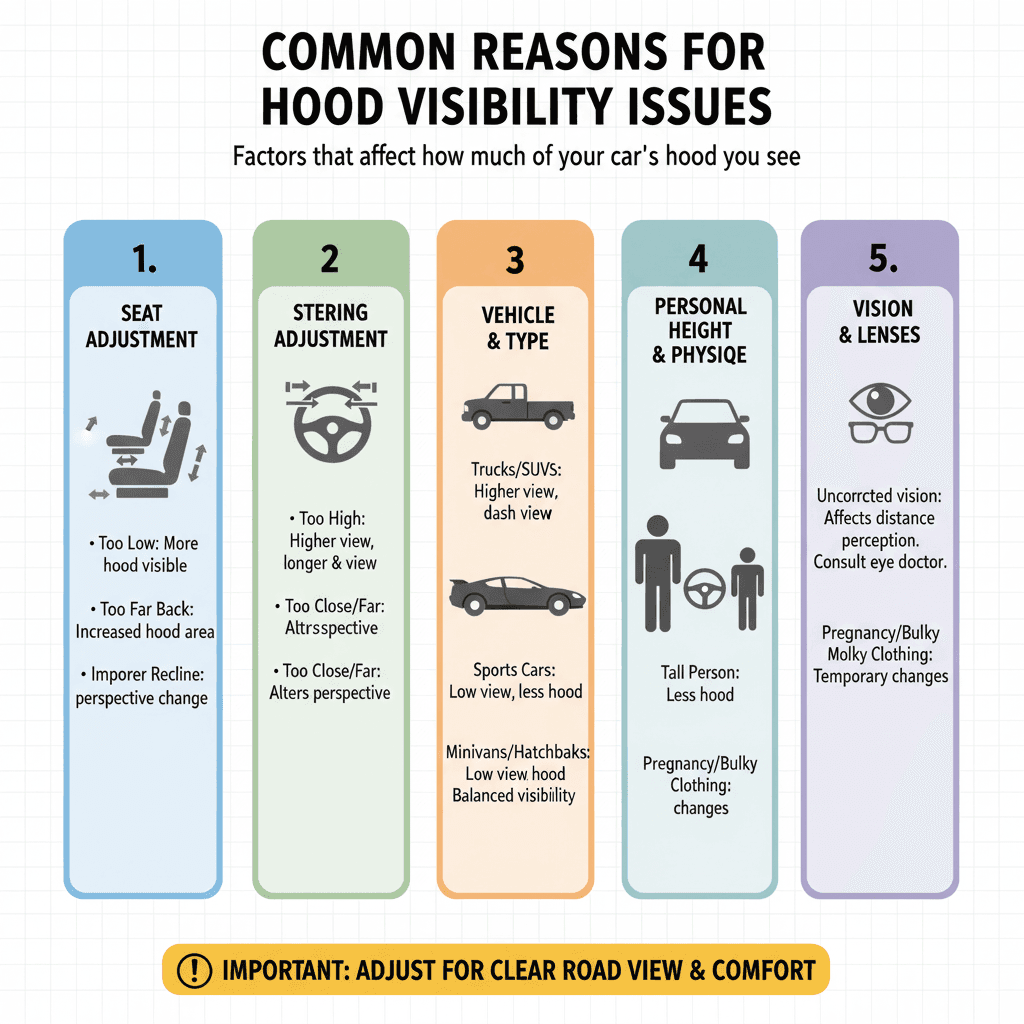
Common Reasons for Hood Visibility Issues
Several factors can influence how much of your car’s hood you see. Understanding these can help you pinpoint the cause of your discomfort or uncertainty.
1. Seat Adjustment
This is the most common culprit. Your car’s seat has multiple adjustment points designed to fit drivers of varying heights and preferences. Not adjusting your seat correctly can significantly alter your view.
- Too Low: If your seat is set too low, you’ll naturally see more of the hood, as your eye level is closer to the dashboard.
- Too Far Back: Sitting too far back from the steering wheel also pushes your viewpoint further away from the windshield’s base, increasing the visible hood area.
- Improper Recline: An overly reclined seat can make it feel like you’re lying down, drastically changing your perspective and often showing more of the hood.
It’s crucial to ensure your seat is adjusted so you can comfortably reach the pedals, grip the steering wheel correctly, and have a clear view of the road and your car’s front end. The Society of Automotive Engineers (SAE) provides excellent guidelines on proper driving posture, which can be a helpful resource. You can find more information on safe driving ergonomics from organizations like NHTSA.
2. Steering Wheel Adjustment
Many modern cars have steering wheels that can be adjusted both up/down (tilt) and in/out (telescope). Using these adjustments in conjunction with your seat position is key.
- Too High: A steering wheel set too high can block your view of the dashboard instruments and the lower part of the windshield, further obscuring the road and hood relationship.
- Too Close/Far: Similar to seat adjustment, the distance of the steering wheel from your body affects your overall perspective.
The goal is to have an unobstructed view of your dashboard, the road, and a clear line of sight over the hood without feeling like you’re reaching too far or are too close to the wheel.
3. Vehicle Design and Type
Different car designs naturally offer different visibility characteristics. This isn’t something you can change, but it’s important to be aware of.
- Trucks and Larger SUVs: These often have higher seating positions and longer hoods, so you’ll typically see more of the hood than in a smaller car. The height can be an advantage for seeing over traffic, but it requires good spatial awareness to manage the front end.
- Sports Cars and Sedans: Lower-slung vehicles often have a more commanding view of the road directly ahead, with less hood visible. This can make them feel sportier but may require more care in tight parking situations.
- Minivans and Hatchbacks: These often strike a balance, providing good visibility without an excessively long hood.
If you’re test-driving a new vehicle, pay close attention to your line of sight and how comfortable you feel judging distances to the front of the car.
4. Personal Height and Physique
Your own body dimensions play a significant role. A very tall person might see less of the hood, while a shorter person might see more, even with the seat adjusted to its lowest setting.
Also, considerations like pregnancy or wearing bulky clothing can temporarily affect how you need to position yourself and therefore your view.
5. Vision and Corrective Lenses
While less common as a direct cause of seeing the hood, uncorrected vision problems can certainly affect your ability to perceive distances accurately, which is often tied to your view. If you have trouble seeing clearly at a distance, it’s always a good idea to consult an eye doctor. Maintaining good vision is paramount for safe driving, as recommended by agencies like the CDC.
How to Properly Adjust Your Seat for Optimal Visibility
Getting your seating position right is arguably the most important step. It ensures safety, comfort, and the best possible view of your surroundings.
Here’s a step-by-step guide:
- Enter the Vehicle: Sit down in the driver’s seat.
- Adjust Seat Height: This is often the first and most crucial adjustment. Raise or lower the seat until your eye level is optimal. You should be able to see the road clearly ahead, and the very top edge of the steering wheel should be below your eye level for an unobstructed view. For hood visibility, aim to see just the lower edge of the hood or the hood ornament/front grille as a reference point, with the road clear.
- Adjust Seat Fore/Aft: Move the seat forward or backward so that your knees are slightly bent when your feet are resting on the pedals, and you can fully depress the brake pedal. This ensures you’re not too close or too far from the steering wheel and controls.
- Adjust Seatback Recline: Set the seatback so you can comfortably reach the steering wheel with a slight bend in your elbows. Your back should be supported by the seat. Avoid an excessive recline, which can compromise your ability to steer and react quickly.
- Adjust Steering Wheel: If your steering wheel is adjustable, use the tilt and telescoping features. Position it so you have a clear, unobstructed view of the instrument cluster and the road, without your knees or torso hitting it.
- Test Your View: With everything adjusted, glance forward. You should see the road ahead and a very small portion of the hood’s lower edge as a guide to the car’s front. You should feel in control and able to judge distances easily.
Most cars have levers or knobs for these adjustments. Familiarize yourself with yours. The owner’s manual for your specific vehicle will have detailed instructions on how to use its particular seat and steering wheel adjustment features.
Visual Cues and Helpful Markers
Beyond just seat adjustment, there are visual cues on your car’s exterior and interior that can help you orient yourself:
Exterior Cues:
- Hood Ornament/Badge: If your car has a hood ornament or a prominent grille badge, this can serve as a direct reference point for the very front of your vehicle.
- Hood Lines/Creases: The natural lines and curves molded into the hood can also help you triangulate your position relative to the front bumper.
- Windshield Wipers: The base of your windshield wipers can sometimes align with the parking-safe zone of your car.
Interior Cues:
- Tip of the Dashboard: Some drivers use the very front edge of the passenger-side dashboard as a rough guide for the car’s width, which can indirectly help gauge front-end position.
- Hood Release Lever: While not for direct viewing, knowing its location is part of becoming familiar with your car.
Experimenting in a safe, empty parking lot is the best way to find what works for you. Try parking into a space, stopping, getting out, and seeing where your bumpers are relative to the lines or obstacles. This practice builds a mental map.
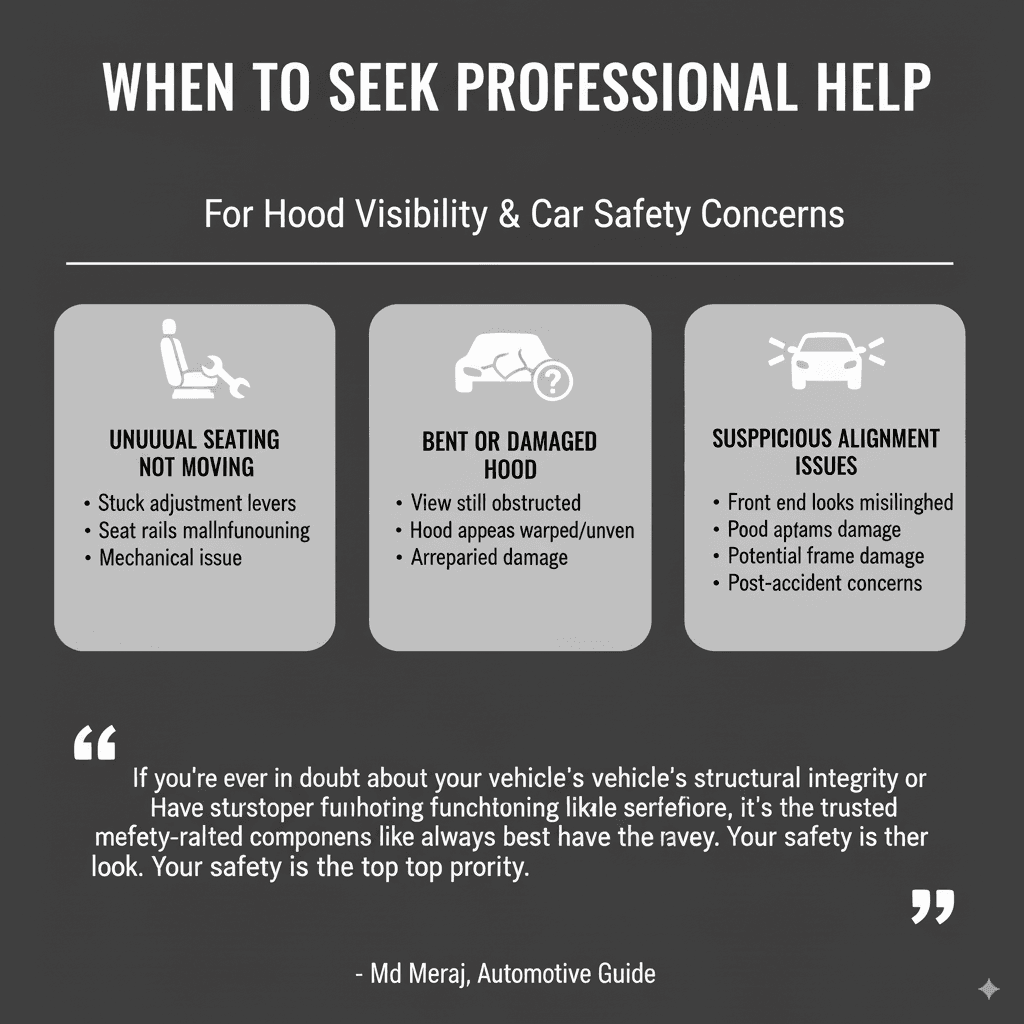
When to Seek Professional Help
While most hood visibility issues are solved with simple seat and steering wheel adjustments, there are a few situations where you might need to consult a professional:
- Unusual Seating Not Moving: If your seat adjustment levers are stuck or not functioning correctly, it could indicate a mechanical issue within the seat rails.
- Bent or Damaged Hood: If, after adjusting your seat, you still have a dramatically different view than expected, and the hood appears warped or uneven, it might have been damaged in a previous incident that wasn’t fully repaired.
- Suspicious Alignment Issues: In rare cases, if the entire front end of the car seems misaligned from your perspective, it could point to frame damage from an accident.
“If you’re ever in doubt about your vehicle’s structural integrity or the proper functioning of safety-related components like your seating, it’s always best to have a trusted mechanic take a look,” says Md Meraj, your automotive guide. “Your safety is the top priority.”
Practice Makes Perfect: Enhancing Your Driving Confidence
Building confidence in your driving ability, especially concerning spatial awareness, takes practice. Don’t underestimate the power of spending a little extra time getting comfortable in your car.
Here are some tips to enhance your confidence:
- Practice in Low-Traffic Areas: Find an empty parking lot or a quiet street (when legally permitted and safe to do so) to practice maneuvers like parking, turning, and backing up.
- Use Your Mirrors: Your side mirrors and rearview mirror are essential tools. Learn to use them effectively in conjunction with your forward view.
- Be Patient with Yourself: Every driver develops their own spatial sense over time. Don’t get discouraged if it takes a few drives to feel completely at ease.
- Regularly Re-evaluate: After a long drive or if you’ve had passengers, it’s a good idea to quickly recheck your seat and mirror positions before you head out again.
Quick Guide: Ideal Hood Visibility Snapshot
To summarize the ideal view, consider this table:
| What You Should See | What You Shouldn’t See (Clearly) | Why It Matters |
|---|---|---|
| The road extending ahead | The entire expanse of the hood | Clear sightlines are crucial for hazard detection and distance judgment. |
| The very bottom edge of the hood or hood ornament as a reference | Over half of the hood | Helps you know where the front of your car is without obstructing the road view. |
| Clear view of the road surface ahead and around the car | Significant portions of the dashboard obscuring the road | Ensures you can see upcoming changes in road conditions. |
Frequently Asked Questions (FAQs)
Q1: How much of the hood am I supposed to see?
A: Ideally, you should see very little of the hood. Just the very bottom edge or a hood ornament/front grille badge should be visible as a reference point for the front of your car. The main focus should be on the road ahead.
Q2: If I see too much hood, what’s the first thing I should adjust?
A: The first thing to adjust is your seat height. Try raising it. Follow this by adjusting the seat fore/aft position to ensure you can comfortably reach the pedals while maintaining a good view.
Q3: Do all cars have their hoods designed to be visible in a certain way?
A: Manufacturers design hoods with visibility in mind, but car types vary. Trucks and larger SUVs naturally have longer hoods, so you might see a bit more. Lower sports cars might show almost none. The key is always to adjust your seat to suit the vehicle and your height.
Q4: Can adjusting my steering wheel help me see the hood better?
A: Yes, the steering wheel and seat adjustments work together. Adjusting the steering wheel’s tilt and reach can help clear your vision of the dashboard, which indirectly affects how you perceive the hood relative to the road. Ensure the wheel doesn’t block your view of the instrument cluster either.
Q5: What if I’m short and always see a lot of my hood, no matter how I adjust the seat?
A: If you’re on the shorter side and even with the seat at its highest setting you see a lot of hood, consider using a seat cushion designed for driving. It can raise your eye level further. Also, practice using the edge of the dashboard on the passenger side as a guide for the car’s width when parking.
Q6: Is it safe to drive if I can’t get my seat adjusted correctly?
A: No, it’s not ideal. Improper seating can compromise your ability to control the vehicle and see hazards. If you cannot achieve a safe

Hi, I’m Melvin, an automobile engineer with extensive experience in automobile equipment. I currently work for a local automobile firm, where I specialize in the car parts industry. I’ve had the opportunity to collaborate with seasoned inspectors, gaining invaluable hands-on experience that goes beyond just theory.
My passion for automotive care started at a young age, which led me to create CarSpareCare. Through CarSpareCare, I share the knowledge and skills I’ve acquired over the years to help others navigate the world of car maintenance and repairs.
My goal is to provide practical tutorials, essential safety advice, and the latest industry insights so that anyone—whether a beginner or an expert—can confidently tackle their automotive projects.

