

Yes, smart cars are generally designed to go on the highway, but their capabilities depend on the specific type of “smart” features they have, like advanced driver-assistance systems (ADAS). Basic smart connectivity doesn’t limit highway use, while more advanced autonomous driving features might have specific requirements or limitations. This guide will clarify everything you need to know.
It’s a question many drivers ponder as technology advances and their cars become more connected: “Can my smart car actually go on the highway?” You might have heard about cars that can park themselves or even steer on their own, and it leaves you wondering if your vehicle is ready for the open road, especially the faster lanes of a highway. The good news is that most cars equipped with smart technology are perfectly capable of highway driving. However, understanding what makes a car “smart” is key to knowing its limits.
Think of “smart” as a spectrum. Some cars simply have advanced infotainment systems and connectivity, while others are equipped with sophisticated sensors and software designed to assist or even take over driving tasks. This guide is here to break down these technologies in a way that’s easy to understand. We’ll explore the different types of smart car features, how they work on the highway, and what you need to know to drive safely and confidently. Let’s get your questions answered so you can hit the road with peace of mind.
Understanding “Smart” in Cars
The term “smart car” is a broad one and can mean different things to different people. At its core, a smart car is one that uses technology to enhance the driving experience, safety, or efficiency. This can range from simple Bluetooth connectivity to complex self-driving capabilities.
Basic Smart Features: Connectivity and Convenience
Most modern cars are “smart” in the sense that they offer enhanced connectivity and convenience features. These are the common elements you’ll find in many new vehicles:
- Infotainment Systems: Touchscreens that control navigation, music, and phone calls.
- Smartphone Integration: Apple CarPlay and Android Auto allow you to use your phone’s apps on the car’s display.
- Bluetooth Connectivity: For hands-free calling and wireless audio streaming.
- Advanced Trip Computers: Providing detailed information about fuel economy, range, and vehicle performance.
- Remote Access: Using a smartphone app to lock/unlock doors, start the engine, or check vehicle status.
These basic smart features do not hinder a car’s ability to drive on the highway. In fact, they are designed to make highway driving more enjoyable and convenient.
Advanced Driver-Assistance Systems (ADAS): The Next Level of Smart
This is where the term “smart car” often starts to involve features that actively interact with the driving process. ADAS uses sensors (like cameras, radar, and lidar) and software to help the driver. These systems are incredibly useful on highways and are designed with highway speeds and traffic in mind.
- Adaptive Cruise Control (ACC): Maintains a set speed and automatically adjusts to keep a safe distance from the car in front. This is a huge boon for highway driving, reducing driver fatigue.
- Lane Keeping Assist (LKA): Detects lane markings and can provide gentle steering input to keep the vehicle centered in its lane.
- Automatic Emergency Braking (AEB): Detects potential collisions and can apply the brakes if the driver doesn’t react in time.
- Blind Spot Monitoring (BSM): Alerts the driver to vehicles in their blind spots.
- Traffic Sign Recognition: Reads speed limit signs and displays them on the dashboard.
- Parking Assist Systems: While mostly for low-speed maneuvers, some advanced systems can also handle highway lane changes.
These ADAS features are specifically engineered for highway environments, where traffic flow can be constant and speeds are higher. They are designed to work together to create a safer and less stressful driving experience.
Automated Driving Systems: The Future of Smart
These are systems that can take on more of the driving task, often referred to as Level 2, Level 3, or even higher levels of automation. It’s important to note that currently, no production car offers full Level 5 autonomy (where the car can drive itself everywhere, in all conditions, without human intervention).
- Level 2 Systems (Partial Automation): These systems can control steering and acceleration/deceleration simultaneously. Examples include Tesla’s Autopilot and GM’s Super Cruise. These systems require the driver to remain attentive and ready to take over at any moment. They are designed for highway use but are not a substitute for an engaged driver.
- Emerging Level 3 Systems (Conditional Automation): These allow the car to handle most driving tasks under specific conditions, like highway driving, and the driver can take their attention away from driving. However, the driver must be ready to take back control when prompted by the system. These are still very new and not widespread.
The key takeaway here is that even with advanced automation, human supervision is crucial for highway driving in the current automotive landscape.
Can Smart Cars Enter Any Highway?
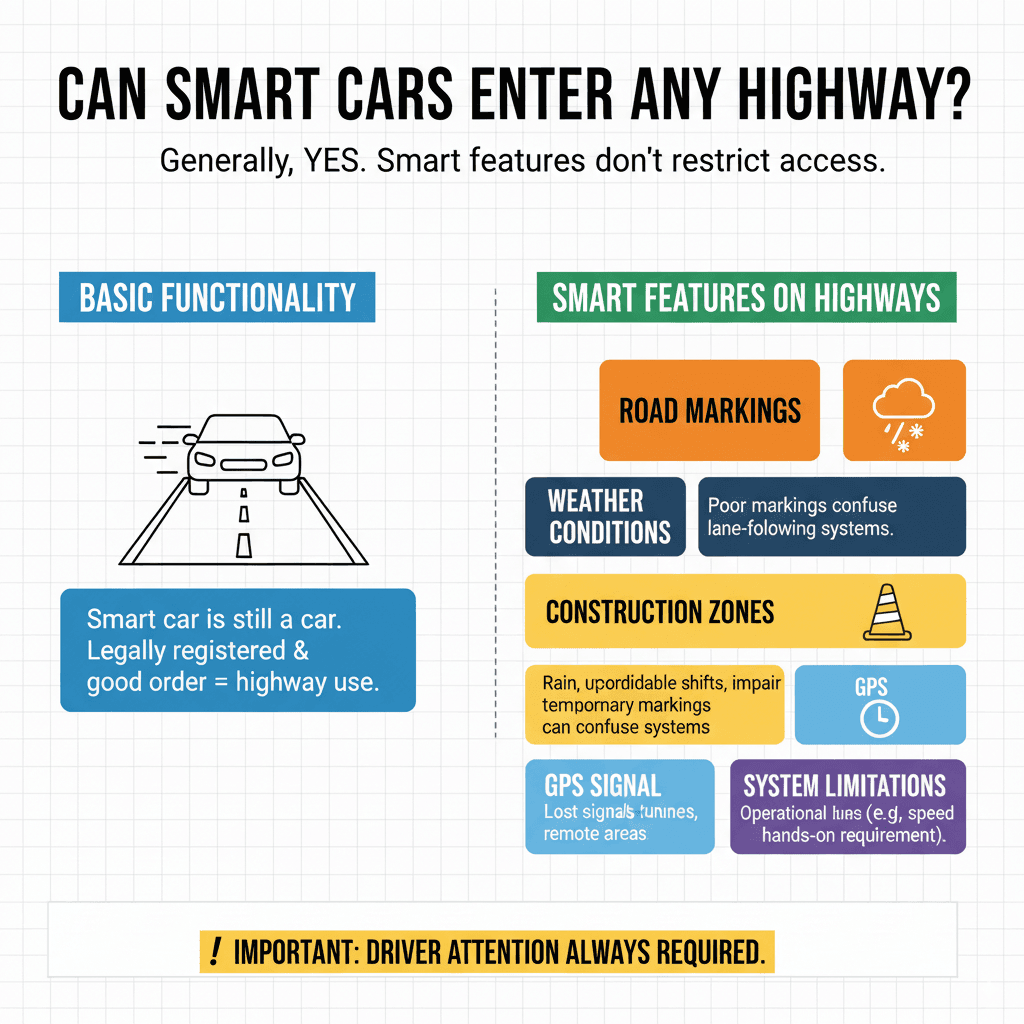
Generally, yes. The “smart” features of a car do not restrict its physical ability to access or travel on highways. The highway itself is a road, and as long as your car is legally registered and in good working order, you can drive it on the highway.
The question is less about permission and more about what the car’s smart capabilities can do on the highway. For instance, a car with just basic Bluetooth won’t perform highway driving tasks automatically, but it can still be used for highway travel. A car with ADAS or an advanced automated driving system can utilize the highway environment to its advantage, offering assistance or partial automation.
Factors That Might Affect Smart Feature Use on Highways:
- Road Markings: Lane Keeping Assist and other lane-following systems rely on clear lane markings. Poorly marked roads can make these features less effective or unusable.
- Weather Conditions: Heavy rain, snow, or fog can impair the function of cameras and sensors, potentially disabling ADAS features.
- Construction Zones: Unpredictable lane shifts, temporary markings, and unusual traffic patterns can confuse automated systems.
- GPS Signal: Some advanced navigation and driver-assistance features use GPS data. Weak or lost signals in tunnels or remote areas can affect their performance.
- System Limitations: Even the most advanced systems have operational boundaries. For example, ACC might have a minimum or maximum speed range, or a system might require you to keep hands on the wheel.
How Smart Features Enhance Highway Driving
Smart car technology, especially ADAS, is largely designed with highway driving in mind. These features aim to make long drives safer, less tiring, and more efficient.
Safety Benefits
ADAS features significantly boost safety on highways:
- Collision Avoidance: Features like AEB and Forward Collision Warning can prevent or mitigate accidents caused by driver inattention or misjudgment, which are common causes of highway crashes. According to the National Highway Traffic Safety Administration (NHTSA), AEB is a critical technology for preventing crashes.
- Sticking to the Road: Lane Keeping Assist helps prevent unintended lane departures, a dangerous situation on high-speed roads.
- Awareness of Surroundings: Blind Spot Monitoring keeps drivers aware of traffic they might not see, which is crucial for safe lane changes on multi-lane highways.
Comfort and Reduced Fatigue
Highway driving, especially long distances, can be mentally taxing. Smart features can help:
- Adaptive Cruise Control: This is a game-changer for highway comfort. It automatically maintains speed and adjusts to traffic, meaning you don’t constantly have to tap the brakes or accelerator. This significantly reduces driver workload and fatigue on predictable highway stretches.
- Lane Centering: Some advanced ACC systems also offer lane centering, which keeps the vehicle centered within its lane. This provides a more relaxed driving experience on straight, clear highways.
Efficiency and Navigation
While not directly about driving automation, smart connectivity also aids in efficient highway travel:
- Real-time Traffic Information: Navigation systems that use live traffic data can reroute you to avoid congestion, saving time and fuel.
- Predictive Maintenance: Some smart cars can alert you to potential issues before they become serious, helping you avoid breakdowns, which are especially inconvenient and costly on highways.
- Optimized Speed: Features that display speed limits or suggest optimal speeds can help you maintain fuel efficiency.
Levels of Driving Automation and Highway Use
The Society of Automotive Engineers (SAE) has defined six levels of driving automation, from Level 0 (no automation) to Level 5 (full automation). Understanding these levels helps clarify what a “smart car” can and cannot do on the highway.
| SAE Level | Name | Driver’s Role on Highway | Example Features | Highway Capability |
|---|---|---|---|---|
| Level 0 | No Driving Automation | Full responsibility for all driving tasks. | Basic cruise control. | Standard highway driving. |
| Level 1 | Driver Assistance | Driver performs all driving tasks, but may receive assistance. | Adaptive Cruise Control (ACC) OR Lane Keeping Assist (LKA). | Fully capable; features provide support. |
| Level 2 | Partial Driving Automation | Vehicle can control both steering and acceleration/deceleration simultaneously, but driver must monitor the driving environment and be prepared to intervene. | ACC + LKA (e.g., Tesla Autopilot, GM Super Cruise, Ford BlueCruise). | Designed for highways, requires constant driver supervision. |
| Level 3 | Conditional Driving Automation | Vehicle can perform all driving tasks and monitor the driving environment under specific conditions. Driver can take their attention away, but must be ready to take back manual control when requested by the system. | Advanced highway driving assist with conditional “eyes off” capability. | Capabilities are conditional and require driver readiness. |
| Level 4 | High Driving Automation | Vehicle can perform all driving tasks and monitor the driving environment under specified conditions. Driver intervention is not required in those conditions. | Limited self-driving in specific geofenced areas or conditions. | Limited highway use, typically in pilot programs; not for personal consumer vehicles widely. |
| Level 5 | Full Driving Automation | Vehicle can perform all driving tasks under all conditions. No driver needed. | N/A (Not yet commercially available). | N/A. |
For the average consumer today, cars with “smart” highway capabilities are typically at Level 2. This means the car can assist significantly with steering and speed, making highway driving much easier, but you, the driver, must always be present, alert, and ready to take over immediately. Think of it as an advanced co-pilot, not a replacement driver.
Essential Checks Before Your Smart Car Hits the Highway
Before you embark on a highway journey, especially if your car has advanced smart features, a quick check can ensure everything is working as it should, keeping you safe and maximizing the benefits of your technology.
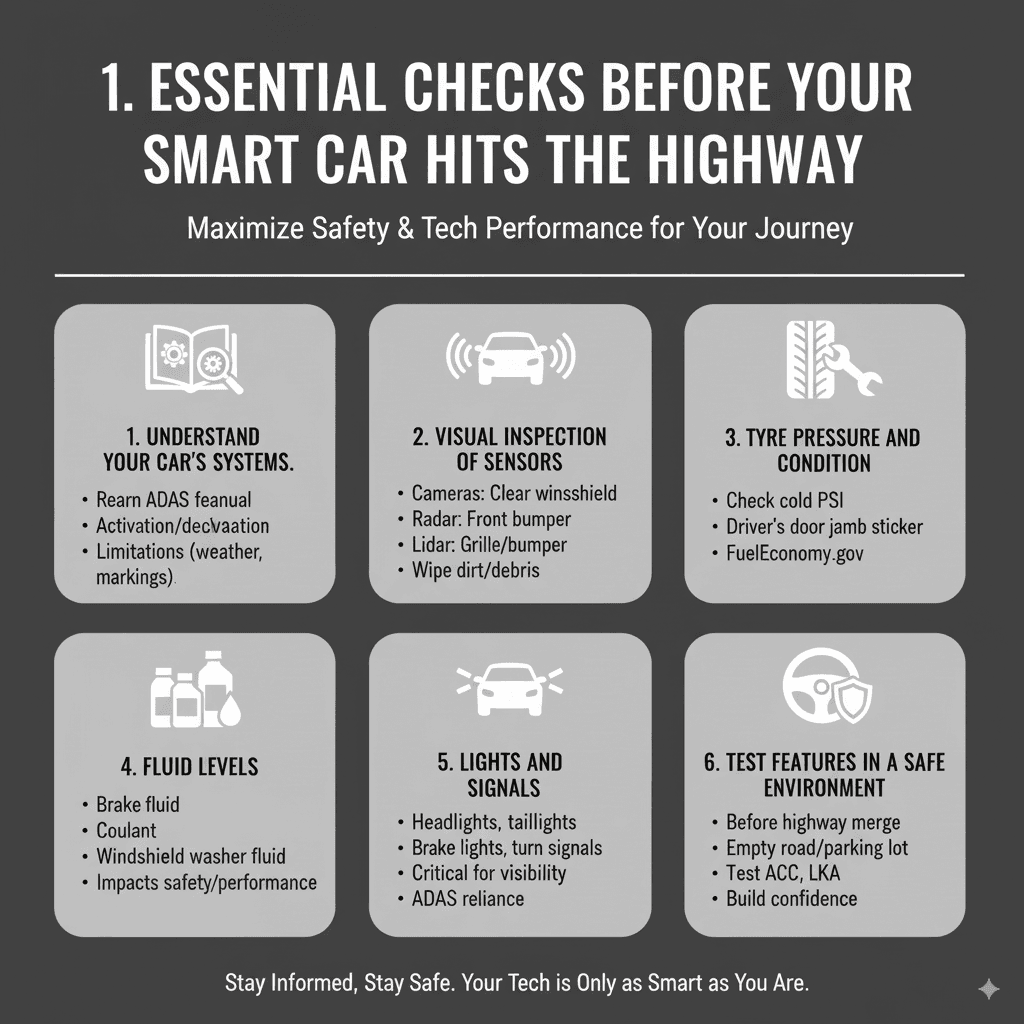
1. Understand Your Car’s Systems
Don’t just assume the features work. Read your car’s owner’s manual! It’s the definitive guide for your specific vehicle. Pay close attention to the sections on ADAS and automated driving systems. Learn:
- What each feature is called by your manufacturer.
- How to activate and deactivate them.
- What alerts or warnings they use.
- Under what conditions they might not work (e.g., poor weather, bad lane markings).
2. Visual Inspection of Sensors
Many smart car features rely on external sensors:
- Cameras: Often located near the rearview mirror or behind the windshield. Ensure they are not obstructed by dirt, debris, or stickers.
- Radar: Usually behind the front bumper or grille. Check for any damage or blockages.
- Lidar: Less common in standard cars but might be integrated into the grille or bumper.
A quick wipe with a soft cloth can often clear minor obstructions.
3. Tyre Pressure and Condition
This is crucial for any vehicle on the highway, but especially important for smart systems. Incorrect tyre pressure can affect how your car handles, how sensors perceive motion, and the performance of systems like ACC and LKA. Check your tyre pressure when the tyres are cold, using a reliable tyre pressure gauge. The correct psi is usually found on a sticker inside the driver’s side door jamb or in your owner’s manual.
Visit FuelEconomy.gov for tips on maintaining your vehicle for optimal performance and efficiency, which includes tire maintenance.
4. Fluid Levels
Ensure essential fluids are at the proper levels, including:
- Brake fluid
- Coolant
- Windshield washer fluid (essential for keeping cameras and sensors clear!)
Low fluid levels can impact safety systems and overall vehicle performance.
5. Lights and Signals
All lights (headlights, taillights, brake lights, turn signals) must be functioning correctly. These are critical for visibility and communication on the highway, and some ADAS features rely on them.
6. Test Features in a Safe Environment
Before you merge onto a busy highway, it’s a good idea to test your smart features in a less demanding environment. On a clear, empty stretch of road or a large, low-traffic parking lot, try activating your ACC or LKA to ensure they respond as expected. This builds confidence and allows you to get a feel for their operation.
Taking the Wheel: Driving with Smart Features on the Highway
So, your smart car is ready. How do you best use its technology on the highway? It’s about collaboration between you and the car.
Using Adaptive Cruise Control (ACC) and Lane Keeping Assist (LKA)
These are the workhorses of highway smart driving for most people.
- Engage Thoughtfully: Activate ACC when you’ve reached your desired cruising speed and traffic is flowing reasonably well. Activate LKA to help you stay centered.
- Monitor Constantly: Even with these systems on, keep your eyes on the road, your hands near the steering wheel (or on it, as required by your system), and your mind engaged. Be ready to brake or steer away from unexpected situations.
- Understand Limitations: Remember that ACC might struggle with very slow traffic, sudden stops, or motorcycles. LKA can be confused by faded lane lines, construction areas, or sharp curves.
- Adjust Settings: Most ACC systems allow you to adjust the following distance. Choose a setting appropriate for the conditions. On highways, a longer distance is generally safer.
Over-Reliance is a Danger
This is perhaps the most crucial point: do not become complacent.
- Stay Alert: Automated systems are aids, not replacements for a vigilant driver. Your brain is still the best safety system in the car.
- Know When to Disengage: If conditions become challenging (heavy rain, snow, complex traffic, poorly marked roads, driver fatigue), it’s often safer to turn off the advanced features and rely on your own driving skills.
- Practice Defensive Driving: Smart features help, but they don’t make you invincible. Continue to anticipate the actions of other drivers and maintain a safe buffer around your vehicle.
Using Navigation and Connectivity
Leverage your car’s smart infotainment for a smoother trip:
- Set Your Destination Before You Go: Input your destination before you start driving or while parked. Once on the highway, focus on driving.
- Use Voice Commands: If your car has voice control, use it for tasks like changing music, making calls, or adjusting the climate control. This keeps your hands on the wheel and eyes on the road.
- Monitor Traffic and Road Conditions: If your navigation system provides real-time traffic updates, pay attention. It can alert you to accidents or delays ahead, allowing you to plan accordingly.
What If My Smart Car Features Malfunction?
No technology is perfect, and sometimes smart car features can malfunction or behave unexpectedly. Here’s what to do:
- Don’t Panic: Most malfunctions are not dangerous if you remain in control.
- Check Your Dashboard: The car will usually display a warning light or message indicating a system fault. Consult your owner’s manual to understand what the warning means.
- Disengage the Feature: If a feature is acting erratically or you receive a warning, turn it off immediately. For example, if LKA is aggressively trying to steer you, disengage it and take

Hi, I’m Melvin, an automobile engineer with extensive experience in automobile equipment. I currently work for a local automobile firm, where I specialize in the car parts industry. I’ve had the opportunity to collaborate with seasoned inspectors, gaining invaluable hands-on experience that goes beyond just theory.
My passion for automotive care started at a young age, which led me to create CarSpareCare. Through CarSpareCare, I share the knowledge and skills I’ve acquired over the years to help others navigate the world of car maintenance and repairs.
My goal is to provide practical tutorials, essential safety advice, and the latest industry insights so that anyone—whether a beginner or an expert—can confidently tackle their automotive projects.

