

Can You Change A Manual Car To Automatic? Yes, But It’s Complex and Costly. While technically possible, converting a manual transmission to an automatic is a significant undertaking. It involves replacing major components, requires specialized tools and expertise, and the cost often outweighs the benefit for most drivers. This guide explores the feasibility, process, and alternatives.
Ever driven a car with an automatic transmission and thought, “I wish my car was like this?” Many drivers, especially those new to manual shifting, find themselves wishing for the ease and convenience of an automatic. Learning to drive a stick shift can be a fun skill, but the daily grind of stop-and-go traffic or the sheer effort of clutch-and-shift can sometimes feel like a chore. This often leads to the question: “Can you change a manual car to an automatic?” It’s a common thought, and the answer isn’t a simple yes or no. It’s more about whether it’s practical and worth it. Let’s break down what’s involved, the challenges you might face, and if it’s a journey you truly want to embark on.
Understanding the Core Difference: Manual vs. Automatic
Before we dive into the “how,” let’s quickly recap what makes manual and automatic transmissions different. Think of your car’s transmission as its gear manager. It takes the engine’s power and sends it to the wheels, adjusting the power delivery as you speed up or slow down.
Manual Transmission (Stick Shift)
In a manual car, YOU are the transmission manager. You use a clutch pedal (the third pedal to the left of the brake) and a gear shift lever to manually select the correct gear for the situation. The clutch disconnects the engine from the transmission temporarily, allowing you to shift gears smoothly. This gives you more direct control and can be more fuel-efficient if driven well.
Automatic Transmission
An automatic transmission does all the gear changing for you. It uses a torque converter and a complex system of hydraulics and planetary gears to select the appropriate gear based on speed, engine load, and throttle position. You simply put the car in “Drive” (D) and go. This offers unparalleled ease of driving, especially in heavy traffic.
Can You Actually Change A Manual Car To An Automatic?
Technically, yes, you can change a manual car to an automatic. However, this isn’t like swapping out a stereo or changing your oil. It’s a major mechanical conversion that involves replacing a significant portion of your car’s drivetrain. It’s akin to swapping out the heart of your vehicle.
What’s Involved in the Conversion Process?
Converting a manual transmission vehicle to an automatic is a complex, labor-intensive, and expensive project. Here’s a look at the major components you’d typically need to replace:
- Transmission: The manual gearbox must be removed and replaced with an automatic transmission designed for your specific car model.
- Clutch System: The clutch pedal, master cylinder, slave cylinder, and associated lines will be removed.
- Flywheel: The manual transmission’s flywheel is replaced with a flexplate designed for an automatic transmission’s torque converter.
- Shifter Assembly: The manual gear stick and linkage are removed and replaced with an automatic shifter and associated cables/linkages.
- Brake Pedal: The manual transmission’s clutch pedal assembly needs to be removed, and the brake pedal might need to be modified or replaced to accommodate the wider automatic brake pedal.
- Torque Converter: This replaces the clutch and is integral to the automatic transmission.
- Transmission Mounts: Automatic transmissions often have different mounting points and requirements than manual ones.
- Cooling System: Automatic transmissions generate more heat than manuals and require a transmission cooler, often integrated into the radiator or as a separate unit.
- Driveshaft: You might need a different driveshaft length or configuration to connect the automatic transmission to the rear differential.
- Electrical System: Modern automatic transmissions are electronically controlled. You’ll need to integrate sensors, the transmission control module (TCM), and associated wiring harnesses into your car’s existing electrical system. This can be very complex, especially for older vehicles without modern ECUs.
- Dashboard Components: You’ll likely need to modify or replace dashboard elements to accommodate an automatic shifter and potentially warning lights or indicators.
- ECU/PCM: The car’s Engine Control Unit (ECU) or Powertrain Control Module (PCM) will need to be reprogrammed or replaced to properly communicate with and manage the automatic transmission.
The Cost Factor: Is It Worth It?
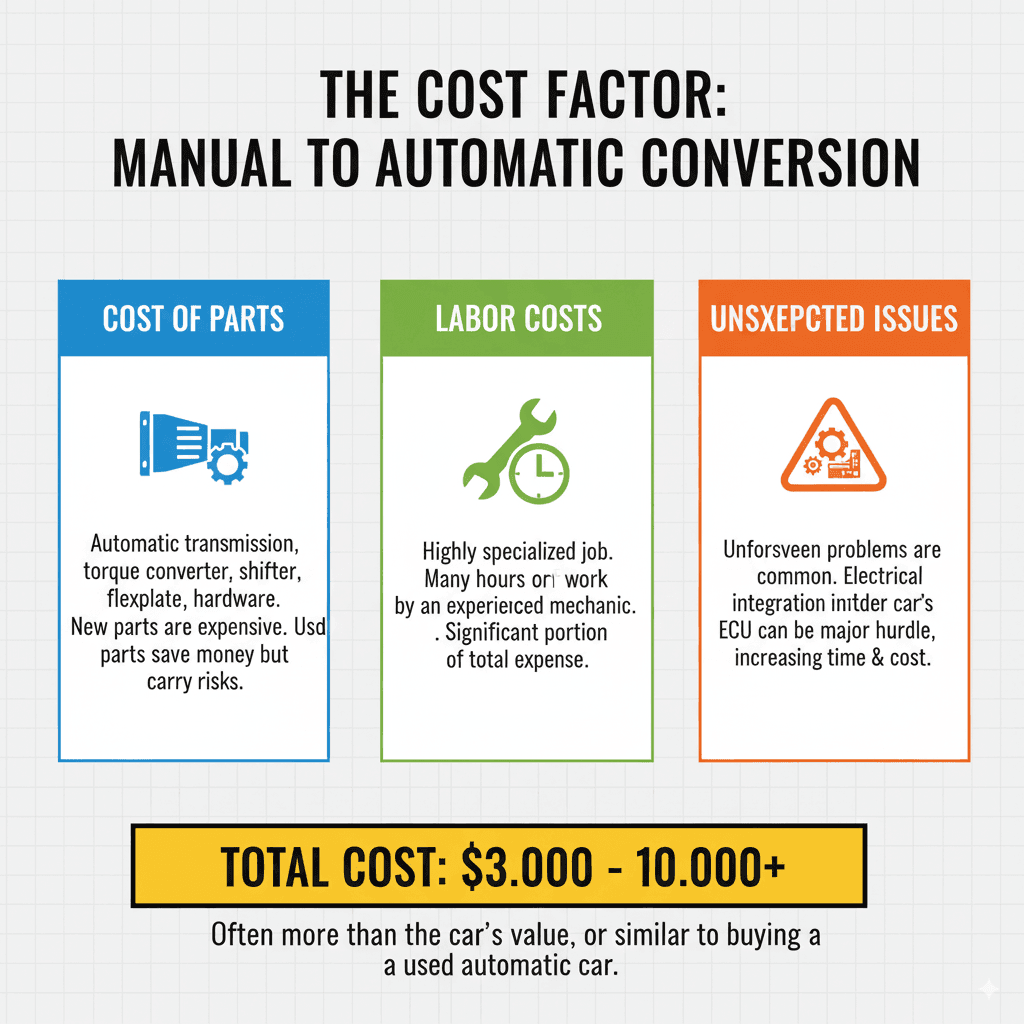
This is where the dream usually meets reality. The cost of performing such a conversion can be astronomical. You’re looking at:
- Cost of Parts: Sourcing a compatible automatic transmission, torque converter, shifter, cooling system, flexplate, and all associated hardware can be expensive, especially if you opt for new parts. Used parts can reduce costs but come with their own risks.
- Labor Costs: This is a highly specialized job. A mechanic experienced in transmission swaps and electrical integration will need many hours to complete the work. Expect labor costs to be a significant portion of the total expense.
- Potential for Unexpected Issues: During a conversion like this, it’s common for unforeseen problems to arise, increasing the time and cost. For instance, integrating the electronics of a modern automatic transmission into an older manual car’s ECU can be a significant hurdle.
Depending on the vehicle and the cost of labor in your area, a full conversion could easily run from $3,000 to $10,000 or even more. In many cases, this cost is more than the car itself is worth, or it approaches the price of purchasing a used car that already has an automatic transmission.
DIY Conversion: A Challenge for the Most Ambitious
While some highly skilled and determined DIYers might take on this project, it’s absolutely not a beginner-friendly task. It requires:
- Extensive mechanical knowledge.
- Advanced welding and fabrication skills.
- Expertise in automotive electrical systems and wiring.
- Access to specialized tools, including transmission jacks, engine hoists, and diagnostic equipment.
- A dedicated workspace and significant time commitment.
Even for experienced hobbyists, a manual-to-automatic conversion is a monumental undertaking. For the average car owner, it’s almost certainly beyond the scope of a feasible DIY project.
Is it Possible for Specific Car Models?
The feasibility and cost of conversion can also vary greatly depending on the car’s make, model, and year. Some cars are far more common with automatic transmissions, making parts easier to find and the integration process more streamlined. For example, converting a popular sedan that was commonly produced with both manual and automatic options might be more straightforward than converting a niche sports car designed predominantly for manual shifting.
Older cars with simpler mechanical and electrical systems might present different challenges compared to newer cars with complex integrated ECUs managing everything. If you’re considering this, research the specifics for your year, make, and model extensively. Websites like Car and Driver and forums dedicated to your specific vehicle model can be invaluable resources for figuring out if others have attempted this and what issues they encountered.
Alternatives to a Full Conversion
Given the significant downsides of a full conversion, most people asking “Can you change a manual car to an automatic?” are really looking for simpler solutions to the downsides of driving stick. Here are much more practical alternatives:
1. Sell Your Manual Car and Buy an Automatic
This is by far the most common, practical, and cost-effective solution. If you’ve decided you truly prefer an automatic transmission, selling your current manual car and purchasing a used vehicle that already has an automatic transmission is usually the smartest financial move. You’ll avoid the massive cost and hassle of a conversion, and you’ll end up with a vehicle better suited to your needs.
Pros of Selling and Buying:
- Significantly cheaper than conversion.
- No complex modifications required.
- You get a car designed from the factory with an automatic.
- Avoids potential reliability issues from a botched conversion.
Cons of Selling and Buying:
- You have to go through the process of selling your old car and buying a new one.
- You might not find the exact same model with an automatic option.
2. Learn to Master the Manual Transmission
Driving a manual car is a skill that, once mastered, can be very rewarding. Yes, it has a learning curve, but the payoff can be great. Many drivers find that after a bit of practice, the “hassle” disappears and becomes second nature. They even start to enjoy the increased engagement and control.
Tips for Learning Manual:
- Practice in an Empty Lot: Get comfortable with engaging the clutch and finding the “friction point” (where the clutch starts to grab) without the pressure of traffic.
- Go Slow: Don’t be afraid to stall. Everyone does it when they’re learning. Just restart and try again.
- Listen to Your Engine: Your engine will tell you when it’s time to shift. Higher RPMs mean you’re likely ready for the next gear up.
- Smooth Clutch Control: Practice releasing the clutch smoothly. Jerky movements lead to jerky rides and stalling.
- Watch Online Tutorials: Resources like those on YouTube can provide visual guides on clutch control and shifting techniques.
Pros of Mastering Manual:
- No extra cost.
- Increases your driving skills and versatility.
- Can be more engaging and fun for some drivers.
- Often better fuel economy if driven optimally.
Cons of Mastering Manual:
- Requires time and practice to learn.
- Can be stressful in heavy traffic initially.
- Requires more attention than driving an automatic.
3. Optimize Your Current Manual Driving
If your frustration with your manual car stems from specific situations, like heavy traffic, there might be ways to mitigate the discomfort without a full conversion.
- Adjust Your Driving Style: Try to anticipate stops and starts. Coasting more can reduce the need for constant clutching and shifting.
- Focus on Smoothness: With practice, your shifts will become smoother, and clutch engagement will be less of a conscious effort.
- Ensure Your Clutch is in Good Condition: A worn-out clutch can make shifting difficult and clunky. If your clutch feels heavy, slips, or is generally difficult to operate, it might need professional inspection. According to the National Highway Traffic Safety Administration (NHTSA), regular vehicle maintenance contributes significantly to safety and reliability. A properly functioning clutch is part of that.

Comparing the Options: A Quick Look
To make the decision clearer, let’s look at the main options side-by-side.
| Option | Estimated Cost | Difficulty Level | Time Commitment | Pros | Cons |
|---|---|---|---|---|---|
| Full Conversion | $3,000 – $10,000+ | Expert | Weeks to months | You keep your current car, modified to your preference. | Extremely expensive, complex, time-consuming, potential for unreliability, may not be feasible for all cars. |
| Sell & Buy Automatic | Depends on car purchase/sale value | Low | Days to weeks | Most cost-effective, no modifications, reliable, straightforward. | Requires finding a suitable replacement car, potential depreciation loss. |
| Master Manual Driving | $0 (aside from potential practice time/fuel) | Medium | Weeks to months of practice | No cost, improves driving skills, potentially more engaging. | Requires effort and patience, can be stressful initially. |
Frequently Asked Questions (FAQ)
Q1: Is it legal to convert a manual car to an automatic?
A1: Generally, yes, it is legal to perform this kind of modification. However, it’s always wise to check with your local Department of Motor Vehicles (DMV) or equivalent authority, especially if your car will undergo a major inspection or re-registration process after the conversion. Ensure all safety systems and roadworthiness are maintained.
Q2: How long does a manual to automatic conversion take?
A2: A professional conversion can take anywhere from several days to a couple of weeks, depending on the complexity, parts availability, and the shop’s workload. A DIY conversion, if even attempted, could take many months or even longer.
Q3: Will a conversion affect my car’s resale value?
A3: This is a tricky one. A professionally done conversion might retain some value, but it’s unlikely to add as much value as it costs. Often, a heavily modified car, especially one with a non-factory conversion, can be harder to sell and might depreciate more because buyers are wary of potential issues. It’s often better to buy an original automatic if resale value is a concern.
Q4: Can I just add an automatic transmission without changing other parts?
A4: No, it’s not possible to simply “bolt on” an automatic transmission. As detailed above, a conversion requires replacing many related components like the torque converter, flexplate, shifter, cooling system, and potentially driveshafts and mounts, along with significant electrical integration.
Q5: Which is better for fuel economy: manual or automatic?
A5: Historically, manuals were more fuel-efficient if driven skillfully. However, modern automatic transmissions, especially CVTs (Continuously Variable Transmissions) and dual-clutch automatics, are often as fuel-efficient or even more so than their manual counterparts, thanks to advanced computer control. The driving style of the person behind the wheel is the biggest factor.
Q6: Are there any kits for converting manual cars to automatic?
A6: True “kits” for fully converting a manual to an automatic transmission are very rare, bordering on non-existent for most vehicles. Unlike some other modifications, a complete transmission swap requires custom fabrication and integration specific to the car model and the donor transmission. You might find some components like shifters or transmission mounts from aftermarket companies, but not a comprehensive bolt-on kit.
Conclusion
So, to circle back to our main question: can you change a manual car to an automatic? Yes, you can, but it’s a monumental task. The significant cost, complexity, and time involved make it an impractical choice for the vast majority of drivers, especially those looking for a simple solution to driving preferences. For most people, the most sensible and budget-friendly path is to sell their current manual vehicle and purchase a comparable model that came factory-equipped with an automatic transmission. If you’re in love with your manual car, consider dedicating some time to mastering its operation – it’s a rewarding skill that can bring a unique connection to your driving experience. Ultimately, the best transmission is the one that fits your lifestyle, budget, and driving enjoyment. And for the convenience of an automatic, buying one that’s already designed that way is almost always the smarter road to travel.

Hi, I’m Melvin, an automobile engineer with extensive experience in automobile equipment. I currently work for a local automobile firm, where I specialize in the car parts industry. I’ve had the opportunity to collaborate with seasoned inspectors, gaining invaluable hands-on experience that goes beyond just theory.
My passion for automotive care started at a young age, which led me to create CarSpareCare. Through CarSpareCare, I share the knowledge and skills I’ve acquired over the years to help others navigate the world of car maintenance and repairs.
My goal is to provide practical tutorials, essential safety advice, and the latest industry insights so that anyone—whether a beginner or an expert—can confidently tackle their automotive projects.

