

Yes, you can “float gears” in a car, but it requires specific conditions and only works with manual transmissions. It’s a technique where you shift gears without using the clutch by matching engine speed to the transmission’s speed. Mastering it can make shifting smoother, especially in older vehicles or racing, and it’s a clever trick for experienced drivers.
Ever heard someone talk about “floating gears” and wondered what they meant? It sounds a bit like magic, right? Like a car doing a trick for its driver. Well, it’s not magic, but it is a fascinating driving technique. For many car owners, especially those new to driving stick shifts, the thought of shifting gears without using the clutch might seem impossible or even dangerous for the car. The clutch pedal is usually a big part of learning to drive a manual, so taking it out of the equation feels like a secret shortcut.
But what if I told you it’s a real technique that some drivers use? And what if it could actually make your driving smoother and, dare I say, a little bit cooler? Don’t worry if you’ve never heard of it or if it sounds complicated. As your friendly auto guide, Md Meraj, I’m here to break down the “genius secret” of floating gears into simple, easy-to-understand steps. We’ll look at what it is, why you might do it, and importantly, how to do it safely (or if you even should!). Ready to unlock this driving trick?
What Does “Floating Gears” Actually Mean?
Let’s start with the basics. When we talk about “floating gears,” we’re referring to a way of shifting gears in a manual transmission vehicle without pressing the clutch pedal. Normally, when you change gears, you press the clutch to disconnect the engine from the transmission. This allows the gears inside to stop spinning freely so you can engage the next gear smoothly. Then, you release the clutch to reconnect the engine.
Floating gears bypasses that clutch step. The goal is to make the speed of the engine match the speed the transmission is expecting for the next gear. If you get this speed match just right, you can slide the gear lever into the next gear without the crunching or grinding sound that usually happens when you try to force gears. It feels incredibly smooth, almost like the car is doing it all by itself.
Think of it like this: imagine trying to push two spinning wheels together. If they’re spinning at very different speeds, it’s hard and noisy. But if they’re spinning at almost the same speed, they’ll touch and move together easily. The gears inside your transmission are like those wheels.
Why Would Anyone Want to “Float Gears”?
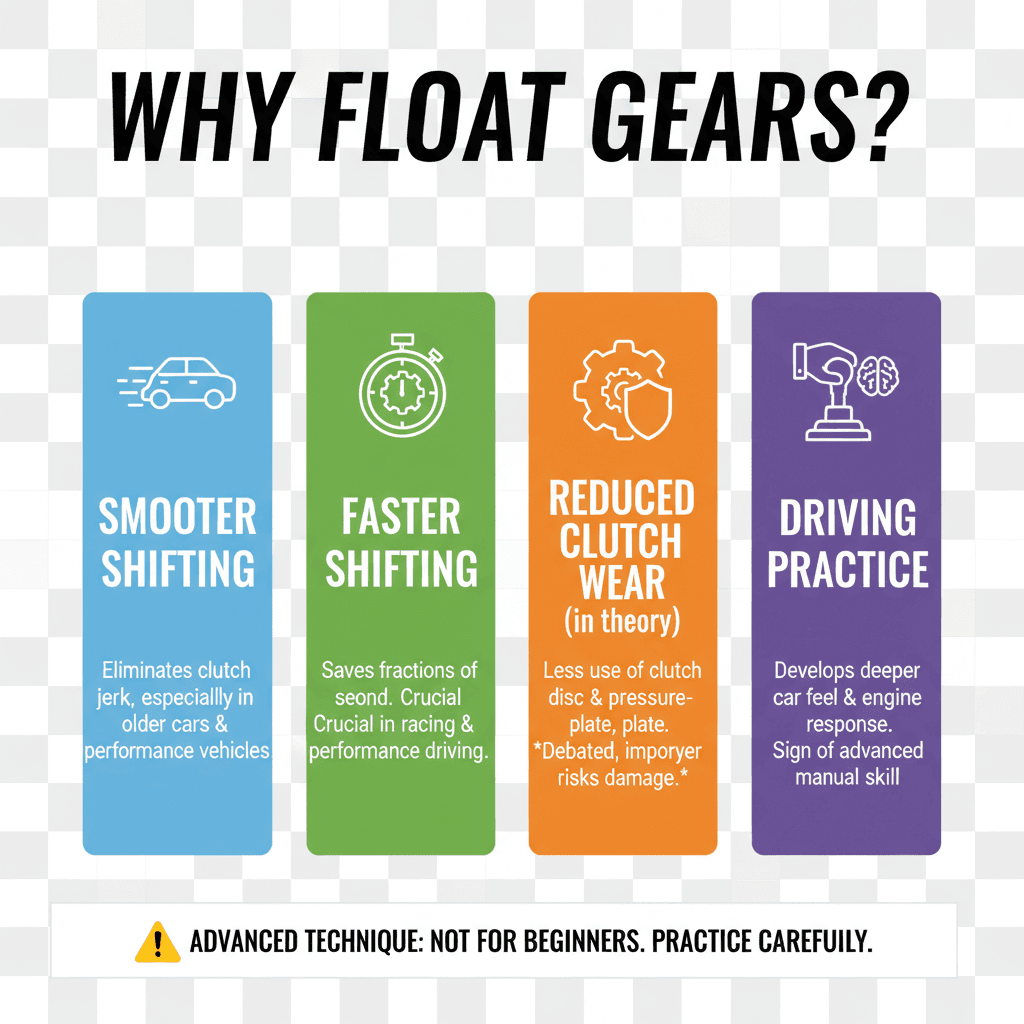
This isn’t just a party trick for gearheads! There are a few practical reasons why drivers might choose to float gears, though it’s important to note these are often more relevant in very specific driving conditions:
- Smoother Shifting: When done perfectly, floating gears can result in an unbelievably smooth shift. This is especially noticeable in older cars or performance vehicles where clutch engagement might be less refined.
- Faster Shifting: Eliminating the clutch pedal action saves a fraction of a second. In racing or other performance driving situations, this can make a small but significant difference.
- Reduced Wear on the Clutch (in theory): By not using the clutch for every shift, some argue you can reduce wear on the clutch disc and pressure plate. However, this is a debated point, as improper floating can cause much more severe damage to other transmission components.
- Driving Practice (for advanced drivers): For some, it’s a fun challenge and a way to develop a deeper feel for the car’s mechanics and engine response. It’s a sign of advanced skill with a manual transmission.
Understanding the “Genius Secret”: How Gears Work
To truly understand floating gears, we need a tiny peek under the hood of how manual transmissions work. Don’t worry, I’ll keep it super simple!
Inside your car’s transmission, there are several pairs of gears, each of a different size. These gears are what allow your car to go from a slow crawl to highway speeds. When you select a gear, different gear sets inside the transmission engage to create different gear ratios. A lower gear (like 1st or 2nd) gives you more torque (pulling power) but less speed. A higher gear (like 5th or 6th) gives you more speed for less engine effort.
When your engine is running, it’s always spinning the input shaft of the transmission. The gears on this shaft are always turning. The challenge comes when you want to select a different gear. If the gears you want to engage are spinning at different speeds, they’ll resist meshing, causing that nasty grinding noise or even damage.
The clutch’s job is to temporarily stop the input shaft from spinning (or at least slow it down significantly) so you can pick the next gear. Floating gears aims to achieve the same result – synchronizing the speeds – but through a different method: engine RPM control.
The Technique: How to Float Gears (Safely-ish)
Alright, here’s where we get into the “how-to.” Remember, this takes practice and a good feel for your car. It’s not something to just jump into without understanding the risks.
Floating Up Through the Gears (e.g., 1st to 2nd, 2nd to 3rd)
This is generally easier than downshifting.
- Accelerate Normally: Drive in your current gear (let’s say 2nd gear) at a steady speed.
- Ease Off the Gas: As you approach the RPM range where you want to shift to the next gear (e.g., 3rd), gently lift your foot off the accelerator pedal.
- “Float” the Shifter: While your foot is off the gas, the engine’s RPMs will start to drop. Almost immediately, gently push the gear lever towards the next gear (3rd). You’re not forcing it; you’re coaxing it.
- Find the Sweet Spot: The trick is to lift off the gas just enough so that the engine RPMs drop to roughly match the speed the transmission wants to be at for the higher gear. When you feel the gate for the next gear, it should slide in with minimal effort.
- Apply Gas Again: Once the new gear is engaged, smoothly apply the accelerator again.
Example: You’re in 2nd gear, going 30 mph, and your engine is at 3000 RPM. You want to shift to 3rd gear. As you ease off the gas, the RPMs will drop. You need to time it so that when the gear lever is nudged towards 3rd, both your engine and the transmission’s internal components for 3rd gear are spinning at the same speed. This often happens at a lower RPM than you were previously at in 2nd gear.
Floating Down Through the Gears (e.g., 3rd to 2nd, 2nd to 1st)
Downshifting is trickier and requires “blipping” the throttle – momentarily pressing the gas pedal. This is often called “heel-and-toe” or “rev-matching,” but for floating down, the goal is subtly different, aiming to match speeds without the clutch.
- Brake or Decelerate: Slow down to the appropriate speed for the lower gear you want to shift into.
- Clutch In (Briefly): This is where it gets tricky for a true “float” downshift. Some techniques still involve a brief clutch in. A pure float downshift would aim to avoid the clutch entirely.
- “Blip” the Throttle: While the clutch is out (or very briefly in, if you’re learning), and before you engage the lower gear, quickly stab the gas pedal. This revs the engine up.
- Guide the Shifter: The idea is to use the gas pedal blip to make the engine speed match the speed the transmission needs for the lower gear. You’ll then gently guide the shifter into the lower gear.
- Clutch Out (if used) & Smoothly Apply Gas: Release the clutch (if you used it) and gradually apply gas.
The Challenge of Downshifting: For cars without a clutch less system (like most standard manuals), trying to float downshift without the clutch is very difficult and risky. The engine RPMs need to increase significantly to match the speed of the faster-spinning transmission input shaft when going to a lower gear. Getting this blip exactly right while also disengaging the gear and re-engaging another is extremely challenging. This is why you’ll often see this technique discussed more in the context of racing or with specific synchronized transmissions.
Tools and Equipment (What You’ll Need to Feel Ready)
You don’t need any special tools to try floating gears, as you’re working with the existing clutch and shifter. However, knowing your car and having the right mindset is key. Here’s what’s important:
- A Manual Transmission Car: This is the most obvious. Automatic, CVT, or dual-clutch transmissions won’t allow for this technique.
- A Functional Clutch: Your clutch needs to be in good working order. If it’s stiff, worn, or engages/disengages poorly, attempt this at your own risk.
- A Smooth-Shifting Gearbox: Some transmissions are more forgiving than others. Older, less synchronized transmissions might actually be easier to float in some cases, while very precise modern ones can be more resistant.
- Patience and Practice: This isn’t a skill learned in 5 minutes. You’ll need to practice in a safe, open area.
- A Good Tachometer: Being able to accurately read your engine’s RPMs is crucial.
- Understanding Your Car’s Power Band: Knowing where your engine makes its best power and how quickly it revs will help.
Risks and Downsides of Floating Gears
While it sounds neat, floating gears isn’t without its risks, especially for beginners.
The Grinding Gear of Doom
If your RPMs are even slightly mismatched when you try to engage the next gear, you’ll hear that horrible grinding noise. This is the sound of gears clashing and wearing down. Doing this repeatedly can:
- Damage the teeth on your gears.
- Wear out your synchronizers (which help match gear speeds and make shifting smooth).
- Potentially lead to costly transmission repairs.
Clutch Abuse (Yes, Really!)
Contrary to what some might think, if you get the RPMs way off when trying to float a gear (especially downshifting), you can put immense stress on your clutch. You might not be pressing the pedal, but the violent engagement forces can be just as bad, if not worse, than a sloppy clutch release.
Transmission Damage
The synchronizers within your transmission are designed to help match speeds. They are not designed to be forced. If you’re using brute strength to get a gear to engage when floating, you’re fighting the transmission and risking expensive damage to internal components.
It’s Not Necessary for Most Drivers
For 99% of everyday driving, using the clutch as intended is the safest and most reliable way to shift gears. Modern car manufacturers design transmissions and clutches to work together seamlessly. Trying to circumvent this process is usually unnecessary and can be detrimental.
When is Floating Gears Actually a Good Idea?
While everyday driving doesn’t require it, there are niche situations where floating gears has its place:
Performance Driving and Racing
In motorsports, fractions of a second count. Eliminating the clutch pedal press and engagement for upshifts saves time. Race cars often have specialized gearboxes or drivers with incredible skill and feel for their cars to do this reliably. They might also use specialized racing transmissions that are more robust or designed for this kind of operation. For context, consider automotive engineering standards; even for performance vehicles, ensuring longevity and reliability often means incorporating clutch-based systems for most operations.
You can find many discussions on automotive forums and engineering websites about transmission design. For example, articles on racing technology from sources like Car and Driver often touch upon the speeds and forces involved in performance shifting.
Older Non-Synchronized Transmissions
Vehicles from before the widespread adoption of synchronized transmissions (think very old trucks or early automobiles) often required floating gears or “double-clutching” (a technique involving clutch in, shift to neutral, clutch out while revving, clutch in again to select the next gear) because they lacked the internal synchros.
Specific Clutchless Manual Transmissions
Some modern vehicles are equipped with what’s called a “clutchless manual” or automated manual transmission. These systems automatically operate a clutch or use clever hydraulics/electronics to achieve gear changes without driver clutch pedal input. In a way, these systems are doing your “floating” for you, but with engineered precision.

Floating Gears vs. Double Clutching vs. Rev Matching
It’s easy to get these advanced manual transmission techniques confused. Let’s clear them up:
| Technique | Purpose | Clutch Usage | Engine RPMs | Common Use |
|---|---|---|---|---|
| Floating Gears | Smooth shifting without clutch pedal. | None (ideally) | Match to desired gear speed | Advanced drivers, racing (upshifts), older cars |
| Double Clutching | Smooth shifting, especially in non-synchro transmissions. | In, out, in (for each shift) | Blip for each stage | Very old cars, heavy trucks |
| Rev Matching | Smooths downshifts by matching engine speed to transmission speed. | Briefly in, then out | Blip before engaging lower gear | Performance driving, spirited driving, daily manual drivers |
See how they’re different? Floating is the one that aims to skip the clutch entirely. Rev matching is what most good manual drivers do for smooth downshifts, and double clutching is for classic cars.
Can You Drive Around “Floating Gears”?
Absolutely! For the vast majority of car owners, understanding and properly using the clutch pedal for every gear change is the recommended and best practice. Modern synchromesh transmissions make shifting smooth and easy when the clutch is used correctly.
If you’re learning to drive a manual, focus on mastering clutch control, smooth engagement, and proper shifting with the clutch. That’s the fundamental skill that will keep your car running smoothly and prevent damage. The technique of floating gears is more of an advanced skill for specific scenarios or for those who want to push the limits of their driving finesse.
For a deeper dive into how transmissions are designed to work best, you might find resources from reputable automotive engineering societies or university automotive programs to be informative. For instance, understanding the role of SAE (Society of Automotive Engineers) standards can give context to why certain designs are chosen for durability. You can explore their resources through their official website.
Frequently Asked Questions (FAQ)
Is floating gears bad for my car?
It can be, especially if done incorrectly or too frequently. Forcing gears or misjudging RPMs will cause wear or damage to your transmission’s gears and synchronizers. For most everyday driving, it’s best to use the clutch pedal as intended.
Will floating gears help me save gas?
Not significantly, and it’s not the right way to save fuel. Proper fuel-efficient driving involves smooth acceleration, anticipating stops, and choosing the right gear for your speed. Trying to float gears for economy is risky and unlikely to yield any measurable fuel savings.
Can I float gears in an automatic car?
No. Automatic transmissions (including CVTs and dual-clutch automatics) manage gear changes internally using hydraulics, electronic controls, or complex clutch packs. They do not have a clutch pedal for the driver to operate in the way a manual transmission does, so “floating gears” is not applicable.
My car has a clutchless manual. Can I float gears in that?
With a true clutchless manual (automated manual), you don’t have a clutch pedal, and the car handles the gear changes automatically. While the principle of matching speeds is involved in how those transmissions work, you, as the driver, are not performing the “floating.” You simply select the desired gear or mode, and the car does the rest.
How can I practice floating gears safely?

Hi, I’m Melvin, an automobile engineer with extensive experience in automobile equipment. I currently work for a local automobile firm, where I specialize in the car parts industry. I’ve had the opportunity to collaborate with seasoned inspectors, gaining invaluable hands-on experience that goes beyond just theory.
My passion for automotive care started at a young age, which led me to create CarSpareCare. Through CarSpareCare, I share the knowledge and skills I’ve acquired over the years to help others navigate the world of car maintenance and repairs.
My goal is to provide practical tutorials, essential safety advice, and the latest industry insights so that anyone—whether a beginner or an expert—can confidently tackle their automotive projects.

