
For most car owners, a quality paint sealant gives the best overall balance; choose wax if you want the easiest short-term protection, sealant for 3–6 months of coverage, and ceramic coating only if you will maintain it for years. Pick poorly and you waste money while paint stays exposed to UV, grime, and wash damage. This guide compares wax vs sealant vs ceramic coating by durability, upkeep, cost, and which one fits your ownership horizon.
| Factor | Wax | Sealant | Ceramic | Winner |
|---|---|---|---|---|
| Durability | 4–8 weeks | 3–6 months | 1–5 years | Ceramic |
| Prep required | Wash and decontaminate | Wash and decontaminate | Wash, decontaminate, and often paint correction | Wax |
| DIY difficulty | Low | Low to moderate | High | Wax |
| Cost per year | Lowest upfront, highest reapplication frequency | Middle ground | Highest upfront, can be lower over several years | Sealant |
| UV resistance | Basic defense only | Better than wax | Strong | Ceramic |
| Chemical resistance | Weak | Moderate | Strong | Ceramic |
| Best use case | Show cars and enthusiasts | Budget-conscious daily use | Long-term owners who maintain paint carefully | Depends on ownership horizon |
How each layer protects clear coat
The real split is not shine. It is how long you will keep protection on the clear coat, how much prep you will accept, and how often you want to reset the finish. Wax is the easiest short-term layer, sealant is the practical middle ground, and ceramic coating is the longest-lived option if you are willing to do the prep and maintenance it expects.
What each product does on clear coat
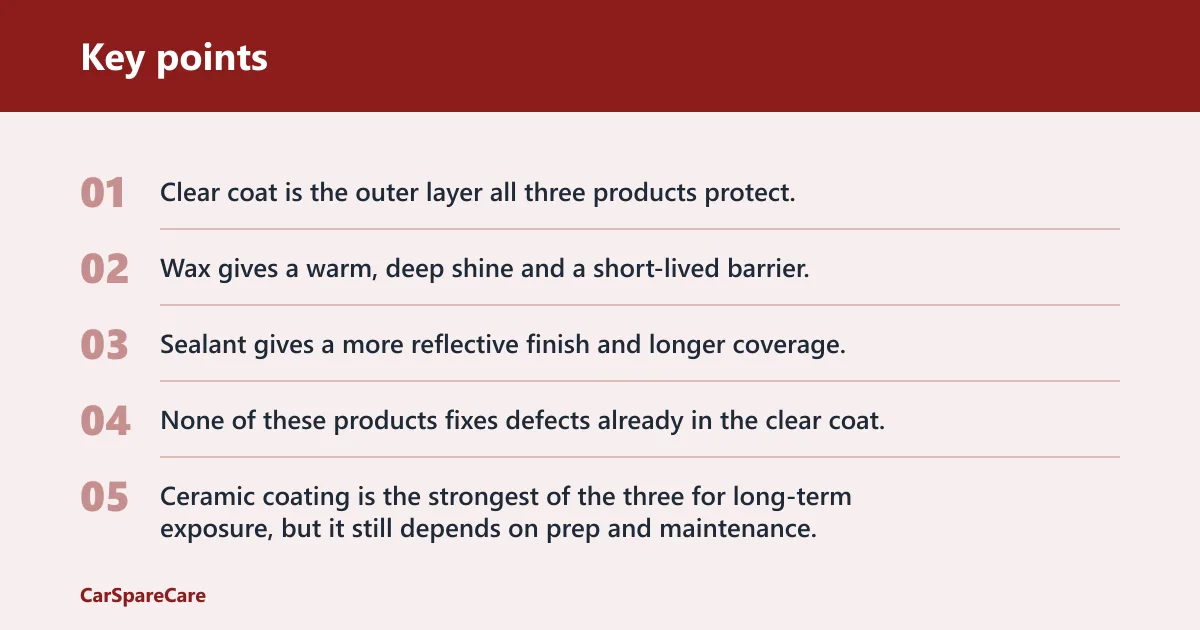
Clear coat is the outer layer all three products protect. It takes UV exposure, heat, road film, and contamination first, so it needs to be clean and decontaminated before anything goes on top. Carnauba wax sits on the surface, synthetic sealant tends to bond more strongly to the paint, and ceramic coating is often described as chemically bonding to the paint.
That difference matters more than gloss. Wax gives a warm, deep shine and a short-lived barrier. Sealant gives a more reflective finish and longer coverage. Ceramic coating usually gives the tightest water behavior and the strongest resistance to UV, chemicals, and contaminants.
What each one can and cannot prevent
None of these products fixes defects already in the clear coat. They do not remove scratches, and they do not fill the gap between a healthy panel and one that needs correction. Ceramic coating can help with chemical attack and etching, but it does not stop true scratches or heavy swirl marks by itself.
Wax is a light shield. It offers only basic defense against light contaminants and UV rays, and sustained surface temperatures above roughly 175°F start breaking it down. Sealant does more for a daily driver. For the prep side of the decision, the ceramic prep guide matters because the coating only performs as well as the surface underneath it. Ceramic coating is the strongest of the three for long-term exposure, but it still depends on prep and maintenance.
Paint protection decision matrix
This matrix compares the three options by the factors that change real ownership cost and results. It is built for a decision, not for a showroom comparison.
| Criteria | Wax | Sealant | Ceramic | Simple score | Recommendation |
|---|---|---|---|---|---|
| Durability | 4–8 weeks | 3–6 months | 1–5 years | Wax 1 / Sealant 2 / Ceramic 3 | Ceramic for the longest horizon |
| Reapplication interval | Frequent | Several times per year | Infrequent, but not zero | Wax 1 / Sealant 2 / Ceramic 3 | Ceramic if you want the fewest resets |
| Prep required | Basic wash and decontamination | Basic wash and decontamination | Wash, decontaminate, and often correct paint | Wax 3 / Sealant 2 / Ceramic 1 | Wax if prep time is limited |
| DIY difficulty | Low | Low to moderate | High | Wax 3 / Sealant 2 / Ceramic 1 | Wax for first-time DIY use |
| Cost per year | Low upfront, higher over repeated cycles | Middle ground | Higher upfront, often lower over several years | Wax 1 / Sealant 2 / Ceramic 3 | Sealant for balanced annual cost |
| UV resistance | Basic | Better | Strong | Wax 1 / Sealant 2 / Ceramic 3 | Ceramic for parked-outside cars |
| Chemical resistance | Weak | Moderate | Strong | Wax 1 / Sealant 2 / Ceramic 3 | Ceramic for bird-dropping and bug exposure |
| Best use case | Show cars and enthusiasts | Budget-conscious owners | Long-term, careful ownership | Use case dependent | Match the product to the ownership horizon |
Eight-criterion scorecard by ownership type
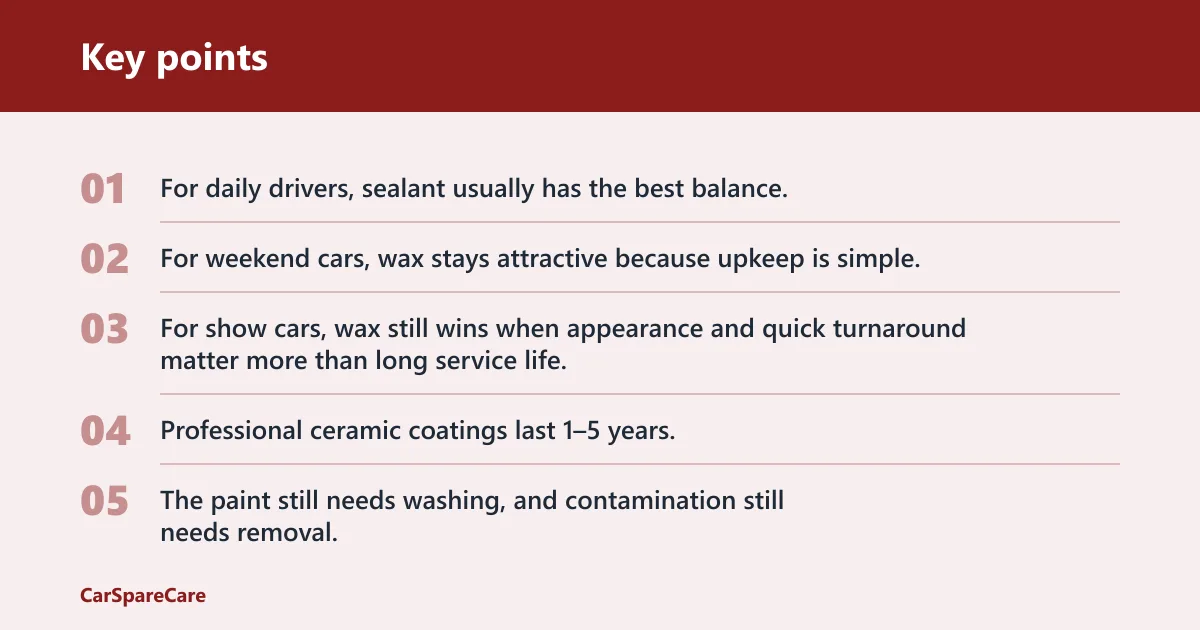
Using the eight criteria above, wax wins on ease and prep, sealant wins the middle ground, and ceramic wins durability, UV, and chemical resistance. For daily drivers, sealant usually has the best balance. For weekend cars, wax stays attractive because upkeep is simple. For show cars, wax still wins when appearance and quick turnaround matter more than long service life.
Best for daily drivers: Sealant. It gives enough durability to reduce repeat work without demanding ceramic-level prep, and it fits the ownership horizon of cars that are washed often but not treated like project paint.
Best for weekend cars: Wax. If the car is garaged, driven less, and maintained for presentation, wax keeps the process simple and the finish easy to refresh.
Best for show cars: Wax. The short interval is less of a drawback when the car is not living through daily exposure, and the warm look is still a strong reason to choose it.
Durability and reapplication interval
Carnauba wax lasts only 4–8 weeks. That short span is why wax works well for show cars and enthusiasts who want a quick, familiar product and are fine reapplying often. Sealant lasts 3–6 months, and another ranking page lists 4–6 months, which still puts it far ahead of wax for routine protection.
Professional ceramic coatings last 1–5 years. That is the longest range here, but it does not mean the coating can be ignored. The paint still needs washing, and contamination still needs removal. The difference is that the protection layer stays on the panel much longer before it needs a reset.
Cost per year over 3 years
Sticker price can mislead. Over a 3-year ownership horizon, wax is the most frequent redo because its 4–8 week life means repeated application cycles. DIY sealant sits in the middle because its 3–6 month window cuts down repeat work without the prep burden of ceramic. DIY ceramic spray can make sense when you want a longer-running layer than wax with lighter upkeep than a full coating, while pro ceramic coating shifts more cost into year one but can reduce annualized cost if you keep the car long enough to spread that upfront spend across multiple years.
A plain-text way to compare the real cost is: product cost + prep supplies + labor time, then divide that total by the months of usable protection you actually get. That is why a cheap bottle can still be the expensive choice if you keep redoing it all year.
How the cost logic changes by ownership horizon
Say your commuter keeps the car for two years and parks outside. Wax may look affordable, but repeated reapplication pushes the yearly cost up. Sealant usually makes more sense because it gives useful coverage without demanding the ceramic price or prep burden. A daily-driver ceramic spray can sit between those two choices when you want easier upkeep than a full coating.
Suppose your car is a weekend toy that sees occasional washes and stays garaged. Wax can be rational because the car is not exposed daily, and the owner may prefer a warm finish with simple reapplication. Ceramic only pays off if the owner plans to keep the car long enough to spread the upfront cost out.
How long does each one last?
Wax is the shortest-lived option, sealant lasts longer, and ceramic coating lasts the longest. That ranking holds across the common ranges: wax at 4–8 weeks, sealant at 3–6 months, and professional ceramic coatings at 1–5 years. The right choice depends on how often you are willing to redo protection, not on the label alone.
Hydrophobicity is a useful check here. Water beading and sheeting show how the surface is behaving after washing and rain. Tight beads often point to a healthy ceramic layer, while weak beading usually means the protection is wearing down or the surface has contamination on it.
Simple inspection before choosing a product
-
Wash the panel thoroughly.
Remove loose dirt first so you are not judging beading through road film. Dirt masks the surface and can make any protection look weaker than it is. -
Rinse and watch the water.
Tight beads and quick sheeting usually mean some protection is still present. Flat water or slow movement often means the layer is faded or the paint is contaminated. -
Feel for contamination.
A clean surface should feel smoother after decontamination. If the paint still feels rough, protection will not sit well and the next product layer will underperform. -
Choose the next layer.
Use wax for a short interval, sealant for a middle ground, and ceramic when you want the longest service life and accept the extra prep.
Which protects against UV, chemicals, and salt?
Ceramic coating protects best against UV, chemicals, and contaminants, with sealant behind it and wax behind sealant. Wax offers only basic UV stability and limited environmental protection. Sealants do better against daily weathering. Ceramic is the strongest pick when the car sees sun, grime, and repeated exposure to harsh residues.
UV exposure and oxidation
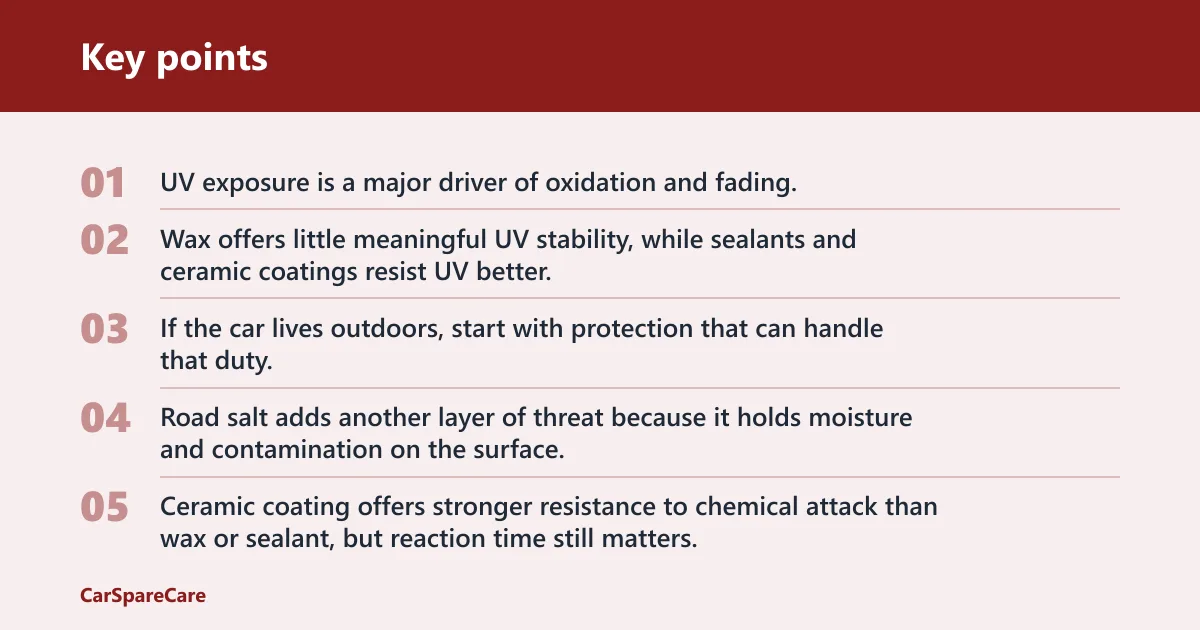
UV exposure is a major driver of oxidation and fading. That matters most for cars parked outside, black paint, and vehicles that see long sun exposure. Wax offers little meaningful UV stability, while sealants and ceramic coatings resist UV better. If the car lives outdoors, start with protection that can handle that duty.
Bird droppings, bug guts, and road salt
Bird droppings and bug guts are acidic. Road salt adds another layer of threat because it holds moisture and contamination on the surface. Ceramic coating offers stronger resistance to chemical attack than wax or sealant, but reaction time still matters. The longer acidic residue sits on paint, the more likely it is to etch the clear coat.
Road salt is especially relevant for winter driving. A product that survives washing and resists contamination gives you more time to clean the car before residues bite into the clear coat. That is a protection problem, not a shine problem.
Hydrophobicity as a real-world clue
Water beading and sheeting do not prove perfect protection, but they are useful indicators. Strong beading often means the surface still has active protection. Weak beading can mean the layer is worn, but it can also mean the paint is dirty. Check after a proper wash, not after a quick rinse.
Does ceramic coating protect against scratches?
Ceramic coating helps more with etching and chemical attack than with true scratches. It can reduce how easily contaminants bond and may make cleaning easier, but it does not stop swirl marks from bad washing or prevent a rock, key, or branch from cutting the clear coat. That distinction matters.
Swirls versus true scratch resistance
Swirl marks usually come from washing technique, towels, or grit dragged across the surface. Ceramic coating does not make the paint scratch-proof. It can change how contamination behaves, but it cannot replace careful washing or prevent hard contact damage.
True scratch resistance needs a different product category. Paint protection film is a transparent, durable film applied to the exterior of vehicles to help shield the paint from scratches, stone chips, and environmental elements. If your main concern is impact damage, film is the closer match, especially when you are weighing DIY difficulty against scratch resistance.
Why prep matters before any protection
Protection performs poorly over contaminated paint. Ceramic coating especially needs a clean, decontaminated surface, and surface preparation often includes paint correction before ceramic coating. If the paint has swirls, oxidation, or bonded residue, sealing it in under a new layer only preserves the problem.
A common first-timer mistake is applying a product to fix a dirty surface. That does not work. Clean first, correct if needed, then protect.
Choose wax, sealant, or ceramic coating if…
The right answer comes from your ownership horizon, wash habits, and tolerance for repeat maintenance. Here is the practical split.
Choose wax if…
- You want the easiest short-term protection and do not mind reapplying every 4–8 weeks.
- You own a show car or another vehicle where warm shine and quick turnaround matter more than durability.
- You prefer the lowest upfront cost and accept that protection fades quickly in sun and heat.
Choose sealant if…
- You want the middle ground between effort and durability.
- You drive a daily car, want 3–6 months of coverage, and do not want ceramic-level prep.
- You are budget-conscious but still want better UV and chemical resistance than wax.
Choose ceramic coating if…
- You plan to keep the car for years and will maintain it properly.
- The car lives outside, sees frequent UV exposure, bird droppings, bug guts, or winter road salt.
- You are willing to pay for stronger prep, including decontamination and often paint correction, before application.


Frequently asked questions
Is wax or ceramic coating better for protecting car paint?
Ceramic coating protects paint better for most long-term use because it resists UV, chemicals, and contamination longer than wax. Wax is easier and cheaper up front, but it is a short-lived layer. If the car sees regular sun or outdoor parking, ceramic is the stronger protection choice.
How long does car wax last compared with sealant and ceramic coating?
Carnauba wax lasts 4–8 weeks, synthetic sealant lasts 3–6 months, and professional ceramic coatings last 1–5 years. The right option depends on how often you are willing to reapply protection. Short ownership or show use can justify wax; longer use usually pushes you toward sealant or ceramic.
Does ceramic coating protect against swirl marks and scratches?
Not in the way many owners hope. Ceramic coating helps with chemical resistance and can make washing easier, but it does not stop true scratches or eliminate swirl marks from poor wash technique. It is a protection layer, not a repair layer or a substitute for careful cleaning.
Is paint sealant worth it instead of wax?
Yes, for most daily drivers. Sealant lasts longer than wax, bonds more strongly to the clear coat, and usually gives better UV and chemical resistance for a reasonable effort level. If you want a balance of cost, durability, and easy application, sealant is often the sensible choice.
What protects paint best from UV, bird droppings, and road salt?
Ceramic coating is the strongest of the three for UV, acidic contamination, and road salt exposure. Sealant is a solid middle option. Wax offers only basic defense, so it is least suited to cars that sit in the sun or see harsh winter roads.
Can I apply wax, sealant, or ceramic coating myself?
Yes, wax and sealant are both DIY-friendly for most owners. Ceramic coating can also be done at home, but it needs more prep, cleaner paint, and more careful application. If the finish is heavily swirled or contaminated, the prep work matters more than the product choice.
What is the real cost over 3 years of wax vs sealant vs ceramic?
Wax usually looks cheapest at the shelf but can cost more over 3 years because it needs frequent reapplication. Sealant usually lands in the middle. Ceramic coating has the highest upfront cost, yet it can be cheaper over several years if the vehicle stays protected and the owner avoids repeated reapplication cycles.

Hi, I’m Melvin, an automobile engineer with extensive experience in automobile equipment. I currently work for a local automobile firm, where I specialize in the car parts industry. I’ve had the opportunity to collaborate with seasoned inspectors, gaining invaluable hands-on experience that goes beyond just theory.
My passion for automotive care started at a young age, which led me to create CarSpareCare. Through CarSpareCare, I share the knowledge and skills I’ve acquired over the years to help others navigate the world of car maintenance and repairs.
My goal is to provide practical tutorials, essential safety advice, and the latest industry insights so that anyone—whether a beginner or an expert—can confidently tackle their automotive projects.

