
Apply spray wax one panel at a time: mist 1–2 sprays onto a cool, clean panel or microfiber applicator, spread it thin, and buff before it dries. Bad technique leaves streaks, uneven protection, and wasted product. This guide shows a panel-by-panel workflow, how to avoid missed spots, and when spray wax is enough versus when you need a stronger paint protection step.
This guide is part of our Automotive paint care guide series.
| Condition | Yes action | No action |
|---|---|---|
| Paint wet or lightly damp? | Yes: apply spray wax to the drying towel or a lightly damp microfiber towel, then buff as you dry. | No: wait until the panel is dry so you can control coverage and spot residue more easily. |
| Working in shade or on a cool panel? | Yes: continue panel by panel with thin coverage. | No: move the car into shade or let panels cool before applying. |
| Towel only lightly damp, not saturated? | Yes: keep using that towel face and flip to a clean side after each panel. | No: switch to a dry, clean microfiber face; a wet towel can smear product and a saturated towel can streak. |
Why spray wax still matters


Spray wax gives you fast, light protection for paint that is already clean. It helps protect the car clear coat from harmful UV rays, which can lead to fading, oxidation, spotting, and clear coat failure if the finish stays exposed for long periods. The risk is real: the EPA explains how UV exposure damages materials, and paint-system references from ScienceDirect on clear coat performance note that clear coats degrade over time under weathering and UV stress. Use spray wax when you want regular upkeep without a long job.
That said, spray wax is not the longest-wearing option. Paste wax usually lasts longer than spray wax, but it also takes more time and needs a work-in and buffing step. If you want a faster maintenance layer, spray wax is the easier choice. If you want longer wear, paste wax or another protection step may fit better. In practical terms, spray wax is the quick maintenance layer, Paste wax is the middle ground for more durability, and ceramic coatings make more sense when you want the longest gap between reapplications and are willing to commit to a more involved protection system.
Wax is also an alternative when ceramic coatings or clear vinyl are not part of the plan. Ceramic coatings and clear vinyl are higher-durability protection options, while wax is the simpler upkeep layer for owners who want regular care without a full protection system. Clear vinyl is especially useful when the goal is physical impact protection on high-strike areas, while wax is better for whole-car gloss maintenance and easy refreshes.
What you’ll need
- Clean microfiber towels, at least 3: one for application, one for buffing, and one spare for replacing a loaded towel
- Spray wax bottle
- Wash-ready paint surface
- Shaded work area
- A cool panel surface
Spray wax checklist
| Panel zone | Exact action | Common mistake to avoid |
|---|---|---|
| Roof | Work one half of the roof at a time; apply to a microfiber towel or the panel, then spread thin and buff before it dries. | Covering the full roof at once and letting product flash unevenly. |
| Hood | Use straight passes from front to back, then cross-check the edges before buffing. | Missing the front edge, cowl line, or raised center sections. |
| Front fenders | Fold the towel to a clean face and finish the curved edge before moving on. | Overworking the towel on a tight curve until it drags or streaks. |
| Doors | Use one door at a time; finish handles, lower edges, and mirrors before buffing. | Leaving trim lines and handle recesses half-covered. |
| Rear quarter and trunk | Recheck badges, spoiler bases, and lip edges, then switch to a fresh towel face if drag increases. | Letting buildup collect around badging and leaving a greasy film. |
Can you use spray wax on a wet car?
Yes, spray wax can be used on a damp car, especially as part of drying. It can go onto the microfiber towel used to dry the car, and it can be used during drying as a wipe-on step. Dry paint is still the safer choice when panels are hot, visibly dirty, or prone to streaking.
When damp paint is acceptable
Damp paint works best right after a proper wash, when the surface is clean and only carries a thin film of water. In that case, spray wax can be applied to the drying towel, then worked across the panel as the water is removed. This keeps the process fast and helps limit skipped areas.
When dry paint is the safer choice
Dry paint is the better choice when the car has water spotting risk, when the finish is dusty after drying, or when the panels are warm. A dry surface makes it easier to see coverage and reduce streaking. It also lowers the chance of leaving uneven high spots behind.
How towel saturation changes the result
A towel that is already wet can spread product too far and dilute the finish. A towel that is too dry can drag and leave patchy coverage. The practical target is a lightly damp microfiber towel, not a soaked one. If the towel starts to feel slick and heavy, switch to a clean section or a second towel.
How do you apply spray wax panel by panel?
Use one panel at a time. Start on cool, clean paint, lay down a light film, and buff before the product dries. The goal is thin, even coverage with no buildup in edges or body lines. Spray wax is easier than paste wax because it does not need the same work-in step, but it still needs control.
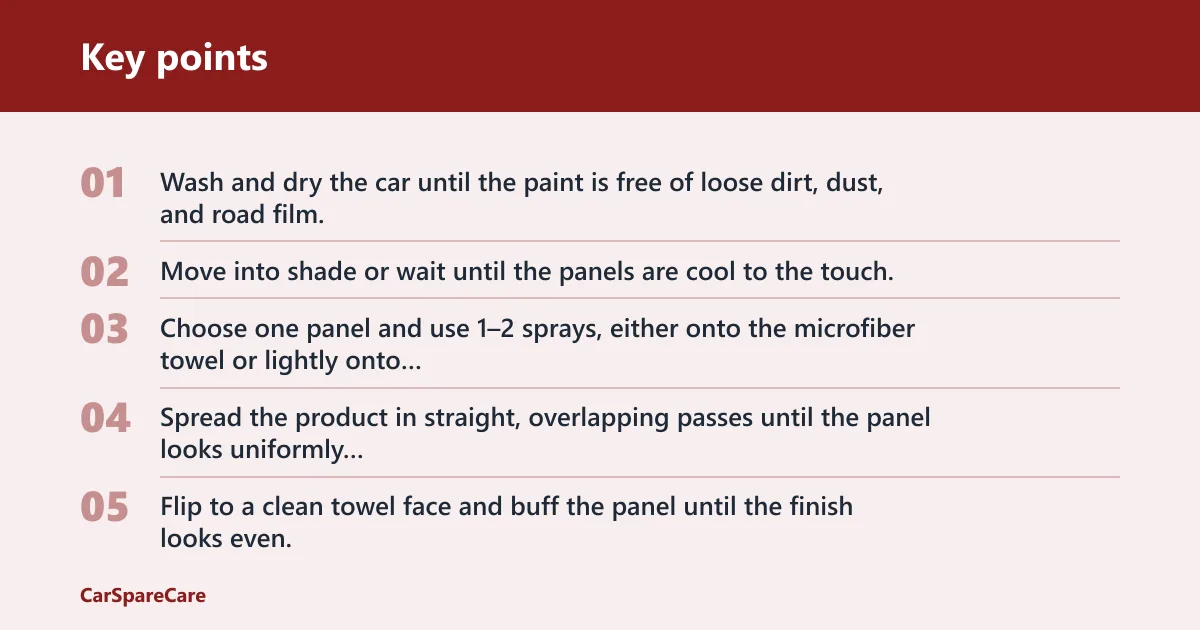
- Wash and dry the car until the paint is free of loose dirt, dust, and road film.
- Move into shade or wait until the panels are cool to the touch.
- Choose one panel and use 1–2 sprays, either onto the microfiber towel or lightly onto the paint.
- Spread the product in straight, overlapping passes until the panel looks uniformly covered.
- Flip to a clean towel face and buff the panel until the finish looks even.
- Check edges, trim lines, and badges, then switch to a fresh towel face before moving to the next panel.
If the panel still looks dry or thin after the first pass, add about 1 more spray and recheck the surface immediately. That is usually enough for one medium panel; more product often creates streaks instead of better coverage.
Step 1: Start with a clean, cool surface
Spray wax should go on top of clean paint, not dust or bonded grime. Contamination can trap residue, dull the finish, and reduce protection. If the car needs a wash or still feels warm from the sun, stop there and reset the surface first.
Step 2: Apply a small amount to the towel or panel
Both methods work. Spraying onto the microfiber towel gives more control, especially on trim-heavy panels or when the paint is warm. Spraying directly onto the paint can be faster, but it demands careful control so the product does not overbuild on one spot.
Step 3: Spread one panel at a time
Work in small sections so the product does not dry before you level it out. A hood, door, or fender can often be split into two sections if the panel is large. Keep the motion light. Heavy pressure can smear product into the seams and make streaks more likely.
Step 4: Flip the towel and buff the finish
Use a second clean face of the towel to remove residue and even out gloss. Spray wax does not need buffing like paste wax, but it still needs a final wipe to remove excess and prevent high spots. If the towel feels damp or grabby, move to a clean section.
Step 5: Move to the next panel with a fresh section
Do not carry a loaded towel across the whole car. Once one face starts to feel saturated, flip it or replace it. That keeps residue from being spread back onto the paint and helps maintain an even finish from panel to panel.
Picture a dark sedan left under trees. One door gets more sap haze than the others, so a heavier pass seems tempting. That is where streaking starts. A cleaner, lighter approach on that door usually leaves a better result than trying to force extra product to cover contamination.
Common mistakes
Most spray-wax problems come from too much product, too much heat, or too little towel control. The finish usually tells the story quickly: streaks, hazy patches, grabby wiping, or gloss that looks uneven from one panel to the next. Fix the process before adding more product.
- Using too much product: Start with 1–2 sprays and add only 1 more spray if the panel still looks dry. More product often leaves residue.
- Working on hot panels or in direct sun: Move to shade or let the panel cool. Heat speeds drying and makes streaks more likely.
- Letting a towel load up: Fold to a fresh face or switch towels when the wipe starts to drag.
- Skipping the second wipe: Always follow the spread step with a clean buffing face.
- Applying over contamination: Wash first if there is dust, grime, or bonded road film.
| Problem | Likely cause | Exact fix |
|---|---|---|
| Streaking | Too much product, warm paint, or an overloaded towel | Move to shade, switch to a fresh towel face, and reduce to 1–2 sprays per panel. |
| Hazing | Product left to dry before buffing or applied too thickly | Rewipe immediately with a clean microfiber face; if haze remains, add less product next panel. |
| Grabby towel | Towel is saturated, dry, or catching on residue | Flip to a clean face or replace the towel; ensure the panel is clean and cool first. |
| Patchy gloss | Uneven spread, missed overlap, or contamination under the wax | Reapply lightly with overlapping passes on a clean panel and inspect under direct reflection. |
| Residue around badges | Product pooling in trim, seams, or tight recesses | Use a towel-wrapped finger or a fresh corner of microfiber to clear the edge immediately. |
How often should you reapply spray wax?
Reapply spray wax as maintenance, not as a one-and-done coating. Frequency depends on how the car is used, how often it is washed, and how much sun it sees. Daily drivers exposed to weather usually need it more often than garaged cars that spend less time in harsh conditions.
Routine for daily drivers
For a car that sits outside, gets rained on, or sees frequent road film, a reapplication after a wash makes sense whenever water behavior and gloss start to fade. That often means a regular upkeep rhythm tied to washing, not a fixed calendar alone.
Routine for garaged cars
A garaged car usually holds its finish longer because it sees less weather and less UV exposure. In that case, spray wax can be reapplied less often, with the finish checked during routine washes. If the surface still beads and feels slick enough for the owner’s routine, a full reapply may wait.
Signs the protection is fading
Watch for faster water sheeting, a flatter look in the gloss, and residue that no longer wipes clean as easily. Those signs suggest the wax layer is thinning. Uneven fading on horizontal panels is common because those panels take more sun and weather.
When paste wax may be the better fit
If longer wear matters more than speed, paste wax usually makes more sense. It takes more time to apply and buff, but it usually lasts longer than spray wax. That makes it a better fit for owners who do not want to reapply as often.
Spray wax vs paste wax vs ceramic coating vs clear vinyl
Choose the protection that matches how the vehicle is used, not just how easy it is to apply. Spray wax is best when you want quick upkeep after washes and do not mind reapplying often. It is usually enough for owners who want a simple gloss boost and light seasonal protection.
Paste wax makes more sense when you want a stronger hand-applied finish with longer-lasting protection than spray wax. It still needs reapplication, but its durability and richer finish usually fit weekend detailers and owners who want a slower, more deliberate process. If you are already spending time on prep and do not mind the extra steps, paste wax is the better middle ground.
Ceramic coatings are the better option when you want the longest maintenance interval and are willing to invest in prep and application. They are more durable than wax, better suited to owners who want easier wash-downs and long-term surface protection, and less about quick gloss refreshes. If the car lives outside, sees frequent washing, or needs a stronger protection plan, ceramic coatings usually make more sense than either wax.
Clear vinyl makes the most sense on high-impact areas such as front bumpers, hoods, mirrors, and rocker zones where you want physical barrier protection rather than just chemical protection. It is a different solution from wax or ceramic coating: wax improves gloss and adds light sacrificial protection, while clear vinyl helps shield against chips and abrasion.
In short, spray wax is enough for fast upkeep, Paste wax is better when durability matters more, ceramic coatings are best for longer-term protection, and clear vinyl is the right call when impact resistance is the priority.
Frequently asked questions
What is the best way to apply spray wax to a car?
The best method is a panel-by-panel routine on cool, clean paint: apply 1–2 sprays to a microfiber towel or the panel, spread it thin, then use a clean towel face to buff. That sequence limits streaks and keeps product use controlled.
Do you apply spray wax to the towel or directly to the paint?
Both methods work, but spraying onto the microfiber towel usually gives more control and less overspray. Direct application is fine on open panels if the panel is cool and the product is spread immediately. Choose the method that gives the most even coverage on that panel.
Does spray wax last as long as paste wax?
No. Paste wax usually lasts longer than spray wax. Spray wax is the quicker, lower-maintenance option, while paste wax is slower to apply and better for owners who want longer wear between applications.
Can spray wax replace a full hand wax?
It can replace a full hand wax for routine upkeep, but not for every owner or every goal. If you want faster application and regular maintenance, spray wax is enough. If you want longer durability and more time between applications, paste wax or another protection method is the better choice.

Hi, I’m Melvin, an automobile engineer with extensive experience in automobile equipment. I currently work for a local automobile firm, where I specialize in the car parts industry. I’ve had the opportunity to collaborate with seasoned inspectors, gaining invaluable hands-on experience that goes beyond just theory.
My passion for automotive care started at a young age, which led me to create CarSpareCare. Through CarSpareCare, I share the knowledge and skills I’ve acquired over the years to help others navigate the world of car maintenance and repairs.
My goal is to provide practical tutorials, essential safety advice, and the latest industry insights so that anyone—whether a beginner or an expert—can confidently tackle their automotive projects.

