
For most daily drivers, Graphene Filler Liquid Wax is the best starting point for long-lasting shine because it pairs the longest stated protection window in this group with a liquid format that spreads evenly and is easier to keep thin than many pastes. It is the strongest durability-first choice here, while carnauba still wins on warm, show-car gloss.
This guide is part of our Automotive paint care guide series.
Best pick and verdict
This guide separates appearance from protection. A wax can look excellent on day one and still fail early if the paint was dirty, the car lives outdoors, or the wash routine is harsh. Industry guidance on paint care is consistent on this point: clean, decontaminated paint is the right base for any protection layer, and microfiber is preferred for safer washing and buffing. See the right way to use a clay bar, the basics of microfiber towels for car washing, and choosing between wax and ceramic spray if you are comparing protection types.
Clear coat matters here. It is the top paint layer on most modern cars, and it takes the brunt of fine scratching, oxidation, UV exposure, and grime. Wax sits on top of that layer, so prep and gentle removal matter as much as the formula. Reputable detailing guidance also notes that clear-coat-safe prep depends on removing bonded contamination before waxing, because wax does not fix embedded grit or oxidation underneath.
Why this pick leads for durability-per-dollar
Graphene Filler Liquid Wax is priced at £28.95 and claims up to 12 months of protection. Based on that stated duration, the rough cost works out to about £2.41 per month. That is the clearest monthly value figure in the supplied data.
The trade-off is simple. It is not the deepest-looking option for black paint or show work. Essence Carnauba Wax and Illusion Show Car Wax are the more obvious gloss-first choices, but they do not come with the same stated durability figure. That distinction matters: stated protection is a manufacturer claim under ideal conditions, while real-world service life depends on where the car is parked, how often it is washed, and how harsh the weather is.
Short answer: choose this if…
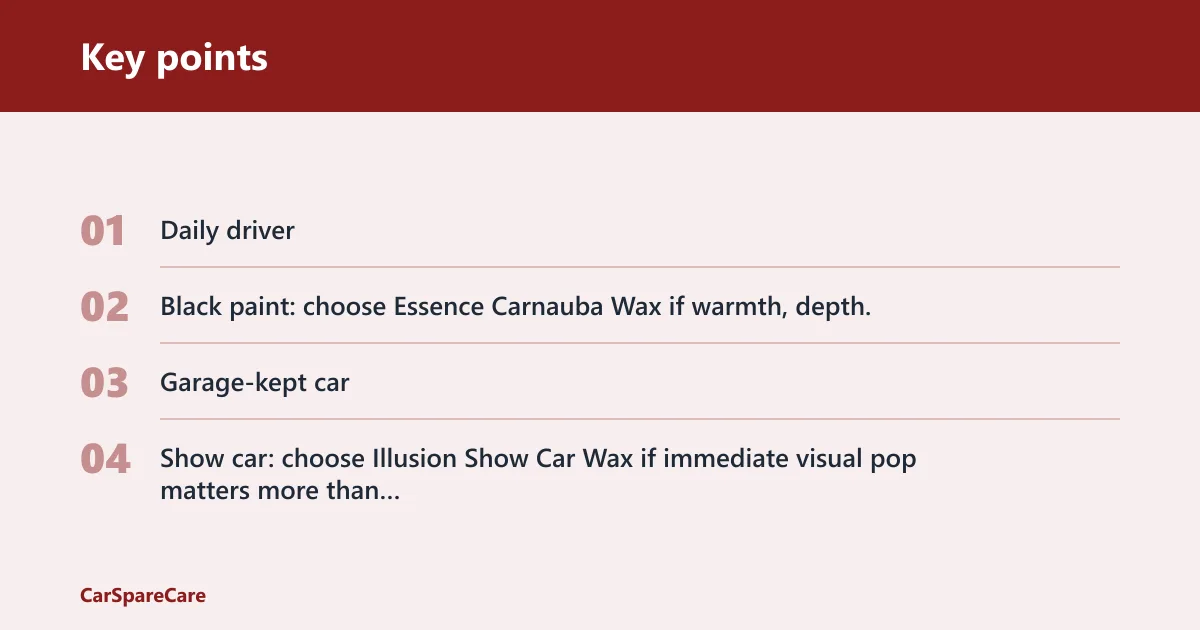
- Daily driver: choose Graphene Filler Liquid Wax if you want the longest stated wear and fewer reapplications.
- Black paint: choose Essence Carnauba Wax if warmth, depth, and a wet look matter more than maximum longevity.
- Garage-kept car: choose Essence Carnauba Wax or Illusion Show Car Wax if the car is sheltered and judged mostly on gloss.
- Show car: choose Illusion Show Car Wax if immediate visual pop matters more than durability.
What it gives up on raw gloss
Carnauba usually gives black and dark paint a warmer, wetter look that many buyers prefer. That is why a hand-applied carnauba finish can look better than a longer-wearing synthetic on day one, especially after careful decontamination and a clean buff. The downside is that the richer first impression does not always translate into the longest service life.
If your priority is maximum visual depth for a weekend car, the best pick changes. For a commuter that sees rain, road film, tunnel washes, and frequent driving, protection per month matters more than the deepest first impression.
Car wax table
| Pick | Shine | Expected durability | Application difficulty | Value per month | Best use case |
|---|---|---|---|---|---|
| Graphene Filler Liquid Wax | High, with a clean reflective finish | Up to 12 months claimed | Low to moderate | About £2.41 per month from the listed price and stated duration | Daily drivers, outdoor parking, buyers who want the strongest stated wear life |
| Essence Carnauba Wax | Very high depth and warmth | Not stated in supplied data | Moderate; hand application suits it well | Cannot calculate from supplied data alone | Black paint, garage-kept cars, owners chasing a show-style finish |
| Fusion Hybrid Car Wax | High | Not stated in supplied data | Low to moderate | Cannot calculate from supplied data alone | Drivers who want a compromise between easy use and longer wear |
| Illusion Show Car Wax | Very high gloss and visual pop | Not stated in supplied data | Moderate | Cannot calculate from supplied data alone | Show cars, fair-weather cars, owners focused on finish over longevity |
| Liquid Wax | Moderate to high | Not stated in supplied data | Low | $11.15 is the listed price, but monthly value cannot be calculated without a stated duration | Budget-minded owners who want a simple liquid format |
| Color Magic® Car Wax | High on the matching color finish | Not stated in supplied data | Low | Cannot calculate from supplied data alone | Owners of Jet Black, Ultra Blue, Radiant Red, Bright White, or Prestige Silver paint |
Read the table this way: shine tells you what the paint looks like right after application; durability tells you how long the protection is likely to matter; value per month is only fair when both price and lifespan are known. A glossy product can still be poor value if it fails early, especially when tunnel washing, winter grime, or outdoor parking shorten the real service life.
Wax types
Wax type matters because different formulas trade gloss, durability, ease of use, and maintenance. The right choice depends less on marketing language and more on how the car is used, where it is stored, and how often it is washed.
Carnauba wax
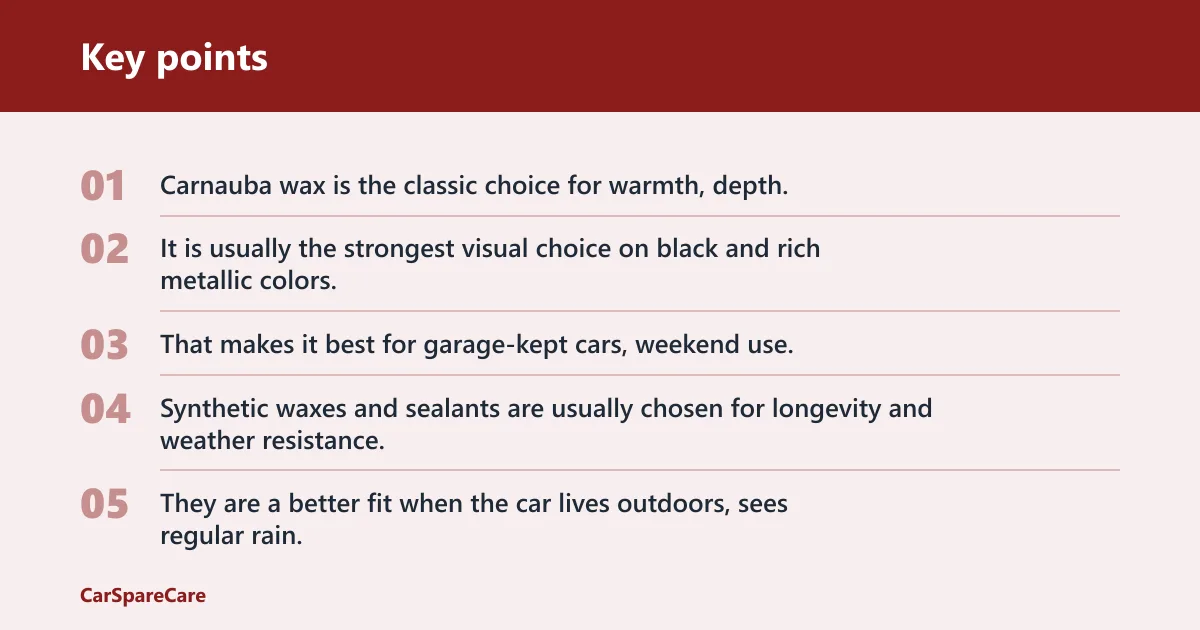
Carnauba wax is the classic choice for warmth, depth, and that show-car glow on dark paint. It is usually the strongest visual choice on black and rich metallic colors, but it generally needs more frequent reapplication than synthetic protection. That makes it best for garage-kept cars, weekend use, and owners who value the finish more than the interval between details.
Synthetic wax or sealant
Synthetic waxes and sealants are usually chosen for longevity and weather resistance. They are a better fit when the car lives outdoors, sees regular rain, or needs a finish that survives longer between full applications. In real-world use, a synthetic layer can look slightly less warm than carnauba at first, but it often stays functionally useful longer.
Hybrid wax
Hybrid waxes try to balance gloss and durability. They are a practical middle path for drivers who want easier application than a traditional paste and better staying power than a pure carnauba finish. For many daily drivers, this is the compromise that feels easiest to live with.
Graphene-style wax
Graphene-style waxes are usually marketed as a longer-lasting, more modern protection option with slicker surface behavior and strong beading. In this guide, the graphene-style product is also the only one with a stated duration claim, which makes it the easiest to compare on a monthly value basis. The key distinction remains the same: the label claim is one thing, while actual service life depends on exposure, washing, and prep quality.
Spray wax
Spray waxes are fast and convenient, but they are generally a maintenance product rather than a long-term protection layer. They can boost gloss and add temporary slickness, yet they usually do not last as long as a paste or a more durable liquid formula. If your goal is the longest possible interval between reapplications, a spray wax is usually not the best primary choice.
Paste wax
Paste waxes tend to appeal to enthusiasts who want more control during application and a traditional hand-finished feel. They can produce excellent gloss, but they often ask for more time, more careful buffing, and more frequent refreshes than a durable liquid or synthetic wax. The right use case is usually appearance-first, not lowest-maintenance.
Who should buy each wax type?
Use the product that fits your parking, color, and wash habits. A wax that looks great on a weekend car can be the wrong answer for a car that sleeps outside and sees rain, road salt, and frequent washing.
Daily drivers and outdoor parking
For commuters, Graphene Filler Liquid Wax is the strongest fit because the stated up-to-12-month protection window points to less frequent reapplication. Fusion Hybrid Car Wax is the safer second choice if you want a simpler middle ground between gloss and wear. For cars parked outside, the likely service life is usually shorter than the stated claim because UV, rain, road film, and repeated washing all work against the finish.
Black paint and dark colors
For black paint, Essence Carnauba Wax is the best gloss-first pick. Turtle Wax also says Hybrid Solutions Ceramic Polish & Wax is for light defects and black or dark paintwork, but that product is outside the main pick set here. On the products ranked in this guide, carnauba gives the cleaner answer for deep visual warmth.
Garage-kept and show cars
Illusion Show Car Wax is the pick for cars that are stored inside, cleaned carefully, and judged mostly on appearance. Essence Carnauba Wax is the other strong choice if you want the classic hand-applied glow that reads well on dark paint. For garage-kept vehicles, actual service life is usually closer to the upper end of any product’s performance because the car is exposed to less weather, less salt, and less wash abrasion.
Color-matched finishes
Color Magic® Car Wax is the only pick here with a color-specific lineup: Jet Black, Ultra Blue, Radiant Red, Bright White, and Prestige Silver. That makes it useful when you want a finish tied to the paint color rather than a one-size-fits-all look.
Wax decision table
| Wax type | Shine | Durability | Application difficulty | Best use case |
|---|---|---|---|---|
| Graphene-style liquid wax | High and clean | Longest stated life in this set | Low to moderate | Daily drivers and outdoor parking |
| Carnauba wax | Highest depth and warmth | Usually shorter than synthetics | Moderate by hand | Black paint, garage-kept cars, show cars |
| Hybrid wax | High | Middle ground | Low to moderate | Drivers who want balance |
| Show-car wax | Very high visual pop | Often secondary to gloss | Moderate | Events and weekend use |
| Liquid wax | Moderate to high | Varies by formula | Low | Fast, even hand application |
| Color-specific wax | High on matching paint | Varies by formula | Low | Paints that benefit from color-matched finishing |
How to read value per month: divide the price by the stated protection months. If no durability figure is supplied, do not guess. A glossy finish with unknown wear life is not the same as a durable one with a known cost-per-month. Reputable detailing advice also supports this approach: the stated duration on a bottle is a starting point, not a guarantee, because washing method, environment, and prep all affect the result.
Pros and cons
Pros
- Graphene Filler Liquid Wax has the clearest durability value in the supplied data.
- Carnauba options are the best fit for deep gloss on dark paint.
- Liquid formats are easier to spread thinly and evenly than many pastes.
- Color-specific waxes help match the finish to the paint color.
- Proper prep with clay bar and microfiber improves the odds of a clean, even finish.
Cons
- Only one product here has a stated protection duration, so some value comparisons stay incomplete.
- Show-car and carnauba finishes usually need more frequent reapplication.
- Gloss claims can hide poor prep quality if the paint is not cleaned first.
- Outdoor storage, winter grime, frequent tunnel washes, and harsh detergents shorten real-world wax life.
How prep changes results
Prep decides whether wax lays down smoothly or gets wasted on contamination. A decontaminated surface gives better bonding, cleaner wipe-off, and a more even finish because the wax touches clear coat instead of dirt, tar, and embedded fallout. That is why clear-coat-safe prep is not optional if you want the finish to last.
Clear coat basics
Wax belongs on the clear coat, not on bonded dirt sitting above it. Clear coat is the top paint layer, and it is scratch-prone enough that rough towels, dirty applicators, and abrasive residue can mar the finish while you are trying to protect it. If you want the best result, use a clean panel, avoid pressure, and work with a soft microfiber towel rather than old cotton rags.
Clay bar prep and lubricant
Clay bar prep removes bonded contamination that washing leaves behind. Use the lubricant recommended with the clay bar kit, because dry claying can leave marks and increase drag. After claying, the surface should feel smoother and look more uniform before wax goes on. For a step-by-step method, see the guide on use a clay bar.
- Wash the car thoroughly and rinse well.
- Use a clay bar with the proper lubricant on one panel at a time.
- Wipe the panel dry with a clean microfibre towel.
- Apply a thin, even coat of wax.
- Let it haze only as directed by the product listing.
- Buff off with a clean microfibre cloth.
Microfibre applicator and buffing cloth
A microfibre applicator helps spread wax in a thin layer without dragging grit across the paint. A separate clean microfibre cloth is the safer choice for removal because it lowers scratch risk and picks up residue better than old cotton rags. If you are buying tools, the article on microfiber towels for car washing explains why towel quality matters as much as the wax itself.
What matters for long-lasting shine?
Long-lasting shine comes from two separate things: how the paint looks and how long the protection stays functional. Carnauba usually wins on depth and warmth. Synthetic sealants and hybrid formulas usually win on longevity, hydrophobic behavior, and easier maintenance in bad weather. That difference is why it helps to compare wax against ceramic spray before buying, especially if you want lower-maintenance protection.
Carnauba versus synthetic sealant
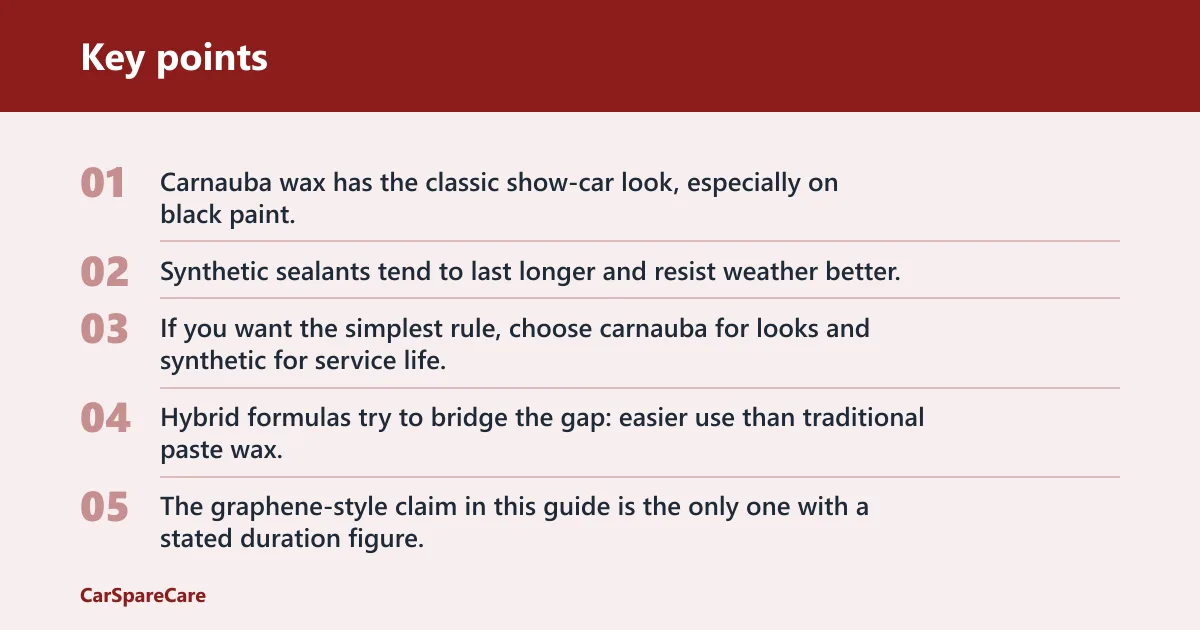
Carnauba wax has the classic show-car look, especially on black paint, but it usually needs more frequent attention. Synthetic sealants tend to last longer and resist weather better, which is why they make more sense for daily drivers and cars parked outside. If you want the simplest rule, choose carnauba for looks and synthetic for service life.
Hybrid and graphene-style claims
Hybrid formulas try to bridge the gap: easier use than traditional paste wax, better wear than pure carnauba, and decent gloss. The graphene-style claim in this guide is the only one with a stated duration figure, so it is the easiest to compare for monthly value. The market claim and the real-life outcome are not the same, though: the stated figure is what the product promises under ideal conditions, while actual service life depends on parking, weather, wash frequency, and how well the paint was prepped.
Suppose a dark sedan lives outside and gets washed every two weeks. A glossy carnauba finish may look richer for the first few days, but a longer-wearing synthetic or graphene-style wax will usually stay useful longer between full reapplications. In winter or under frequent tunnel washing, the gap can widen further because road salt, alkaline cleaners, and harsh brush contact all shorten the lifespan of surface protection.
Wash habits and reapplication timing
How often you wax depends on exposure. A garage-kept car can often wait longer than a daily driver, while winter road salt, hard water, and frequent automatic washes shorten real-world protection. If water stops beading and the surface feels grabby after washing, it is time to reapply. Frequent tunnel washing is especially hard on wax because strong detergents and brushes remove protection faster than gentle hand washing.
A common first-timer mistake is chasing shine without cleaning the paint first. Say your hood has light road film and dust after a week of driving: wax on top may still look bright, but it will not bond as evenly as it does on a clayed, clean panel.
Real-world durability by use case
The same wax can deliver very different results depending on where the car lives. On a garage-kept car, a stated 12-month product can often come much closer to that claim than it would on a daily commuter. On a car parked outdoors, the likely service life is usually shorter than the stated claim because of UV, rain, pollution, and temperature swings. A winter-driven car often sits at the shortest end of the range because road salt and frequent washing break down protection faster. For a car that sees frequent tunnel washes, expect the real service life to be shorter still, because wash chemistry and brush abrasion reduce how long the layer remains effective.
Who it’s for
This guide suits car owners who want a ranked answer, not a generic category list. It is best for daily drivers, owners of black or dark cars, and anyone deciding between a longer-lasting synthetic finish and a warmer carnauba look. It is less useful if you want only the cheapest quick detailer-style shine.
If your car sits outdoors, start with the most durable pick. If your car is garage-kept and judged on reflection, start with the carnauba or show-car option. That choice matters more than brand names alone.
Frequently asked questions
What is the best and longest lasting car wax?
For the strongest stated durability in this guide, Graphene Filler Liquid Wax is the best answer because it claims up to 12 months of protection. That makes it the best pick for buyers who care more about reapplication intervals and durability-per-dollar than the deepest first-day gloss.
What car wax gives the best shine
For the best pure shine, Essence Carnauba Wax is the better fit because carnauba is the finish most associated with depth and warmth on paint, especially black. Illusion Show Car Wax is also aimed at appearance-first results, but carnauba usually gives the richest visual feel.
Which car wax lasts the longest on a daily driver?
Graphene Filler Liquid Wax is the longest-lasting choice in the supplied data because it is the only one with a stated protection claim: up to 12 months. For a daily driver, that matters more than a slightly wetter initial look, especially if the car sleeps outside.
Is carnauba or synthetic wax better for long-lasting shine?
Synthetic or hybrid wax is usually better for long-lasting shine because it tends to hold protection longer and resist weather better. Carnauba usually looks warmer and deeper at first, but it generally needs more frequent reapplication to keep that look on a driven car.
How often should I wax my car for lasting protection?
A practical rule is to re-wax when water beading drops, the paint feels less slick after washing, or grime starts sticking more easily. Daily drivers may need attention more often than garage-kept cars, and winter or outdoor storage shortens the interval further. If the car is exposed to frequent tunnel washes, the interval may need to be shorter still.
Can I wax a car by hand and still get a deep shine?
Yes. Hand application can still produce a deep shine if the paint is washed, clayed, and dried first, then the wax is applied thinly with a microfibre applicator and buffed with a clean cloth. The finish depends more on prep and removal than on machine use alone.
Do spray waxes last as long as paste waxes?
Usually no. Spray waxes are faster to apply and good for topping up gloss, but paste waxes and longer-wearing liquid formulas usually last longer. If durability matters, choose the format with the stronger stated protection window rather than the quickest wipe-on option. Spray wax is best thought of as a maintenance booster, not the primary long-life layer.

Hi, I’m Melvin, an automobile engineer with extensive experience in automobile equipment. I currently work for a local automobile firm, where I specialize in the car parts industry. I’ve had the opportunity to collaborate with seasoned inspectors, gaining invaluable hands-on experience that goes beyond just theory.
My passion for automotive care started at a young age, which led me to create CarSpareCare. Through CarSpareCare, I share the knowledge and skills I’ve acquired over the years to help others navigate the world of car maintenance and repairs.
My goal is to provide practical tutorials, essential safety advice, and the latest industry insights so that anyone—whether a beginner or an expert—can confidently tackle their automotive projects.

