
A clunk when turning and braking usually comes from loose brake hardware if it happens on pedal application, or from worn suspension or steering joints if it appears on turn-in, at steering lock, or during weight transfer. If you ignore it, stopping distance can increase, tires can wear unevenly, and a worn part can break on the road. This guide shows how to separate brake noise from ball joints, tie rods, strut mounts, sway-bar links, and load-shift clunks by the exact moment the sound occurs.
Why timing matters
The exact moment the noise starts matters more than the word “clunk.” A sound that appears only when you press the brake pedal points somewhere different from one that shows up as the wheel starts to turn, or only when the body rolls and loads the outside front corner. That timing narrows the fault fast.
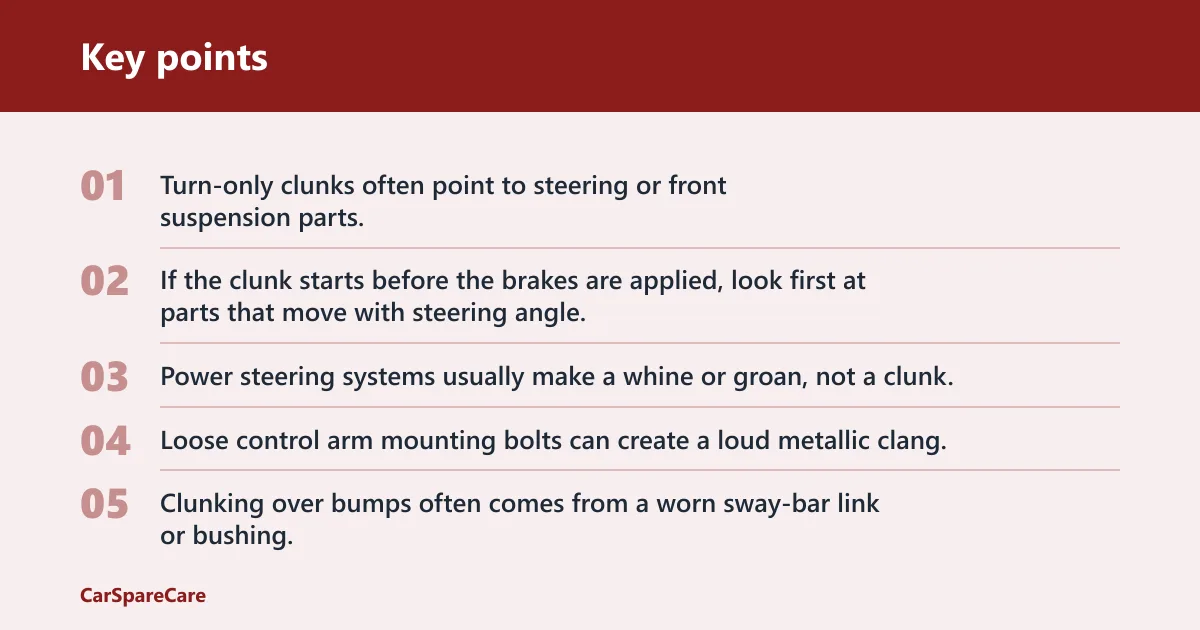
Turn-only clunks often point to steering or front suspension parts. Brake-only clunks point more toward caliper hardware, pad clips, or a loose mounting point that shifts as hydraulic force loads the brakes.
Turn-only clues
If the clunk starts before the brakes are applied, look first at parts that move with steering angle. Ball joints are often a possible cause of clunking when turning or over bumps, and bad CV joints are commonly reported to click while turning rather than clunk. Power steering systems usually make a whine or groan, not a clunk.
Brake-only clues
If the sound appears when the pedal is pressed, brake hardware or a joint that shifts under braking load is a common place to look. Worn control arm bushings can clunk while braking, and a loose brake component can create noise similar to a control arm problem. Loose control arm mounting bolts can create a loud metallic clang.
Turn-and-brake clues
A clunk that happens only when you steer and brake together often means load transfer is exposing wear that a straight-line stop does not. The outside front corner takes extra force during a turn, so a worn bushing, loose caliper part, or ball joint can move enough to bang.
Stationary steering clues
If the noise appears while turning the wheel in place, suspension parts that shift with steering load move higher on the list. That includes tie rod ends, ball joints, strut mounts, and sometimes steering rack issues. A clunk that happens while stationary is less likely to be a wheel bearing and less likely to be caused by the road surface.
Bump-related clues
If the clunk only happens on bumps, the usual suspects are sway bar links and bushings, strut mounts, shocks, or a worn control arm bushing. Clunking over bumps often comes from a worn sway-bar link or bushing. Check on level ground so the suspension sits at normal ride height.
Clunk timing matrix
This matrix is a quick way to map the sound to the most likely area. “Likely” means the part commonly fits that timing. “Possible” means it can fit, but other parts are higher on the list. “Unlikely” means the timing does not match well.
| Part | Turn-only | Brake-only | Turn-and-brake | Stationary steering | Bumps |
|---|---|---|---|---|---|
| Ball joints | Likely; urgent if play is felt | Possible; urgent if looseness is obvious | Likely; urgent if clunk grows with load | Possible; urgent if steering feels loose | Likely; urgent if noise is sharp or repeated |
| Tie rod ends | Likely; urgent if steering drift or shake appears | Possible; urgent if brake input changes alignment feel | Likely; urgent if clunk and drift occur together | Likely; urgent if play shows at the wheel | Possible; urgent if the front end feels loose |
| Control arm bushings | Possible; urgent if movement is obvious | Likely; urgent if clunk happens on pedal application | Likely; urgent if weight transfer makes the sound louder | Unlikely; check other parts first | Possible; urgent if torn or separated |
| Sway bar links | Likely; urgent if the clunk is repetitive | Possible; urgent if the sound appears with front dive | Likely; urgent if roll and brake overlap the noise | Unlikely; steering in place is a weaker match | Likely; urgent if noise is repeatable over small bumps |
| Caliper hardware | Possible; urgent if the noise starts at pedal touch | Likely; urgent because loose hardware can affect braking feel | Likely; urgent if steering load changes the knock | Unlikely; not a steering-at-rest part | Unlikely; bumps do not usually trigger it first |
| Strut mounts | Likely; urgent if the top mount pops or binds | Possible; urgent if the front end dips and clunks | Likely; urgent if the pop comes during body roll | Likely; urgent if the spring top shifts while turning | Likely; urgent if rough roads make it louder |
| Wheel bearings | Possible; urgent if noise changes with steering load | Unlikely; usually more of a hum or grind | Possible; urgent if cornering makes the sound grow | Unlikely; wheel bearings usually do not clunk in place | Possible; urgent if the wheel feels rough or noisy |
Could suspension wear be causing the clunk?
Yes. Suspension wear is a common reason, but the part depends on when the sound happens. A ball joint or tie rod end usually shows itself in steering movement, while a control arm bushing often complains during braking load transfer. A sway bar link is more likely over bumps or in a turn.
Ball joints and steering knuckle play
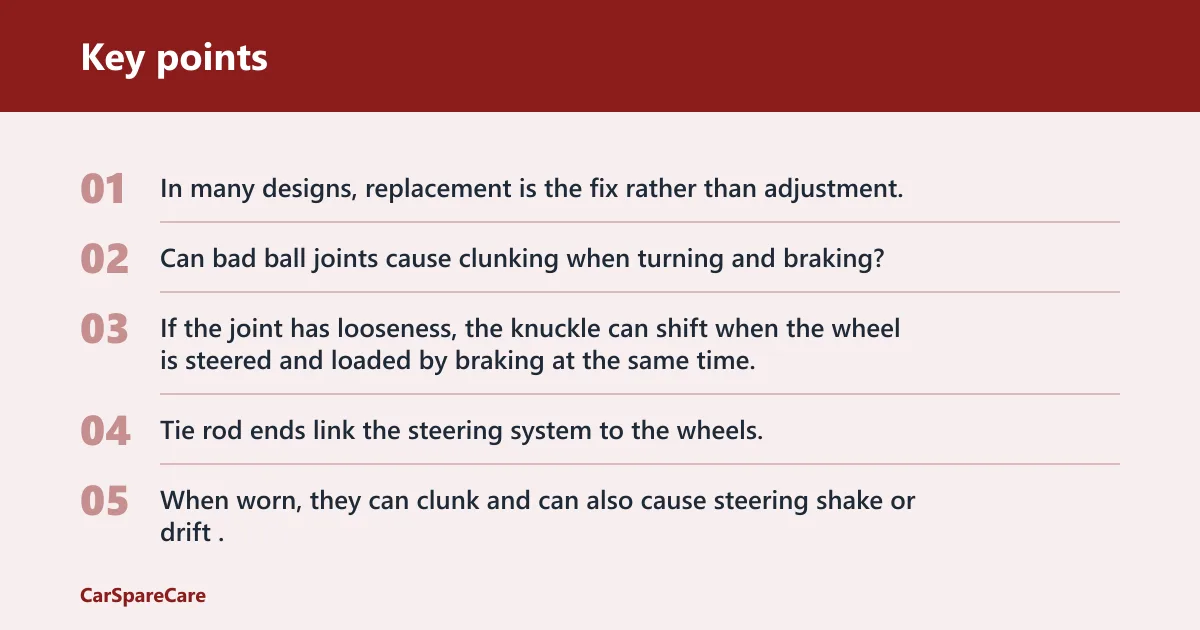
Ball joints connect the steering knuckle to the suspension, so wear can create a clunk when the wheel changes angle or load. They can clunk when worn or loose, and excess play is safety-critical. In many designs, replacement is the fix rather than adjustment.
Can bad ball joints cause clunking when turning and braking? Yes. If the joint has looseness, the knuckle can shift when the wheel is steered and loaded by braking at the same time. That movement can turn a light tap into a louder clunk.
Tie rod ends and steering drift
Tie rod ends link the steering system to the wheels. When worn, they can clunk and can also cause steering shake or drift. Check them for play because looseness in the joint can show up as a delay, a shake, or a knock when you start to turn.
Control arm bushings under braking load
Control arm bushings are rubber or polyurethane isolators that let the arm move in a controlled way. When they soften, split, or separate, the arm can shift under braking load and create a thud or clunk. They can also affect alignment and tire wear.
A front-end bushing can be quiet on a smooth road and noisy only when the nose dips under braking. That is why a brake-only clunk should not be treated as a brake problem until the suspension load path is considered.
Sway bar links on level ground
Sway bar links and bushings are common clunk sources over bumps and during turns. Many use ball-joint style ends. Wear creates looseness, and that looseness becomes noise when the bar tries to resist body roll.
Can sway bar links make a clunk only when braking or turning? Yes. A turn, a brake dive, or both can load the bar enough to expose play. Check on level ground so the links are not preloaded by a lifted wheel or a sloped driveway.
Strut mounts and shocks on rough roads
Strut mounts and shock absorbers can clunk when worn or damaged, and they may pop during suspension movement. The sound is often louder on rough roads and can be mistaken for steering noise because the top mount moves as the wheel turns and the body settles.
Vehicle layout matters here. A MacPherson strut front end puts the spring and damper at the top of the steering assembly, so upper mount noise often sounds like it comes from the wheel. A double-wishbone layout separates those loads more clearly, which can make diagnosis easier.
Could the brakes be the source?
Yes, especially if the noise starts exactly as the pedal is applied. Loose brake hardware can cause clicking noises when turning, and it can also make a knock or clunk when you stop. A loose brake component can create noise similar to a control arm problem, which is why timing matters so much.
Loose caliper brackets and slide pins
Brake caliper hardware includes brackets, slide pins, and pad hardware. If any of it is loose, the caliper can shift and make a knocking or clunking sound during braking. That movement can mimic suspension noise, especially at low speed in a parking lot.
Pad hardware and anti-rattle clips
Pad hardware that is bent, missing, or poorly seated can let the pad move when the brakes clamp down. The result can sound like a tap, knock, or clunk as the rotor changes load. That noise usually follows pedal pressure more closely than steering angle.
How braking can copy suspension noise
Braking shifts weight forward. That forward load can make a worn control arm bushing move, a loose caliper bracket knock, or a weak pad clip shift at the same moment. The ear hears one sound. The timing decides which part is moving. (Howacarworks)
Why does my car clunk when I turn and brake?
Because cornering and braking stack loads on the same front corner. The outside front wheel carries more weight in a turn, and braking adds nose dive and fore-aft load. That combined force can make a weak bushing, ball joint, caliper bracket, or strut mount move enough to clunk.
Front suspension geometry changes the answer too. On many cars, the load path in a turn-and-stop event is different from a straight stop, so a part that is quiet while cruising can knock only when both forces hit together. That is why a turn-plus-brake complaint is more useful than a generic “front end noise” complaint.
What can you check without tools?
You can narrow the source with a few no-tools checks. The goal is not to repair anything on the spot. The goal is to find which timing matches the sound so the right system gets inspected first.
-
Find a slow, empty lot.
Drive at walking speed and make a few gentle left and right turns, then add light braking. Keep the speed low so the noise pattern is easier to hear and you do not add other road noises. -
Compare left and right turns.
If the clunk is louder in one direction, that can point to the loaded outside front corner. A CV joint usually clicks more on one direction of turn, while a worn joint or mount may clunk on both but louder on one side. -
Try a light brake stop.
Press the pedal smoothly from low speed. If the clunk begins exactly with pedal application, brake hardware or a bushing that shifts under braking load moves higher on the list. -
Notice steering feel changes.
Watch for steering shake, wander, or drift after the clunk. Tie rod ends and ball joints can produce noise plus a change in steering feel, which is a stronger warning than noise alone. -
Cross-check bumps.
Roll over a small speed bump or rough patch at low speed. If the sound grows over bumps, sway bar links, bushings, strut mounts, or shocks become more likely.
Say your car clunks only when you brake while turning left out of a parking space, but it is quiet in a straight stop. That pattern fits a load-transfer problem better than a pure brake squeak, so a control arm bushing, ball joint, or caliper hardware issue moves to the top of the list.
Suppose the front right wheel clunks when you turn the steering wheel at idle, but the noise disappears the moment the car rolls straight. That pattern fits steering-linked wear better than brake hardware, so tie rod ends, ball joints, or the upper strut mount deserve first attention.
When is the noise dangerous?
The noise is dangerous when it comes with excess play, steering change, or a harsh metallic knock that grows fast. A worn or loose ball joint is generally treated as a safety-critical issue. A loose tie rod end can affect steering control. Severe bearing noise or a wheel that feels rough can also justify urgent action.
When should you stop driving if your car clunks on turns? Stop driving if the steering feels loose, the wheel shakes, the car pulls hard, the clunk becomes a bang, or the sound is matched by visible tire lean or metal-to-metal contact. Those signs mean a component may be close to failure.
-
Park if steering changes.
If the car drifts, shakes, or feels vague after the clunk, do not keep driving. Tie rod ends and ball joints can lose control before they fail outright. -
Stop for severe brake noise.
If the clunk happens with a soft pedal, reduced braking feel, or repeated knocking at every stop, have the brake hardware inspected before more driving. Loose caliper parts can move enough to affect braking consistency. -
Treat rough bearing noise as urgent.
A wheel bearing usually hums or grinds rather than clunks, but severe change with cornering load deserves prompt inspection. If the noise is growing fast, do not wait on it.
Frequently asked questions
What causes brakes to make clunk noise when turning and moving
Loose caliper hardware is a common brake-side cause when the clunk appears as you move and steer at the same time. If the noise follows pedal application, inspect brackets, slide pins, and pad hardware first. If it follows steering angle more than the pedal, look at suspension joints.
Why does my front wheel clunk when I turn?
A front wheel that clunks on turns often points to a worn ball joint, tie rod end, sway bar link, or strut mount. Bad CV joints usually click rather than clunk, so a sharp clicking sound matters. Steering shake or drift makes the joint wear more likely.
What causes a knocking sound when braking
Worn control arm bushings can cause clunking while braking, and loose brake hardware can create a similar knock. The key difference is timing: a knock that starts the instant the pedal is pressed points toward brake parts or a bushing that shifts under brake load.
Is a clunking noise when turning and braking dangerous?
It can be. A clunk tied to excess play in a ball joint, tie rod end, or steering-related part is a safety concern, and loose brake hardware can affect stopping feel. Stop driving if the steering feels loose, the noise gets louder fast, or braking changes.
Can sway bar links make a clunk only when braking or turning?
Yes. Sway bar links and bushings often clunk over bumps and during turns, and they can also make noise when braking because front dive loads the bar differently. A level-ground inspection helps because a hanging wheel can hide or exaggerate the looseness.

Hi, I’m Melvin, an automobile engineer with extensive experience in automobile equipment. I currently work for a local automobile firm, where I specialize in the car parts industry. I’ve had the opportunity to collaborate with seasoned inspectors, gaining invaluable hands-on experience that goes beyond just theory.
My passion for automotive care started at a young age, which led me to create CarSpareCare. Through CarSpareCare, I share the knowledge and skills I’ve acquired over the years to help others navigate the world of car maintenance and repairs.
My goal is to provide practical tutorials, essential safety advice, and the latest industry insights so that anyone—whether a beginner or an expert—can confidently tackle their automotive projects.

