
Byline: Written for hands-on automotive diagnosis and repair workflows, with emphasis on phase-based troubleshooting used in professional service bays.
What causes a car to pull when accelerating and braking is usually a phase-specific fault: acceleration pull points first to torque steer, driveline imbalance, or suspension compliance, while braking pull points first to a sticking caliper, brake hose restriction, or uneven brake drag. If it pulls only on acceleration, look first at torque steer, unequal engine or transaxle torque, or a tire fault. If it pulls only on braking, look at a sticking caliper, hose, pad, or rotor. If it pulls in both phases, start with tire pressure, alignment, or worn suspension. Miss the phase, and you can replace the wrong parts while the real fault stays hidden. This guide separates acceleration pull, braking pull, and combined pull into the most likely subsystem. SAE literature on torque steer and OEM service procedures for brake drag diagnosis both support that phase-first approach; Ford, GM, and Toyota service information commonly directs technicians to isolate load state before replacing parts.
Phase diagnosis table
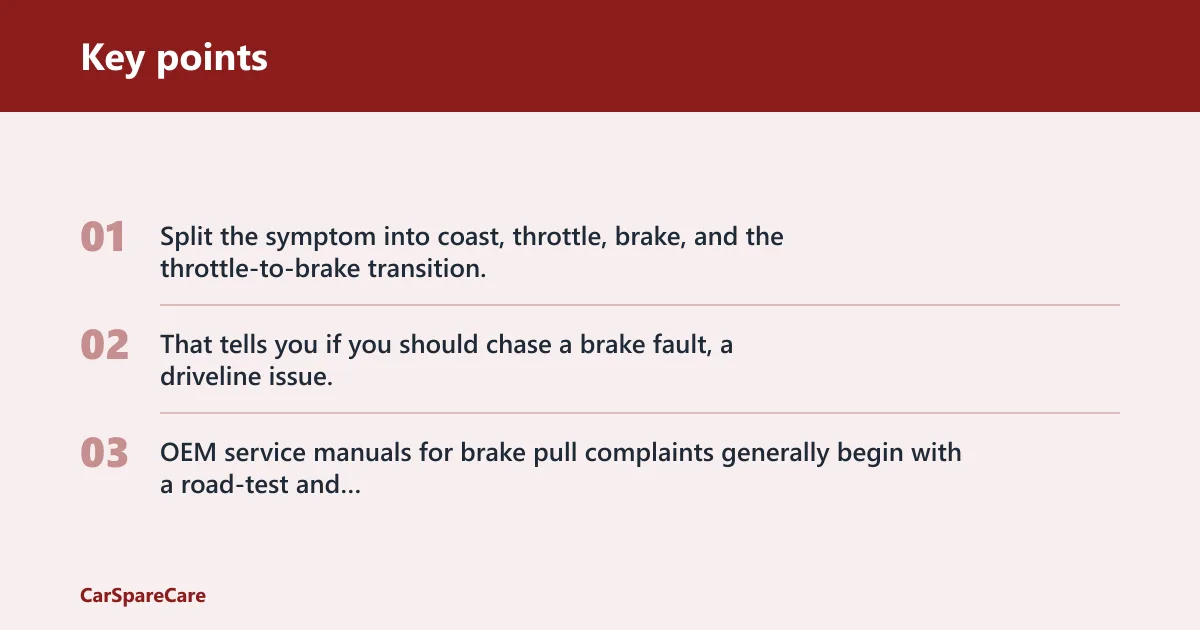
Split the symptom into coast, throttle, brake, and the throttle-to-brake transition. That tells you if you should chase a brake fault, a driveline issue, or a geometry problem instead of guessing. OEM service manuals for brake pull complaints generally begin with a road-test and temperature comparison, while SAE papers on torque steer describe load-dependent steering moments that appear primarily under drive torque.
| Driving state | Likely causes | Quick driveway checks | Stop-driving red flags |
|---|---|---|---|
| Coast, steering straight | Tire pressure difference, tread conicity, wheel alignment, thrust angle, tire wear mismatch | Check pressures cold and note steering wheel center on a flat road; swap front tires side to side if size and rotation pattern allow | Visible cord, bulge, or severe vibration |
| Accelerate only | Front-wheel-drive torque steer, CV axle or inner joint wear, equal-length halfshaft imbalance, tire pull under load, control arm bushing compliance | Compare light throttle with hard throttle in a straight line; watch whether the wheel tugs harder as engine torque rises | Clunking, heavy vibration, grease loss, or a CV joint that clicks on turns |
| Brake only | Sticking brake caliper, slide pin corrosion, collapsed brake hose, pad drag, rotor hot spot, wheel bearing play affecting rotor runout | After a short drive, compare wheel and rotor temperatures side to side without touching hot parts | Smoke, burning smell, one wheel far hotter than the others |
| Accelerate then brake | Combined tire issue, alignment error, suspension bushing shift, steering rack free play, tie rod binding, brake drag that appears after heat builds | Repeat the same route at the same speed and note whether the pull changes with load transfer | Pull that worsens fast, steering wheel that moves on its own, or brake fade |
Why does the car pull only when you accelerate?
Acceleration-only pull can point to torque steer on front-wheel-drive cars, a weak or worn CV axle or inner joint, or a tire that reacts differently when loaded. If the pull grows with throttle, the fault often sits in the driveline or a suspension part that shifts geometry under engine torque. SAE papers on torque steer and OEM driveline diagnostics both note that the symptom is often load-sensitive rather than constant.
Torque steer and front-wheel-drive clues
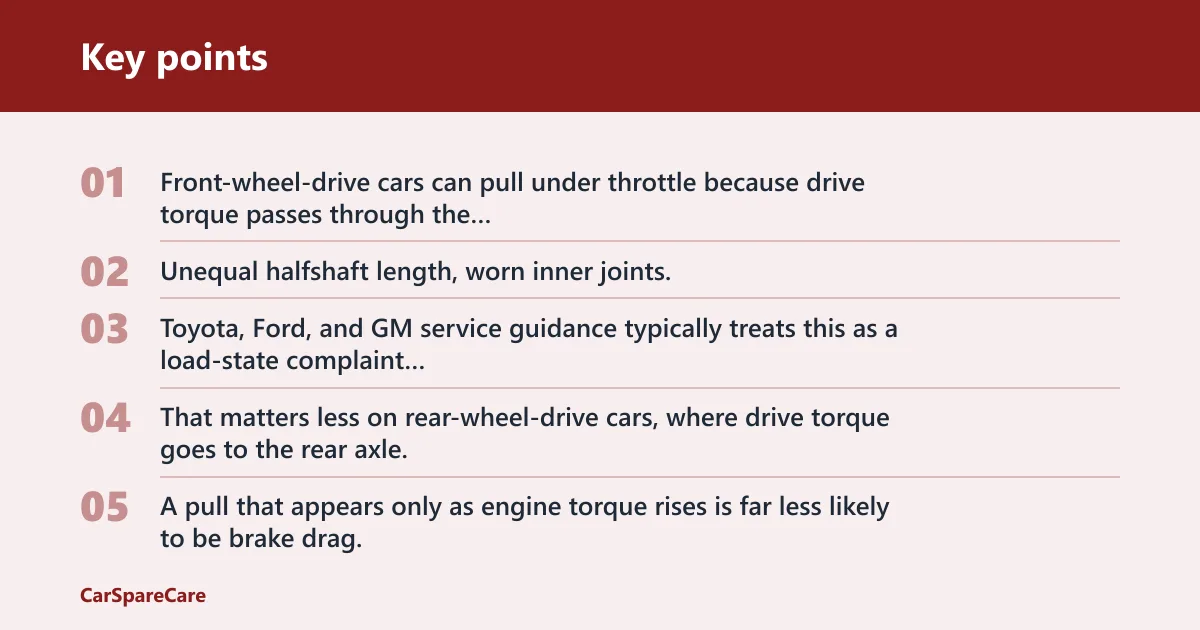
Front-wheel-drive cars can pull under throttle because drive torque passes through the front wheels, steering and driving them at the same time. Unequal halfshaft length, worn inner joints, or unequal compliance in the suspension can make one side react differently when power comes on. Toyota, Ford, and GM service guidance typically treats this as a load-state complaint first, not a static alignment complaint.
That matters less on rear-wheel-drive cars, where drive torque goes to the rear axle, and less on many all-wheel-drive layouts unless one axle or one side has a fault. A pull that appears only as engine torque rises is far less likely to be brake drag.
CV axle and halfshaft clues
A worn inner CV joint can create a side pull or a shimmy that appears under load, especially on a front-wheel-drive vehicle with equal-length halfshaft concerns. Clicking in turns, grease thrown around the boot, or a pull that changes with throttle are useful clues.
Suppose a compact front-wheel-drive car tracks straight at steady speed, then drifts right only when you roll into the throttle in second gear. That pattern points more toward torque steer or a worn inner joint than toward alignment alone.
Suspension shift under load
Control arm bushings can soften, crack, or shift enough that the wheel geometry changes when torque loads the suspension. That can change toe or caster under acceleration and make the car feel as if it is being tugged to one side. SAE discussions of compliance steer describe this exact load-induced geometry change.
Why does the car pull only when you brake?
Brake-only pull usually means one side is dragging harder than the other. The usual suspects are a sticking caliper piston, slide pin corrosion, or an internally collapsed brake hose that acts like a one-way valve and slows caliper release after pedal pressure drops. OEM brake service manuals commonly call for hose inspection when one wheel runs hot or releases slowly.
Sticking caliper symptoms
A brake caliper with a sticking piston or corroded slide pins may clamp one pad harder, release late, or build heat on one side. That side often feels hotter after a short drive, and the car may veer toward the side with less braking force when the pedal is pressed.
One useful check is an after-drive temperature comparison. After a moderate drive with little braking, compare left and right front wheel temperatures with a contactless thermometer or by careful hand proximity; a much hotter wheel points toward drag, not alignment.
Collapsed hose behavior
An internally collapsed brake hose can let pressure reach the caliper but restrict the return path, so the caliper does not release normally. That creates a side-specific symptom that often gets worse as heat builds and fluid movement changes. This is why OEM service manuals often pair hot-wheel complaints with hose replacement checks, and why SAE brake-system discussions treat hose restriction as a valid cause of asymmetric drag.
If the pull appears after a brake job, inspect hose routing and banjo fitting position. A twisted hose can act like a restriction, and a line that looks fine outside may still pinch inside.
Brake drag and caliper faults
Brake drag is a common cause of a pull that appears only when braking. It is urgent because it can overheat the rotor, damage pads, and change the pull from mild to severe during one drive.
After-drive heat and drag
A drag check works best after a short, normal drive that includes light braking but no hard stops. If one wheel or rotor is clearly hotter than the others, do not keep driving to “see if it goes away.” Heat is a clue and a warning. Factory manuals for many OEMs use side-to-side temperature imbalance as a key indicator of brake drag, caliper seizure, or hose restriction.
Brake fade, smoke, a burning smell, or a wheel that is too hot to approach safely are stop-driving conditions. Tow or inspect immediately.
Brake-service mistakes that create pull
Recent brake work can introduce the fault. Common mistakes include dry or seized slide pins, pad hardware installed wrong, a caliper bracket assembled off center, hose routing that twists the hose, or uneven wheel fastener torque that changes rotor seating.
Uneven wheel fastener torque can also affect rotor runout on some cars, which may show up as pulsation, pull, or pad knockback after service. If the pull started right after brake replacement, do not assume the new parts are bad before checking installation details.
Tires and wheel alignment
Tires and alignment often explain pull that shows up while cruising, or pull that changes little between coast, light throttle, and light brake. They can also amplify a small brake or suspension fault, so they deserve a close check even when the brakes look fine.
Pressure and tread conicity
Uneven pressure can make one tire carry and steer differently, especially across the front axle. A tire with tread conicity can pull to one side even when the alignment is within spec, and that pull may change after a rotation swap test.
Check cold pressures first and compare both sides. Then look for left-right wear mismatch, cupping, feathering, or a tire that was mounted in a different direction from its mate.
Alignment angles that matter
Toe changes straight-line tracking. Camber changes how the tire loads across the tread. Caster affects self-centering and can create side-to-side pull if the values are uneven. Thrust angle can make the car dog-track even when the steering wheel looks almost straight.
Steering wheel center matters too. If the wheel sits off-center on a level road, the alignment may be out, or the rear thrust line may not match the front geometry.
Simple tire checks
- Set all tires to the door-jamb pressure when cold.
- Inspect both front tires for uneven wear, bulges, or a separated belt.
- Swap the front tires side to side if the rotation pattern allows it.
- Road-test again on the same road at the same speed.
- If the pull changes sides, the tire is a strong suspect.
What driveline or suspension faults can shift pull under load?
Several parts can move only when torque, braking force, or road load changes the suspension geometry. That is why a car may coast straight, then pull under throttle or brake, even when the basic alignment printout looks acceptable.
Wheel bearing play and rotor runout
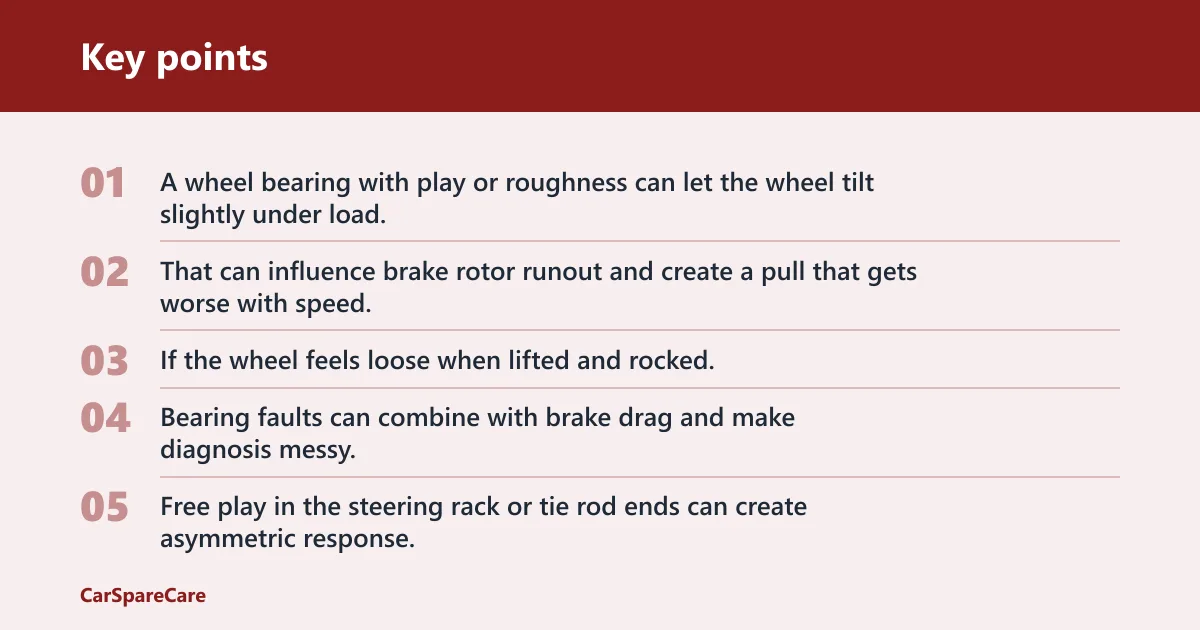
A wheel bearing with play or roughness can let the wheel tilt slightly under load. That can influence brake rotor runout and create a pull that gets worse with speed, braking, or cornering load.
If the wheel feels loose when lifted and rocked, or if you hear roughness when spinning it by hand, do not ignore it. Bearing faults can combine with brake drag and make diagnosis messy.
Steering rack and tie rod end faults
Free play in the steering rack or tie rod ends can create asymmetric response, vague centering, or a pull that becomes obvious at higher speed. Binding is the opposite problem: one side may resist movement more than the other, so the car tracks poorly even when the brakes are fine.
High-speed tracking issues that change with small steering inputs often point here. These parts do not usually cause hot-wheel symptoms, so the temperature clue helps separate them from brake drag.
Suspension bushings under braking and acceleration
Control arm bushings can change shape under load, which changes toe and caster differently during braking than during acceleration. That is why one car may pull right on throttle and left on the brake if the bushings are worn unevenly.
Picture a midsize sedan that tracks straight on a flat road, but the wheel tugs left when the driver brakes from 50 mph and tugging flips right when throttle returns. That phase swap points more toward compliance or brake release differences than toward a single bad alignment angle.
Frequently asked questions
Why does my car pull to one side when I accelerate?
Acceleration pull usually points to torque steer on a front-wheel-drive car, a worn inner CV joint, unequal halfshaft behavior, or a tire that reacts differently under load. If the pull grows with throttle but fades when coasting, brake drag is less likely than driveline or suspension compliance.
Why does my car pull when I brake and accelerate?
Pull in both phases often means two problems overlap, or one worn part changes behavior under load transfer. Start with tire pressure, tire condition, and brake drag, then check alignment, steering parts, and suspension bushings. Phase matters because the likely subsystem changes with pedal input.
Can bad tires make a car pull while accelerating?
Yes. Uneven pressure, tread conicity, or left-right wear mismatch can cause a pull that becomes more obvious when the tire is loaded harder under acceleration. A rotation swap test is useful because a tire-related pull often follows the tire, not the wheel position.
Can a sticking brake caliper cause pulling under acceleration?
Yes, if the caliper is dragging after a previous brake application. A sticking piston, seized slide pins, or a collapsed hose can leave one front wheel partly applied, so the car may pull even while accelerating because one side is still resisting more than the other.
Does wheel alignment affect pulling when braking and accelerating?
Yes, especially toe, camber, caster, and thrust angle. Alignment problems often show up as steady pull, off-center steering wheel, or dog-tracking, and worn suspension parts can shift those angles differently under brake and throttle load. Alignment should be checked after brake drag is ruled out.
How do I tell if the pull is from brakes or drivetrain?
Use phase and heat. A brake fault can usually cause a pull during braking and leave one wheel hotter after a short drive. A driveline fault usually shows up during acceleration, especially on a front-wheel-drive car, and may vary with throttle rather than with brake pedal pressure.
Why does my car pull only after replacing brakes or tires?
Recent service can introduce the fault. Wrong slide pin lubrication, twisted hose routing, uneven wheel fastener torque, a tire installed in a new position, or a pad hardware mistake can create a new pull. If the symptom started right after service, inspect the work before chasing unrelated parts.
Can a bad CV axle cause a car to pull under acceleration?
Yes. A worn CV axle or inner joint can create torque steer, vibration, or a side pull that appears mainly on throttle, especially on front-wheel-drive cars. If the pull changes with engine load and not with braking, the axle deserves attention before alignment is blamed.
Sources: SAE technical papers on torque steer and compliance steer; OEM brake service manuals from Ford, GM, and Toyota for brake drag, hose restriction, and caliper diagnosis; OEM driveline service procedures that isolate load-dependent pull before alignment correction.

Hi, I’m Melvin, an automobile engineer with extensive experience in automobile equipment. I currently work for a local automobile firm, where I specialize in the car parts industry. I’ve had the opportunity to collaborate with seasoned inspectors, gaining invaluable hands-on experience that goes beyond just theory.
My passion for automotive care started at a young age, which led me to create CarSpareCare. Through CarSpareCare, I share the knowledge and skills I’ve acquired over the years to help others navigate the world of car maintenance and repairs.
My goal is to provide practical tutorials, essential safety advice, and the latest industry insights so that anyone—whether a beginner or an expert—can confidently tackle their automotive projects.

