
Yes, alignment problems can contribute to braking pull, but if the car only pulls when you press the brake pedal, check the brakes first; alignment is the second suspect, not the first. Skipping the real fault can waste money on alignments and let a brake, tire, or suspension problem worsen. This guide shows how to separate alignment-related drift from brake drag, tire mismatch, hydraulic issues, and suspension asymmetry.
What braking pull usually means
Pulling that shows up only under braking is usually a timing clue. Straight-line drift points more toward alignment, tire pressure, or road crown. A pull that grows the moment the pedal is pressed points first to brake force imbalance, caliper drag, hose restriction, or uneven pad and rotor condition.
Pull only while braking
If the car tracks straight at speed but yanks left or right when you brake, the brake system deserves the first inspection. One wheel may be applying more force than the other, or one side may be dragging before the pedal is fully released. That pattern is not classic alignment behavior.
Pull all the time
A constant pull on level roads is more often tied to wheel alignment, tire pressure, tire wear, or suspension geometry. Misaligned wheels are among the top reasons a car pulls to one side, and manufacturer angles matter. Camber, caster, and toe each affect straight-line tracking.
Pull after alignment work
If the pull remains after an alignment, do not stop at the printout. An alignment can be correct and the vehicle can still pull because a brake is dragging, a tire is mismatched, or a suspension part is moving under load. Recent curb or pothole impacts make that more likely.
Alignment vs brake pull
Alignment can cause pull, but the symptom pattern matters more than the label on the printout. Camber, caster, and toe are the angles that matter most. If they are not set to the manufacturer’s precise angles, the vehicle can drift or need steering correction. That usually shows up while driving, not only during braking.
Camber, caster, and toe
Camber changes how the tire sits on the road, caster affects directional stability, and toe influences whether the wheels track together or fight each other. A full alignment check measures all three. If one side is outside factory specifications, the car can pull or wander.
When alignment can cause pull
Alignment-related pull is most likely after a pothole, curb strike, suspension repair, tire replacement, or uneven tire wear. It can also appear if the steering wheel is off-center after work. Roads with a crown can add a slight drift, especially in right-hand traffic, but that is usually mild.
When brakes are more likely
If the steering wheel yanks only when braking force increases, brake components move up the list. Greer’s notes that a car can yank the wheel when you hit the brakes, and it lists caliper problems among pull causes. Uneven brake engagement, hose restriction, and low fluid are all suspects.
Brake pull matrix
The matrix below separates timing from likely cause. Use it to avoid treating every pull as an alignment problem. A braking-only pull needs brake and hydraulic checks before another alignment visit.
| Symptom timing | Likely system | Most likely checks | Next action |
|---|---|---|---|
| Straight driving drift | Alignment, tire pressure, suspension | Camber, caster, toe; tire PSI; inner or outer edge wear; loose tie rods or bushings | Check tire pressure, inspect wear, then book alignment and suspension inspection |
| Braking-only pull | Brakes or hydraulic balance | Sticking caliper, pad wear side-to-side, rotor condition, hose restriction, fluid level | Inspect brakes first; do not assume alignment is the main fault |
| Pull after alignment | Brake drag, tire mismatch, suspension asymmetry | Rotor heat, caliper slide movement, tire sizes and pressures, ball joints, control arms, struts | Recheck the brake system and suspension before repeating alignment |
| Pull plus shaking during braking | Brakes, especially rotors or uneven pad contact | Warped or uneven rotors, pad transfer, caliper action, wheel end play | Inspect brake hardware and side-to-side rotor condition promptly |
Can a stuck caliper feel like alignment trouble?
Yes. A stuck caliper can make the car pull like an alignment problem because it can apply constant pressure to one wheel. That creates drag on one side, and the pull often gets worse when braking. Uneven pad wear and one hot wheel after a drive are common clues.
Caliper drag and one-wheel braking
A caliper can stick on its slides or piston and keep a pad lightly engaged. That side then slows more than the other side, especially under braking. Greer’s lists brake caliper issues as a cause of pulling. On rear-brake systems, the symptom can be subtle at first and still serious.
Pad and rotor clues
Inspect brake pads and rotors side-to-side. Uneven pad thickness, a rotor with unusual scoring, or a rotor condition that differs from the opposite side can point to imbalance. Greer’s notes that misaligned wheels or warped rotors can cause heavy vibration, and steering wheel shake with braking supports a brake-side diagnosis.
Hydraulic imbalance
Brake hydraulic balance matters. A damaged brake hose can restrict fluid movement toward one wheel, and low brake fluid may indicate a leak somewhere in the system. If one side receives less or more pressure than the other, the vehicle can pull when the pedal is applied. That is a brake diagnosis, not an alignment one.
What else can mimic alignment problems?
Tire pressure differences, suspension wear, and road crown can all copy alignment symptoms. The key is whether the pull is mild and road-specific, or strong, repeatable, and tied to braking. A slight drift on a crowned road is not the same as a worsening pull during every stop.
Tire pressure differences
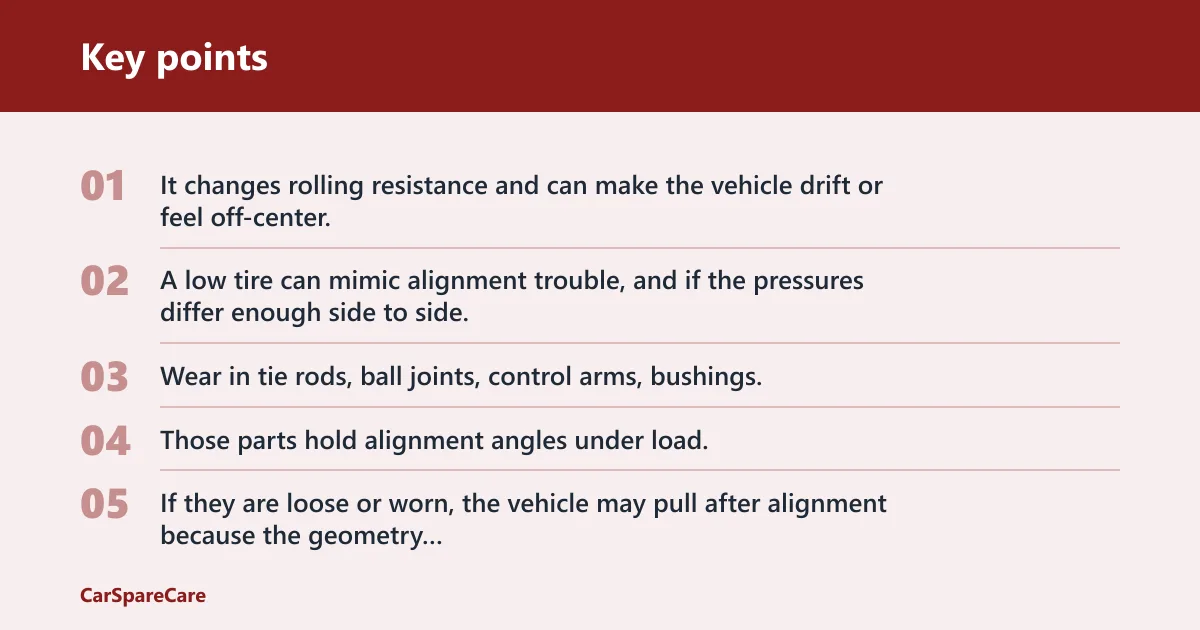
Uneven PSI is the easiest first check. It changes rolling resistance and can make the vehicle drift or feel off-center. A low tire can mimic alignment trouble, and if the pressures differ enough side to side, the steering may also feel strange during braking. Check pressure before expensive diagnostics.
Suspension wear
Wear in tie rods, ball joints, control arms, bushings, or struts can shift steering geometry and create pull or wander. Those parts hold alignment angles under load. If they are loose or worn, the vehicle may pull after alignment because the geometry changes while driving or braking.
Road crown and road surface
Road crown is normal. In right-hand traffic, many roads slope slightly so water drains away, and that can make a vehicle drift gently right. That is usually a mild, road-specific behavior. A strong or worsening pull, especially one that shows up only under braking, needs another explanation.
Say your sedan tracks straight on a flat parking lot but pulls hard left every time you stop at a light. If the left front brake is dragging, the pull may appear only during pedal application, even though the alignment printout looks acceptable.
Suppose a pickup with about 35 psi in one front tire and about 29 psi in the other feels slightly off on the highway. If the pull becomes obvious only when braking, the tire pressure difference may be part of the problem, but the brake system still needs a side-to-side check.
Inspection order for pull diagnosis
Use a common diagnostic sequence for home checks and shop diagnosis. It starts with the simplest causes and moves toward the parts that most often create braking pull. If the pull is safety-related, especially after recent brake work, do not delay the brake inspection.
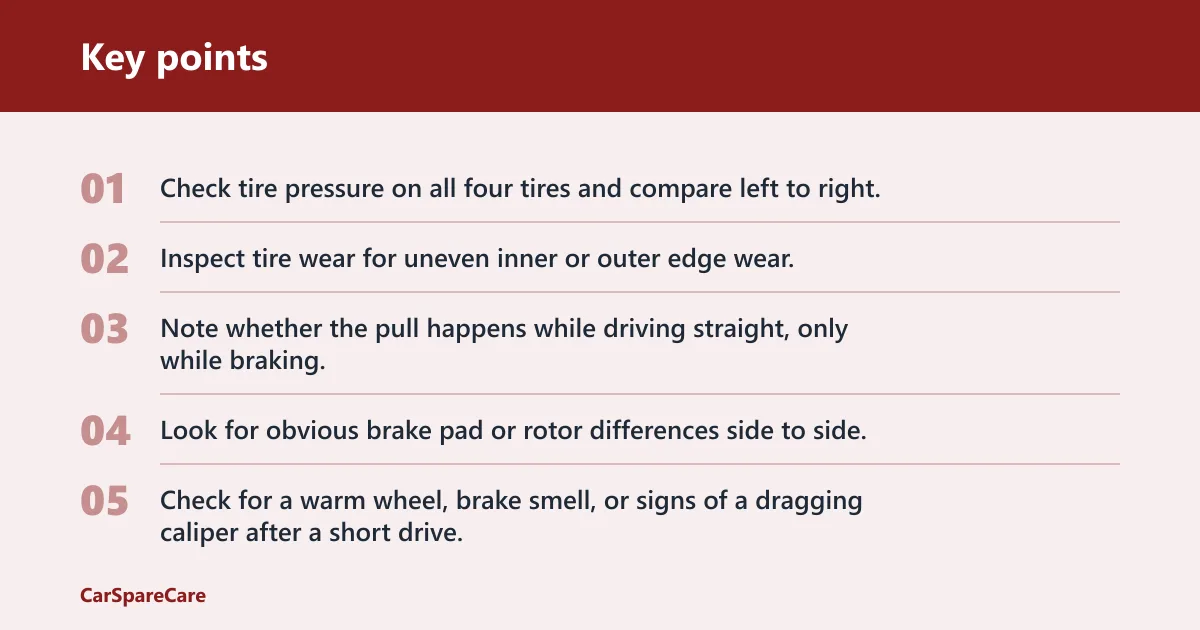
- Check tire pressure on all four tires and compare left to right.
- Inspect tire wear for uneven inner or outer edge wear.
- Note whether the pull happens while driving straight, only while braking, or only after recent alignment work.
- Look for obvious brake pad or rotor differences side to side.
- Check for a warm wheel, brake smell, or signs of a dragging caliper after a short drive.
- Inspect brake fluid level and look for visible leakage.
- Check brake hoses for restriction, damage, or swelling.
- Inspect tie rods, ball joints, control arms, bushings, and struts for wear or play.
- Compare steering wheel center position and note any recent curb or pothole impact.
- Book an alignment check once brakes, tires, and suspension have been reviewed, or sooner if steering geometry looks disturbed.
Alignment check timing
Many mechanics recommend an alignment check every 12,000 miles or annually. Greer’s recommends an alignment check every 6,000 miles or at every other oil change. After an impact or uneven tire wear, an alignment check is reasonable, but it should be paired with brake and tire inspection when braking pull is present.
When an alignment alone will not fix it
An alignment alone will not fix a pull that is caused by brake drag, hydraulic imbalance, or a sticking caliper. If the pull remains after alignment, the next step is to inspect the brake system side to side, then check suspension parts that can shift under load. That order saves time and money.
After alignment, the pull remains
If the vehicle still pulls after a correct alignment, the problem may be outside the alignment rack. Check for unequal brake application, tire pressure mismatch, or a worn suspension part that moves after the settings are measured. Alignment numbers can look correct on paper while a mechanical fault remains.
When to inspect brakes first
Inspect brakes first if the pull appears only when braking, if the steering wheel jerks during stops, if one wheel is hotter than the others, or if the issue began after brake service. Heavy-duty vehicles, AWD models, and rear-brake systems can show the same pattern, with more than one axle involved.
When to book a full suspension check
Book a suspension check if the pull changes with bumps, the steering wanders between stops, the wheel does not return cleanly, or the car recently hit a pothole or curb. Worn suspension parts can move enough to create a pull that an alignment alone cannot correct.
Frequently asked questions
Can alignment problems cause braking pull?
Yes, alignment problems can contribute to a pull, but they usually cause drift while driving, not a pull that appears only when braking. Camber, caster, and toe outside factory specifications can make the car track poorly. If the pull appears under braking, inspect the brakes first.
Why does my car pull left or right when I brake?
That usually means one side is braking harder than the other. A sticking caliper, uneven pad or rotor condition, hose restriction, or hydraulic imbalance can cause it. Tire pressure and suspension wear can add to the symptom, but braking-only pull points first to the brake system.
Will an alignment fix a pull that only happens under braking?
Usually not by itself. An alignment can correct straight-line tracking, but a braking-only pull often comes from brake drag, caliper issues, or uneven hydraulic pressure. If the pull began after brake work or gets worse during stops, the brake system needs inspection before another alignment.
How do I tell if the pull is brakes or alignment?
Look at timing. A pull during normal cruising points more toward alignment, tire pressure, or suspension. A pull that appears only when the pedal is pressed points more toward brakes or hydraulics. Steering wheel shake during braking also supports a brake-side problem, not just an alignment one.
Can a stuck caliper feel like an alignment problem?
Yes. A stuck caliper can hold one wheel back and make the car drift or pull like it is misaligned. It can also make the pull worse when braking because that wheel is already dragging. Uneven pad wear, heat, and rotor differences are common clues.
Can tire pressure cause a car to pull when braking?
Yes, uneven tire pressure can create rolling resistance differences that mimic alignment symptoms. A low tire can make the car drift, and the effect may feel stronger under braking. It is a simple first check, but if the pull is sudden or one-sided, do not stop there.

Hi, I’m Melvin, an automobile engineer with extensive experience in automobile equipment. I currently work for a local automobile firm, where I specialize in the car parts industry. I’ve had the opportunity to collaborate with seasoned inspectors, gaining invaluable hands-on experience that goes beyond just theory.
My passion for automotive care started at a young age, which led me to create CarSpareCare. Through CarSpareCare, I share the knowledge and skills I’ve acquired over the years to help others navigate the world of car maintenance and repairs.
My goal is to provide practical tutorials, essential safety advice, and the latest industry insights so that anyone—whether a beginner or an expert—can confidently tackle their automotive projects.

