
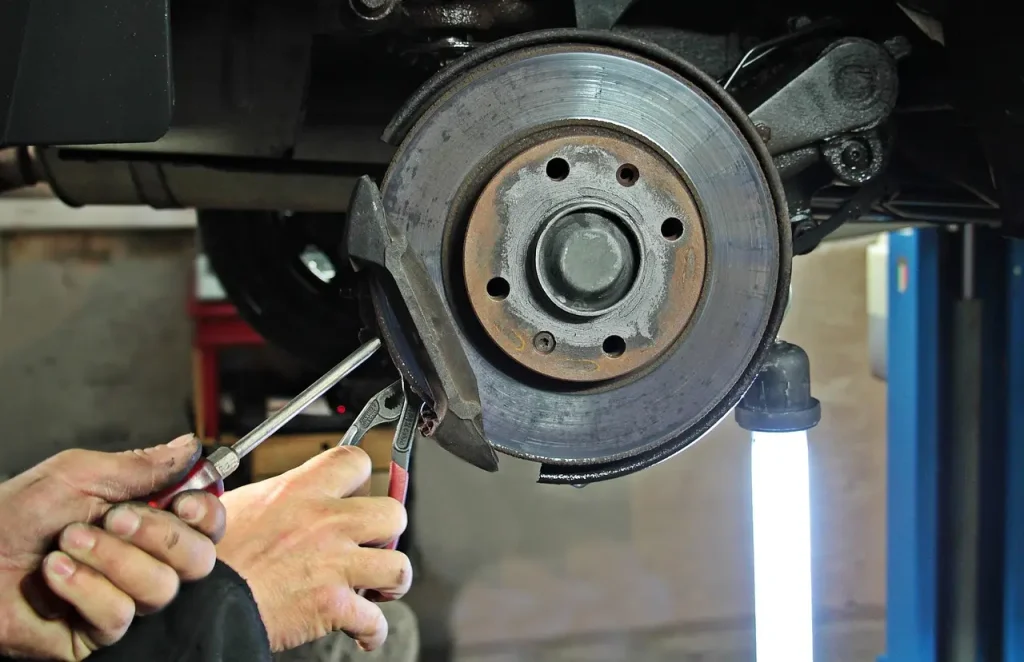
Any pull, shake, grind, soft pedal, or warning light during a used-car test drive is a repair-cost flag, and some combinations are a walk-away signal. I use a 10-minute loop, check the wheel and pedal on a straight road, then separate parking-lot clues from road-speed clues before I pay for an inspection.
What you’ll need for the test drive
- A quiet route with a straight road and a safe stopping area
- A phone or notes app for a quick scorecard
- A tire-pressure gauge, if available, to spot obvious low-pressure noise or pull
- A partner who can watch the car from outside during one low-speed pass, if possible
A short route can tell you a lot if the same symptom appears twice under the same condition. The goal is not to name the exact failed part on the spot. It is to sort likely brake, steering, and suspension faults before a lift check, and to decide whether the car is worth that next step.
How do I inspect steering and brakes on a used car during a test drive?
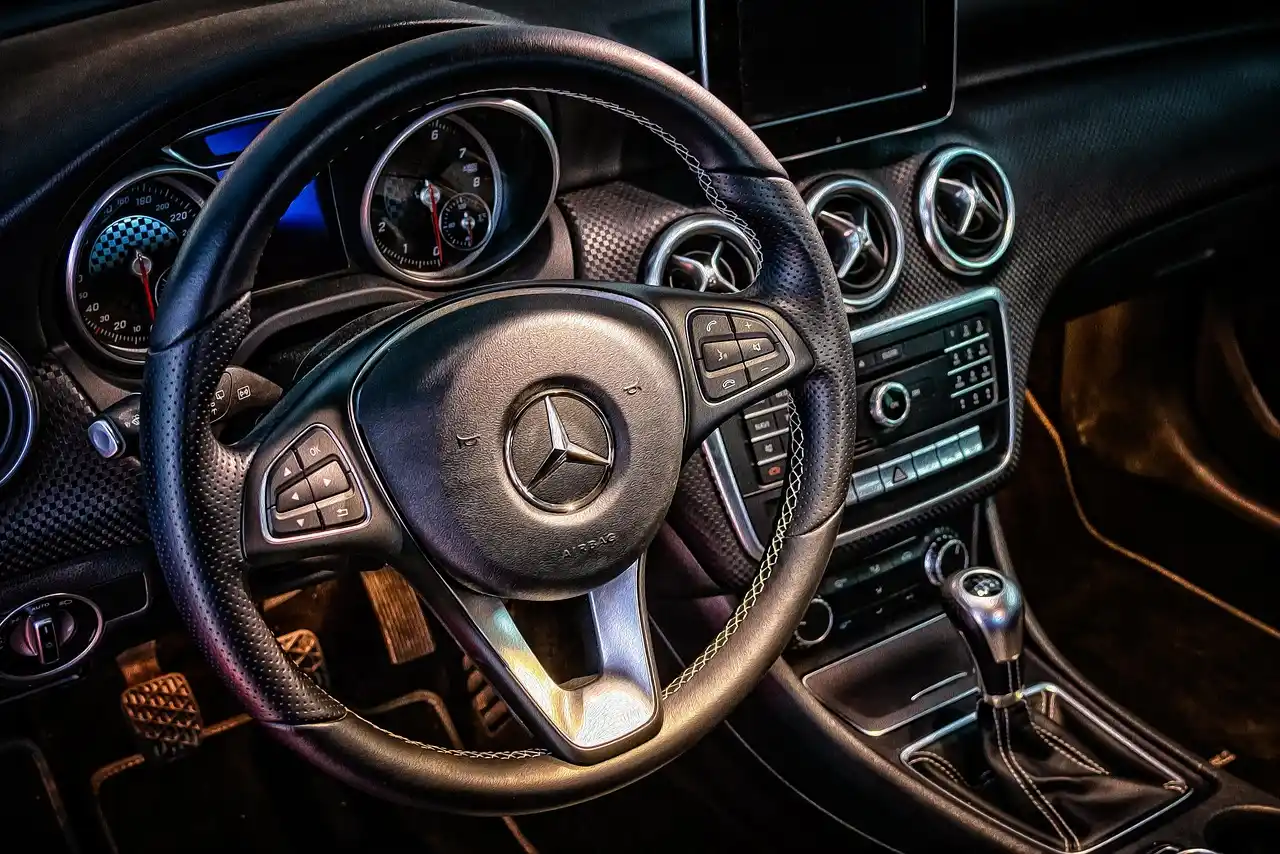
Start with the dash, then the pedal, then straight-road steering, then light and hard braking, and finish with bumps, turns, and a safe ABS check. That order matters because parking-lot noise can point to one set of parts, while mid-speed shake or wander can point to another. Mixing those clues leads to bad calls.
- Check the brake warning and ABS lights before you move.
- Press the brake pedal in the lot and note travel, firmness, and free play.
- Drive a straight road and hold the wheel lightly for center, play, and return-to-center.
- Brake lightly, then brake harder, and watch for pull, pulsation, or shake.
- Turn slowly over bumps and listen for clunks, then do one safe low-speed ABS stop.
If the car fails more than one step, mark it as a caution or walk-away candidate instead of trying to guess the exact repair on the spot. A brake system service starts from 799 CZK, vehicle inspections and checks start at 1,799 CZK, fault diagnosis and repairs diagnostics start at 999 CZK, suspension repair and wheel alignment start at 2,299 CZK, and mechanical repair starts at 899 CZK.
Step 1: Start with the dash lights and idle feel
The brake warning light and ABS light should ideally be off before the car moves. If either stays on, the rest of the drive only tells you how the problem feels, not whether the system is healthy. That is already a repair flag, and on some cars it means the car may brake normally until the next fault event, then behave badly.
With the engine idling, press and release the brake pedal once or twice. It should feel the same each time, with no grit, and the idle should stay steady. A rough idle is a separate issue, but a weak battery, low voltage, or dash warnings can skew ABS behavior and make diagnosis less clear.
What should I feel through the brake pedal on a test drive?
The pedal should move a short, predictable distance, then feel firm and steady. It should not sink while you hold light pressure. A long travel, spongy feel, pulsation, or extra free play points to different problems, from air in the hydraulics to worn pads, rotor issues, or a caliper that is not applying evenly.
Quick pedal check
- Press the pedal in the lot with the engine running.
- Hold light pressure for a few seconds.
- Release and press again to compare feel.
A pedal that slowly sinks while held is a hard caution. A soft pedal usually suggests hydraulic or pad/rotor wear. Pulsation felt at the pedal often tracks with rotor thickness variation or heat spots, and a hard pedal with poor stopping feel can point to booster, vacuum, or brake balance issues.
Step 3: Test straight-line steering on a level road
On a level straight road, the steering wheel should sit near center and the car should track ahead without constant correction. Small corrections are normal. A wheel that sits off-center, a dead zone before the tires respond, or a car that drifts on its own points toward alignment, tire, or steering wear that needs more than a guess.
Watch how the wheel returns after a gentle turn. It should unwind cleanly. A slow return, notchy feel, or vibration through the wheel at road speed is worth marking. Vibration under braking is a different clue from vibration while cruising, and that split helps narrow the fault.
What steering wheel symptoms should I check for while driving?
Check five things: center position on a straight road, play before the tires respond, return-to-center after a turn, vibration at speed, and any pull to one side. Those symptoms separate loose steering parts from alignment drift and from brake drag, which often feels similar during a short drive.
Inner tie rod wear often shows up as vague steering, delayed response, or a light clunk when the wheel is nudged left and right. Outer tie rod wear more often shows up as looseness and a sharper knock during small steering inputs or low-speed turns. Ball joint play tends to feel less precise under load, especially over bumps.
Step 4: Brake lightly, then brake harder
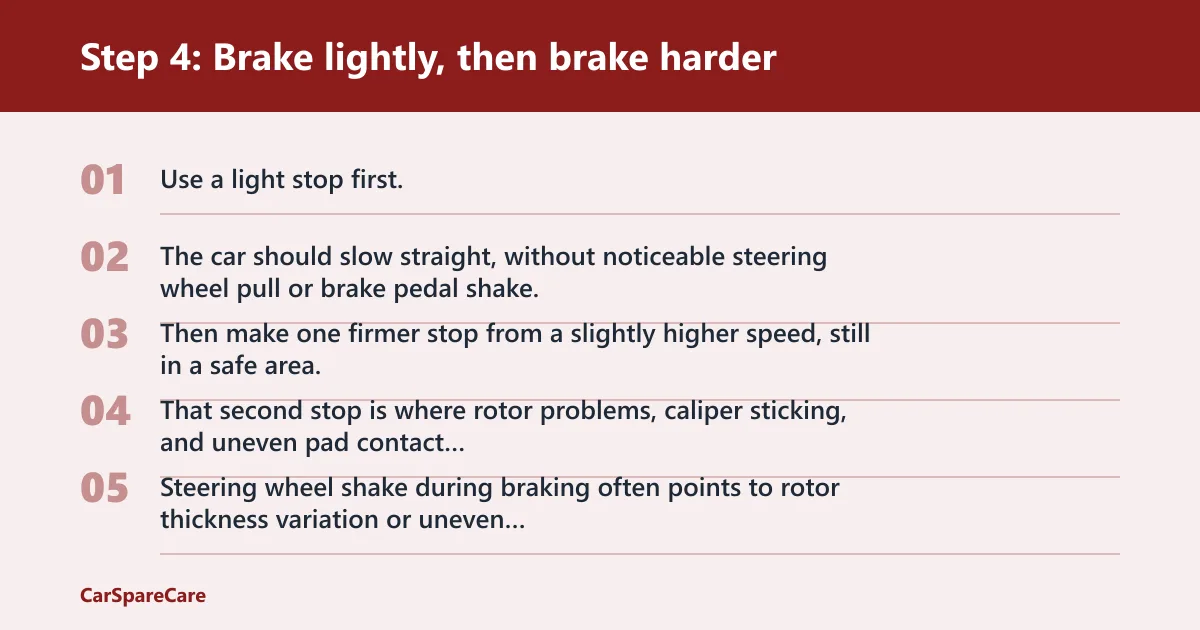
Use a light stop first. The car should slow straight, without noticeable steering wheel pull or brake pedal shake. Then make one firmer stop from a slightly higher speed, still in a safe area. That second stop is where rotor problems, caliper sticking, and uneven pad contact usually show themselves.
Steering wheel shake during braking often points to rotor thickness variation or uneven rotor contact, especially if the wheel is smooth at cruise. A pull left or right when braking is more often a caliper, pad, hose, or tire issue on one side than a pure alignment problem. If one front wheel smells hot or feels much hotter after a short drive, stop and treat it as a serious warning.
How can I tell if the brakes are worn without tools?
Listen for squealing, grinding, or scraping, feel for a long or soft pedal, and note whether braking is even. Thin pads often squeal first, then grind if the backing plate starts touching the rotor. Uneven wear, one hot wheel, or a pulsing stop suggests more than normal pad wear.
What noises during braking are red flags on a used car?
Grinding, metal-on-metal scraping, and repeated clunks are the loudest warnings. Squealing alone can mean worn pads or glazed pads, but grinding means stop treating it as a simple maintenance item. A single clunk over the brake pedal can also come from caliper hardware or suspension shift under load.
Step 5: Listen and feel over bumps and turns
Drive slowly over a rough patch, then make a gentle left and right turn while loading and unloading the suspension. Clunks that happen only when weight shifts are often more useful than a constant rattle. That is where tie rods, ball joints, and control arm bushings separate from each other.
Outer tie rod ends usually announce themselves during small steering inputs and parking-lot turns, with looseness or a click at the wheel. Inner tie rods more often feel vague on center and can cause delayed response without a big noise. Ball joints are more likely to clunk over bumps and reduce steering precision under load. Cracked or torn control arm bushings can cause braking wander, steering instability, and a dull knock during acceleration or braking.
How do I check if a car pulls left or right when braking?
Pick a straight road, accelerate evenly, then brake lightly without steering input. Repeat once with a firmer stop. If the nose consistently yaws to one side only while braking, suspect a sticking caliper, uneven pad wear, a hose issue, or contaminated friction material on that corner.
Step 6: Do a safe low-speed ABS check
ABS should only be checked in a controlled, low-risk stop with predictable traction. On a clean, open surface, brake firmly enough to trigger ABS at low speed. A normal system usually gives a rapid pulsing through the pedal and a chattering feel. That is different from a long, sinking pedal or a wheel that locks solid.
If the ABS light is on, or if the pedal pulse is weak, delayed, or odd, treat it as a fault until proven otherwise. An ABS warning does not always mean the car is unsafe to roll around a lot, but it does mean the system may not save you during a panic stop. That is enough for a strong caution, and sometimes a walk-away.
When should I walk away from a used car because of steering or brake issues?
Walk away if the car has a brake warning light, an ABS light, a pedal that sinks, grinding brakes, a strong pull under braking, or steering play that feels unsafe on center. If a couple of those show up together, the repair risk is high enough to pause the deal.
Single-item faults can sometimes be negotiated, but combined steering and brake symptoms often mean the car needs a deeper suspension or brake job. Vehicle inspections and checks start at 1,799 CZK, and brake system service starts from 799 CZK, which is cheap compared with guessing wrong on a worn car. If the wheel is off-center and the car also pulls or shakes, budget for suspension repair and wheel alignment starting at 2,299 CZK.
What steering and brake issues are easiest to miss on a short drive?
Heat imbalance, slight on-center play, and a brake pull that only shows under firmer braking are the big misses. Short drives also hide delayed tie rod response and a ball joint that only clunks when the suspension is loaded. If the route never leaves parking-lot speed, you will miss most of them.
One-page used-car test-drive scorecard
| Check | Pass | Caution | Walk away | Likely cause |
|---|---|---|---|---|
| Brake pedal travel | Short, even, firm | Slightly long or soft | Sinks while held | Air, wear, hydraulic fault |
| Brake pedal pulsation | None | Light pulse only on hard stop | Strong, repeated pulse | Rotor variation, heat spots |
| Steering wheel center | Near center | Off-center but steady | Off-center with drift | Alignment, worn steering parts |
| Pull while braking | Tracks straight | Small tug once | Pulls every stop | Caliper, hose, pad, tire |
| Vibration under braking | None | Light shake | Strong shake or shimmy | Rotor issue, hub, suspension |
| Clunks over bumps or turns | Silent | Single light knock | Repeat clunk or looseness | Tie rod, ball joint, bushings |
| Warning lights | Off | Intermittent | On continuously | Brake or ABS fault |
Quick notes box: write the road speed, the stop type, which wheel felt hot, and whether the symptom changed left vs right. That small note makes the inspection quote more accurate and prevents repeat test drives that tell you nothing new.
Common mistakes during a used-car test drive
The biggest mistake is testing only at parking-lot speed. That hides rotor shake, wheel vibration, and many steering faults. The second mistake is calling every pull an alignment issue. A pull that appears only while braking is a brake-side problem until proven otherwise.
Another miss is ignoring heat imbalance. If one wheel feels far hotter than the others after a short drive, the car may have a sticking caliper or dragging pad. Also watch for noises that only appear on turns or when the front end loads up, because that is where tie rods, ball joints, and control arm bushings often speak first.
Should I test brakes at low speed and highway speed?
Yes, but keep it safe and legal. Low speed reveals pedal feel, ABS pulse, and light pull. A higher-speed road stop, done on an open straight road, is better for rotor shake and steering vibration. You do not need highway speed; you need one stop that loads the system enough to expose faults.
Frequently asked questions
How do I inspect steering and brakes on a used car during a test drive?
Use a straight road, one light stop, one firmer stop, and one slow turn over bumps. Check the wheel center, pedal feel, pull direction, vibration, and warning lights in that order. If the same symptom appears twice, treat it as a real fault, not a one-off quirk.
What steering wheel symptoms should I check for while driving?
Watch for off-center position, play before the tires respond, poor return-to-center, vibration at speed, and any pull that forces constant correction. On-center looseness points more toward steering wear or alignment drift than a brake problem, while vibration during braking points more toward rotors or calipers.
How can I tell if the brakes are worn without tools?
Listen for squeal or grind, feel for a soft or long pedal, and notice whether the car stops straight. Uneven pad wear often shows up as noise on one corner or a pull during braking. Grinding is the strongest sign that the pads are already past normal wear.
What noises during braking are red flags on a used car?
Grinding is the main stop sign. Repeated clunks, scraping metal, and loud chirps that stay after a few stops are also bad signs. Squealing can be less severe, but it still warrants a closer look because pad wear, glazing, or rotor contact may already be present.
How do I check if a car pulls left or right when braking?
Drive straight, then brake lightly without steering correction. Repeat with one firmer stop. If the car pulls the same way each time, suspect a sticking caliper, uneven pad wear, or a hose problem on that side. If it only pulls during hard stops, rotor or brake balance issues move higher on the list.
What should I feel through the brake pedal on a test drive?
The pedal should feel firm, predictable, and consistent from one stop to the next. It should not sink, pulse badly, or need extra travel before braking starts. A soft or spongy pedal usually points to hydraulic or wear issues, while pulsation often points to rotor trouble.

Hi, I’m Melvin, an automobile engineer with extensive experience in automobile equipment. I currently work for a local automobile firm, where I specialize in the car parts industry. I’ve had the opportunity to collaborate with seasoned inspectors, gaining invaluable hands-on experience that goes beyond just theory.
My passion for automotive care started at a young age, which led me to create CarSpareCare. Through CarSpareCare, I share the knowledge and skills I’ve acquired over the years to help others navigate the world of car maintenance and repairs.
My goal is to provide practical tutorials, essential safety advice, and the latest industry insights so that anyone—whether a beginner or an expert—can confidently tackle their automotive projects.

