
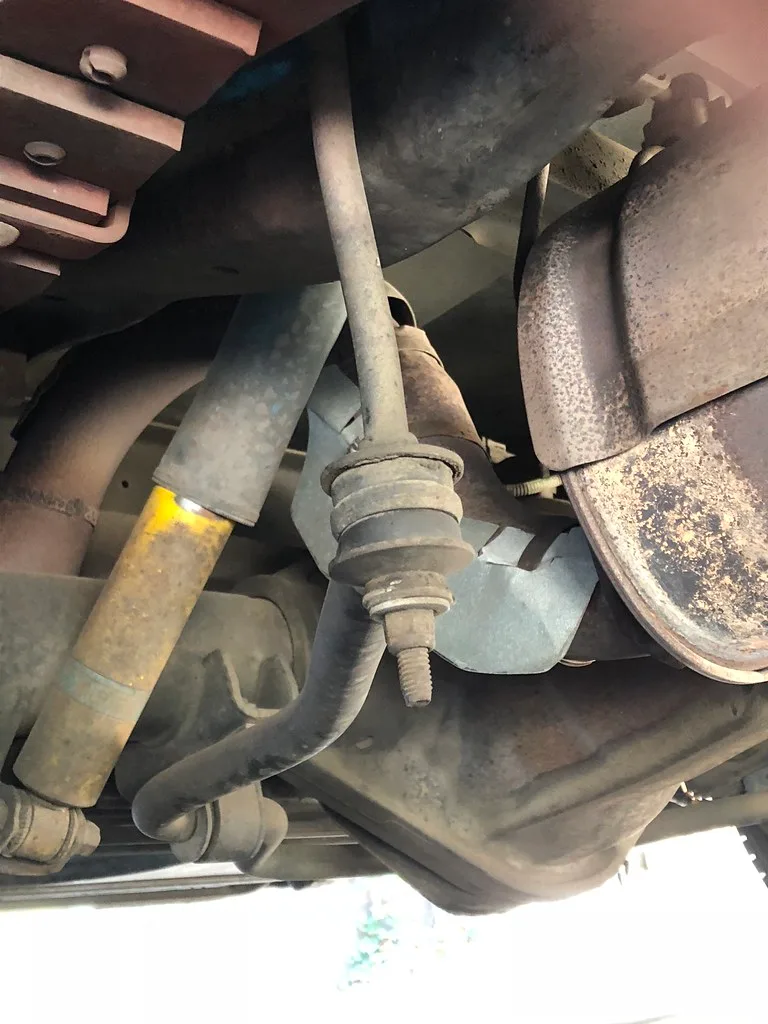
Yes, worn sway bar links can change steering feel, but they usually bring clunks or vague turn-in over bumps, not true loose-on-center steering. I have seen people replace good parts, then miss a brake or tie-rod fault that mattered more. This guide separates sway-bar-link noise from steering and brake faults, then shows the road-test and jack-test clues.
What you’ll need before you inspect anything
- Jack and jack stands
- Lug wrench or wheel removal tools
- Flashlight
- Gloves
- Pry bar
- Torque wrench for reassembly
- Shop rags and a marker or paint pen
What a sway bar link actually does
Sway bar links connect the anti-roll bar, also called the stabilizer bar, to the suspension on each side. The bar spans the vehicle from left to right and resists body roll in turns. When a link loosens, the car can feel less tied down in corners or over a one-wheel bump.
Front and rear layouts matter
Front sway bar links are often blamed first because they sit closer to steering inputs and front suspension load. Front links can connect to control arms, steering knuckles, or struts, depending on vehicle design. Rear links may connect to the control arms or frame. A vehicle could have up to four sway bar links, and some models use front and/or rear bars.
What wears out
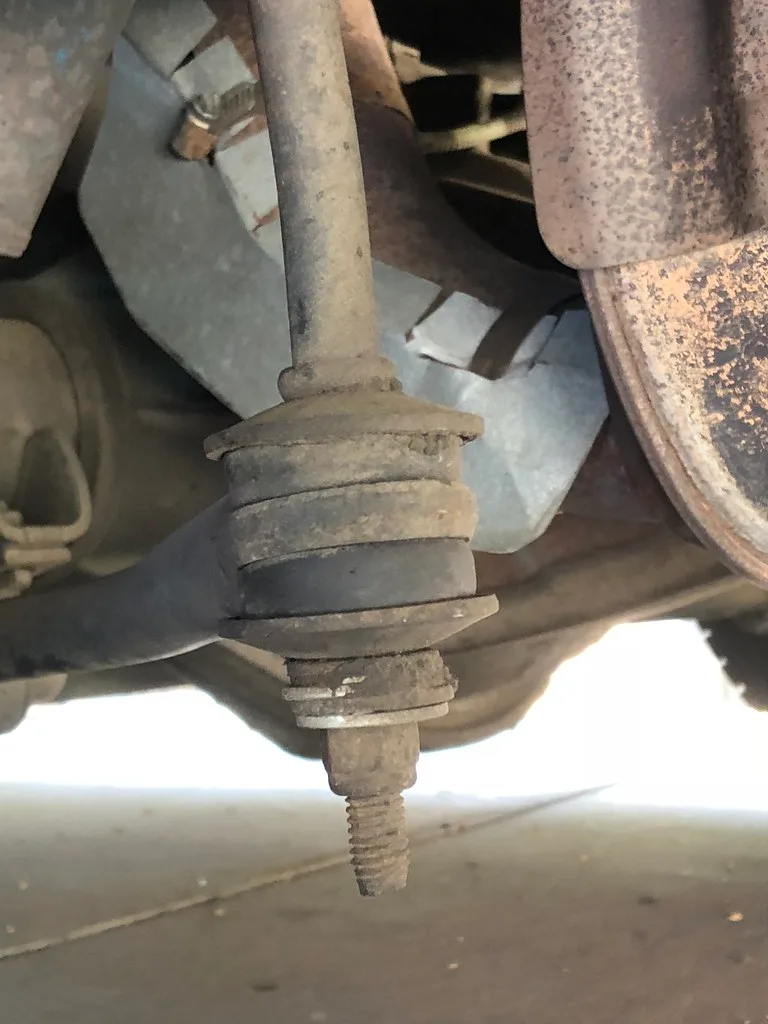
Wear usually shows up as play at the ball stud or ball joint in the end link, torn boots, cracked or dry-rotted rubber or polyurethane bushings, rusted hardware, or seized link hardware. That wear creates looseness and noise. It usually does not create steering gear play by itself.
Use this decision table to narrow the fault

Read the table by matching the driving complaint first, then checking the quickest driveway test. If the symptom changes mainly with bumps, braking, or cornering, sway bar links move up the list. If it stays constant at the wheel, tie rods, ball joints, alignment, or brakes are usually more likely.
| Driver complaint | Likely cause | Likely sway bar link? | Red flags | Quickest driveway check |
|---|---|---|---|---|
| Clunk over small bumps | Worn sway bar link or bushing | Yes | Noise repeats on one side, especially at low speed | Bounce one front corner; listen at the link while the wheel loads and unloads |
| Knock when turning slowly | Loose link, tie rod, or ball joint | Maybe | Steering wheel free play points away from links | With the wheel off the ground, shake tire at 3 and 9 o’clock, then inspect link play |
| Popping or hammering on driveway entry | End-link play or dry bushings | Yes | Noise changes when one wheel climbs a curb or ramp | Slowly drive one wheel onto a ramp and watch the link angle |
| Loose steering on center | Tie rod wear, steering gear, or alignment | Unlikely | Steering play is present even on smooth roads | Check front toe and inner/outer tie rod play before blaming links |
| Pulling to one side | Alignment, brake drag, tire issue | Unlikely | Pull changes under braking or after tire rotation | Verify tire pressures, then compare brake rotor temperature after a short drive |
| Steering wheel shake at speed | Wheel balance, bent wheel, tire problem | No | Shake grows with speed, not bumps | Note whether the vibration starts near highway speed and stays steady |
| Clunk when braking | Control arm bushings, brake hardware, or loose link | Maybe | Weight transfer forward makes worn bushings obvious | Brake from 10 to 5 mph over a rough lot and listen for a single knock |
| Uneven tire wear | Alignment, ball joints, tie rods, or worn bushings | Sometimes | Link wear alone is rarely the only reason | Inspect tire edges and check for play at all front-end joints |
How to inspect sway bar links step by step
- Park on level ground, chock the rear wheels, and loosen the lug nuts only if the wheel must come off.
- Lift the vehicle with a jack and support it on jack stands; never work under a car supported only by a jack.
- Grab each link near the top and bottom and try to move it by hand.
- Look for torn boots, cracked bushings, shiny rust trails, or missing washers and nuts.
- Use a pry bar gently against the link or sway bar to feel for clunking at the ball stud or bushing.
- Turn the steering wheel or load one wheel up a ramp and see whether the noise changes when one side of the suspension is compressed.
- Mark the fastener position before removal, then reinstall with a torque wrench to the vehicle’s specified torque.
What bad link play looks like
Good links move only with the suspension. Bad ones show a visible knock, a dry snap, or a loose socket that shifts before the suspension moves. If the stud flops, the boot is split, or the hardware is rusted and hanging off-axis, the link is suspect. A seized link can also bind and make the bar act strangely over bumps.
Are bad sway bar links the same as tie rod, ball joint, or alignment problems?
No. Sway bar links usually create suspension noise and a vague, side-to-side unsettled feeling in turns or over one-wheel bumps. Tie rods, ball joints, control arm bushings, and alignment faults more often create true steering looseness, wander, pull, or uneven tire wear. If the steering wheel has free play at center, start with steering parts.
Tie rod clues
Outer and inner tie rod wear is often checked with a 3-and-9 o’clock wheel shake test when the car is lifted. A worn link may rattle, but it should not let the wheel steer on its own. If the wheel shifts before the tire responds, the fault points away from the sway bar link.
Ball joint and control arm bushing clues
Ball joint wear often shows up as clunking while braking, turning, or hitting dips, plus movement at the hub when the suspension is loaded. Control arm bushings can make the car dart, wander, or clunk under load transfer. Those faults are more likely than links when the complaint is loose tracking, not just noise.
When wheel alignment is the real issue
Alignment matters when the car pulls, the steering wheel sits off-center, or the tires wear on one edge. Sway bar links do not set toe, camber, or caster. If the symptom is constant pull on a straight road, inspect alignment and brake drag before condemning links.
Can you drive with bad sway bar links, and what should they cost?
A car with a worn sway bar link is often drivable for a short distance if the noise is mild and the link is only loose, but a broken link, missing fastener, or severely rusted hardware should stay parked. Cost depends on front or rear layout, part quality, and how seized the hardware is.
Front versus rear replacement context
Front links are often diagnosed first because they can affect how the car settles into a turn and are commonly associated with steering-related complaints. Rear links can still make the vehicle feel sloppy, especially in lane changes or quick load shifts. Front links are commonly priced around $20 to $85 per pair for parts, with an all-in replacement estimate of about $100 to $250 for both links on one axle. Rear links are about $15 to $35 per pair for most common vehicles. Family Handyman places the job around $100 and says replacing sway bar end links is a beginner job taking 60–90 minutes.
Why replace in pairs
Replacing both links on the same axle usually makes sense because the opposite side has lived the same miles, seen the same potholes, and often has the same wear. If one side is loose, the other side is rarely far behind. Pairs also keep the bar action even across the axle.
If that didn’t work, try this next
- Check tie rod ends for play by lifting the front axle and shaking the tire at 3 and 9 o’clock.
- Inspect ball joints by supporting the suspension and watching for vertical movement at the knuckle.
- Inspect control arm bushings for cracks, separation, or movement while braking lightly in a parking lot.
- Schedule a wheel alignment if pull, off-center steering, or uneven tire wear remains after the mechanical checks.
Common mistakes
Many people replace links after hearing a clunk and stop there. That misses tie rod play, ball joint wear, or a brake issue that shows up only under load. Another common mistake is checking the link on the ground, where the suspension is already loaded and the play hides.
Do not reuse rusty hardware if the threads are damaged. Do not guess at torque. A torque wrench matters because overtightening can bind the joint and undertightening can leave the new link noisy again. Also, do not confuse steady steering-wheel vibration with a sway bar link fault; that pattern fits wheel balance or brake pulsation more often.
Frequently asked questions
Can worn sway bar links affect steering feel?
Yes, but the feel change is usually indirect. The car may feel loose or unsettled in turns and over one-wheel bumps because the sway bar is not controlling body motion as well. A worn link does not normally create true steering gear play, so constant on-center looseness points elsewhere.
Do bad sway bar links make steering feel loose?
They can make the car feel loose in the chassis, especially during turn-in, lane changes, and rough-road driving. That is different from steering-wheel free play. If the wheel can move before the tires respond, inspect tie rods, steering gear, and alignment first.
Can sway bar links cause clunking when turning or braking?
Yes. Family Handyman notes worn sway bar links can cause poor handling and braking, and the noise may sound like popping, hammering, or dull thumping. If the clunk shows up mainly with braking or a single front wheel hitting a bump, the links move higher on the list.
How do I tell if sway bar links are worn or broken?
Lift the vehicle on jack stands, grab the link, and look for visible knock or side play at the ball stud, torn boots, cracked bushings, rusted fasteners, or missing hardware. A bad link usually moves with a dry rattle or clunk before the sway bar does.
Are sway bar link symptoms the same as tie rod or ball joint problems?
No. Tie rod and ball joint faults more often create true steering looseness, wander, or wheel movement during a 3-and-9 or vertical shake test. Sway bar links more often cause noise and unsettled body motion over bumps or in turns, not steering-system free play.
Can I drive with bad sway bar links?
If the link is only noisy and still attached, short local driving is usually possible. If it is broken, missing hardware, or letting the bar strike other parts, stop driving and repair it. That kind of fault can get worse fast and can mask a more serious front-end issue.
How much does it cost to replace sway bar links?
Front links are often quoted at about $100 to $250 for both links on one axle, with parts around $20 to $85 per pair for front links. Rear links are often about $15 to $35 per pair for common vehicles. Labor rises when rusted fasteners fight the job.
Do worn sway bar links cause vibration in the steering wheel?
Usually no. A bad link more often causes clunking, knocking, or a vague feel in corners and over bumps. A steady steering-wheel vibration at speed often points more toward wheel balance, bent wheels, tires, or brake pulsation than toward sway bar links.
Should sway bar links be replaced in pairs?
Yes, on the same axle when wear is confirmed. The opposite link has usually seen similar mileage and road abuse, so replacing one side only can leave the car uneven and bring the noise back soon. Match the front pair or rear pair as a set.

Hi, I’m Melvin, an automobile engineer with extensive experience in automobile equipment. I currently work for a local automobile firm, where I specialize in the car parts industry. I’ve had the opportunity to collaborate with seasoned inspectors, gaining invaluable hands-on experience that goes beyond just theory.
My passion for automotive care started at a young age, which led me to create CarSpareCare. Through CarSpareCare, I share the knowledge and skills I’ve acquired over the years to help others navigate the world of car maintenance and repairs.
My goal is to provide practical tutorials, essential safety advice, and the latest industry insights so that anyone—whether a beginner or an expert—can confidently tackle their automotive projects.

