

A steering wheel shimmy around that speed often points to wheel and tire imbalance, a bent wheel, a tire defect, or front-end looseness that shows up at speed, and changes while braking or accelerating can help narrow it down. Ignore it and you can wear tires quickly, while a small alignment or suspension fault can become a larger safety issue. This guide shows what changes at 40 mph, what does not, and how to isolate the cause by testing coasting, braking, and steering load.
What a 40 mph shimmy usually means
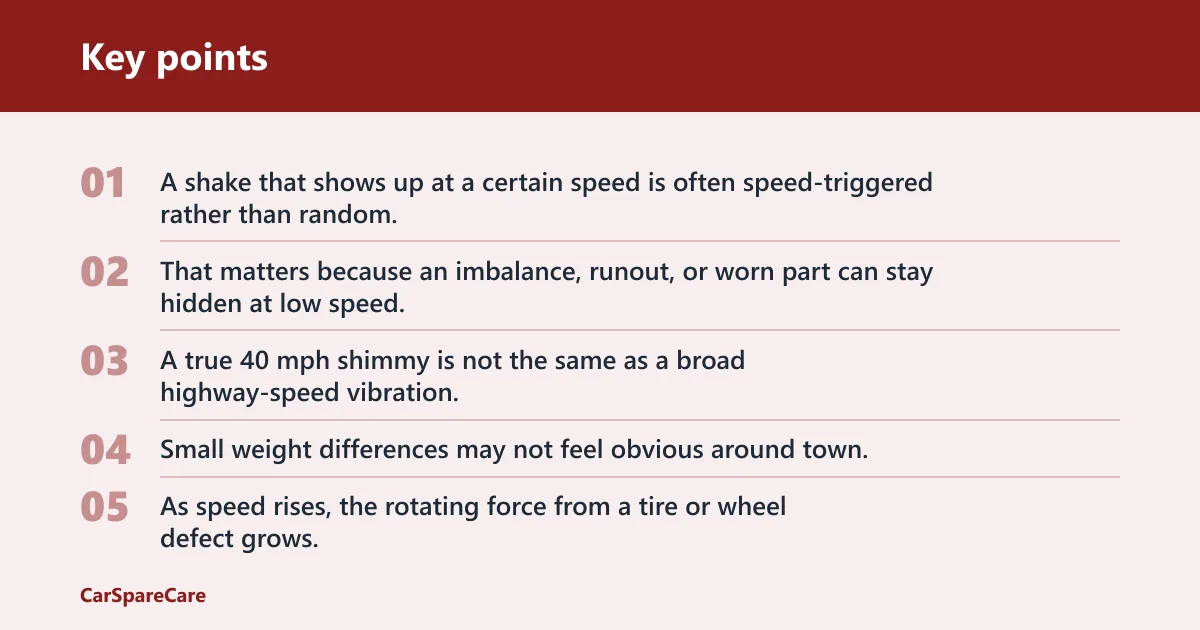
A shake that shows up at a certain speed is often speed-triggered rather than random. That matters because an imbalance, runout, or worn part can stay hidden at low speed, then hit a resonance band where the vibration becomes obvious. A true 40 mph shimmy is not the same as a broad highway-speed vibration.
Why the shake shows up in one speed band
Small weight differences may not feel obvious around town. As speed rises, the rotating force from a tire or wheel defect grows, and the steering system can start to amplify it. That is why a problem can feel quiet at 25 mph, then show up sharply near 40 mph, then change again at higher speed.
Why 40 mph is a clue, not a diagnosis
At that speed, the car may be crossing a resonance point in the tire, wheel, or front suspension. The exact number is less important than the pattern: narrow speed range, steering wheel shake, and changes with braking or load. A highway-speed shake can point to the same area, but the diagnostic path is not identical.
What changes between slow, city, and highway speeds
City speeds may hide the issue. Highway speed can make a tire or wheel problem more obvious, and a vibration may appear at highway speed even if it started lower. If the shake appears in one speed band only, that usually steers attention toward wheel balance, runout, or a part that reacts to rotation rather than engine speed.
What causes a steering wheel to shake at 40 mph?
The usual causes are wheel and tire imbalance, wheel runout, tire defects, or looseness in steering and suspension parts that let a small rotating error become a felt shimmy. Alignment can contribute after impact, but a pure vibration at one speed often starts with the tire, wheel, or a worn front-end component.
Tire and wheel balance problems
An improperly balanced tire and wheel assembly can create a speed-specific shake. Wheel balancing corrects uneven weight distribution around the tire and wheel. If the standard balance does not fix it, road force variation is a common failure case: the assembly can be balanced and still cause vibration.
That is where road-force balancing helps. It loads the tire against a drum and can reveal a heavy spot, stiff spot, or uniformity problem that a basic spin balance misses. If the shimmy remains after balancing, do not assume the tires are ruled out.
Bent wheels, tire defects, and wheel runout
Wheel runout means the wheel or tire wobbles as it turns. Lateral runout is side-to-side wobble; radial runout is up-and-down wobble. A bent wheel or a tire defect can create both. Tire damage can also include bulges, flat spots, or internal damage, any of which can make the steering wheel shake at one speed.
A dial indicator can measure runout directly. A road-force machine can also flag a tire and wheel that looks normal on a simple spin but still vibrates on the road. After a pothole or curb strike, this check moves up the list fast.
Uneven tire wear and suspension wear
Feathered tread may suggest alignment trouble. Cupped or scalloped wear may point toward balance, worn shocks or struts, or another suspension concern. If the tire is already wearing unevenly, the wear pattern can feed the vibration and make a minor imbalance feel worse.
Worn control arm bushings, ball joints, and tie rods can also let the wheel move in ways it should not. Suspension dampers matter too. Weak shocks or struts can allow tire hop and cupping, which turns a mild issue into a noticeable steering-wheel shimmy.
Brake shake or road shake: how to tell them apart
If the vibration grows while braking, brake rotor variation becomes a stronger suspect than tire balance. If the shake stays about the same with light braking, the cause is more likely in the tire, wheel, or front suspension. That difference is one of the fastest ways to narrow the fault.
Why vibration that grows while braking points to rotors
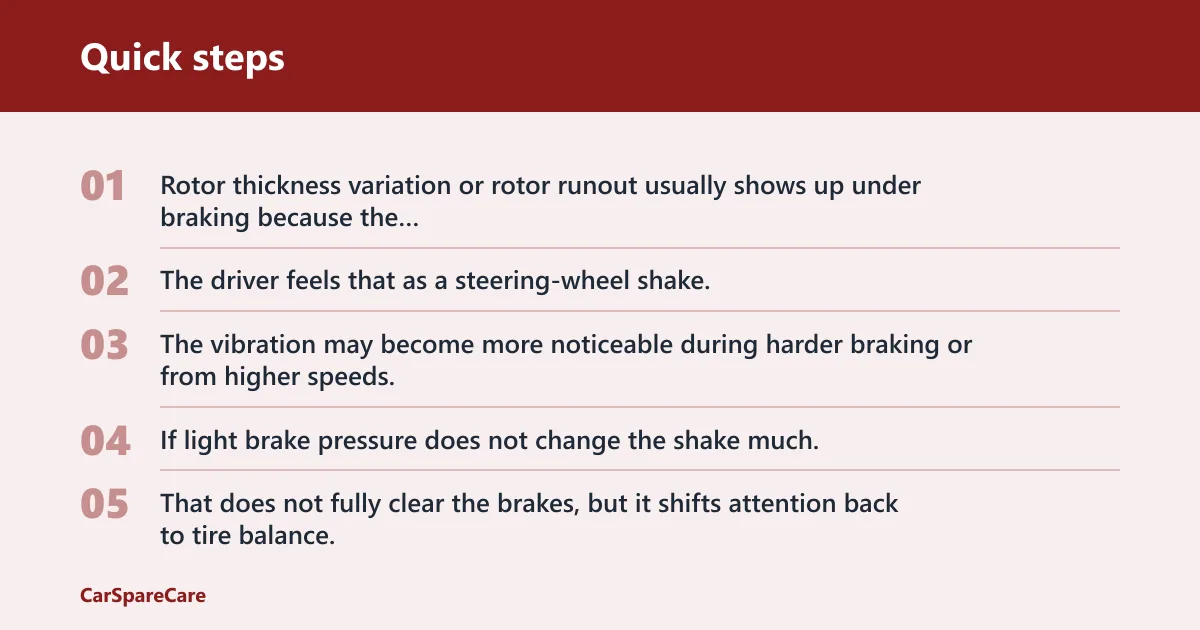
Rotor thickness variation or rotor runout usually shows up under braking because the pads apply force to the rotor face. The driver feels that as a steering-wheel shake, sometimes most clearly at moderate braking from higher speeds. The vibration may become more noticeable during harder braking or from higher speeds.
What it means if the shake stays the same with light braking
If light brake pressure does not change the shake much, the issue is somewhat less likely to be rotor related. That does not fully clear the brakes, but it shifts attention back to tire balance, wheel runout, loose steering parts, or a tire defect. A brake complaint and a wheel complaint can overlap, so the test matters.
Why bad brakes can sometimes feel like a wheel shimmy
Brake problems do not always feel like a pedal issue first. Rotor variation can transmit through the hub and suspension and show up in the steering wheel. If the vibration is strongest only while braking, ask for a brake rotor inspection before replacing tires or chasing alignment first.
What should you inspect first after hitting a pothole?
Start with the tire sidewall and wheel edge, then move to steering and suspension parts, then consider an alignment check. A pothole or curb impact can change alignment angles, bend a rim, or damage a tire internally. That sequence catches the common impact failures before they turn into repeated vibration or tire wear.
Bent rim and tire sidewall checks
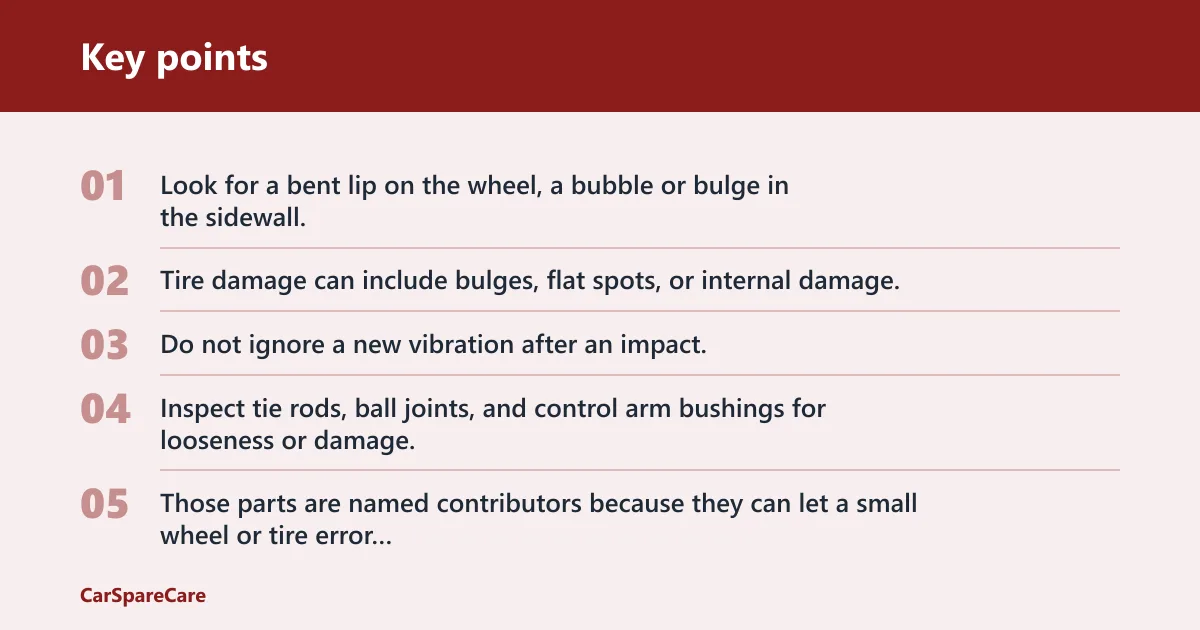
Look for a bent lip on the wheel, a bubble or bulge in the sidewall, and fresh scuffs on the rim. Tire damage can include bulges, flat spots, or internal damage, and those can create a shake even if the tread still looks intact. Do not ignore a new vibration after an impact.
Suspension and steering linkage checks
Inspect tie rods, ball joints, and control arm bushings for looseness or damage. Those parts are named contributors because they can let a small wheel or tire error become a steering-wheel shake. If the front end clunks, wanders, or feels loose, the problem may be larger than balance alone.
Why alignment may be needed after impact
Alignment problems may be accompanied by pulling to one side and an off-center steering wheel. They usually cause pull or crooked wheel position more than a pure shimmy. Still, after a pothole or curb strike, toe, camber, or caster can shift enough to create uneven wear or make an existing vibration worse.
Say your car hits a deep pothole at 35 mph and the steering wheel starts shaking at 40 mph on the next drive. A bent wheel or shifted alignment angle is more likely than a random coincidence, so the first shop request should be a wheel inspection plus an alignment check if no wheel damage is found.
What the steering-input test tells you
Changes when turning left or right point the diagnosis away from simple balance and toward load-sensitive parts such as a wheel bearing or suspension joint. Steering input changes the load on each front corner. That makes the shake pattern useful, because the symptom may get better, worse, or louder on one side.
Changes when turning left or right
If the vibration changes while gently steering left or right, note which direction affects it. A wheel bearing clue often includes noise that changes with speed and steering load, not just vibration. A bearing problem is more convincing when the shake comes with humming, grinding, or rumbling noise.
What a wheel bearing clue looks like
A worn wheel bearing can cause vibration plus a humming, grinding, or rumbling noise. That noise often changes as weight shifts from one side of the car to the other in a turn. A silent shake is less suggestive of a bearing than a shake with a matching noise.
How road surface changes can separate tire issues from chassis issues
If the shimmy changes a lot on coarse pavement but eases on smooth asphalt, the tire and wheel assembly is still high on the list. If the shake follows steering load more than pavement texture, look harder at bearings, tie rods, ball joints, and control arm bushings. Road surface alone does not prove the cause, but it helps separate patterns.
What causes shimmy at high speeds?
High-speed shimmy usually comes from the same core faults as a 40 mph shake, but the symptom is easier to trigger because rotating forces grow with speed. A high-speed shake can appear at highway speed, especially if the tire has runout, a hidden defect, or a balance problem that was mild at lower speed.
Why highway speed can expose hidden faults
As speed rises, a small imbalance becomes a larger force. That can turn a faint vibration into a steering-wheel shake that is hard to ignore. It is one reason a car can feel fine around town and still shake on the freeway.
What to request if balancing did not fix it
If standard balancing did not solve it, ask for road-force balancing and a runout check. If the wheel or tire is bent, no amount of normal balance weights will solve the whole problem. That is the failure case many quick diagnoses miss.
What suspension parts can make the wheel vibrate at one speed only?
Loose or worn tie rods, ball joints, control arm bushings, shocks, and struts can let the front wheels move enough to magnify a speed-specific shake. These parts often do not create the vibration by themselves. They let another problem feel much worse.
Suppose a driver replaces two front tires, but the 40 mph shimmy stays. The next request should not be another blind tire swap. A shop should check runout, tie rod play, ball joint condition, and whether the shocks or struts are allowing tire hop.
Speed-shimmy decision table
Use the symptom pattern first. Then ask for the test that matches it. That keeps the diagnosis focused and avoids replacing parts at random.
| Symptom pattern | Likely causes | First shop test to request |
|---|---|---|
| 40 mph only | Wheel and tire imbalance, road force variation, mild runout | Road-force balancing with a spin balance check |
| Worse with braking | Brake rotor variation or rotor runout | Brake rotor measurement and front brake inspection |
| Changes when turning left or right | Wheel bearing, tie rod, ball joint, control arm bushing | Front-end play check with steering-load test |
| Appears after pothole impact | Bent wheel, tire damage, alignment change, suspension damage | Wheel/runout inspection and alignment check |
| Persists after balancing | Runout, tire uniformity defect, bent wheel, worn suspension part | Dial indicator runout check and tire uniformity inspection |
Is a steering wheel shake at 40 mph dangerous?
It can be, especially if it is getting worse, follows a pothole strike, or comes with noise, pull, or braking vibration. A mild, unchanged shake may be drivable for a short distance to a shop. A worsening shake deserves prompt inspection because it may signal tire damage or loose steering parts.
When to stop driving and inspect now
Stop and inspect now if the shake is severe, the car pulls hard, the steering wheel is not centered, or you hear humming, grinding, or rumbling from the front end. Also stop if you see a tire bulge, a bent wheel, or a fresh leak. Those are not wait-and-see conditions.
When you can drive a short distance to a shop
If the shimmy is mild, steady, and only at one speed band, a short drive to a shop is usually reasonable. Keep speed down and avoid hard braking. If the symptom changes quickly, gets louder, or spreads to more speeds, do not keep testing it on the road.
Signs that mean the problem is getting worse
More speeds, more vibration, new steering pull, and new noise all point to progression. Uneven tire wear can also build quickly if the cause is left alone. The safest rule is simple: if the shake is no longer a narrow-band annoyance, treat it as an inspection item, not a future project.
Frequently asked questions
How can I tell if it’s tire balance or alignment?
Balance problems usually create a speed-specific shake, while alignment problems more often cause pull or an off-center steering wheel. Feathered tread points toward alignment trouble. If balancing does not fix the shimmy, or if the car also pulls, an alignment check becomes more likely.
Can bad brakes cause a shimmy even if I’m not braking?
Usually no, because brake rotor problems are most noticeable while braking. A rotor issue can still be confused with a wheel shake, but if the vibration stays the same off the brakes, tires, wheels, or suspension are more likely. Brake-linked shake should change with pedal pressure.
What causes shimmy in steering wheel?
A steering-wheel shimmy comes from forces reaching the steering system through the front wheels. Tire imbalance, wheel runout, bent rims, brake rotor variation, and looseness in tie rods, ball joints, or control arm bushings are common paths. The key is whether the shake changes with speed, braking, or steering load.
What causes wheel shimmy?
Wheel shimmy usually comes from imbalance, runout, tire uniformity problems, or worn suspension and steering parts. A wheel can be balanced and still shake if the tire has road force variation or the wheel is bent. That is why a simple spin balance does not always finish the diagnosis.

Hi, I’m Melvin, an automobile engineer with extensive experience in automobile equipment. I currently work for a local automobile firm, where I specialize in the car parts industry. I’ve had the opportunity to collaborate with seasoned inspectors, gaining invaluable hands-on experience that goes beyond just theory.
My passion for automotive care started at a young age, which led me to create CarSpareCare. Through CarSpareCare, I share the knowledge and skills I’ve acquired over the years to help others navigate the world of car maintenance and repairs.
My goal is to provide practical tutorials, essential safety advice, and the latest industry insights so that anyone—whether a beginner or an expert—can confidently tackle their automotive projects.

