
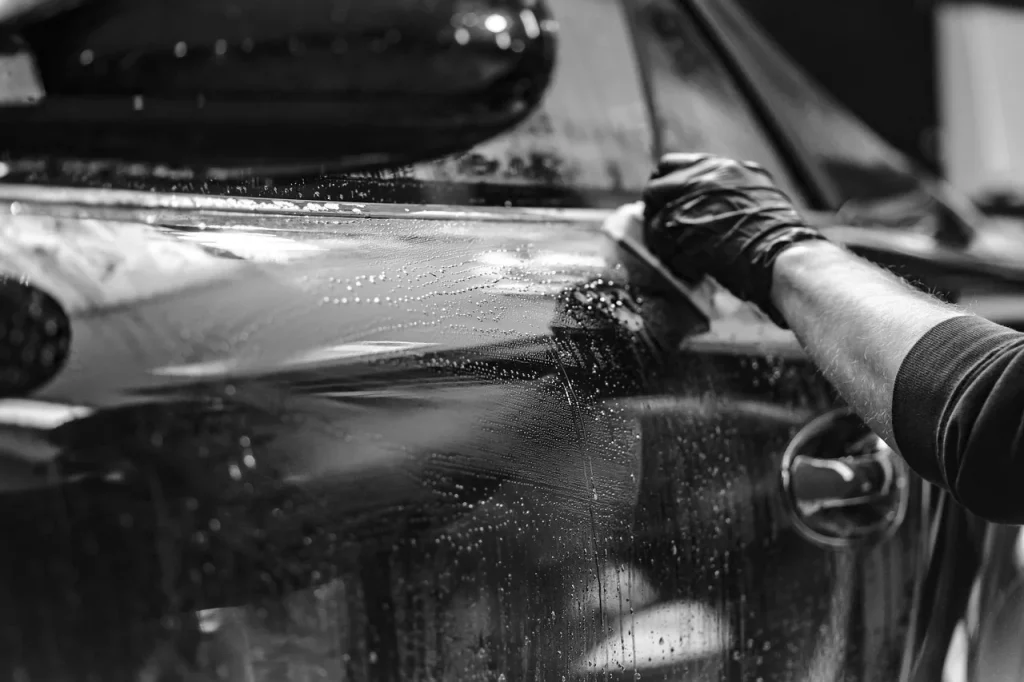
Wash a black car by pre-rinsing, washing top to bottom with a clean mitt, and drying with clean microfiber. Keep the mitt, towel, and water free of grit. Skip that, and fine swirls and water spots show up fast on black paint. This guide covers a contamination-first hand wash routine that isolates the mitt, towel, and water as separate risk points.
Why black paint shows swirls
Swirl marks are micro-scratches in the car’s clear coat, and black paint makes them easier to see because light catches the defect edge strongly. The scratch is often small. The contrast is what makes it obvious.
The clear coat is the top protective layer over the color coat, so most wash-induced marks live there first. Washing is also the most common time black paint gets touched, which makes contact steps the highest-risk part of the job.
Which wash steps create the most risk?
Three steps are commonly cited as the main sources of visible damage: pre-rinse when grit remains on the surface, mitt contact when dirt is trapped in the fibers, and drying when a towel carries contamination across the clear coat. On black paint, the failure is usually not one big mistake. It is repeated tiny ones.
What you’ll need
- Two wash buckets, one for soapy water and one for rinsing the mitt
- Two grit guards, one in each bucket
- A microfiber wash mitt with clean, uncontaminated fibers
- A pH-neutral car shampoo and the measuring cap from the bottle
- A hose or pressure sprayer for the pre-rinse
- One or two large, plush microfiber drying towels
- Optional filtered or deionized water for the final rinse
- Optional sealant or ceramic coating for maintenance between washes
Use a clean mitt for contact washing, not a sponge or an old towel. A spare mitt helps if one falls on the ground or loads up with road film faster than expected.
Black car wash checklist
Use this screen before you touch the paint. If any item fails, change the wash plan before contact begins.
| Check | Pass | Fail | Action |
|---|---|---|---|
| Paint condition | Light dust only | Heavy road film, mud, or winter grit | Hand wash is acceptable only for light contamination; stop and correct first if the surface feels gritty or looks caked |
| Water quality | Filtered or deionized water, or ordinary tap water on a cool panel with prompt drying | Hard tap water on hot paint, or water left to air-dry | Use filtered or deionized water for the final rinse when spot risk is high |
| Mitt and towel cleanliness | Freshly washed, clean, and free of debris | Loaded with dirt, dropped, or reused after lower-panel grime | Switch to clean tools before contact resumes |
| Drying method | Blotting or very light glide with plush microfiber | Bath towel, aggressive rubbing, or a dirty drying towel | Stop and change towels before finishing the car |
If the paint already shows obvious swirls in direct sun, a safe wash can still clean the car, but it will not remove those defects. Paint correction should come first when the marks are severe enough to distract in shade or remain visible after washing.
How do you wash a black car safely?
Wash in the shade on cool paint, rinse loose grit off first, then use a clean mitt and the two-bucket method. Shade keeps water from drying too quickly on the panel, and cool paint gives you more time to rinse and dry cleanly. The goal is simple: move dirt off the car without dragging it back across the clear coat.
- Park out of direct sun and let the panels cool.
- Pre-rinse every panel with a high-pressure spray or strong hose stream.
- Fill one bucket with shampoo mix and one with clean rinse water, then place a grit guard in each.
- Measure the shampoo at the label dilution ratio and mix it thoroughly.
- Wash one section at a time from roof to lower panels.
- Rinse the mitt in the rinse bucket after each pass, then reload it with fresh suds.
- Work the lower dirty areas last, since they hold the most grit.
- Rinse the whole car again before drying so soap residue and loosened dirt do not drag.
Suppose a compact hatchback has only light dust after a garage night. One rinse, one mitt, and one wash pass per panel is usually enough. A pickup with winter salt spray and mud needs more rinse time and more mitt rinsing, because the lower panels carry far more contamination.
How do you dry a black car without scratching it?
Dry as soon as practical after washing with a large, plush microfiber towel. Use blotting or only a very light glide. The towel should move water, not scrub the paint.
- Lay the towel flat on a panel and blot first.
- If needed, drag it with almost no pressure in one direction only.
- Fold the towel into quarters for better control and a clean contact face.
- Switch to a fresh towel when the first one becomes damp or picks up grime.
- Use filtered or deionized water for the final rinse when tap water is hard or spotting is common.
Filtered or deionized water reduces mineral deposits, which lowers the chance of spotting and streaking. It does not promise zero spots in every condition, especially if the panel is hot or the drying step is delayed.
When should you use filtered or deionized water?
Use it for the final rinse when your tap water is hard, when the car will sit wet for a few minutes, or when you wash a black car in a location that spots quickly. It is most useful as a final-rinse step, not as a substitute for a clean drying towel.
When should you stop and correct paint first?
Stop and inspect before a full hand wash if the car carries heavy road film, mud, winter grit, or visible sand that does not rinse off cleanly. Those conditions raise the chance that a wash mitt will drag abrasive material across the clear coat.
If swirl marks are already obvious in sunlight, washing alone will not remove them. A dual-action polisher is the safer correction tool for many black cars, and a professional detailer is the better choice when the panel has deep defects, thin clear coat concerns, or severe marring across multiple panels.
- Inspect the paint in bright, direct light.
- If defects are light and the surface is otherwise clean, hand wash first.
- If the finish shows heavy swirls, plan correction before aggressive washing or polishing by hand.
- If the dirt load is heavy, choose a thorough pre-rinse and a very gentle wash only after the loose grit is gone.
A common first-timer mistake is to wash a black SUV with winter grit still clinging to the lower doors. The mitt loads up fast, then the drying towel carries that same grit across the finish. The fix is not more pressure. It is more rinse, more towel control, and a stop point when the surface stays abrasive.
Common mistakes to avoid
These errors show up fast on black paint and are easy to prevent.
- Using old bath towels, a sponge, or a dirty wash mitt
- Skipping the rinse bucket or leaving out grit guards
- Letting tap water air-dry on hot panels
- Using household detergent instead of pH-neutral shampoo
- Dragging one contaminated drying towel over the whole car
- Working a lower dirty panel before the upper panels are clean
Sealant or ceramic coating helps future washing by making water bead and slide more readily. That can reduce drying time and lower spotting risk, but it does not replace a clean mitt, a clean towel, or a careful wash order.
Frequently asked questions
What is the best wash method for black paint?
The best method is a hand wash with the two-bucket system, grit guards, and pH-neutral shampoo. For heavily contaminated cars, start with a stronger pre-rinse and do not touch the paint until loose grit is gone. That method keeps the clear coat from carrying new micro-scratches.
Should I use the two-bucket method on a black car?
Yes. One bucket holds the shampoo solution and the second holds rinse water so dirt stays out of the wash bucket. That matters more on black paint because small marks stand out quickly. A grit guard in each bucket helps keep heavier debris at the bottom.
What tools do I need to wash black paint safely?
You need two buckets, grit guards, a microfiber wash mitt, pH-neutral shampoo, and at least one large plush microfiber drying towel. Add filtered or deionized water for the final rinse if your tap water spots easily. A spare mitt and spare towel are smart backups.
Can you remove swirl marks on a black car?
Yes, but removal is correction work, not wash work. Light marring may respond to a dual-action polisher and the right finishing pad and polish. Deep or widespread defects often need a detailer, especially if you want to avoid thinning the clear coat unnecessarily.

Hi, I’m Melvin, an automobile engineer with extensive experience in automobile equipment. I currently work for a local automobile firm, where I specialize in the car parts industry. I’ve had the opportunity to collaborate with seasoned inspectors, gaining invaluable hands-on experience that goes beyond just theory.
My passion for automotive care started at a young age, which led me to create CarSpareCare. Through CarSpareCare, I share the knowledge and skills I’ve acquired over the years to help others navigate the world of car maintenance and repairs.
My goal is to provide practical tutorials, essential safety advice, and the latest industry insights so that anyone—whether a beginner or an expert—can confidently tackle their automotive projects.

