
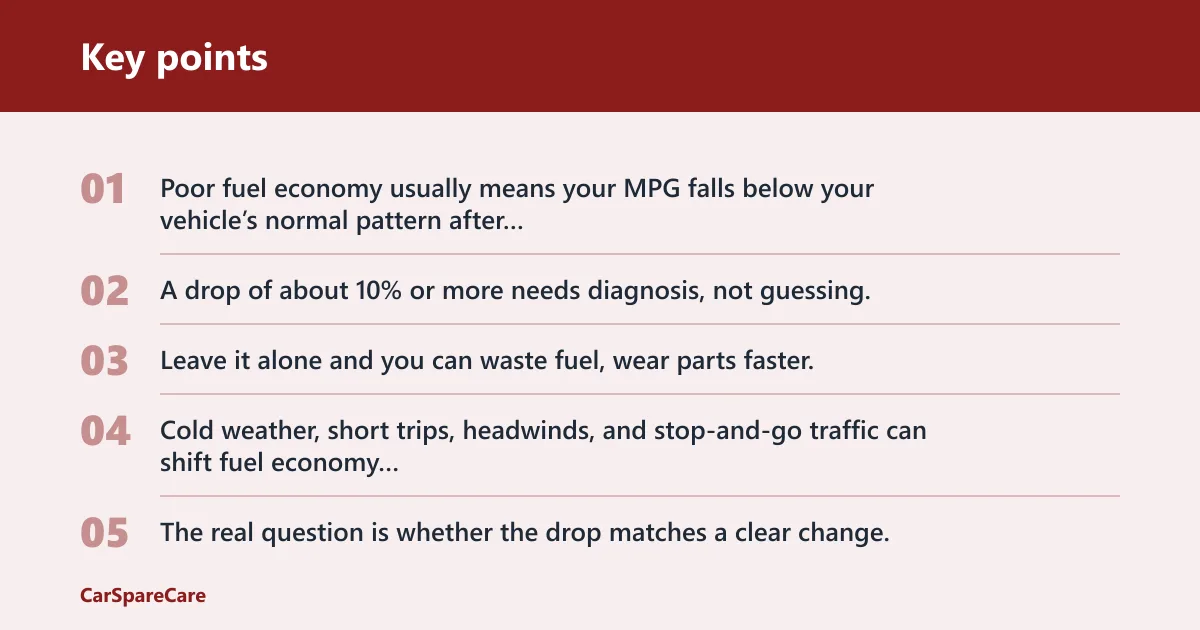
Poor fuel economy usually means your MPG falls below your vehicle’s normal pattern after a change in weather, route, traffic, or maintenance condition. A drop of about 10% or more needs diagnosis, not guessing. Leave it alone and you can waste fuel, wear parts faster, and miss a fault that will get worse.
What poor fuel economy looks like
Normal MPG variation versus a real drop
Some MPG movement is normal. Cold weather, short trips, headwinds, and stop-and-go traffic can shift fuel economy enough that the same car feels worse for a few tanks. The real question is whether the drop matches a clear change, or whether it appeared without an obvious driving or weather reason.
If the lower MPG shows up only in winter, on short commutes, or on a new route with more idling, that points first to conditions and warm-up. If the drop appears across the same route, the same driver, and the same season, it is more likely to be a rolling-resistance issue, a brake drag problem, or an engine-control fault.
Sudden loss of MPG versus gradual decline
A sudden MPG loss usually points to something that changed quickly: a tire pressure drop, a dragging brake, a check engine light fault, or a thermostat stuck open. A gradual decline often fits maintenance wear, such as aging spark plugs, a filter that is getting restricted, or a sensor that is drifting out of range.
Picture a sedan that drops from its usual commute MPG to a much lower number over one week. If the route did not change, start with tire pressure and brake drag before replacing parts. If the decline has been slow over months, look harder at maintenance age and engine-control data.
The symptoms that point to a mechanical cause
Mechanical causes usually leave clues beyond low MPG. Look for weak acceleration, rough idle, a fuel smell, hot wheels, weak cabin heat, or a check engine light. Those signs help separate simple rolling-resistance issues from warm-up problems and fuel-control faults.
Poor fuel economy symptom map
This table gives you a quick way to sort likely causes before you buy parts. Start with the symptom pattern, then match it to the safest check and the urgency.
| Symptom pattern | Likely cause | Quick safe check | Urgency | Mainly affects |
|---|---|---|---|---|
| MPG lower after a cold snap; tires look normal but feel soft | Underinflated tires | Check cold tire pressure against the driver-door jamb sticker | Low, but check soon | Both |
| One wheel hotter than the others; car feels sluggish or drags | Dragging brakes | After a short drive, compare wheel temperature carefully without touching hot parts | High; urgent inspection | Both |
| City MPG drops first; cabin heat seems weak on short trips | Thermostat stuck open | Watch whether engine warm-up is slow and heat output stays weak | Moderate to high | City |
| Rough idle, poor acceleration, or misfire feel with lower MPG | Worn or fouled spark plugs | Check service history and scan for misfire codes | Moderate | Both |
| Check engine light on, fuel smell, or rich-running symptoms | Faulty oxygen sensor | Read trouble codes before replacing anything | High if drivability suffers | Both |
| Sluggish performance with no obvious tire or brake issue | Mass airflow sensor fault | Check for intake contamination and code data | Moderate | Both |
| Drop appears mainly after short winter trips | Cold weather, short trips, extra warm-up time | Compare MPG on longer drives in similar weather | Low unless warning signs appear | City |
Can low tire pressure cause bad gas mileage?
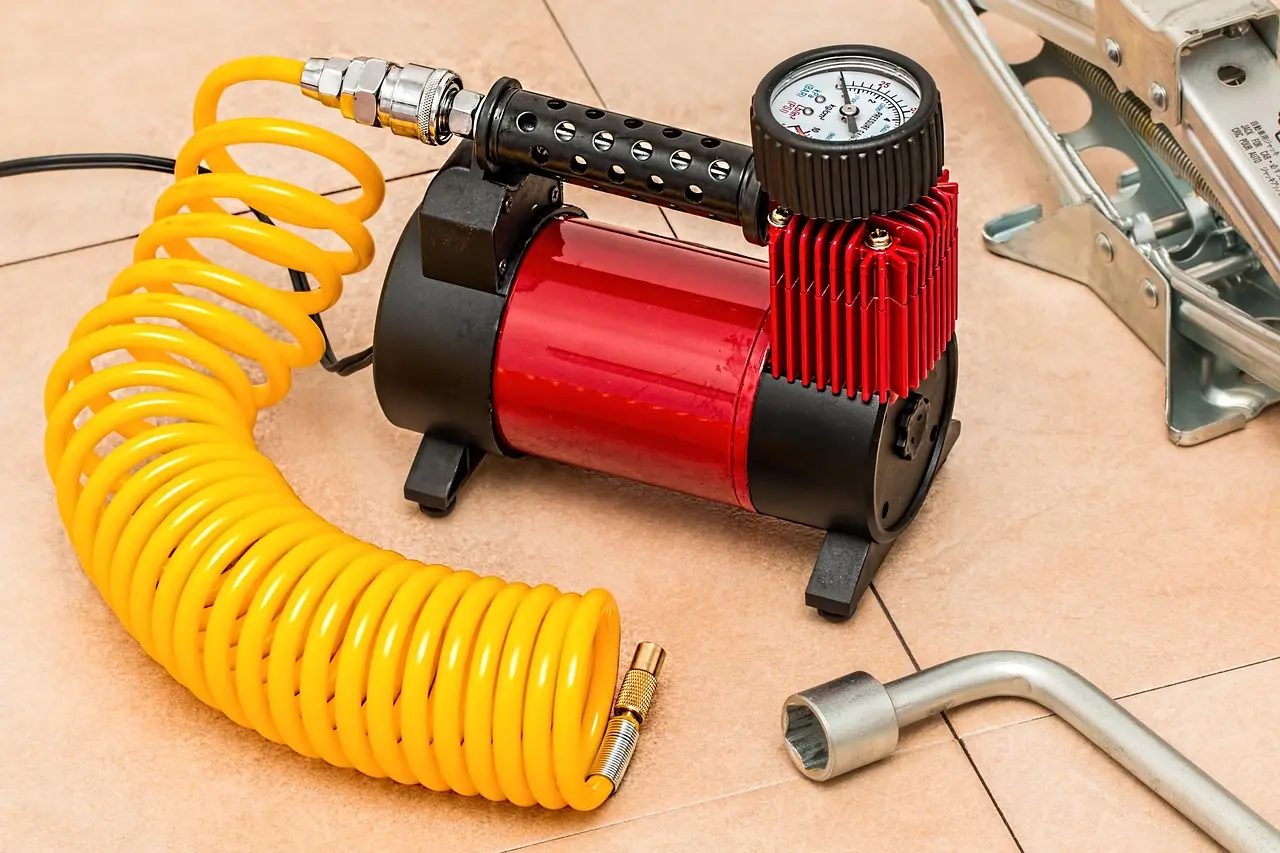
Yes. Underinflated tires increase rolling resistance, so the engine has to work harder to keep the car moving. Even a small pressure loss across four tires can trim MPG, and a drop of 1 PSI across four tires can cut gas mileage by 0.1% to 0.3%.
Why underinflation raises rolling resistance
A tire that is low on air flexes more as it rolls. That extra flex wastes energy as heat, which shows up as lower MPG. Underinflating tires by 10 PSI can slash efficiency by 2 to 3 percent, and correcting improper tire pressure can improve fuel economy by up to 3 percent.
How cold weather changes pressure
Cold weather lowers tire pressure, so a car that was fine in mild weather can drift into underinflation once temperatures fall. That is why monthly pressure checks matter, especially after a seasonal temperature change. Check cold pressure before driving, not after a highway run that warmed the tires.
How to check the placard value
- Find the driver-door jamb sticker.
- Read the recommended cold tire pressure for your vehicle.
- Use a gauge on cold tires before driving or after the car has sat long enough to cool down.
- Adjust all tires to the listed value, including the spare if the vehicle uses a monitoring system that references it.
- Recheck monthly and after large temperature swings.
Can a dirty air filter affect fuel economy?
Yes, though it is usually not the first thing to blame unless the filter is heavily restricted. A clogged filter can reduce airflow, hurt acceleration, and change throttle response. On older carbureted vehicles, a dirty air filter can reduce fuel economy by as much as 10 percent.
When airflow restriction matters
Engine air filters are commonly replaced every about 15,000 to 30,000 miles, though the service interval depends on driving conditions. Dusty roads and long service gaps can shorten that window. When the filter is restricted, the engine may feel lazy off the line and less responsive to throttle input.
What else a clogged filter can change
A restricted filter does not usually cause a hot wheel or a fuel smell. It tends to show up as reduced airflow, weaker acceleration, and sometimes a slight drop in MPG. Most air filters cost between $15 and $40, but replacement should follow the symptom pattern rather than guesswork.
When filter service should move higher on the list
If the filter is visibly dirty, damp, or clogged with debris, move it up the checklist. If the car also has sluggish throttle response and no tire or brake issue, filter service becomes more likely. If the MPG drop is sudden and large, still check tire pressure and codes first.
Do spark plugs affect gas mileage?
Yes. Worn or fouled spark plugs can cause incomplete combustion, which wastes fuel and can make the engine feel rough. Spark plugs are often recommended for replacement every 30,000 to 100,000 miles, depending on plug type and engine design. Restoring ignition health can improve MPG by several percent.
How worn plugs waste fuel
When spark plugs fire weakly, the air-fuel charge may not burn completely. That can leave the engine running less efficiently and may trigger misfire-related drivability issues. You may notice hesitation, rough idle, poor acceleration, or a general loss of smoothness before the MPG drop becomes obvious.
Why plug type changes replacement timing
Replacement intervals vary by plug type. Copper plugs usually need service sooner than iridium or platinum designs, and manufacturer intervals can differ widely. That is why service history matters more than a one-size-fits-all mileage guess.
Why MPG can improve after ignition repair
Fixing ignition problems does not just stop a misfire light. It can restore more complete combustion, which helps the engine use fuel more effectively. If the car has been running rough and the plugs are overdue, plug service belongs near the top of the list.
Which sensor faults can hurt MPG?
Two common suspects are the oxygen sensor and the mass airflow sensor. An oxygen sensor feeds air-fuel mixture data to the engine computer, while a mass airflow sensor measures the air volume and density entering the engine. Faulty readings can change fuel delivery and lower MPG.
Oxygen sensor signs and rich running
A faulty oxygen sensor can cause the engine to run rich, which wastes fuel. The check engine light often appears, and in extreme cases a faulty oxygen sensor can reduce MPG by as much as 40 percent. Fuel smell and poor economy together make this fault more likely.
Mass airflow sensor symptoms and fuel delivery errors
A bad mass airflow sensor can send the wrong airflow signal to the engine computer. That can alter fuel delivery and cause sluggish performance, poor throttle response, or an uneven idle. If the car feels lazy but does not show tire or brake issues, this sensor deserves attention.
How a check engine light helps narrow the fault
A lit check engine light does not name the exact part, but it narrows the hunt. Scan codes help separate sensor faults from routine maintenance items. If the light is flashing, stop driving and get the car checked, because a flashing light can signal a misfire serious enough to damage the catalytic converter.
What driving and weather factors matter?

Driving conditions can lower MPG even when the car has no mechanical fault. Stop-and-go traffic, short trips, cold weather, higher speeds, extra weight, and roof drag all raise fuel use. The challenge is knowing when those factors explain the drop and when they only mask a real problem.
Stop-and-go traffic and short trips
Stop-and-go traffic lowers mileage because the car spends more time accelerating from rest and idling at lights. Idling can waste 0.25 to 0.5 gallons per hour. Short trips are even harder on MPG because the engine may not reach efficient operating temperature before you park again.
Cold weather, warm-up time, and tire pressure
Why does my MPG drop in cold weather? Cold temperatures lengthen warm-up time and lower tire pressure at the same time. That combination hurts city MPG first. Weak cabin heat can also point to a thermostat that is stuck open, which keeps the engine too cool for too long.
Speed, route choice, weight, and roof drag
Higher speed increases aerodynamic drag, so highway MPG can fall even if the car is mechanically sound. Aggressive driving can lower gas mileage by up to 30% at highway speeds and by up to 40% in stop-and-go traffic. Excess weight can reduce efficiency by about 1 percent per 100 pounds, and a roof rack can slash fuel economy by 12.7 percent even when empty.
Suppose your compact SUV loses MPG mostly on a 10-mile city run in January, and the heater takes longer than usual to blow warm air. That pattern points first to cold-weather warm-up loss and possibly a thermostat issue, not a bad oxygen sensor. If the same SUV also has one wheel hotter than the others, brake drag moves much higher on the list.
When should I get a car checked for poor fuel economy?
Get the car checked when the MPG drop is sudden, when a warning light appears, or when the loss is paired with fuel smell, rough idle, overheating, or one hot wheel. Those signs suggest a fault that can get worse, and some of them call for urgent inspection rather than routine maintenance.
Safe escalation criteria
A flashing check engine light is urgent. So is a hot wheel, strong fuel smell, overheating, or obvious brake drag. Those signs move the issue out of the “wait and watch” category. If you see none of them, start with tire pressure, then codes, then the air filter, plugs, and sensor data.
A priority checklist before buying parts
- Check cold tire pressure against the door-jamb sticker.
- Look for one wheel hotter than the others after a short drive.
- Scan for engine codes if the check engine light is on.
- Inspect the engine air filter for restriction.
- Review spark plug service history and misfire symptoms.
- Consider oxygen sensor or mass airflow sensor faults if the car runs rich, idles badly, or feels sluggish.
Frequently asked questions
What causes poor fuel economy in a car?
Poor fuel economy usually comes from underinflated tires, dragging brakes, a cold-running engine, worn spark plugs, bad sensor data, or driving conditions that raise fuel use. Start with the cheapest safe checks first: tire pressure, hot-wheel inspection, warning lights, and recent route or weather changes before replacing parts.
What causes bad fuel economy in a car?
Bad fuel economy can be caused by the same issues as poor MPG: rolling resistance, warm-up problems, ignition wear, and fuel-control faults. If the drop is sudden, look for tire pressure loss, brake drag, or a check engine light. If it is gradual, maintenance age becomes more likely.
What is poor fuel economy?
Poor fuel economy means your vehicle is using more fuel than its normal pattern for the same kind of driving. A meaningful drop is often tied to weather, route, traffic, or a mechanical issue. A 10% or larger decline deserves diagnosis instead of assumption.
Why is my fuel economy getting worse?
Fuel economy usually gets worse because something has changed. Cold weather, short trips, higher speeds, traffic, low tire pressure, or a part that is wearing out can all be responsible. If the decline is steady, check maintenance items. If it is abrupt, check for a fault first.
Can an oxygen sensor cause poor fuel economy?
Yes. An oxygen sensor feeds mixture data to the engine computer, and a faulty one can make the engine run rich. The check engine light often appears, and MPG can fall sharply in extreme cases. Scan codes first so you do not guess at the wrong sensor.
Why does my MPG drop in cold weather?
Cold weather lowers tire pressure and extends engine warm-up time, so MPG often falls most on short city trips. Weak cabin heat can also point to a thermostat stuck open. If the drop appears only in winter, conditions may explain it; if it persists, check for a fault.

Hi, I’m Melvin, an automobile engineer with extensive experience in automobile equipment. I currently work for a local automobile firm, where I specialize in the car parts industry. I’ve had the opportunity to collaborate with seasoned inspectors, gaining invaluable hands-on experience that goes beyond just theory.
My passion for automotive care started at a young age, which led me to create CarSpareCare. Through CarSpareCare, I share the knowledge and skills I’ve acquired over the years to help others navigate the world of car maintenance and repairs.
My goal is to provide practical tutorials, essential safety advice, and the latest industry insights so that anyone—whether a beginner or an expert—can confidently tackle their automotive projects.

