

For short-distance commuters, a common rule of thumb is to follow time first: change engine oil every about 6-12 months, replace brake fluid every about 2 years, and inspect battery, coolant, and filters at each season change even if mileage stays low. Ignoring short-trip use lets moisture, fuel dilution, and weak batteries age the car faster than the odometer suggests. This guide turns low-mileage driving into a practical maintenance schedule with intervals, checks, and the parts most likely to suffer on repeated short runs.
Why short trips age cars faster
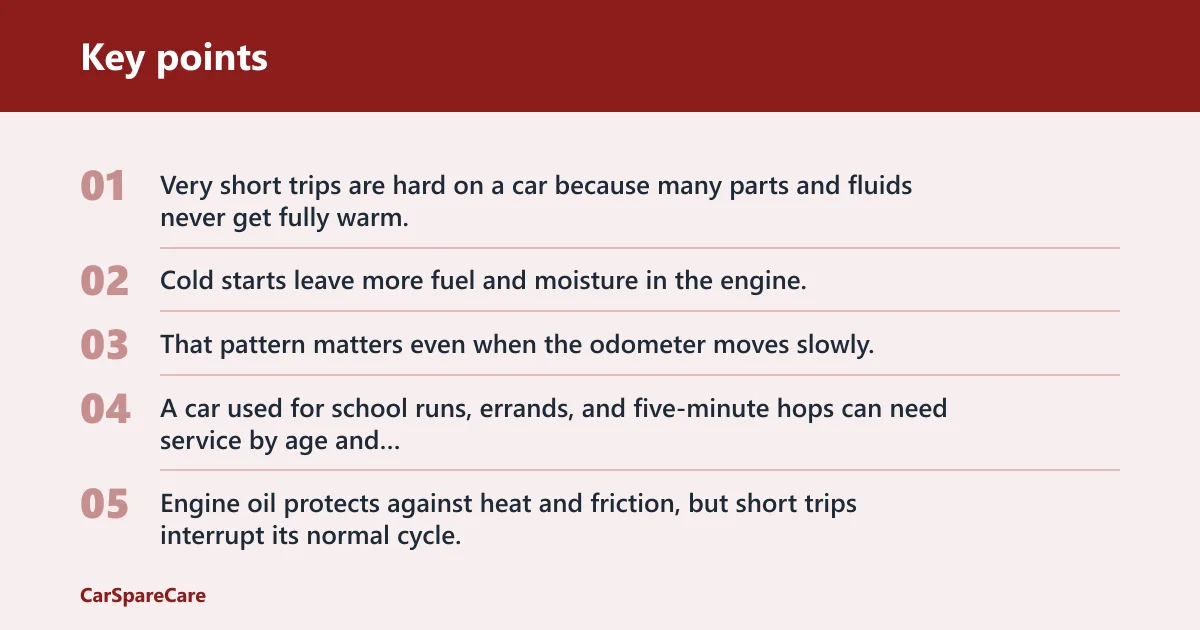
Very short trips are hard on a car because many parts and fluids never get fully warm. Cold starts leave more fuel and moisture in the engine, while stop-and-go traffic adds heat, braking, and charging demands without giving the battery much time to recover.
That pattern matters even when the odometer moves slowly. A car used for school runs, errands, and five-minute hops can need service by age and condition before it needs service by mileage.
What repeated cold starts do to oil and moisture
Engine oil protects against heat and friction, but short trips interrupt its normal cycle. Moisture from combustion and fuel dilution can build up faster when the engine does not stay hot long enough to boil contaminants away.
That is why oil can age out before the mileage interval. For low-mileage drivers, the calendar often matters more than the odometer.
How stop-and-go traffic changes wear patterns
Stop-and-go driving adds repeated braking, idling, and heat soak. CJ Auto Services notes that commuter vehicles face constant stop-and-go traffic, short trips, hot pavement, sudden rain, and wear that builds up quietly.
Heat is hard on batteries, fluids, hoses, and air conditioning systems. The result is uneven wear: brakes and battery load rise, while airflow through filters and cooling parts can suffer in traffic-heavy use.
Why low mileage can hide maintenance needs
Low mileage does not mean low maintenance. A car that covers only a few miles a day may still need oil changes, fluid checks, and battery testing because age, humidity, and heat still work on the car between drives.
Say your car covers 3 miles to school and 3 miles back, five days a week. The odometer stays low, but the engine may never run long enough to fully dry out moisture or recharge the battery.
When should you use time instead of mileage?

Use time instead of mileage when the car spends most of its life on very short trips, in heavy traffic, or parked for long stretches between uses. If the owner’s manual gives both a time and mileage interval, the sooner one is the safer baseline for short-distance commuters.
If your driving pattern is seasonal, irregular, or mostly low-speed city use, age-based service should move up the list. The manufacturer service schedule still sets the baseline, but short-trip driving justifies earlier checks on the items that age with time, heat, and moisture.
A simple rule for low-mileage drivers
Use mileage when the car regularly reaches full operating temperature on longer drives. Use time when trips are short enough that the engine, battery, and exhaust system rarely get fully warm. If most drives are under about 10 minutes, treat the calendar as your main service clock.
For many commuters, that means oil, filters, and fluid checks should happen on a seasonal or annual rhythm even if the car has not reached a high mileage total.
When the owner’s manual should override habit
The owner’s manual is the primary baseline for service intervals. If it calls for earlier service than this guide, follow it. If it gives a severe-use schedule, short-trip, stop-and-go driving usually belongs in that category.
For full service planning, one commuter guide recommends a full service every 12 months or every 10,000–15,000 miles. For short-trip use, the 12-month mark often arrives first.
How to handle seasonal or irregular driving
Seasonal storage, long vacation gaps, and winter-only use can age fluids and batteries without adding many miles. A battery can test fine after a drive and still struggle later if it spends most of the week undercharged.
Inspect at each season change. That is the cleanest way to catch heat damage in summer, moisture issues in damp weather, and cold-weather battery weakness before it leaves you stranded.

Short-distance commuter maintenance matrix
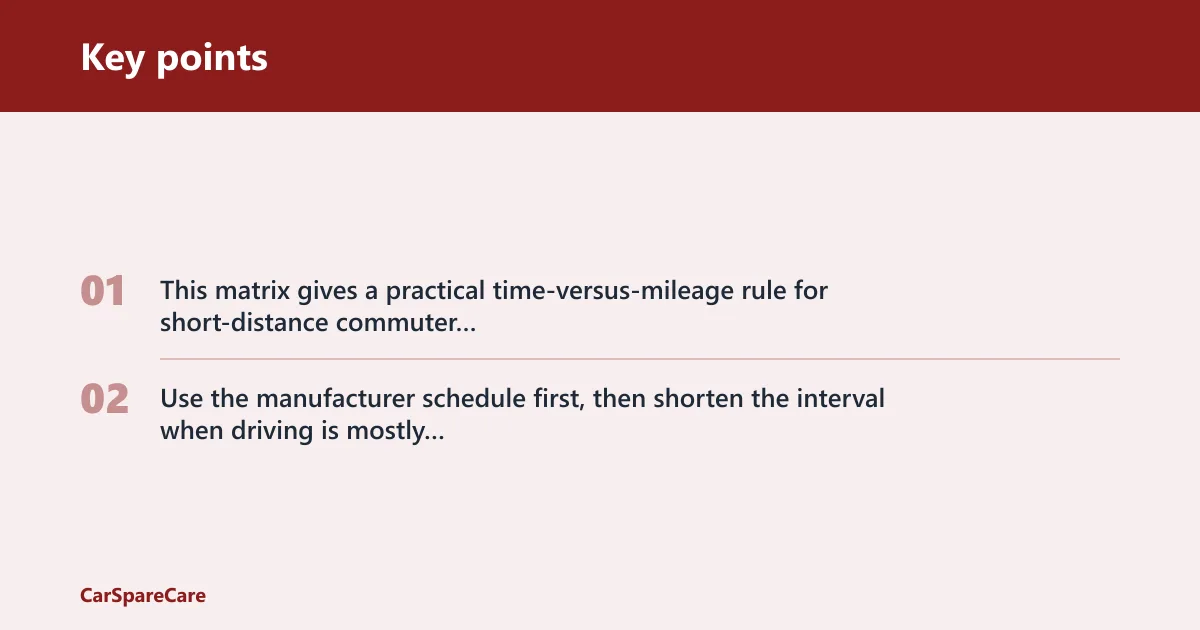
This matrix gives a practical time-versus-mileage rule for short-distance commuter maintenance. Use the manufacturer schedule first, then shorten the interval when driving is mostly short, stop-and-go, hot, dusty, or humid.
| System | Why short trips stress it | What to check | When to act |
|---|---|---|---|
| Engine oil | Short trips keep oil from reaching full operating temperature, which can leave moisture and fuel dilution in the crankcase. | Level, color, smell, service date, oil-life reminder | Follow the manual first; for low-mileage short-trip driving, plan changes by time rather than waiting for miles |
| Battery | Short drives may not fully recharge the battery, and heat shortens battery life. | Slow cranking, dim lights, electrical glitches, battery age | Test if symptoms appear, and at each season change on a short-trip vehicle |
| Tires | Frequent starts, stops, and curb-side parking can hide uneven wear and pressure loss. | Pressure, tread depth, sidewall damage, wear pattern | Check monthly; act sooner for uneven wear or low pressure |
| Brakes | Repeated braking in traffic wears pads and can heat rotors more often. | Pad thickness, rotor condition, pedal feel, squeal, grinding | Inspect at the first warning sign, and at each season change if driving is mostly stop-and-go |
| Coolant | Heat, idling, and blocked airflow raise thermal load in daily traffic. | Level, leak traces, hose condition, overflow tank, warning light | Check at each season change and before long drives |
| Transmission fluid | Frequent low-speed shifting and heat can age fluid even when mileage is modest. | Fluid level, color, odor, shift quality, hesitation | Use the manual; for low-mileage cars, do not skip time-based checks |
| Engine air filter | Dust, pollen, and traffic grime can restrict airflow. | Dirt load, restriction, service date | Inspect seasonally or sooner in dusty traffic; replace if clogged |
| Cabin air filter | Urban traffic, pollen, and dust can clog it faster and raise HVAC load. | Airflow, odor, visible dirt, fan noise, AC performance | Replace earlier if airflow drops or if traffic and dust are constant |
What should you check every month?
Check tires, battery symptoms, and fluid levels every month if the car is used mostly for short trips. Monthly checks catch slow pressure loss, weak charging, and leaks before they become expensive or unsafe.
The check takes little time. Monthly five-minute checks for tire pressure, tread depth, and visual damage, which fits short-trip ownership well.
Tire pressure and tread depth
Check pressure when tires are cold, and compare all four tires. Short-trip drivers can miss uneven wear because the car is never on long runs often enough to make the problem obvious.
Look for edge wear, bulges, nails, and cuts. If tread is getting close to the wear bars, do not wait for a convenient service interval.
Battery warning signs and slow cranking
A battery can test fine and still fail a short-trip car because it never gets a full recharge. Heat shortens battery life, and many drivers do not realize there is a problem until the car struggles to start.
Slow cranking, dim lights, and electrical glitches are signs to test the battery and charging system. If those symptoms appear after a series of short drives, the battery should move to the top of the list.
Fluid levels, leaks, and dashboard lights
Check engine oil, coolant, brake fluid, power steering fluid, and windscreen washer fluid on the same monthly routine. That matches the core items most commuter schedules list for regular checks.
Look under the car for drips, and do not ignore warning lights. A low coolant level can lead to overheating, while low fluid in other systems can turn a small leak into a bigger repair.
What fluids matter most on short commutes?
Engine oil and coolant matter most, with transmission fluid close behind. Short trips make oil age faster, increase moisture risk, and keep the cooling system under repeated heat load. Transmission fluid also deserves time-based attention on low-mileage cars because age and heat still change its condition.
Engine oil and service timing
Short-trip driving can make engine oil go bad faster because the oil may never fully dry out moisture or burn off fuel dilution. That is why oil should be checked by time as well as mileage, especially for cars that spend most of their life on errands and school runs.
For commuters, oil and filter changes are specifically recommended in heavy traffic and frequent short trips. The clean rule is simple: if the car rarely gets long drives, do not wait for mileage alone.
Coolant and overheating prevention
Coolant keeps heat under control, and short-trip traffic can raise heat without giving the system much recovery time. Check coolant level, look for leaks, and watch for warning lights or temperature spikes.
A low coolant level can cause overheating. That risk is higher in hot weather, on hot pavement, and during repeated idling.
Transmission fluid and shift quality
Transmission fluid supports shifting and lubrication. Low or dirty fluid can cause hesitation or rough shifting, which may show up first in stop-and-go driving.
Do not assume low mileage protects the fluid. Time-based checks matter for cars that rarely build up long, continuous heat cycles.
Do air filters need earlier replacement in traffic?
Yes, often. Engine air filters and cabin air filters can load up faster in dusty traffic, urban driving, and pollen-heavy conditions. The engine filter affects airflow and performance, while the cabin filter affects cabin airflow and HVAC load.
In traffic, both filters can age by dirt load even when mileage looks modest. If airflow drops, replacement may be due before the usual interval.
Engine air filter restriction and airflow
A dirty engine air filter can affect performance. Inspect it for dirt, staining, and restriction, especially if the car spends time in construction zones, dusty streets, or heavy traffic.
Do not wait for a rough-running engine if the filter looks loaded. Restricted airflow can steal efficiency before the issue feels dramatic.
Cabin air filter load and HVAC performance
A clogged cabin filter can reduce airflow and make the AC work harder. That matters in commuter cars because the HVAC system is used often, even on very short runs.
Should you replace the cabin air filter more often if you commute in traffic? Usually yes, if the filter picks up dust, pollen, or soot quickly. Reduced airflow, weak fan output, and stale odors are the usual clues.
Dust, pollen, and urban driving conditions
Urban traffic, roadside dust, and seasonal pollen all shorten filter life. Humid weather can also make stale air and musty odors more noticeable inside the cabin.
Suppose your commute is six miles through a city corridor with construction detours and idling at signals. The filter may need attention much sooner than a highway commuter’s filter, even with similar mileage.
How do brakes and tires show short-trip wear?
Brakes and tires show short-trip wear through frequent use, heat, and hidden patterns. You should inspect pad thickness, rotor condition, tire pressure, tread depth, and alignment-related wear because commuter driving can wear components steadily without making noise right away.
Pads, rotors, and pedal feel
Braking issues can be caught early through squealing, grinding, or a spongy feel. Frequent stop-and-go driving wears pads faster, and repeated heat can make rotor problems show up sooner.
If stopping distance grows or the pedal feels different, do not wait. Brake checks should happen before the car reaches a squeal or grind.
Uneven wear, alignment, and inflation
Tire wear can hide on low-mileage cars because the driving pattern is short and repetitive. Pressure loss, curb contact, and parking on one side of the same street can all create uneven wear.
Monthly pressure checks are practical for commuters. Tire tread depth and visual damage belong in that same routine.
Warning signs you should not ignore
Look for vibration under braking, pulling to one side, one tire wearing faster than the others, or a steering wheel that sits off-center. Those signs can point to brake, tire, or alignment trouble that short trips can mask for weeks.
Have a mechanic handle serious issues. That is especially important if warning lights, fluid loss, or grinding noises appear together.
Frequently asked questions
Is short-distance driving bad for your car?
Yes, if most trips are short enough that the engine never fully warms up. Short-distance driving can age oil, drain the battery, and load filters faster than the odometer suggests. Very short trips with heavy traffic, cold weather, or humidity are the hardest on the car.
How often should a commuter car get serviced if I only drive a few miles a day?
Use the manufacturer schedule as the baseline, then lean on time-based service. For many low-mileage commuters, a yearly full service is a sensible floor, with oil and filter changes timed by age rather than miles. Seasonal checks are smart when trips are mostly short.
What maintenance does a car need for lots of short trips?
Focus on engine oil, battery testing, tires, brakes, coolant, transmission fluid, and both air filters. Short-trip use calls for monthly tire checks, seasonal battery and fluid inspections, and earlier attention to filters if the car sees dust, pollen, or constant stop-and-go traffic.
Does short-trip driving make engine oil go bad faster?
Yes. Short trips can keep oil from getting hot enough to evaporate moisture and break down contaminants. That is why oil changes should follow time as well as mileage on a commuter car that rarely runs long enough to fully warm up.
How do I know if my battery is being drained by short drives?
Watch for slow cranking, dim headlights, dashboard glitches, or a need to jump-start after the car sits. Heat also shortens battery life. If the car is driven mostly in short bursts, have the battery and charging system tested before winter or after repeated weak starts.
What fluids matter most for a car used on short commutes?
Engine oil matters most, followed by coolant and transmission fluid. Oil is the one most likely to age out on short trips, coolant protects against heat and overheating, and transmission fluid can still degrade by time even when mileage stays low.

Hi, I’m Melvin, an automobile engineer with extensive experience in automobile equipment. I currently work for a local automobile firm, where I specialize in the car parts industry. I’ve had the opportunity to collaborate with seasoned inspectors, gaining invaluable hands-on experience that goes beyond just theory.
My passion for automotive care started at a young age, which led me to create CarSpareCare. Through CarSpareCare, I share the knowledge and skills I’ve acquired over the years to help others navigate the world of car maintenance and repairs.
My goal is to provide practical tutorials, essential safety advice, and the latest industry insights so that anyone—whether a beginner or an expert—can confidently tackle their automotive projects.

