
For high-mileage cars, sort maintenance by risk: fix safety faults and fluid loss first, service wear items next, and leave low-risk convenience work for later. At about 75,000-100,000 miles, begin with fluids, belts, tires, brakes, and the cooling system. Skip that order, and a small fault can become a roadside failure or a larger bill. This guide shows what to inspect now, what to schedule next, and what can wait by mileage band.
High-mileage maintenance triage table

This table separates true high-mileage priorities from normal age-related wear. Use it when budget is limited, then move items up or down based on leaks, warning signs, and how the car is used.
| Mileage band | Inspect now | Service soon | Monitor |
|---|---|---|---|
| 75,000–100,000 miles | Oil level and leaks; coolant level, hoses, cap, and reservoir; brake pad thickness; tire tread and pressure; battery; OBD2 codes; radiator and accessory belts | Spark plugs; transmission fluid condition; brake fluid age; alignment if wear is uneven | Minor cosmetic seepage, small rubber surface cracking, and parts that show no symptoms yet |
| 100,000–125,000 miles | Transmission fluid level and shift quality; cooling system residue or wetness; suspension play; steering play; uneven tire wear; belt glazing or fraying | Drain-and-fill service for transmission if the manual calls for it; coolant service by interval; spark plugs if not already done | Low-risk seepage that has not changed, but only if fluid level and temperature stay stable |
| 125,000–150,000 miles | Shocks and struts; control arm bushings; ball joints; tie rods; brake rotors; transfer case and differential fluids on AWD or 4WD; hose softness or bulging | Brake fluid replacement if old; drivetrain fluid service if overdue; cooling service if age or condition is unknown | Parts with no play, no noise, and no uneven wear can wait, but only after a clean inspection |
| 150,000+ miles | Safety systems first: brakes, tires, steering, suspension, cooling, and transmission behavior under load | Any overdue fluid service, rubber parts showing age, and components that affect drivability or stopping distance | Convenience items and non-urgent cosmetic repairs, provided no fault codes or symptoms are present |
The reason the list changes by mileage is simple. Age and mileage raise the odds that leaks, rubber failure, and wear will show up together. A hose that looks fine at 80,000 miles may not stay that way much longer if the car tows, sits in traffic, or sees short trips every day.
What should you check first?
Start with fluids, leaks, visible wear, and anything that points to a safety or breakdown risk. Then scan for stored diagnostic trouble codes with an OBD2 tool even if the check engine light is off, test the battery, and take a short drive to catch brake, tire, or steering clues that do not show up at idle.
Start with fluids, leaks, and visible wear
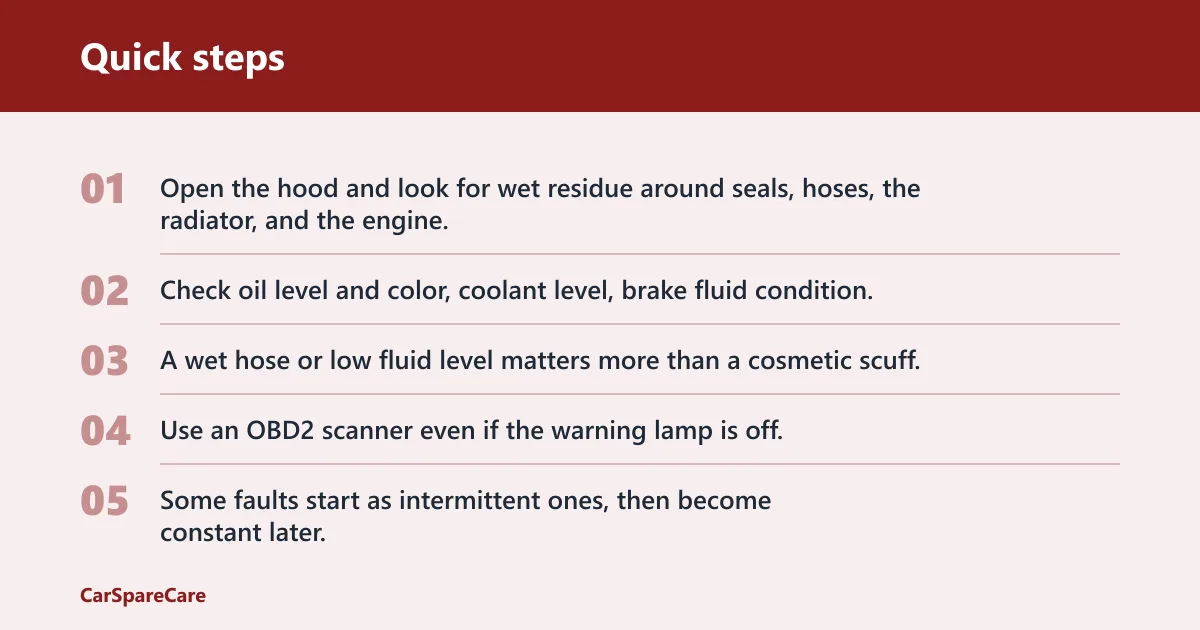
Open the hood and look for wet residue around seals, hoses, the radiator, and the engine. Check oil level and color, coolant level, brake fluid condition, and transmission fluid level if the car provides a safe way to verify it. A wet hose or low fluid level matters more than a cosmetic scuff.
Scan for stored trouble codes
Use an OBD2 scanner even if the warning lamp is off. Some faults start as intermittent ones, then become constant later. Stored codes can point to misfires, sensor issues, or cooling problems before drivability changes become obvious.
Test the battery before chasing symptoms
Battery weakness can mimic a starter problem, a charging issue, or random electrical faults. Test it as part of the baseline inspection and verify warning indicators on the dash. If the battery is old or cranks slowly on cold starts, treat it as a likely cause rather than a nuisance.
Look for brake, tire, and steering clues on a short drive
Listen for squealing, grinding, or humming. Feel for pedal pulsation, pulling, or steering wander. Check for vibration at speed, which can come from tires, alignment, or worn suspension parts. These clues help separate a wear item from a more urgent failure.
How do I maintain a high-mileage car?
Maintain it by inspecting the systems that fail first on older vehicles: oil, coolant, transmission fluid, brakes, tires, suspension, steering, belts, hoses, plugs, and battery. Follow the owner’s manual for intervals, then move items up when you see leaks, uneven wear, temperature spikes, delayed shifting, or longer stopping distance.
Engine oil and coolant checks
Check engine oil often and use the manufacturer-recommended viscosity. Watch for burning oil, sludge, and wet residue around valve covers, pan gaskets, and front or rear seals. Coolant deserves the same attention: follow the owner’s manual flush interval, inspect hoses for cracking, softness, or bulging, and check the radiator cap and reservoir.
Temperature spikes matter. A cooling system can look acceptable in the driveway and still fail under load, in stop-and-go traffic, or on a hot day. Delaying a coolant hose or service interval can turn a manageable repair into an overheating event that risks head gaskets, a radiator, or a water pump.
How severe use changes service timing
Towing, short trips, and hot weather shorten the useful life of fluids and rubber parts. Short trips leave condensation and fuel contamination behind, while towing and heat push the cooling and transmission systems harder. That is why the same car can need earlier service even when the odometer looks modest.
Suppose a 4-cylinder sedan makes only five-mile commutes in summer and idles in traffic each afternoon. The owner’s manual interval still matters, but the car should be checked sooner for coolant loss, battery weakness, and transmission heat stress than a similar car used on long highway drives.
Transmission and drivetrain fluid care
Transmission fluid should be checked for level and condition, then serviced by the drain-and-fill or other interval listed in the manual. Watch for harsh shifting, delayed engagement, or shuddering. On AWD and 4WD vehicles, transfer case and differential fluids also belong on the checklist, not as an afterthought.
Level and condition checks
Low fluid can cause slipping, delayed engagement, or noisy operation. Dark, burnt-smelling fluid is also a warning sign. If the fluid looks contaminated or the shifts have changed, do not wait for the problem to become severe; drivetrain wear can move from a service item to a repair quickly.
Why timing matters here
Transmission service often costs far less than transmission repair. The same logic applies to transfer case and differential fluids. Ignore them, and wear particles and heat can move through bearings and clutches, which raises the chance of a much larger bill than a routine drain-and-fill.
Brake, tire, and alignment checks
Brakes, tires, and alignment are the main safety group on a high-mileage car. Review pad thickness, rotor condition, and brake fluid age. Inspect tires for uneven wear, cracking, and low tread depth, then set pressure to the door placard. Uneven wear often points to alignment or suspension issues, not just old rubber.
Brake system checks
Look for thin pads, grooved or warped rotors, and brake fluid that is old or discolored. Squealing often points to pad wear; grinding usually means the pads are already too thin; pulsation points toward rotor wear or thickness variation. Those are not cosmetic complaints. They are repair signals.
Tires and alignment clues
Check tread depth across the tire, not only at one spot. Cupping, feathering, and edge wear often point to shocks, struts, or alignment trouble. Cracking and dry rot matter too, especially on cars that sit outside or see hot summers. Pressure should match the door placard, not the sidewall number.
Suspension, steering, belts, and hoses
Suspension and steering parts wear gradually, so the change can be easy to miss. Inspect shocks and struts, control arm bushings, ball joints, tie rods, and steering play. Also inspect radiator hoses and accessory belts for cracking, glazing, fraying, or any age-related rubber failure that could stop the car unexpectedly.
Suspension and steering components
Loose steering, clunks over bumps, and drifting on the road are strong clues. Worn bushings and ball joints can affect tire wear, braking stability, and control. If the steering wheel needs constant correction or the front end feels loose, the issue belongs near the top of the list.
Belts and hoses that fail with age
Rubber parts fail from heat, time, and contamination. Radiator hoses can soften or bulge before they split. Accessory belts can glaze or fray before they snap. Replacing a belt or hose on schedule is usually a small job compared with the damage from overheating or a dead charging system.
A common first-timer mistake is replacing a belt only after it squeals. By then, the belt may already be glazed, and the tensioner or idler pulley may be part of the problem too. The better check is visual and tactile: cracks, fraying, shine, and abnormal play.
Why do older cars need tighter service timing?
Older cars need tighter timing because age and mileage raise the odds of multiple small failures appearing together. A fluid that is slightly low, a hose that is slightly soft, and a tire that is slightly underinflated can stack into a larger problem. Triage matters because not every fault becomes dangerous at the same speed.
Why short trips, towing, and hot climates matter
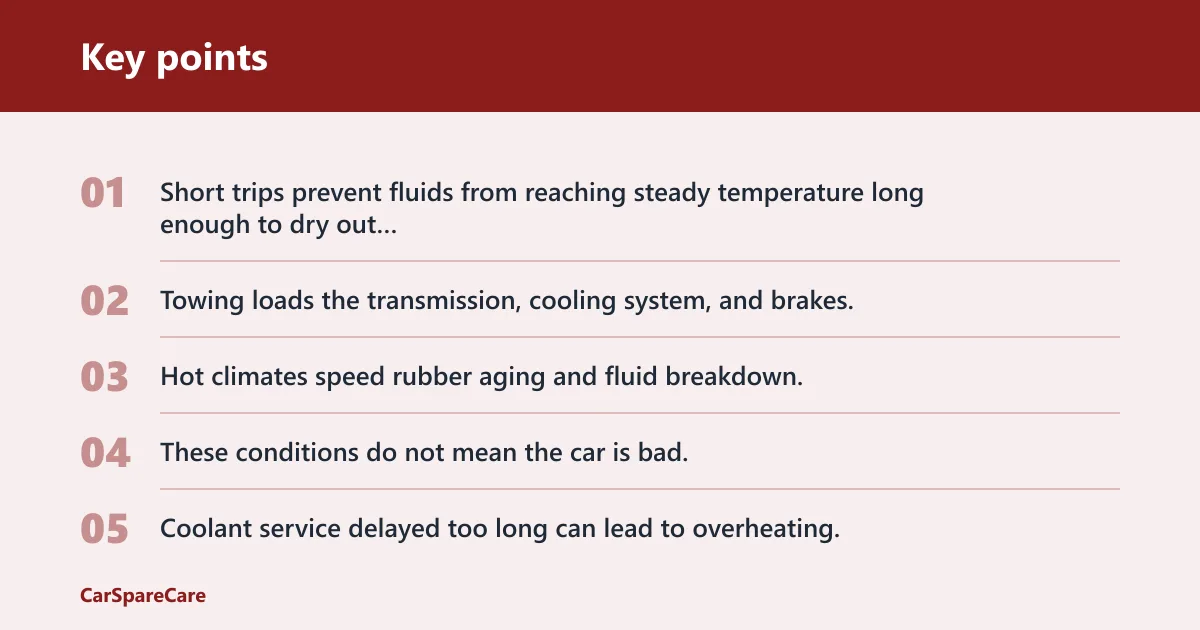
Short trips prevent fluids from reaching steady temperature long enough to dry out moisture. Towing loads the transmission, cooling system, and brakes. Hot climates speed rubber aging and fluid breakdown. These conditions do not mean the car is bad; they mean the service interval should be treated as a ceiling, not a target.
When a delayed service becomes a bigger repair
Coolant service delayed too long can lead to overheating, and overheating can damage expensive parts fast. Transmission service delayed past the point of clear symptoms can move from routine maintenance to slip, shudder, or internal wear. The same is true for brakes, where ignored pad wear can damage rotors.
What maintenance does a car need at 100,000 miles?
At 100,000 miles, a car usually needs a fuller baseline than it did at 75,000. Focus on oil, coolant, transmission fluid, brakes, tires, suspension, steering, belts, hoses, battery, and spark plugs. If the manual calls for a service at this point, do not stretch it simply because the car still drives well.
Common 100,000-mile service window items
Spark plugs often fall into an approximate 75,000- to 100,000-mile range, depending on engine design and plug type. Brake fluid age, coolant age, and transmission fluid condition also deserve close attention here. At this mileage, a clean inspection matters as much as the service itself.
- Check oil level, coolant level, brake fluid, and transmission fluid condition.
- Inspect tires, brakes, belts, hoses, and battery health.
- Scan the car for stored codes with an OBD2 tool.
- Road-test for noise, vibration, pulling, delayed shifting, and temperature spikes.
- Service the items the manual calls for first.
Frequently asked questions
How often should I service an older car with over 100,000 miles?
Service intervals should still follow the owner’s manual, but inspection should happen more often. A practical rhythm is to look over oil, coolant, tires, and visible rubber at every fuel or wash stop, then do a deeper check at regular maintenance visits or whenever the car changes behavior.
What are the most important high-mileage car maintenance tips?
Start with the systems that can cause breakdowns or safety loss: oil, coolant, transmission fluid, brakes, tires, suspension, steering, belts, hoses, and battery. Use an OBD2 scanner even with no warning light, because intermittent faults can be stored before the dashboard tells you there is a problem.
How do I know if my high-mileage car needs service?
Look for low fluids, wet residue, odd smells, new noises, delayed shifting, squealing brakes, pulsation, uneven tire wear, steering play, temperature spikes, or an older battery that cranks slowly. If any of those appear, move that system ahead of routine cosmetic work and schedule inspection sooner.
Why is regular maintenance more important on older cars?
Because wear accumulates and the margin for error gets smaller. An older car can still be reliable, but small leaks, aged rubber, and worn parts are more likely to appear together. Regular checks catch those changes before they become overheating, braking, charging, or driveline failures.
When should I replace belts, hoses, and fluids on a high-mileage car?
Replace them by condition and by the manual, not by mileage alone. Cracking, glazing, fraying, softness, bulging, dark fluid, burnt smell, or overheating means the item has moved up the list. If the car sees towing, short trips, or hot weather, inspect and service sooner.

Hi, I’m Melvin, an automobile engineer with extensive experience in automobile equipment. I currently work for a local automobile firm, where I specialize in the car parts industry. I’ve had the opportunity to collaborate with seasoned inspectors, gaining invaluable hands-on experience that goes beyond just theory.
My passion for automotive care started at a young age, which led me to create CarSpareCare. Through CarSpareCare, I share the knowledge and skills I’ve acquired over the years to help others navigate the world of car maintenance and repairs.
My goal is to provide practical tutorials, essential safety advice, and the latest industry insights so that anyone—whether a beginner or an expert—can confidently tackle their automotive projects.

