Steering kickback after a pothole usually means one of three things: a bent wheel or damaged tire if the shake starts right away, an alignment shift if the car pulls afterward, or worn steering and suspension parts if the wheel clunks or keeps darting. Ignore it and you can chew through tires fast, lose straight tracking, and turn a small hit into a bigger repair bill. This guide maps the jolt pattern to the most likely fault and shows the checks that separate wheel damage from alignment or worn parts.
What steering kickback feels like after a pothole

Steering kickback is a sudden force sent back through the steering wheel when a front wheel hits an obstacle. One hard jolt can be normal road shock. Repeated shimmy, clunking, wheel deflection, or a steering wheel that stays off-center points toward damage or wear that needs inspection.
One hard jolt versus repeated shimmy
A one-off jolt usually comes from the tire and suspension taking the hit and then settling back down. Repeated kickback after a short drive can suggest a bent rim, tire issue, loose steering parts, or geometry that changed after impact. That pattern often means a bent rim, a tire issue, loose steering parts, or geometry that changed after impact.
Wheel tug, clunk, vibration, and off-center steering
The exact feel matters. A tug can sometimes mean the alignment changed. A clunk can often mean play in a joint, bushing, or mount. Vibration points more toward the wheel and tire assembly. An off-center wheel after the hit suggests alignment shift or a mount that moved.
What normal road shock feels like
Normal road shock is brief and ends when the wheel clears the pothole. The steering wheel may move, but it does not keep shaking, pulling, or making noise. The car should track straight afterward, and the wheel should return to a centered position without effort.
What causes steering kickback when hitting potholes?

Potholes send a sharp upward force into the tire, wheel, and suspension. That force can travel back through the steering linkage if the impact is hard enough or if parts already have wear. Front-end geometry, tire condition, and steering play decide whether the driver feels a quick jolt or a longer fault pattern.
Road impact force sent back through the tire and suspension
The tire absorbs the first hit, then the wheel and suspension move upward. If the impact is severe, some of that force reaches the steering wheel as kickback. A healthy front end damps the event. Weak damping or loose parts let more of the hit reach the driver.
How wear turns a brief hit into a stronger wheel reaction
Wear in steering or suspension parts can let the wheel move more than it should. That extra motion turns a brief pothole strike into a bigger steering reaction. The wheel may jerk, twitch, or continue to wander after the impact.
Why front geometry and steering play matter
Toe, camber, and caster affect how the tires point and how they load the road. If those angles shift, the car may pull, track poorly, or feel unstable. Steering play adds another problem: the wheel can move before the tires react, which makes kickback feel vague or delayed.

Use this symptom-to-cause matrix first
This matrix separates road-force shock from actual loose steering. Start with the symptom that matches the post-pothole behavior, then move to the part most likely involved. It is a faster filter than guessing at the whole front end.
| What you feel after the pothole | Most likely damaged part | Why it fits | Drive, inspect, or tow |
|---|---|---|---|
| Single jolt, then normal steering | Tire/wheel assembly or normal road shock | Impact was absorbed once and did not change tracking | Drive; inspect soon if the tire or wheel looks suspect |
| Clunk over bumps or during braking | Tie rod end, control arm bushing, or ball joint | Loose joint or worn rubber shifts under load | Inspect soon; tow if the clunk is loud or steering feels loose |
| Pull, wander, off-center wheel, or new vibration | Wheel alignment, bent wheel, tire damage, or subframe shift | Impact changed toe, camber, or wheel shape | Inspect soon; tow if the car pulls hard or shakes strongly |
| Dead spot, notchiness, uneven assist, or noise after impact | Steering rack or intermediate shaft | Impact reached steering gear or coupler | Inspect soon; tow if steering binds or feels unpredictable |
| Wheel skips, hops, or keeps shaking after the hit | Shock absorber or strut, often with tire damage | Weak damping lets the wheel bounce instead of settling | Inspect soon; tow if control is poor or the tire is damaged |
Can bad tie rods, bushings, or ball joints cause kickback?
Yes. Wear in tie rods, control arm bushings, or ball joints can turn a pothole hit into steering looseness, clunks, and wandering. These parts hold the wheel in position. When they have play, the wheel can shift after impact instead of returning cleanly to line.
Tie rod end play and toe instability
Tie rod ends control toe stability and steering precision. If an inner or outer joint has play, the wheel can twitch, wander, or feel vague after a pothole. Clunking and uneven tire wear often follow. A loose tie rod can make the steering wheel feel delayed.
Control arm bushing movement under load
Control arm bushings are rubber or hydraulic cushions that locate the wheel under braking and turning. When they soften or split, the wheel can shift after an impact. Common signs are braking clunks, vague steering, and a steering wheel that does not feel centered after the hit.
Ball joint wear and safety risk
Ball joints connect the control arm to the steering knuckle. Wear can cause popping, wandering, and uneven tire wear. If a ball joint is very loose, it can become unsafe to keep driving because the wheel may move out of position under load. That is a stop-driving problem.
How wheels, tires, and alignment change the feel
A bent rim, bulged tire, broken belt, or low pressure can mimic steering fault. Alignment then changes how the car tracks after the hit. Before blaming steering parts, look at the wheel and tire, because they often explain the first jolt and the later vibration.
Bent rim, bulge, bubble, or broken belt
A bent wheel can create vibration, steering shake, and a pull that may feel like a suspension fault. Tire sidewall bulges, cuts, bubbles, and broken belts may not be obvious at speed, but they can make the steering wheel jerk after a pothole. Any visible defect matters.
Low tire pressure and sidewall flex
Low pressure can let the tire sidewall flex more, so the rim and suspension may take a harder hit. That extra flex can make kickback feel worse. It can also hide a rim bend or tire injury by making the car feel soft, vague, or unstable.
Toe, camber, and caster shift after impact
Potholes can knock alignment angles out of spec. Toe changes often cause a pull or wandering. Camber changes can affect tire wear and grip. Caster shifts can make the steering wheel return poorly or feel uneven side to side. Off-center steering after impact often points here.
Could the steering rack, column, or subframe be the issue?
Yes, though these are less common than tire, alignment, or outer suspension faults. A hard hit can damage rack mounts, internal rack parts, the intermediate shaft, or the subframe itself. These faults tend to create a dead spot, noise, or a wheel that stays off-center.
Rack damage, internal play, and seal leaks
The steering rack contains the gears that help move the wheels. Impact can bend mounts, create internal play, or damage seals. Symptoms include a dead spot, notchiness, uneven assist, or noise after the pothole. Fluid leaks near the rack are another warning sign.
Intermediate shaft or coupler looseness
The steering column and intermediate shaft use joints or couplers to connect the wheel to the rack. Less common than suspension wear, but still important after a hard hit, looseness here can transmit noise or create play that feels like slack in the wheel.
Shifted mounts and a wheel that stays off-center
A subframe or suspension mount can shift after a severe impact. When that happens, the steering wheel may stay off-center even after an alignment attempt. If the wheel points straight only when the tires are visibly crooked, a mounting point may have moved.
What to inspect after a hard pothole hit
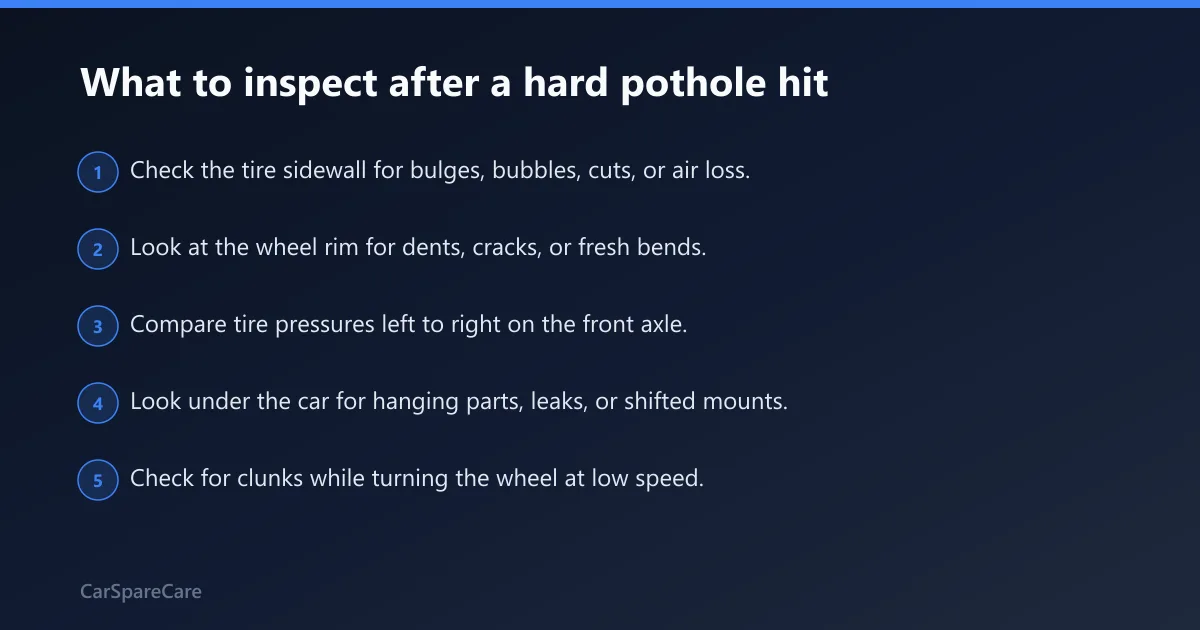
Start with the parts that fail most often and reveal damage fastest. Look at the wheel and tire first, then check steering and suspension joints, then confirm alignment behavior. If the car feels unstable, do not keep driving to see if it improves.
- Check the tire sidewall for bulges, bubbles, cuts, or air loss.
- Look at the wheel rim for dents, cracks, or fresh bends.
- Compare tire pressures left to right on the front axle.
- Look under the car for hanging parts, leaks, or shifted mounts.
- Check for clunks while turning the wheel at low speed.
- Watch for pull, wander, vibration, or an off-center wheel on a straight road.
When to book a suspension and alignment inspection
Book an inspection when the wheel stays off-center, the car pulls, the steering feels loose, or a new vibration appears after the hit. A proper check should include the tire, wheel, steering and suspension parts, and a four-wheel alignment if the car can be safely driven.
When to stop driving
Stop driving if the steering suddenly binds, the wheel has major free play, the car darts across the lane, a tire has a bubble or visible cord, or the suspension makes loud repeated clunks. Those signs suggest more than simple road shock and can point to failure under load.
Is steering kickback from potholes normal or a sign of damage?
It can be normal if it is a single jolt with no lasting change. It is a sign of damage when the kickback repeats, the steering wheel stays off-center, the car pulls, or there is clunking or vibration. The longer the symptom lasts, the less likely it is just road shock.
When is steering kickback dangerous enough to stop driving?
It is dangerous enough to stop driving when steering control changes suddenly, the wheel feels loose or sticky, the car pulls hard, or a tire or wheel is visibly damaged. A loud clunk, a strong shimmy, or a wheel that no longer tracks straight also deserves immediate attention.
How much repair damage can one pothole cause to steering or suspension?
One pothole can do little more than jar the wheel, or it can bend a rim, damage a tire, knock alignment out, or stress tie rods, ball joints, and struts. The result depends on speed, pothole depth, tire pressure, and whether parts were already worn.
Frequently asked questions
Can bad tie rods cause steering kickback over bumps?
Yes. Worn tie rod ends let the wheel move before the steering input is fully transferred, which can feel like looseness, clunking, or a wheel that darts after a bump. Tie rod play also affects toe stability, so the car may wander or wear tires unevenly.
Can worn control arm bushings make the wheel jerk after a pothole?
Yes. Control arm bushings locate the wheel under load, and worn rubber or hydraulic bushings allow the wheel to shift after impact. That movement can feel like a jerk, a braking clunk, or vague steering, especially when turning or braking right after the pothole hit.
Does wheel alignment affect steering kickback?
Yes. Alignment does not create kickback by itself, but a pothole can knock toe, camber, or caster out of spec. After that, the wheel may sit off-center, the car may pull, and steering may feel less steady. Alignment problems are often the result, not the first cause.
Can low tire pressure make pothole kickback feel worse?
Yes. Low pressure increases sidewall flex, so the tire absorbs less of the hit and the wheel can transmit more shock. It also raises the chance of rim damage and tire injury. If kickback feels worse after a pothole, check pressure before assuming the steering is at fault.
How do I tell if my steering rack is damaged after hitting a pothole?
Look for a dead spot, notchiness, uneven assist, or noise that starts after the impact. A rack problem may also show up as looseness that is different from tie rod play. If the wheel binds, leaks appear near the rack, or steering feel changes sharply, the car needs inspection soon.

Hi, I’m Melvin, an automobile engineer with extensive experience in automobile equipment. I currently work for a local automobile firm, where I specialize in the car parts industry. I’ve had the opportunity to collaborate with seasoned inspectors, gaining invaluable hands-on experience that goes beyond just theory.
My passion for automotive care started at a young age, which led me to create CarSpareCare. Through CarSpareCare, I share the knowledge and skills I’ve acquired over the years to help others navigate the world of car maintenance and repairs.
My goal is to provide practical tutorials, essential safety advice, and the latest industry insights so that anyone—whether a beginner or an expert—can confidently tackle their automotive projects.