

A steering wheel vibration after a tire rotation usually points to a wheel, tire, or lug-torque problem; if the shake moves to a different corner after rotation, the fault is likely there, not in the steering. Start with lug torque to spec, then use the vibration’s speed and location to separate balance, seating, and hidden tire defects.
What you’ll need
- Torque wrench matched to the vehicle’s lug-nut spec
- Tire pressure gauge for cold pressure checks
- Jack and jack stands, or a safe lift
- Flashlight
- Wheel brush or wire brush
- Tread depth gauge or simple tread inspection tool
- Dial indicator for runout checks, if available
Why does my steering wheel vibrate after a tire rotation?
A rotation can expose a wheel or tire issue rather than create one. If the same tire was already out of balance, bent, damaged, or poorly seated, moving it to the front can make the steering wheel feel it. The timing, speed, and whether the shake moved are the best clues.
Use the symptom pattern first
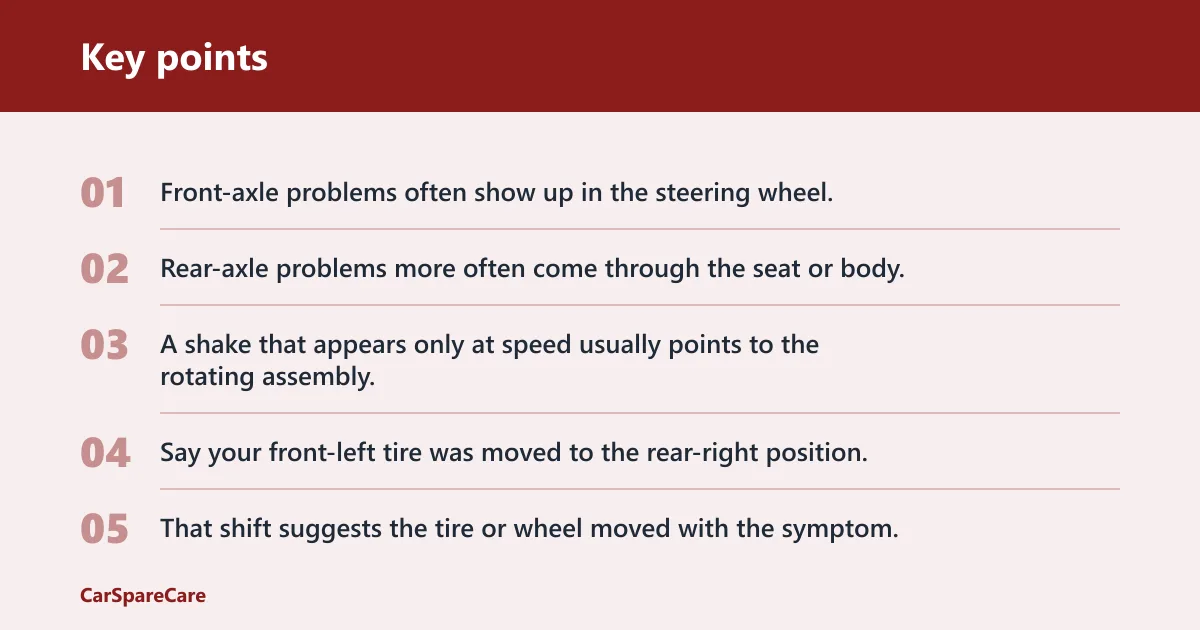
Front-axle problems often show up in the steering wheel. Rear-axle problems more often come through the seat or body, then move forward if the rear tire is now on the front. A shake that appears only at speed usually points to the rotating assembly, not the steering rack.
Say your front-left tire was moved to the rear-right position, and the vibration now appears at 60 mph instead of 0 to 30 mph. That shift suggests the tire or wheel moved with the symptom, which narrows the fault faster than a full suspension search.
Is the vibration speed-related?
If the shake starts near highway speed, an unbalanced wheel is one of the first things to check. Many balanced wheels may still vibrate around about 50 to 70 mph when a weight is missing or when a tire has a hidden defect. A low-speed shimmy points elsewhere.
- Drive at the speed where the shake starts and note the exact range, such as 45 to 55 mph or 60 to 70 mph.
- Lightly brake while steady at that speed; if the feel changes only under braking, inspect the rotors and hub seating next.
- Repeat the test on a smooth road and then a different road surface; a road-speed shake that stays consistent is more likely wheel or tire related.
Check whether it changes with braking
If braking changes the vibration, the rotor or hub face may be part of the problem. If braking does nothing and the shake tracks road speed, start with tire balance, wheel condition, and tire defect checks before moving deeper into the suspension.
Follow the symptom matrix
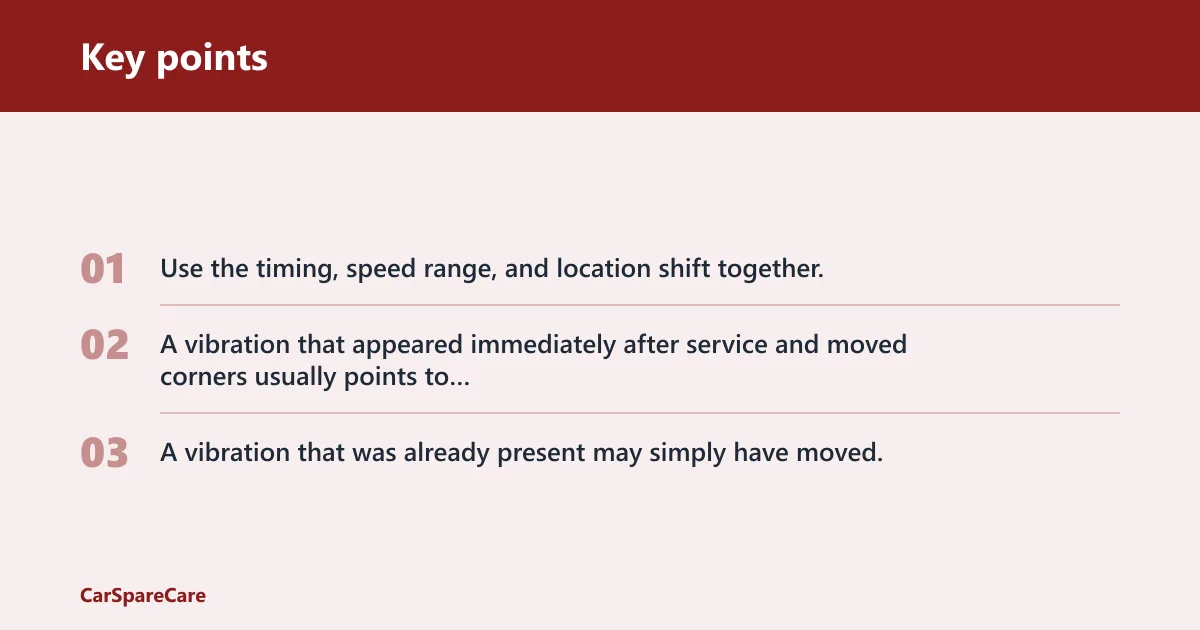
Use the timing, speed range, and location shift together. One clue alone can mislead you. A vibration that appeared immediately after service and moved corners usually points to tire, wheel, or seating work done during the rotation. A vibration that was already present may simply have moved.
| Symptom pattern | Likely cause | Why it happens after rotation | Best confirmation step |
|---|---|---|---|
| Starts immediately after service; steering wheel shake at 50 to 70 mph | Wheel/tire imbalance | A tire with a small imbalance may now be on the front axle, where the steering wheel feels it more strongly | Recheck balance on the wheel that moved to the front |
| Starts immediately after service; shake at any speed, sometimes worse on one corner | Wheel not seated flat | Rust, dirt, or debris on the hub or rotor face can hold the wheel off-center | Remove the wheel and inspect the hub and rotor seating surface |
| Vibration follows the same tire to a new corner | Shifted or defective tire | Internal belt separation or conicity can move with the tire during rotation | Inspect tread, sidewall, and runout; replace if defects are found |
| Vibration appears after service, but balance check passes | Bent wheel or runout | A bent wheel can be hard to spot by eye and may not show until it spins at speed | Measure radial and lateral runout with a dial indicator |
| Vehicle pulls or feels odd after service, with mild shake | Tire pressure mismatch | Wrong cold pressure can mimic a vibration or pull after the tire positions change | Check all four tires when cold against the door placard |
Check lug torque and wheel seating
Uneven lug torque is one of the first things to verify. Torque should be even across all lug nuts and match the vehicle spec, not a guess. Overtightened or uneven lugs can stop the wheel from seating flat and create a wobble after service.
- Set the torque wrench to the vehicle’s lug specification from the owner’s manual or service data.
- Loosen and retorque the lugs in a star pattern, so the wheel pulls down evenly.
- Remove the wheel if needed and inspect the hub and rotor face for rust, dirt, or debris.
- Clean the seating surface with a brush until the wheel can sit flush.
- Reinstall the wheel and torque again in a star pattern, then road test the car.
A common first-timer mistake is tightening by feel after rotation. That can leave one lug too tight and another too loose, which changes the wheel’s seating instead of fixing it.
Could a tire or wheel be out of balance?
Unbalanced wheels are the most common cause, and they often show up around 50 to 70 mph. A small lost weight can be enough. Clip-on and adhesive balance weights can fall off during tire service, which creates a new shake on the wheel that lost it.
- Inspect the barrel and spoke area for missing clip-on or adhesive weights.
- Compare the vibrating wheel with the others and note whether the symptom moved with it after rotation.
- Have that wheel rebalanced if the weight is missing or if the vibration matches the same speed range.
- Check for bent rims, visible tire damage, or obvious bulges before mounting it again.
Suppose the left rear tire was moved to the front and the shake appeared at 65 mph. If a weight is missing from that wheel, rebalance that assembly before chasing alignment or steering parts.
What if the shake still stays?
If torque, seating, balance, pressure, and tire condition check out, move to the rotation pattern and the chassis. Incorrect rotation on directional tires or a staggered setup can confuse the diagnosis, because not every tire can move to every corner. If the problem survives all wheel and tire checks, suspension wear can amplify it.
- Confirm the rotation pattern used matches the owner’s manual.
- Verify whether the tires are directional or staggered, because those setups limit rotation options.
- Inspect tie rods, control arm bushings, and ball joints for play if the shake persists.
- Schedule an alignment or suspension inspection if the vibration remains after wheel and tire checks pass.
On many cars, EVs included, tire wear can be more uneven because of weight and torque load. That makes rotation pattern and wheel condition even more important.
Common mistakes
These errors send a simple wheel problem down the wrong path. Avoid them first.
- Checking balance before lug torque and seating
- Inflating to the sidewall max instead of the door placard spec
- Ignoring a missing balance weight because the tire “looks fine”
- Skipping the hub and rotor face when the wheel was recently off
- Assuming a vibration that appeared after rotation was caused by the rotation itself
- Using the wrong rotation pattern on directional or staggered tires
Do I need to rebalance tires after rotation?
Not always, but it is the right next check when the vibration moved with the tire or shows up around highway speed. Rebalance the wheel that now causes the shake, especially if a weight is missing or the symptom follows that same tire to a different corner.
Can overtightened lug nuts cause steering wheel vibration?
Yes. Overtightened or uneven lugs can distort how the wheel sits against the hub and may create wobble after service. Retorque with a torque wrench to the vehicle spec, then recheck in a star pattern after the first short drive if the manual calls for it.
Frequently asked questions
Can tire rotation cause steering wheel shake?
Rotation does not usually create a shake by itself. It more often reveals an imbalance, bent wheel, missing weight, or tire defect that was already present. If the symptom began right after service, inspect seating, torque, and the new wheel position first.
How do I tell if the vibration is from the front or rear tires?
Front-tire issues are usually felt in the steering wheel. Rear-tire issues more often feel like seat or floor vibration. If the symptom moved from the rear to the front after rotation, the same tire may now be on the axle where it is easier to feel.
Could a bent wheel or bad tire cause the shake even after rotation?
Yes. A bent wheel can keep shaking at speed, and a bad tire with belt separation or conicity can follow the tire to a new corner. Use a dial indicator for runout if available, and replace the tire if it has a bulge, separation, or repeat imbalance.
How soon after rotation should I check lug torque?
Check it immediately if the steering wheel shake starts after service. If the vehicle manual asks for a follow-up torque check after a short drive, use that interval. The important point is to verify even torque to spec before driving far.
What should I inspect if the vibration started immediately after service?
Inspect lug torque, wheel seating, hub and rotor faces, and the presence of balance weights. Then confirm pressure against the door placard and check whether the vibration now sits at a different corner. If those checks pass, move to balance, runout, and suspension play.

Hi, I’m Melvin, an automobile engineer with extensive experience in automobile equipment. I currently work for a local automobile firm, where I specialize in the car parts industry. I’ve had the opportunity to collaborate with seasoned inspectors, gaining invaluable hands-on experience that goes beyond just theory.
My passion for automotive care started at a young age, which led me to create CarSpareCare. Through CarSpareCare, I share the knowledge and skills I’ve acquired over the years to help others navigate the world of car maintenance and repairs.
My goal is to provide practical tutorials, essential safety advice, and the latest industry insights so that anyone—whether a beginner or an expert—can confidently tackle their automotive projects.

