

A bad CV axle usually clicks on full-lock turns, vibrates under acceleration, or leaks grease from torn boots; if the noise changes with steering angle, check the axle before anything else. Leave it alone and the joint can loosen further, shred the boot, and leave you stranded. This guide shows how to separate axle faults from tire, bearing, and suspension problems before you buy parts.
What a bad CV axle feels like
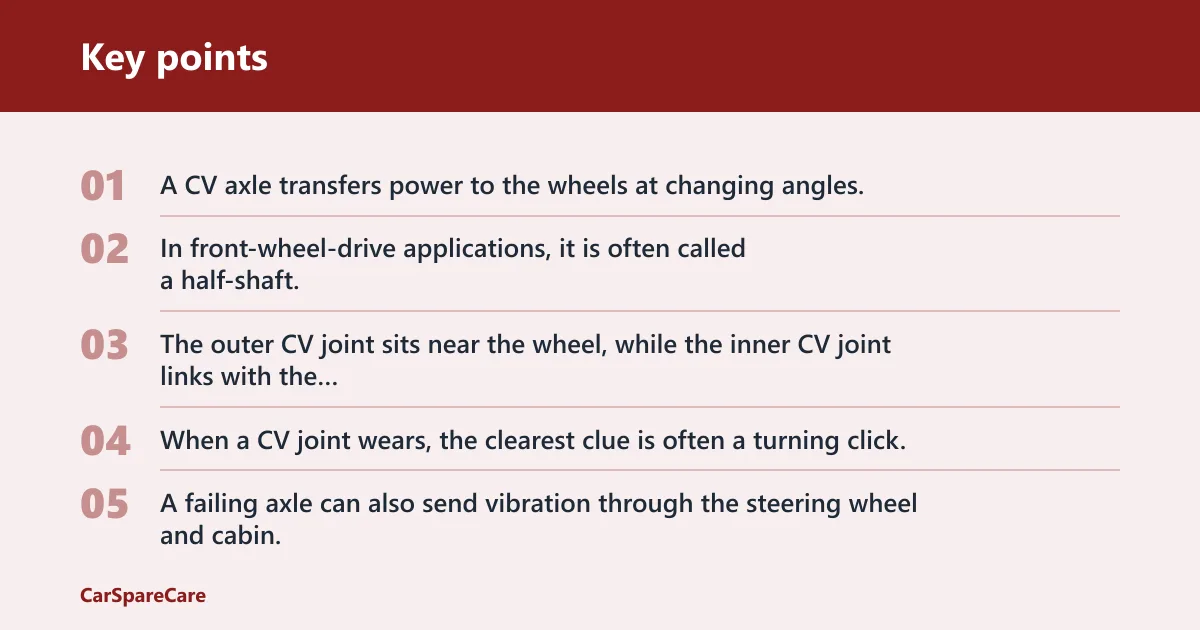
A CV axle transfers power to the wheels at changing angles. In front-wheel-drive applications, it is often called a half-shaft, and front-wheel-drive vehicles commonly use one CV axle per front wheel. The outer CV joint sits near the wheel, while the inner CV joint links with the transmission.
When a CV joint wears, the clearest clue is often a turning click. A failing axle can also send vibration through the steering wheel and cabin, and torn boots can leave grease around the wheel end. Straight-line humming by itself is less specific and often points to tires or a wheel bearing instead.
Clicking on turns
Turning noise is the strongest road clue for a CV joint problem. An outer CV joint usually clicks most when the steering is near full lock, because the joint is working at its steepest angle. That makes the sound more useful than a generic noise heard only while driving straight.
Vibration on acceleration
Vibration that shows up when you get on the throttle can point to the inner joint, the axle shaft, or another driveline problem. It can also come from tires, alignment, or a wheel bearing, so the vibration has to be matched with where and when it happens.
Grease around the wheel end
Leaking grease is a listed symptom of bad CV joints. A torn axle boot can let grease escape and dirt enter, which can increase friction and accelerate joint wear. Wet splatter near the suspension or inside the wheel well deserves a closer look right away.
What you’ll need
- Flashlight
- Gloves and rags
- Jack and jack stands
- Wheel chocks
- Shop towel or paper towels for grease checks
CV axle diagnosis matrix
This table separates the most common symptoms by driving condition and urgency. Use it before buying parts, because tire, wheel bearing, and strut faults can mimic axle trouble.
| Symptom | Where it happens | Likely source | Urgency |
|---|---|---|---|
| Sharp clicking | Turning, especially tight corners or full lock | Outer joint | Inspect soon |
| Rhythmic click that changes with steering angle | Turning and lane changes | Outer joint | Inspect soon |
| Shudder or vibration | Acceleration in a straight line | Inner joint or axle shaft | Inspect soon |
| Grease splatter or wet boot | Visible at the wheel end, parked or driving | Boot | Inspect soon |
| Vibration plus wandering or uneven tire wear | Straight line at speed | Another part | Inspect soon |
| Loud clunk, severe vibration, or the car barely moves | Any driving condition | Outer joint, inner joint, or shaft damage | Do not drive |
| Light vibration with no clicking or grease leak | Steady cruising | Another part | Drive short distance |
How do you check a CV axle?
Start with the boots, then look for grease, then check for looseness and damage. A visual check will not prove every axle fault, but it can separate a torn boot from a more serious joint problem and help you avoid replacing the wrong side.
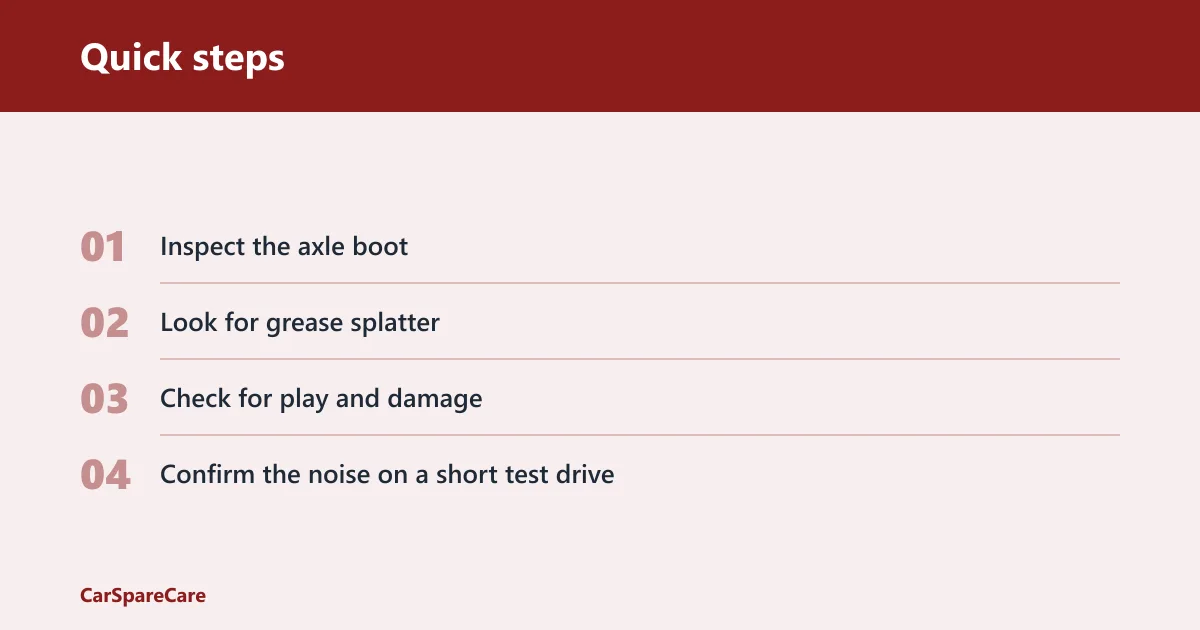
- Inspect the axle boot. Look for cracks, splits, missing clamps, or rubber that has pulled away from the joint housing.
- Look for grease splatter. Search the inside of the wheel, control arm, strut, and nearby body panels for wet black grease.
- Check for play and damage. With the car safely supported, look for obvious looseness, bent components, or a boot that has thrown grease outward.
- Confirm the noise on a short test drive. Drive slowly in a parking lot and turn sharply left and right. A turning click that changes with steering angle points more strongly to the outer joint.
Say your front-wheel-drive car clicks only in a tight right turn and the left wheel well has grease splatter. That pattern points first to the left outer joint, because the outside wheel in a turn is loaded more heavily and the joint angle is higher.
Suppose the car vibrates under acceleration but stays quiet in turns. That makes the inner joint or shaft more likely than the outer joint, though tires and wheel balance still need to be ruled out.
How do you tell if the noise is the axle?
Noise that changes with steering angle is the most useful axle clue. Outer joint problems usually click in corners, especially at full lock. Inner joint trouble shows up more under load, while tires, wheel bearings, and struts can create sounds that seem similar from the driver’s seat.
Outer joint clues during turns
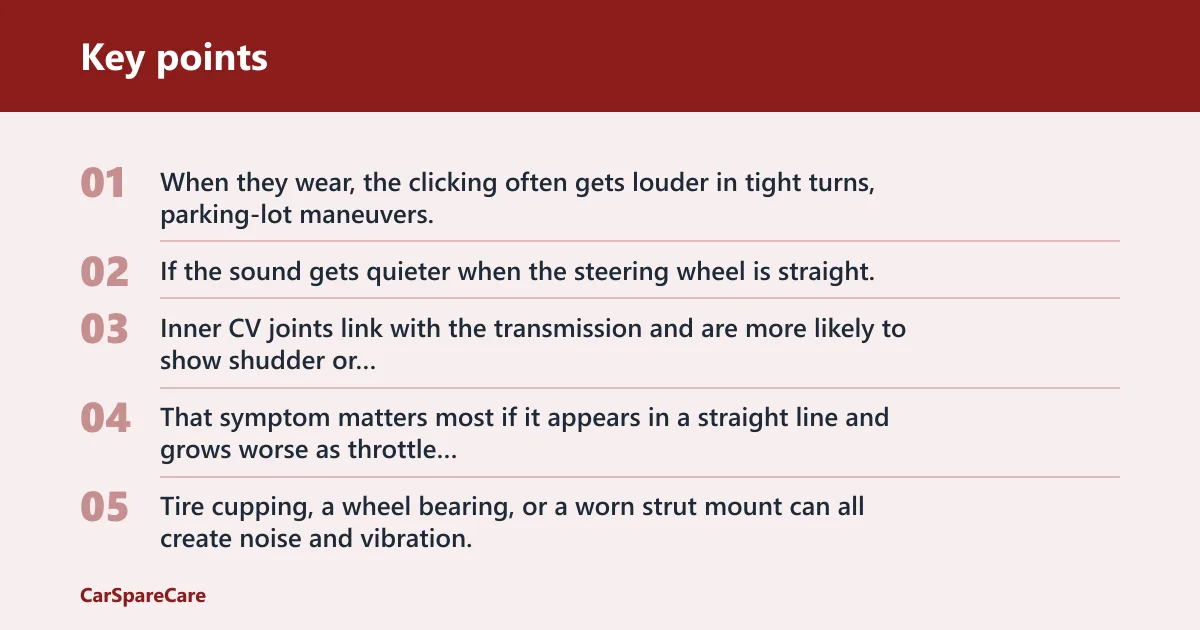
Outer CV joints connect near the wheel. When they wear, the clicking often gets louder in tight turns, parking-lot maneuvers, or U-turns. If the sound gets quieter when the steering wheel is straight, the outer joint moves higher on the list.
Inner joint clues under load
Inner CV joints link with the transmission and are more likely to show shudder or vibration during acceleration. That symptom matters most if it appears in a straight line and grows worse as throttle increases.
Why tires, bearings, and struts can sound similar
Tire cupping, a wheel bearing, or a worn strut mount can all create noise and vibration. A wheel bearing often sounds more like a hum or growl that changes with speed, not steering angle. That overlap is why a full inspection is required before you order a replacement axle.
When is it unsafe to keep driving?
If the axle is close to failing, the car may still move for a short time, but that does not make it safe. Ignoring symptoms can let the axle break while driving, so the decision depends on how severe the noise, vibration, and grease loss are.
Signs to stop driving now
Stop driving if the clicking becomes a loud grind, the car shudders badly on acceleration, the boot is torn open with heavy grease loss, or the wheel feels unstable. Those signs suggest major joint damage or shaft failure.
Signs you can drive a short distance
If the car only clicks in tight turns and still drives normally, you may be able to move it a short distance to a shop. Keep speed low, avoid hard turns, and do not plan a long trip.
When to book an inspection soon
Book an inspection soon if you notice grease around the wheel end, mild vibration, or a clicking noise that is getting more frequent. A mechanic inspection matters because the same symptoms can come from tires, wheel bearings, struts, or alignment.
Common mistakes
Replacing the wrong side is common. The noise from the outside wheel in a turn can point away from the side you first expect, so match the symptom to the turning direction before you buy parts.
Another mistake is treating every vibration as a bad axle. Tire balance, alignment, and wheel bearing problems often overlap with axle symptoms. A torn boot is also easy to ignore, but once grease escapes and dirt enters, the joint wears faster.
Waiting after vibration starts is a bad bet. By the time the noise becomes loud enough to notice at normal speed, the joint may already be loose enough to fail completely.
Replacement cost and repair considerations
Replacing a CV axle is typically estimated at $200 to $600. A front axle repair may cost $500 to $800 for parts and labor, while rear axle repair is estimated at $450 to $650. Price depends on vehicle type, axle assembly, and labor time.
CV axles are commonly replaced as a unit when damage is confirmed. If only one side is failing, replacing that side alone may be enough. If the boot is torn but the joint has not been contaminated for long, the repair decision can still change after inspection.
A mechanic inspection is the right next step when symptoms overlap with other suspension problems. It helps rule out tire wear, wheel bearings, struts, and alignment before money goes into the wrong repair.
Frequently asked questions
What happens when cv axle goes bad?
A bad CV axle usually starts with clicking on turns, then adds vibration under load or grease loss from a torn boot. If wear continues, the joint can get looser, throw out more grease, and eventually fail hard enough to leave the vehicle unable to move normally.
What happens if a cv axle fails?
If a CV axle fails completely, power transfer to that wheel can stop or become erratic. The car may shudder, refuse to pull correctly, or become stranded. That is why loud joint noise, heavy vibration, or obvious shaft damage should be treated as a stop-driving problem.
What causes cv axle to go bad?
Boot damage is a common trigger because it lets grease escape and dirt enter the joint. Age, mileage, repeated sharp steering angles, and impact damage can also wear the joint or shaft. Once lubrication is lost, friction rises and the joint wears faster.
Why do cv axles go bad?
They go bad when the joint loses grease, gets contaminated, or is worked past its wear limit. Front-wheel-drive vehicles place a lot of motion and angle change on the axle, so a damaged boot or worn joint can progress quickly once the protective grease is gone.
How can you tell if a CV axle is going bad while driving?
Listen for clicking in tight turns, especially at full lock, and watch for vibration during acceleration. If the sound changes with steering angle, the outer joint is more suspect; if shudder appears under load, the inner joint moves higher on the list. A mechanic inspection is still needed to rule out lookalikes.

Hi, I’m Melvin, an automobile engineer with extensive experience in automobile equipment. I currently work for a local automobile firm, where I specialize in the car parts industry. I’ve had the opportunity to collaborate with seasoned inspectors, gaining invaluable hands-on experience that goes beyond just theory.
My passion for automotive care started at a young age, which led me to create CarSpareCare. Through CarSpareCare, I share the knowledge and skills I’ve acquired over the years to help others navigate the world of car maintenance and repairs.
My goal is to provide practical tutorials, essential safety advice, and the latest industry insights so that anyone—whether a beginner or an expert—can confidently tackle their automotive projects.

