
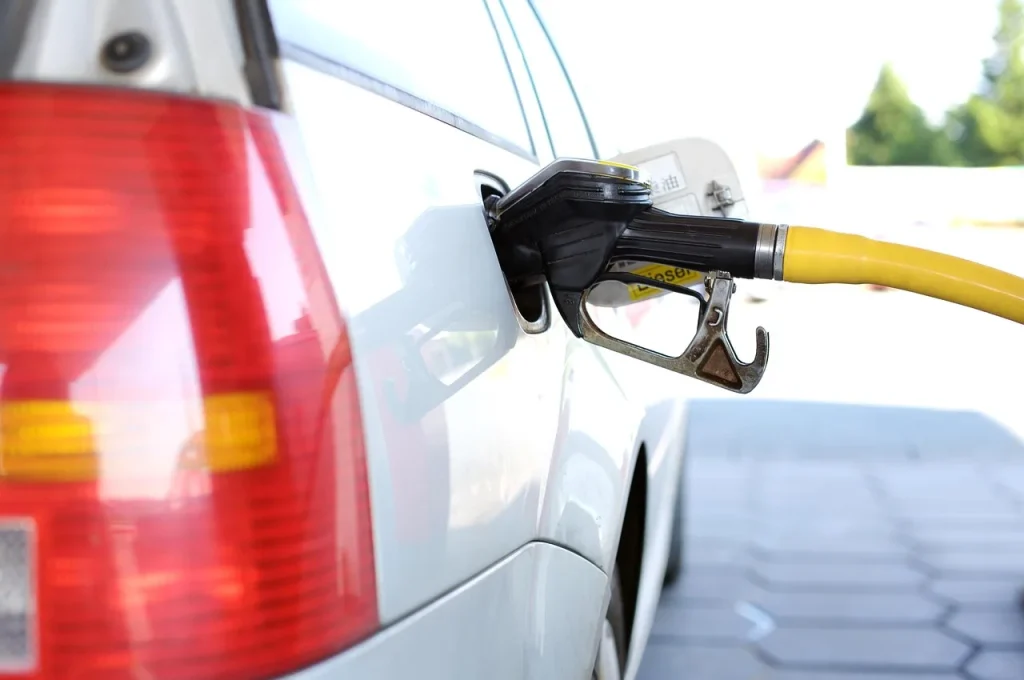
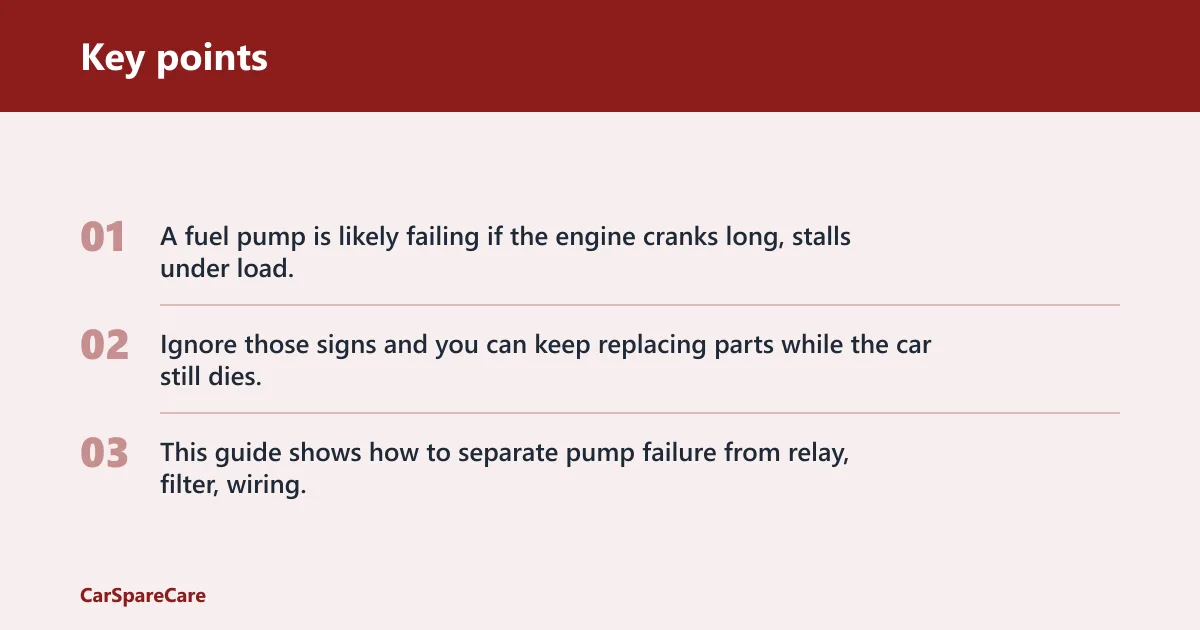
A fuel pump is likely failing if the engine cranks long, stalls under load, and fuel pressure stays below spec or drops during a key-on or acceleration test after fuse and relay checks. Ignore those signs and you can keep replacing parts while the car still dies. This guide shows how to separate pump failure from relay, filter, wiring, or fuel-starvation faults using symptom checks and simple tests.
Fuel pump diagnostic matrix
| Symptom | Likely cause | Quick check | Expected reading | Next action |
|---|---|---|---|---|
| Weak acceleration under load | Weak pump, restricted filter, undersized flow rate | Watch fuel pressure during a loaded pull | Pressure should stay near the vehicle-specific spec; many port-injected engines use about 58 to 62 PSI | If pressure falls sharply, test pump power, ground, and flow rate before replacement |
| No-start | Relay, fuse, wiring, pump, or extreme fuel starvation | Check key-on pressure and pump command at the connector | 0 psi is a strong clue, but no pump voltage points first to relay, fuse, wiring, or control faults | Test relay and circuit first; do not assume the pump is bad |
| Intermittent stall | Pump overheating, wiring fault, relay fault, clogged strainer | Look for stall after heat soak or on rough roads | Pressure may recover after cooldown if the fault is electrical or thermal | Check voltage drop, connector condition, and in-tank strainer |
| Whining pump | Pump running dry, low fuel level, inlet restriction, worn pump | Listen near the tank at key-on and engine idle | Noise alone is not proof of failure | Check fuel level, inlet restriction, and pressure under load |
| Low fuel pressure | Weak pump, clogged filter, voltage drop, leak in supply side | Measure pressure with a fuel pressure gauge | Below spec; an undersized pump can drop to 38 PSI under full throttle/high load in the example table | Compare against spec, then split the fault between pressure loss and circuit loss |
| Relay failure | Bad fuel pump relay or poor relay control | Swap or test the relay separately | Fuel pump may not prime or may run weakly if relay contacts are poor | Repair the relay circuit before condemning the pump |
| Clogged filter | Fuel starvation from restriction | Check service history and pressure drop under load | Pressure may look acceptable at idle and fall when demand rises | Replace the filter if the vehicle uses a serviceable one; the text says a clogged fuel filter should be replaced with every pump swap |
| Voltage-drop issue | High resistance in power or ground circuit | Perform a voltage drop test while the pump is loaded | More than 0.5 volts of drop under load is a problem | Repair the circuit before installing a new pump |
| Tow-now versus drive-short-distance | Severe failure or mild drivability problem | Judge by stalling, no-start, and loss of power | No-start, repeated stall, or severe power loss | Tow now for no-start or repeat stall; short-drive only if the vehicle runs steadily and the symptom is mild |
What a failing fuel pump feels like
An electric fuel pump sits in or near the tank and is responsible for moving fuel at the pressure and flow the engine needs. It can fail gradually, with hard starts and weak acceleration, or suddenly, with a no-start or stall. A whining or buzzing sound from the tank area is common, but it is only one clue.
Common warning signs
Watch for long crank time, sputtering on steep grades or at highway speed, loss of pull during acceleration, and an engine that stalls after running for a while. Low fuel level can shorten pump life because the pump depends on fuel for cooling and lubrication, and a starved pump can reach over 200°F.
Say your compact car starts normally in the morning, then loses power climbing a grade at 65 mph and recovers on flat ground. That pattern points to a load-related problem, which could be a weak pump, a clogged filter, or a voltage drop, not just a noisy pump.
Is the pump weak under load?
Fuel pressure can look acceptable at idle and still fall under acceleration, which is why load testing matters. A weak pump may deliver enough pressure for a no-load check but not enough volume when the engine asks for more fuel. Pressure is measured in PSI or bar, while fuel flow rate is measured in GPH or LPH.
How to check if a fuel pump is failing
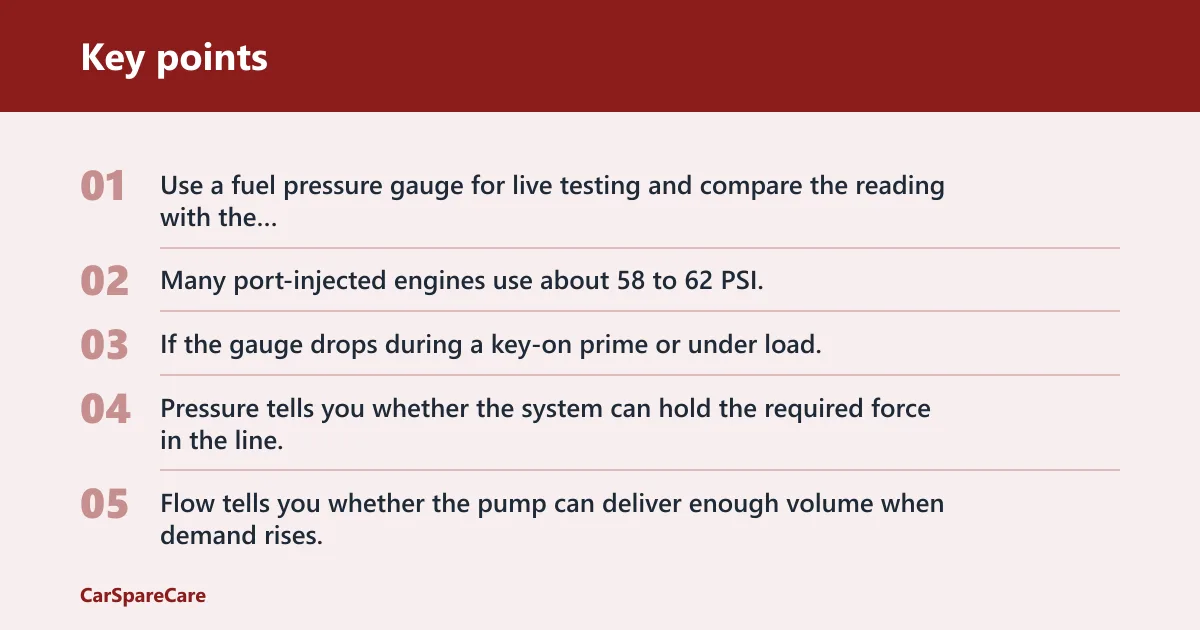
Use a fuel pressure gauge for live testing and compare the reading with the vehicle-specific spec. Many port-injected engines use about 58 to 62 PSI, but the correct target depends on the vehicle. If the gauge drops during a key-on prime or under load, the pump or supply system may be weak.
What pressure and flow tell you
Pressure tells you whether the system can hold the required force in the line. Flow tells you whether the pump can deliver enough volume when demand rises. A pump can make acceptable static pressure and still be short on flow, which is why an undersized pump may only fail during hard acceleration or towing.
A common first-timer mistake is to see decent idle pressure and stop there. That can miss a pump that cannot keep up at full throttle, where the example table shows an undersized pump dropping to 38 PSI under full load.
Is it the relay, wiring, or pump?
A fuel pump relay is an electrical control component, and a bad relay can mimic pump failure by preventing the pump from priming or by sending unstable power. If the relay, fuse, wiring, or ground has a fault, the pump may be fine. That is why electrical checks come before replacement.
How to check if a fuel pump is bad with multimeter
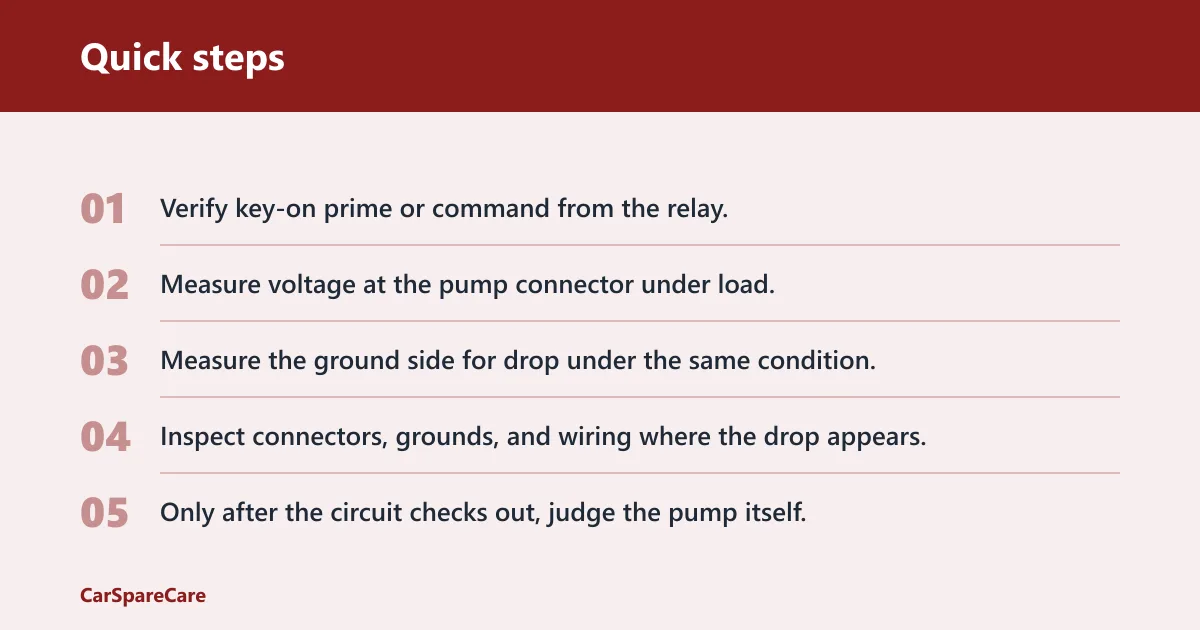
Check pump power and ground with a multimeter while the circuit is loaded. Fuel pumps are designed to run around 13.5 volts when the engine is running, and a voltage drop of more than 0.5 volts under load is a problem. That points to resistance in the circuit, not automatically to a bad pump.
- Verify key-on prime or command from the relay.
- Measure voltage at the pump connector under load.
- Measure the ground side for drop under the same condition.
- Inspect connectors, grounds, and wiring where the drop appears.
- Only after the circuit checks out, judge the pump itself.
How to tell if fuel pump relay is bad without multimeter
You can narrow a relay fault by listening for prime noise, checking whether the pump starts and stops normally, or swapping with a matching relay if the vehicle uses an identical one. No prime, intermittent prime, or a pump that only works after tapping the relay box can point to relay trouble, but a swap test is only useful if the relay match is exact.
Could the filter or strainer be the problem?
A clogged fuel filter can starve the engine and can sometimes look like a weak pump. Many modern vehicles use a non-serviceable in-tank filter or strainer instead of a separate external filter, so you need to follow the vehicle’s service design rather than assuming there is a spin-on part to replace.
How to tell if fuel pump is bad or fuel filter
If pressure is acceptable at idle but falls with load, a restriction may be limiting flow. If repeated failures happen after a new pump, contamination, a clogged strainer, a torn sock, or a tank debris problem is worth checking. The in-tank strainer is the first-line debris filter, and it can clog, tear, or restrict inlet flow.
Suppose a sedan gets a new pump but fails again within months. That pattern often points to contamination or a blocked strainer rather than a bad replacement pump. If the tank has debris, the new pump can be damaged the same way as the old one.
Pressure and flow checks that matter
Fuel pressure and fuel flow are different tests. Pressure shows whether the system can maintain the required PSI or bar; flow shows whether the pump can supply enough GPH or LPH when demand rises. That difference matters on port-injected gasoline engines, diesel lift pumps, motorcycle systems, lawn mowers, and outboard engines, because layout and service access vary.
Can you test a fuel pump out of the tank?
Yes, but an out-of-tank test only tells part of the story. A bench test can show whether the pump spins and moves fuel, yet it does not always reveal a restriction in the strainer, tank pickup, wiring, relay, or under-load voltage loss. For that reason, in-vehicle pressure and voltage checks are still necessary.
How to see if a fuel pump is bad
Use the symptom, pressure, and circuit sequence together. If pressure is low, compare it with spec. If pressure is normal at idle but falls under load, suspect flow or restriction. If voltage drop is excessive, fix the circuit before replacing the pump. If the car has a no-start with no pump command, look upstream first.
Should you drive it or tow it?
Tow it now if the engine will not start, if it stalls repeatedly, or if power loss is severe enough that traffic movement becomes unsafe. Short-distance driving is only a reasonable choice when the vehicle starts reliably, idles steadily, and the symptom seems limited to mild hesitation without stall risk. Low fuel level can worsen the problem and shorten pump life.
When to stop diagnosis and arrange repair
If the pump noise grows louder, pressure falls below spec on a road test, or the engine cuts out under load, stop extending the diagnosis on public roads. Fuel pressure gauge use during a road test should follow the tool instructions, with the gauge secured outside the cabin or engine bay as directed, not routed in an improvised way.
Picture a pickup that loses power only on a steep hill but still idles smoothly in the driveway. That can be safe enough for a short, careful diagnostic drive if you can monitor pressure properly. A no-start after that same symptom set is different, and that vehicle should be repaired before further driving.
Frequently asked questions
How to check if a fuel pump is failing: check for long crank, whining
Check for long crank, whining from the tank, sputtering under load, and pressure that stays below spec or drops during acceleration. Then separate pump faults from relay, wiring, and filter issues with a pressure gauge and a voltage drop test. Symptom-only diagnosis is not enough.
How do you check for a bad fuel pump?
Start with the relay and fuse, then check pump voltage, ground, and fuel pressure. Use the vehicle’s pressure spec, not a generic number, because systems vary. If the pump has power and ground but pressure stays low, the pump or its inlet restriction becomes the next focus.
Can a fuel pump fail suddenly?
Yes. An electric fuel pump can fail gradually or suddenly. Sudden failure often shows up as a no-start or instant stall, while gradual failure gives you hard starts, whining, and weak acceleration first. A relay or wiring fault can mimic the same pattern, so test before replacing parts.
How to tell if fuel pump is bad or fuel filter: if pressure is low
If pressure is low at idle and worse under load, either a weak pump or a clogged filter can be involved. A filter or strainer restriction often causes starvation when demand rises. If the vehicle uses a serviceable filter, replace it as part of the repair path; some systems use in-tank filtration only.
Can you test a fuel pump out of the tank: yes, but that test?
Yes, but that test only confirms limited functions. It can show whether the motor runs and whether the pump moves fuel, yet it does not duplicate tank pickup restriction, heat soak, or vehicle wiring loss. Use it as one step, not the final answer.

Hi, I’m Melvin, an automobile engineer with extensive experience in automobile equipment. I currently work for a local automobile firm, where I specialize in the car parts industry. I’ve had the opportunity to collaborate with seasoned inspectors, gaining invaluable hands-on experience that goes beyond just theory.
My passion for automotive care started at a young age, which led me to create CarSpareCare. Through CarSpareCare, I share the knowledge and skills I’ve acquired over the years to help others navigate the world of car maintenance and repairs.
My goal is to provide practical tutorials, essential safety advice, and the latest industry insights so that anyone—whether a beginner or an expert—can confidently tackle their automotive projects.

