

Choose windshield wipers by vehicle fitment first: confirm the exact blade length, connector, and arm type from the owner’s manual or parts lookup before comparing beam, hybrid, or winter styles. Buying the wrong connector or a blade that lifts in your conditions can lead to chatter, streaks, poor clearing, and sometimes a blade that may not mount at all. This guide shows how to match the correct size and connector, then pick the right blade design for rain, snow, heat, and outdoor parking.
Why fitment comes first when choosing windshield wipers
The right blade type cannot fix the wrong fit. A wiper blade has to match the arm, the connector, and the length for each side of the car. Blade lengths vary, driver and passenger sides may differ in size, and a correct length still fails if the connector does not lock properly.
Why the right length can still be the wrong blade
Length is only one part of the purchase. A blade can be the correct inches on paper and still miss the arm style, sit too high on the windshield, or foul the hood edge. I see this often: the part looks close, then wipes badly once installed.
Driver and passenger sides are often different
Many cars use different lengths on the left and right sides. That matters because the driver’s side usually needs a larger sweep for direct vision, while the passenger side may be shorter to avoid overlap or trim contact. Never assume both sides match because the old pair looked similar.
What wrong fitment can do to coverage and clearance
Too short leaves blind spots. Too long can hit trim, contact the hood, or misalign across the glass. Wrong arm fitment can also change the blade angle, which leads to lift, chatter, or a strip of water left in the viewing area after each pass.
How do you find the right windshield wipers for your car?

Start with the owner’s manual, then confirm the exact year, make, model, and trim before you buy. That is the safest way to identify the correct blade length, connector style, and side pairing. Measuring the old blades helps, but it should back up the manual, not replace it.
Check the owner’s manual first
The car owner’s manual is often the first fitment source because it may list compatible blade sizes for that vehicle. It is the best place to verify what belongs on the driver side and passenger side before spending money on the wrong set.
Confirm the exact year, make, model, and trim
Small trim changes can alter wiper arms, connector styles, or the way the blade sweeps the glass. The same nameplate does not always mean the same fitment. If a parts lookup asks for trim or body style, provide it.
Measure the old blades only as a backup check
Measure the old blades in inches if the manual is missing or unclear, but treat that as a check rather than the only answer. Old blades may already be wrong, bent, or swapped from a previous repair. A worn blade can mislead you by looking longer or shorter than it really is.
How to verify blade size and arm fitment before you buy
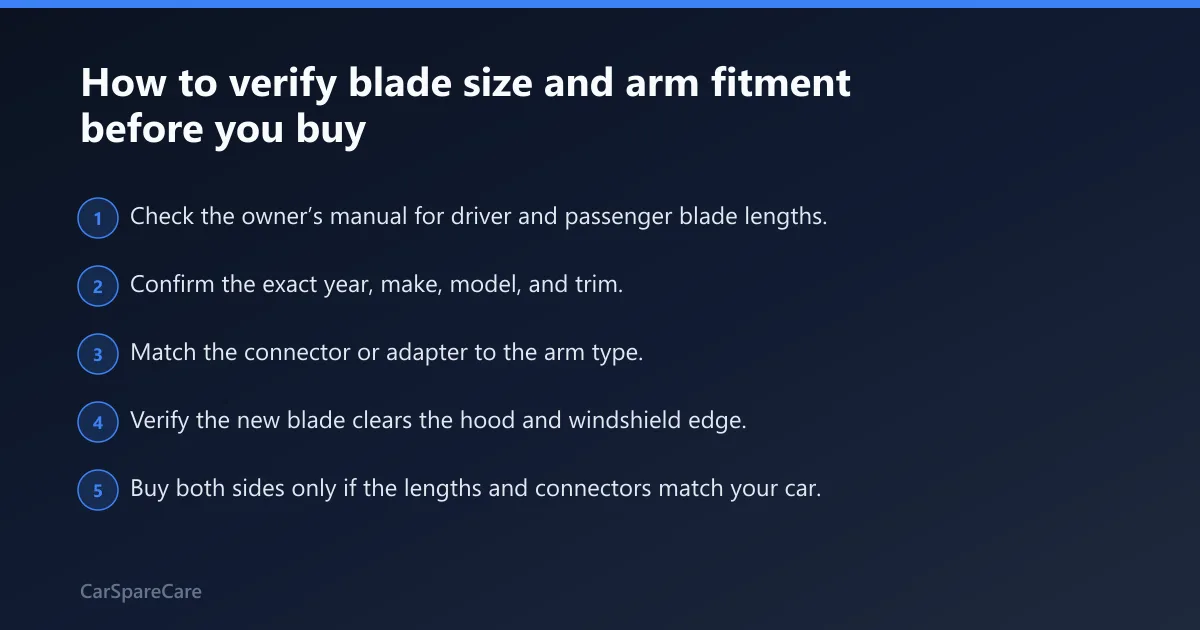
Verify blade size in inches, then verify how the blade attaches to the arm. A correct length that does not lock onto the arm is useless. Before checkout, make sure the blade clears the windshield edge, the hood line, and any parked position obstruction.
Measure blade length in inches
Wiper blade size is measured in inches, and it must match the vehicle, not a guess based on similar cars. The correct size protects windshield coverage area and helps avoid blind spots. Some vehicles use the same length on both sides, but many do not.
Check connector and adapter style
Wiper arm fitment is where many purchases fail. The blade must attach correctly to the arm, and the connector style can vary by car model. Some blades ship with adapters, while others are built for a specific arm shape. If the clip does not seat fully, do not force it.
Make sure the blade clears the hood and windshield edge
A blade that is too long can bump trim or sit outside its intended sweep. That may look fine in the package and fail once the wipers move. Watch the parked position, the lift point near the cowl, and the upper edge of the glass.
- Check the owner’s manual for driver and passenger blade lengths.
- Confirm the exact year, make, model, and trim.
- Match the connector or adapter to the arm type.
- Verify the new blade clears the hood and windshield edge.
- Buy both sides only if the lengths and connectors match your car.
How should climate and parking conditions change your choice?
Climate and parking exposure should shape the blade design after fitment is confirmed. Heavy rain, snow, heat, and outdoor parking change how fast rubber ages and how well the frame holds pressure. Cold climates may require replacing wipers sooner, especially when ice and road salt are part of daily use.
Heavy rain and frequent highway use
For long wet commutes, steady pressure and clean contact matter more than low sticker cost. Beam or hybrid styles usually handle wind and speed better than older frame designs because they keep more even pressure across the windshield.
Snow, ice, and freezing mornings
Snow and ice expose weak frames fast. Conventional wipers are widely used for simplicity and cost, but they are generally weaker in heavy snow or ice. Beam and hybrid blades usually cope better when the blade must flex around frozen buildup.
Street parking, sun exposure, and fast rubber wear
Outdoor parking is hard on windshield wiper rubber. Heat and sunlight dry the edge, and dry rubber loses its snug contact with the glass. If the car sits outside all day, choose a blade with better weather resistance and inspect it more often.
Which wiper blade type should you choose?
Choose the blade type after the fitment check. Conventional blades suit lower-cost replacement needs and mild weather. Beam blades are often a good fit for heavy rain, snow, ice, and higher-speed driving. Hybrid blades sit between the two, with a shape that aims for better all-weather performance without going full frame-less on every car.
Conventional wiper blades
Conventional wipers use a frame-based design and are widely used for simplicity and cost. They can work well in mild conditions and are often the lowest-cost option. Their weakness shows up in heavy snow, ice, or situations where the frame can load up with debris.
Beam wiper blades
Beam wipers have a sleek, aerodynamic design without a metal frame. They help ensure even pressure across the windshield, which is useful in harsh weather and at speed. For cars that live outside or face frequent winter conditions, beam blades are often the stronger pick.
Hybrid wiper blades
Hybrid blades combine conventional and beam features. They usually use an aerodynamic shell with a more structured core, which can improve all-weather performance. They are a sensible middle ground when the driver wants better wind control than a conventional blade and more snow tolerance than a basic frame design.
Use this fitment-first decision table
This table keeps the purchase order straight: fitment first, then climate, then parking exposure. It also helps avoid the common mistake of buying the correct length with the wrong connector or a blade type that fights local weather conditions.
| Blade type | Best climate | Parking exposure | Connector style to verify | Fitment note |
|---|---|---|---|---|
| Conventional | Mild rain, light dust, infrequent winter use | Garage or covered parking | Standard hook, bayonet, pin, or side-lock, depending on car | Lowest cost, but weaker in heavy snow or ice |
| Beam | Heavy rain, snow, ice, high-speed driving | Outdoor parking, exposed to wind and frost | Exact arm match plus adapter if needed | Better pressure consistency and weather resistance |
| Hybrid | Mixed seasons, frequent wet roads, occasional snow | Garage or street parking | Check whether the blade ships with the correct clip | Good middle ground when weather changes through the year |
Match driver and passenger lengths before checkout
Confirm the lengths separately before you pay. The driver and passenger sides may differ, and that is normal. A set built around one number can be wrong for the other side even when the packaging looks vehicle-specific.
What if the new blades still skip, chatter, or smear?
If a correctly sized blade still skips, chatter, or smears, the problem is often installation, contamination, or wear elsewhere. Clean the glass first, then inspect the rubber edge, the arm tension, and the adapter seating. Bent arms or aged windshield glass can also create poor wiping.
Clean the windshield and inspect the rubber
Windshield wiper rubber has to stay supple enough to maintain contact pressure. Road film, wax, and oily residue can make a good blade perform badly. Wipe the glass clean, then look for cracks, nicks, hard edges, or a blade edge that no longer sits flat.
Check arm tension and blade seating
If the arm presses too lightly, the blade may lift at speed or leave streaks. If the blade is not fully locked into the connector, it can chatter across the glass. Re-seat the adapter and make sure the locking tab is fully engaged.
Look for bent arms, wrong adapters, or worn glass
A bent arm changes the blade angle and can cause one corner to miss. A wrong adapter can fit loosely even when the length is correct. On older vehicles, worn or pitted glass can make new blades smear until the windshield is cleaned or polished properly.
Are left and right windshield wipers interchangeable?
Sometimes, but not always. Left and right windshield wipers are interchangeable only when the lengths, connector style, and arm shape match the vehicle’s setup. If the sides use different lengths or a different attachment, swapping them can reduce coverage or stop the blade from fitting at all.
When the lengths are the same
If both sides use the same blade length and the same connector, interchangeability is usually straightforward. Even then, the blade still needs the correct sweep angle and parked clearance. Equal length does not guarantee equal fit across all cars.
When the lengths differ
When one side is longer, it is usually best not to swap them. The wrong side can leave a blind spot or hit the cowl. This is one of the most common buying mistakes because the box may list a pair, but the car may use two different sizes.
When the connector or arm shape differs
Some cars use a different arm shape or connector on each side. In that case, the blades are not interchangeable even if they appear similar. Always match the adapter and the locking method to each arm before installation.
Frequently asked questions
How to find the right windshield wipers for my car
Use the owner’s manual first, then confirm the exact year, make, model, and trim. Check driver and passenger blade lengths separately, because they may differ. After that, verify the connector or adapter style so the blade attaches correctly to the arm.
How to choose the right windscreen wipers
Choose by fitment first, then by weather use. Confirm the blade lengths in inches, the connector style, and the arm type. After fitment is settled, pick conventional, beam, or hybrid based on rain, snow, parking exposure, and how often the car sits outside.
Are left and right windshield wipers interchangeable
Only sometimes. They are interchangeable when the lengths are the same and the connector style matches on both sides. If one side is longer, or the arm shape differs, swapping them can create poor coverage, a bad parked position, or a blade that will not attach properly.
How to find the right size windshield wipers
Start with the owner’s manual and parts lookup for the exact vehicle. If needed, measure the old blades as a backup check, but do not trust worn blades alone. The correct size must clear the windshield area without leaving blind spots or hitting trim.
Do any windshield wipers work
No. The blade has to match the length, arm fitment, and connector style for the car. A universal-looking blade may fail on the arm, sit at the wrong angle, or clear too little glass. Fitment matters more than packaging claims.
How to choose wiper blades
Choose the correct size first, then decide between conventional, beam, and hybrid. Look at climate, parking exposure, and the rubber quality. If the car faces winter weather or stays outside, better pressure control and weather resistance matter more than the cheapest option.

Hi, I’m Melvin, an automobile engineer with extensive experience in automobile equipment. I currently work for a local automobile firm, where I specialize in the car parts industry. I’ve had the opportunity to collaborate with seasoned inspectors, gaining invaluable hands-on experience that goes beyond just theory.
My passion for automotive care started at a young age, which led me to create CarSpareCare. Through CarSpareCare, I share the knowledge and skills I’ve acquired over the years to help others navigate the world of car maintenance and repairs.
My goal is to provide practical tutorials, essential safety advice, and the latest industry insights so that anyone—whether a beginner or an expert—can confidently tackle their automotive projects.

