
A thermostat stuck open often makes the engine warm up slowly, keeps the heater weak, and leaves the temperature gauge below normal after a cold start. If you ignore it, fuel use can rise, a coolant fault can stay hidden, and you may replace the wrong part. This guide shows a fast cold-start check that separates a stuck-open thermostat from low coolant, trapped air, a bad temperature sensor, and heater-core restriction.
Cold-Start diagnostic sequence

- Start with a fully cold engine and verify the reservoir level at the cold mark.
- Turn the heater to full hot and note when warm air begins.
- Watch the upper radiator hose for early warmth.
- Check the dash gauge and, if available, compare it with OBD-II live coolant temperature.
- If the vehicle recently had cooling service, confirm the system was bled per the OEM procedure.
- Use the pattern, not one symptom alone, to decide whether the thermostat, coolant level, air pocket, sensor, or heater core is the better fit.
What a thermostat does
The engine thermostat is a temperature-controlled valve in the cooling system, usually housed in the thermostat housing. It stays closed while the engine is cold, then opens at a set temperature so coolant can flow through the radiator. Common failure modes are stuck open, stuck closed, and slow opening.
That opening point matters because heater output depends on the engine reaching normal operating temperature. Most vehicles regulate somewhere around 190 to 220°F, but the exact range varies by model and engine calibration. Thermostats are commonly rated in that band, and OEM service data may specify a different target depending on engine family and emissions strategy. The dash gauge can hide small changes, so slow warm-up is often the better clue. For general thermostat operating behavior, see major parts references such as Gates and Standard Motor Products, and for exact service specs use the OEM procedure for the vehicle.
Why warm-up speed matters
A thermostat that opens too early lets coolant circulate through the radiator before the engine is ready. Warm-up takes longer, and the cabin heater can stay weak, especially on short trips and in cold weather. A thermostat that sticks closed does the opposite, the engine heats quickly and may overheat. On some vehicles, the PCM may also set thermostat rationality or performance codes if warm-up does not match expected model-specific behavior.
What you’ll need
- Safety gloves
- Paper towel or rag
- Flashlight
- OBD-II scan tool or app with live data
- Coolant-safe container if you need to check the radiator cap area
- Owner’s manual for the correct coolant fill points and thermostat rating
Start with a cold engine
Start here because a cold check separates thermostat faults from look-alikes. Check coolant only when the engine is fully cold. Then watch the dash, note cabin heat, and see whether the temperature gauge rises normally after a cold start.
Check the coolant level first
Check the reservoir and, if the design allows it, the radiator level only when the engine is cold. Low coolant can cause weak heat, delayed heat, and fluctuating gauge readings. If the reservoir is below the marked range, top up with the correct mix in about 250 mL increments and recheck after each addition.
Look at the dash and heater output
Turn the heater to full hot and a medium blower setting. If the cabin stays cool for an unusually long time, note whether the gauge stays low too. Defroster performance matters here as well. Weak defrost on a cold morning is often the first clue. Buffered gauges can also mask a slow warm-up, so a normal-looking needle does not always mean normal coolant temperature.
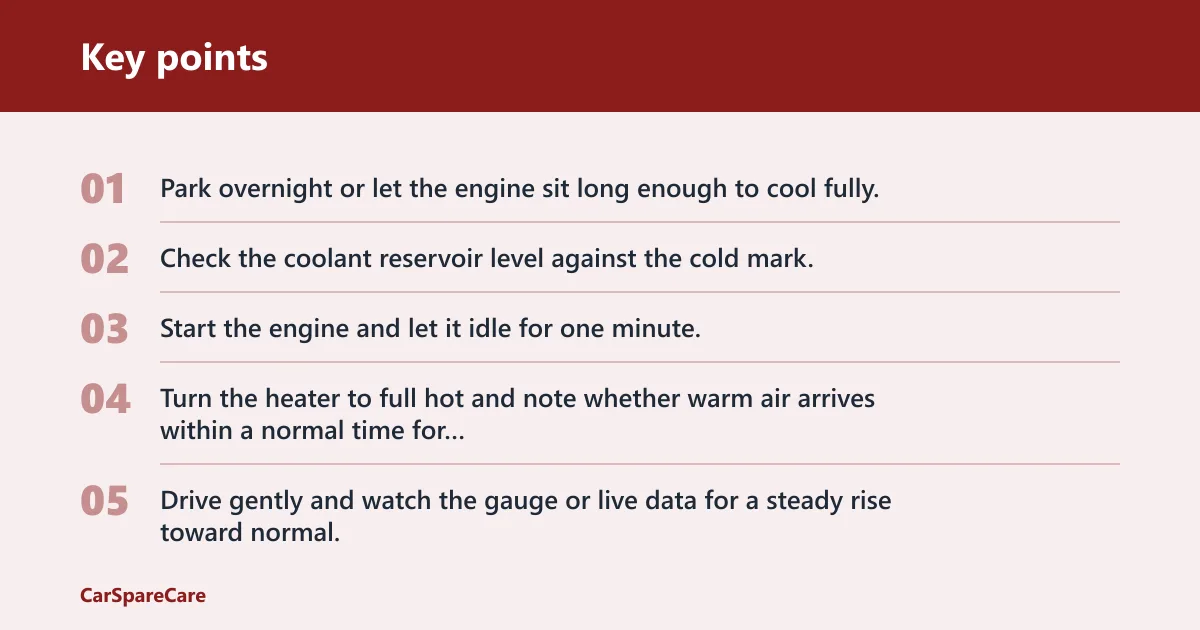
- Park overnight or let the engine sit long enough to cool fully.
- Check the coolant reservoir level against the cold mark.
- Start the engine and let it idle for one minute.
- Turn the heater to full hot and note whether warm air arrives within a normal time for that vehicle.
- Drive gently and watch the gauge or live data for a steady rise toward normal.
How to check the upper hose
The upper radiator hose is a quick tactile clue. On a cold start, it should stay cool for a while. If it warms very early, coolant may be circulating through the radiator before the engine has reached operating temperature.
What early hose warmth means
Early hose warmth points toward a thermostat that is stuck open or opening too soon. It is a clue, not proof. A hose can feel warm early if hot coolant has mixed into the system because of air, a failed sensor command on some vehicles, or another cooling fault. Electric water pumps and computer-controlled fan logic can also change hose feel and warm-up timing, so compare hose temperature with scan data whenever possible.
How to read hose temperature with context
Compare the hose with the engine’s actual warm-up. If the gauge stays low and the hose is already heating within the first few minutes, the thermostat moves up the list. If the heater is weak but the hose is still cool, look harder at coolant level and trapped air first.
Say your compact car idles for 10 minutes on a 35°F morning, the gauge barely moves off cold, and the upper hose is already warm. That pattern fits a thermostat opening too early more than a heater-core issue.
A stuck-open thermostat often shows a slow warm-up curve, weak cabin heat, and an upper radiator hose that gets warm too early after a cold start. The best confirmation is not one symptom alone, but a pattern: delayed rise to normal temperature, then a stable but low reading under light driving.
Read the warm-up curve
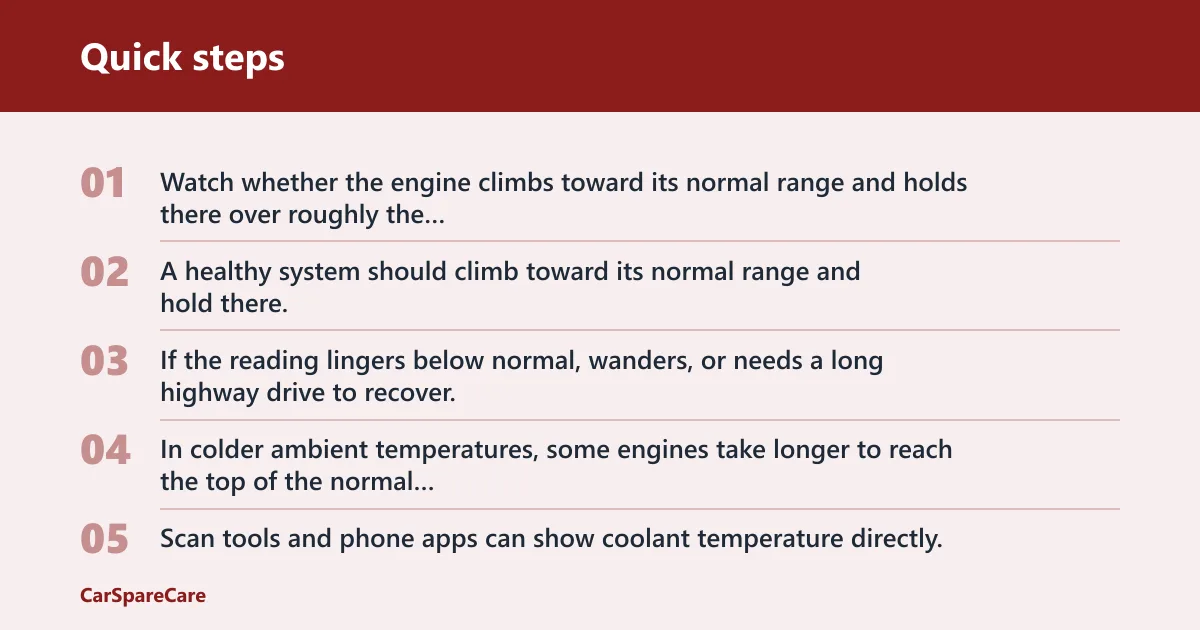
Watch whether the engine climbs toward its normal range and holds there over roughly the first 10 to 15 minutes of driving from cold. A healthy system should climb toward its normal range and hold there. If the reading lingers below normal, wanders, or needs a long highway drive to recover, the thermostat is suspect. In colder ambient temperatures, some engines take longer to reach the top of the normal range, so use the vehicle’s expected behavior rather than a single universal time.
Use OBD-II live data if available
Scan tools and phone apps can show coolant temperature directly. Start the engine cold, then watch the number rise steadily. You want a curve, not a single reading. If the coolant temperature stalls far below the expected range, or rises very slowly while the heater stays weak, that supports a stuck-open thermostat diagnosis. For sensor testing and rationality checks, reputable repair databases and OEM charts typically recommend comparing ECT data with ambient conditions, connector condition, and warm-up behavior.
Suppose the scan tool shows 52°F at startup, 120°F after eight minutes of city driving, and only 154°F after a 15-minute commute. That is more convincing than a dash gauge alone, especially on vehicles with buffered gauges.
Stuck-open thermostat vs look-alikes
These symptoms overlap. Low coolant, air in the system, a weak heater core, and a bad coolant temperature sensor can also resemble a thermostat fault at first. Use the quick checks below before ordering parts.
| Symptom | Quick check | Likely cause | Next step | What rules it out |
|---|---|---|---|---|
| Slow warm-up, weak heat, hose warms early | Cold start plus OBD-II warm-up curve | Stuck-open thermostat | Replace thermostat and gasket if the curve stays low | Rules out a simple gauge issue when scan data also stays low |
| Weak heat with low reservoir level | Check coolant only when cold | Low coolant | Top up to the cold mark and inspect for leaks | Rules out thermostat failure when the system is simply underfilled |
| Heat comes and goes after recent service | Listen for gurgling and check heater output after bleeding | Air in system | Bleed the cooling system per the service procedure | Rules out a bad thermostat when symptoms started right after service |
| Gauge reads cold but scan data looks normal | Compare dash reading with OBD-II coolant temperature | Bad coolant temperature sensor or gauge issue | Inspect the sensor, connector, and wiring | Rules out thermostat failure when the engine is warming normally |
| Engine warms normally but cabin heat stays weak | Check hose temp and heater outlet temperature | Weak heater core or restricted flow | Inspect heater hoses and heater-core flow | Rules out the thermostat when engine temperature is normal but cabin heat is not |
Should you replace it now?
Replace the thermostat when the cold-start pattern, hose temperature, and live coolant data all point the same way. If the engine warms slowly on repeated cold starts and the scan tool shows a low warm-up curve, the thermostat is the likely fault. If not, inspect coolant level, air, and sensor data first.
When the thermostat is the likely fault
- Confirm the coolant level is correct when cold.
- Repeat the cold-start drive and watch OBD-II live data.
- If coolant temperature stays below normal for too long, replace the thermostat and thermostat housing gasket together if the seal is disturbed.
When to inspect coolant level, bleed the system, or check the sensor first
- If the reservoir is low, refill with the correct mix and inspect for leaks before replacing parts.
- If the problem started after coolant service, perform the cooling system bleed procedure for that vehicle.
- If scan data looks normal but the dash does not, inspect the coolant temperature sensor and connector.
Common mistakes
Most mistakes come from skipping the cold check. A warm engine can hide low coolant, air pockets, and a thermostat that is opening late. Another common error is reading only the dashboard gauge. Some vehicles buffer the gauge so it looks normal even when coolant temperature is not.
A common first-timer mistake is replacing the thermostat after a short idle check. That can miss a trapped-air problem, especially after a drain-and-fill. Bleeding the cooling system first often saves time, and some models require a specific fill-and-bleed sequence from OEM service information because the thermostat, bleeder screws, or degas bottle layout can vary.
Another mistake is confusing weak cabin heat with a failed thermostat. A restricted heater core can keep the cabin cold even when engine temperature is normal. Check both heater hoses and scan data before condemning the thermostat.
Frequently asked questions
How do you tell if the thermostat is stuck open or closed?
Stuck open usually means slow warm-up, weak heater output, and a low temperature reading after a cold start. Stuck closed usually means the engine heats too fast and may overheat. Compare the warm-up curve, hose temperature, and dashboard behavior instead of relying on one symptom.
What happens if a thermostat is stuck open?
The engine often takes longer to reach operating temperature, fuel economy can drop, and the cabin heater may stay weak on short trips. The engine may never settle at a normal temperature on light driving, which can also keep the defroster from working well in cold weather.
How can I check if my car thermostat is stuck open?
Start with a cold engine, verify coolant level, then drive while watching OBD-II live data or the gauge. If the temperature rises slowly and the upper radiator hose warms early, the thermostat is a strong suspect. A scan tool gives the clearest answer.
Can a bad coolant temperature sensor look like a stuck-open thermostat?
Yes. A faulty coolant temperature sensor can make the dash or scan data read colder than the engine really is. Compare live data with the heater output and the actual warm-up feel. If the engine warms normally but the reading does not, check the sensor and connector. Some vehicles may also set thermostat rationality codes or ECT plausibility codes when the signal does not match expected warm-up behavior.
How long should it take the engine to warm up if the thermostat is working?
There is no single time that fits every vehicle. Ambient temperature, engine size, idle time, and driving cycle all matter. A healthy system should reach its normal operating range within a few miles of mixed driving, not stay low throughout a typical commute.
Should I replace the thermostat or diagnose the cooling system first?
Diagnose first. Check coolant level cold, look for air in the system, and compare live coolant temperature with the dash reading. Replace the thermostat only after those checks point to a warm-up problem that repeats on a cold start and the rest of the cooling system looks sound.

Hi, I’m Melvin, an automobile engineer with extensive experience in automobile equipment. I currently work for a local automobile firm, where I specialize in the car parts industry. I’ve had the opportunity to collaborate with seasoned inspectors, gaining invaluable hands-on experience that goes beyond just theory.
My passion for automotive care started at a young age, which led me to create CarSpareCare. Through CarSpareCare, I share the knowledge and skills I’ve acquired over the years to help others navigate the world of car maintenance and repairs.
My goal is to provide practical tutorials, essential safety advice, and the latest industry insights so that anyone—whether a beginner or an expert—can confidently tackle their automotive projects.

