
Check coolant only after the engine has fully cooled, with the cap closed and the level between the MIN and MAX marks. If it sits below MIN, top up with the correct mix after the car cools. Checking it the wrong way can cause burns, overfill problems, or missed leaks that lead to overheating. This guide shows the safest home check, how to read level, color, and smell, and when repeat loss means you should book a leak diagnosis.
What you’ll need


- Gloves and safety glasses
- Rag or paper towel
- Funnel for topping up
- Owner’s manual or OEM coolant specification
- The correct engine coolant, also called antifreeze
📊 Checking your coolant level should take you less than 10 minutes. Source: How To Check Your Coolant Level.
Should you check coolant hot or cold?
Check coolant only when the engine is cold. A hot cooling system is pressurized, and an overheating engine can spray hot fluid or steam if a cap or fill point is opened too soon. A cold check gives a reliable reading and keeps the job safer.
Do not crack open a hot radiator cap or pressurized fill point. Some vehicles use a remote fill location instead of a visible reservoir, so the safe access point can vary by model. If the engine was recently run, wait until the hoses and cap feel cool before touching anything.
How do you find the reservoir?
Look for the coolant reservoir, also called the expansion tank, a translucent plastic tank with MIN and MAX marks. On many cars, it sits near the radiator, but some models place it on the inner wing or behind trim. Many cars also mark the cold reading with a COLD line.
If you do not see a translucent tank, check the owner’s manual for a remote fill point or alternate level check. Some systems route filling through a cap near the radiator, while others place the reservoir farther away in the engine bay. Never guess the fill point on a pressurized system.
How do I check my engine coolant level safely?
Park on level ground, switch off the engine, and let it cool fully. Then read the reservoir without opening a hot cap. The level should be between the minimum and maximum marks when cold, and a low coolant warning means coolant should be added to the reservoir as soon as possible. (Firestonecompleteautocare)
A cold check should take less than 10 minutes. Use gloves, safety glasses, and a rag or paper towel in case the tank is dusty or the cap area is damp. If the engine temperature gauge has been rising toward the hot or red zone, stop driving and inspect the system only after it cools.
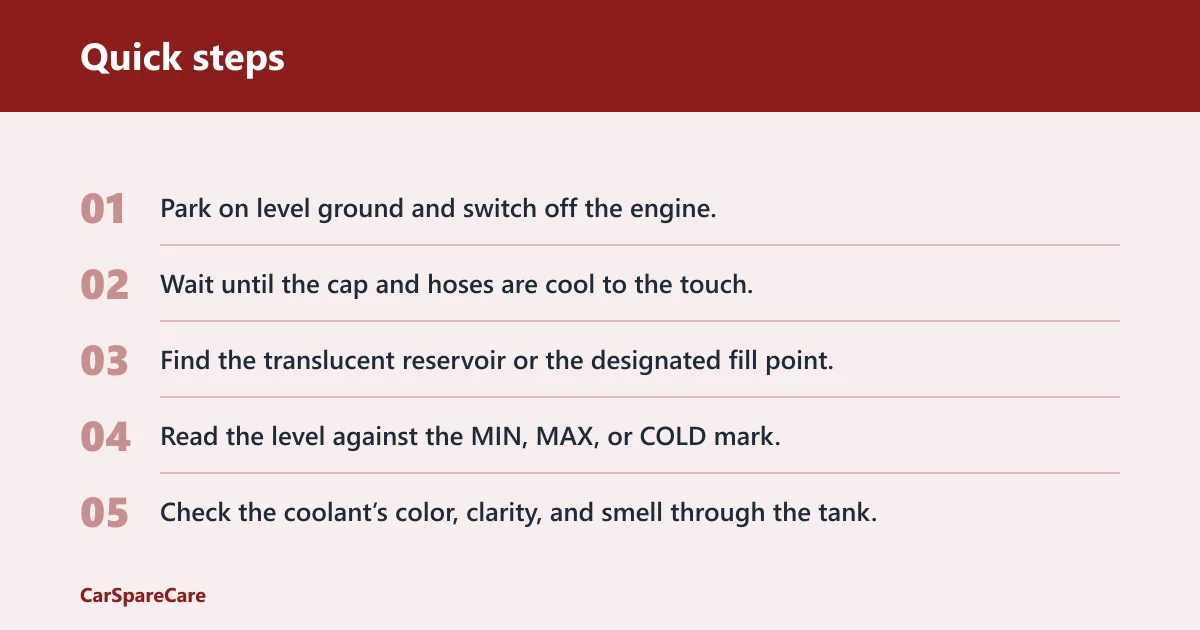
- Park on level ground and switch off the engine.
- Wait until the cap and hoses are cool to the touch.
- Find the translucent reservoir or the designated fill point.
- Read the level against the MIN, MAX, or COLD mark.
- Check the coolant’s color, clarity, and smell through the tank.
- If the level is below MIN, add the correct coolant mix through a funnel.
- Add about 100 to 200 mL at a time, then recheck the mark before adding more.
- Close the cap fully and inspect for drips, puddles, or a warning light after the next drive.
How do I top up coolant safely?
Use the coolant specification listed in the owner’s manual or OEM guidance, not color alone. Engine coolant contains corrosion inhibitors, and the wrong type can damage an engine or reduce protection. Check the spec for the exact vehicle, because IAT, OAT, HOAT, and vehicle-specific fluids are not interchangeable.
Many products are pre-mixed, and some systems call for a 50-50 mix of water and antifreeze. If the bottle is concentrate, mix it exactly as directed before adding it. Pour slowly, stop at the marked level, and do not overfill a cold tank. (Thedrive)
How to decide what to add
- If the bottle says pre-mixed, add it as supplied.
- If the bottle is concentrate, follow the label for the water ratio.
- If the manual specifies 50/50, use that ratio unless the fluid is already premixed.
- If the coolant type is unclear, stop and verify the exact spec before topping up.
Common mistakes
Reading a hot tank can make the level look higher or lower than it really is. An overfull cold tank is also a problem, because coolant expands as it warms and needs room in the reservoir. If the level is above MAX when cold, siphon or drain to the mark only after the system is fully cool.
Do not use color alone to identify coolant type. Green, orange, and other bright colors can all appear in different formulations, so the label and manual matter more than appearance. Also avoid ignoring repeat loss, rusty or cloudy fluid, and foamy coolant.
Say your hatchback shows a level just below MIN on Monday, and the gauge sits normal after a top-up. If the level is low again after a top-up, that is unlikely to be a one-off reading issue; it can point to a leak or another fault that needs diagnosis.
A common first-timer mistake is assuming a sweet smell near the car is harmless. Coolant leaks often leave a sweet odor, and a puddle, hissing sound, steam from the engine bay, or a rising temperature gauge should move the job from top-up to inspection.
Coolant check decision table
| Symptom or reading | What it likely means | Safe next step | When to stop DIY |
|---|---|---|---|
| Level between marks cold | Level is normal for a cold check | Close the cap and monitor the gauge over the next drives | Stop if the level starts dropping again or the gauge rises |
| Below MIN cold | Coolant is low and may point to a leak | Top up with the correct coolant and mix, then recheck after the engine cools | Stop if it drops again, or if you see leaks, steam, or warning lights |
| Overfull when cold | Reservoir may be overfilled | Remove excess only when fully cool and return to the marked range | Stop if the cap area is hot, the tank is cracked, or coolant spills continue |
| Level drops again after top-up | Likely leak at a hose, radiator, water pump, thermostat housing, or heater core | Inspect for puddles, sweet smell, hissing, or damp fittings | Book a leak diagnosis now |
| Cloudy, oily, or foamy coolant | Contamination or mixing problem | Do not keep topping up; check the oil cap, reservoir, and manual guidance | Stop DIY and arrange a professional inspection |
| No visible reservoir on the vehicle | Vehicle may use a remote fill point or a different service layout | Check the owner’s manual for the correct fill location and warning-light response | Stop if you cannot find the designated point without opening a hot system |
When should you seek professional help?
Book a leak diagnosis if the level drops again after a top-up, if the temperature gauge keeps climbing, or if there are puddles, sweet smells, hissing, or steam. Repeat loss usually means a hose, radiator, water pump, thermostat housing, or heater core needs attention.
Also stop DIY if the coolant is cloudy, oily, rusty, or foamy. Those signs can point to contamination, air in the system, or internal trouble that needs proper testing. A low coolant warning should not be ignored, because coolant should be added to the reservoir as soon as possible.
Frequently asked questions
How do I check coolant level in car when the engine is cold?
Park on level ground, switch off the engine, and let the hoses cool. Find the reservoir or remote fill point, then read the marks through the tank. A cold reading below MIN means you should add coolant soon, using the fluid type listed by the manual.
When should I check coolant level?
Check it during routine maintenance and any time the warning light comes on, the gauge rises, or you smell coolant. A cold check is the safest method, and checking coolant only when the engine is cool is the rule to follow for safety. Make it a habit before longer trips.
How do I check if coolant is good?
Look for clear fluid with the correct color for that vehicle and no oil film, foam, rust, or cloudiness. Color alone is not enough to identify type, so confirm the spec in the owner’s manual. If it looks contaminated, stop topping up and get it inspected.
Where should the coolant level be on the reservoir?
On a cold engine, the level should be between the minimum and maximum marks. Many tanks also have a COLD line that shows the correct cold reading. If the level is above MAX when cold, remove excess only after the system has cooled fully.
How do I check if my car needs coolant?
Look for a level below MIN, a rising temperature gauge, a low coolant warning, or signs of loss under the car. Puddles, a sweet smell, hissing, or steam point to a leak. If the level keeps dropping after a top-up, book a leak diagnosis.

Hi, I’m Melvin, an automobile engineer with extensive experience in automobile equipment. I currently work for a local automobile firm, where I specialize in the car parts industry. I’ve had the opportunity to collaborate with seasoned inspectors, gaining invaluable hands-on experience that goes beyond just theory.
My passion for automotive care started at a young age, which led me to create CarSpareCare. Through CarSpareCare, I share the knowledge and skills I’ve acquired over the years to help others navigate the world of car maintenance and repairs.
My goal is to provide practical tutorials, essential safety advice, and the latest industry insights so that anyone—whether a beginner or an expert—can confidently tackle their automotive projects.

