Wheel weights usually fall off after adhesive failure, curb damage, corrosion, or a poor install; winter road salt and freeze-thaw can speed it up, and any shake, steering-wheel vibration, or fresh bare patch means recheck balance. Left alone, the tire can wear unevenly, ride harshly, and stress bearings and suspension parts. This guide covers the common causes, winter effects, warning signs, and when to rebalance, inspect the wheel, or visit a tire shop.
What wheel weights do
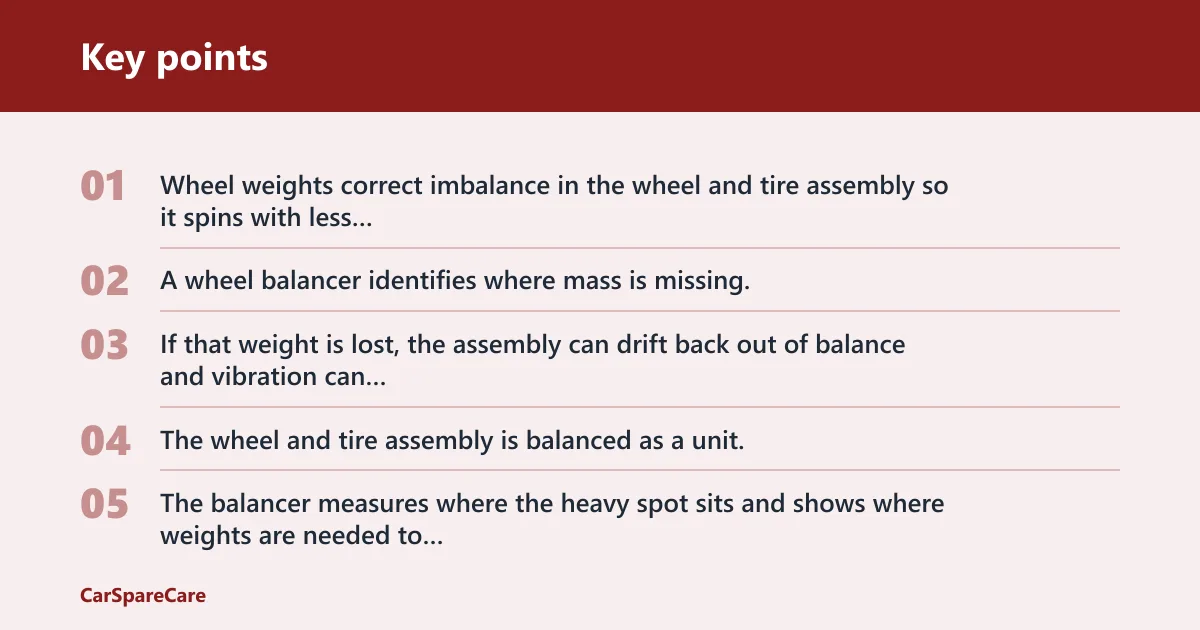


Wheel weights correct imbalance in the wheel and tire assembly so it spins with less vibration. A wheel balancer identifies where mass is missing, then places the weight where the machine calls for it. If that weight is lost, the assembly can drift back out of balance and vibration can return.
How a wheel and tire assembly is balanced
The wheel and tire assembly is balanced as a unit. The balancer measures where the heavy spot sits and shows where weights are needed to counter it. One example imbalance shown was about 0.25 oz at the 6 o’clock position, which can matter if it is no longer offset correctly.
What changes when a weight goes missing
When a weight disappears, the balance correction disappears too. The car may still drive, but the vibration can move back into the steering wheel, seat, or floor depending on whether the front or rear wheel is involved. A wrong measurement can leave a wheel vibrating at highway speed.
Why a balancer is still needed after a weight falls off
A missing weight is a clue, not a full diagnosis. The wheel may simply need the same correction replaced, or it may have a rim, tire, or mounting problem that caused the loss. A wheel balancer is still the right tool because it confirms where correction is needed before anything is reinstalled.
Why wheel weights fall off
Adhesive wheel weights fail when the strip cannot bond to the wheel surface well enough, or when something damages the bond after installation. Clip-on wheel weights fail differently because they depend on mechanical grip at the rim lip. The cause matters, because the fix changes with the wheel material, finish, and failure pattern.
Cold metal and stiff adhesive in winter
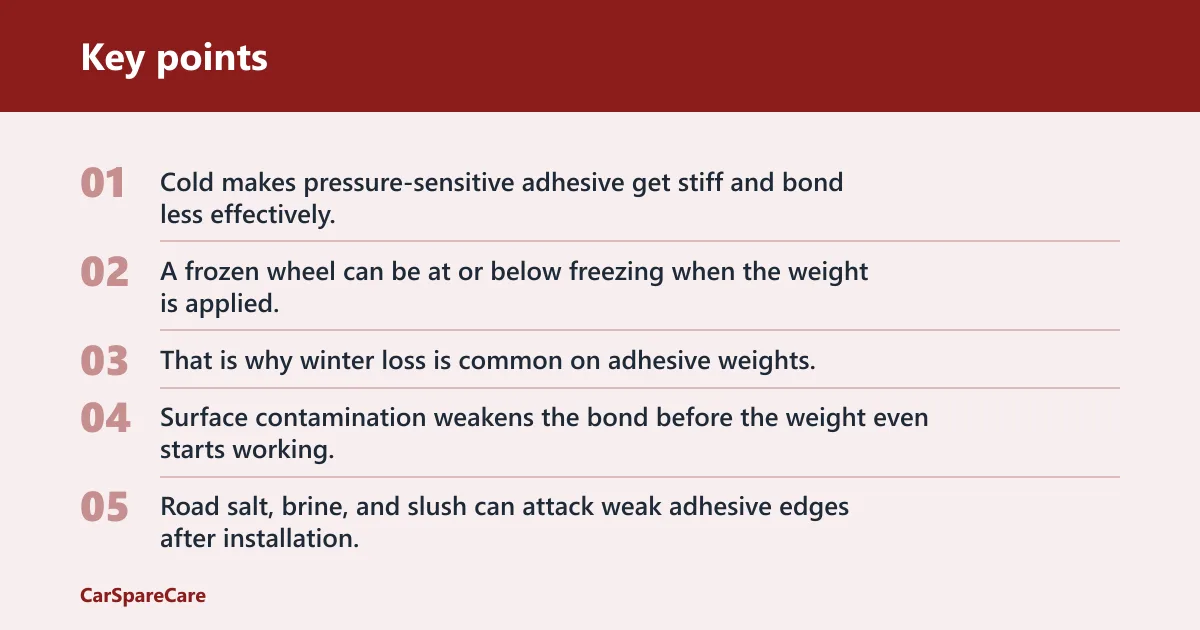
Cold makes pressure-sensitive adhesive get stiff and bond less effectively. A frozen wheel can be at or below freezing when the weight is applied, which reduces wet-out on the metal. That is why winter loss is common on adhesive weights, especially when the wheel and shop air are both cold.
Surface contamination from brine, salt, and oil
Surface contamination weakens the bond before the weight even starts working. Road salt, brine, and slush can attack weak adhesive edges after installation, while an oily haze or residue from old adhesive keeps the strip from touching clean metal. If the strip zone is not truly clean, the bond starts at a disadvantage.
Short press time, bad prep, or reused strip
Press time matters right after application. The guide says to use firm, full-contact pressure across the whole weight, because weak edges can lift first. Wheel prep should include removing the old weight and cleaning the bond area thoroughly, and wheel weight adhesive should not be reused after removal.
Rim damage, corrosion, and rough finish problems
A damaged wheel surface can defeat even a correct install. Corrosion under the strip, pitting on the rim, or a rough finish leaves fewer clean contact points. That is especially important on wheels with paint chips, baked-on brake dust, or a finish that has already started to lift.
Picture a front alloy wheel that loses a strip weight a week after a tire rotation. If the shop reuses the old strip, applies it over a dull film, and sends the wheel out cold, the loss is more likely than if the wheel had been cleaned twice and pressed firmly.
Say your car starts to shake above 55 mph after a car wash, and the missing weight leaves a shiny patch with adhesive residue. That points first to bond failure or contamination, not automatically to a bent rim. The next step is still inspection, not guessing.
Can wheel weights fall off in winter?
Yes. Winter is a common time for adhesive weights to let go because cold stiffens the adhesive, frozen wheels reduce wet-out, and road salt can work at weak edges after installation. Clip-on weights are less sensitive to temperature, but they still need the right rim shape and a secure fit.
What cold does to adhesive wheel weights
Adhesive wheel weights depend on pressure-sensitive adhesive bonding to clean metal. In cold conditions, the adhesive gets stiffer and needs more help to flow into the surface texture. If the wheel is at or below freezing, the bond can form poorly even when the weight looks seated.
Why shop temperature and wheel temperature both matter
Warm air alone is not enough if the wheel itself is cold. The metal surface has to be warm enough for the strip to wet out properly, and the prep solvent must flash dry before application. If solvent is still wet, it can leave residue or weaken the bond zone.
When clip-on weights are the better fit
Clip-on wheel weights attach mechanically to the rim lip and are used in a standard balancing routine on wheels that suit them. They are common when the wheel design allows a secure clip and the finish or shape makes adhesive weights a poor choice. They are not a universal replacement.
The first clue is often a new vibration pattern after the car was smooth before. Steering-wheel shake often points toward the front wheels, while seat or floor vibration often points toward the rear. A bare patch, residue, or missing strip at the weight location confirms the loss, but not the deeper cause.
Common vibration clues at specific speeds
Balance problems often show up at a narrow speed range rather than all the time. Highway-speed shake is a common complaint, and a wrong measurement can leave a wheel vibrating at highway speed even if the car feels fine around town. Note the speed where it starts and where it fades.
Steering-wheel shake versus seat shake
Steering-wheel shake usually comes from the front axle. Seat or rear-floor vibration more often points to the rear. That pattern helps narrow the search, but it does not identify the exact fault. A lost wheel weight, a bent rim, tire runout, or an imbalance can feel similar to the driver.
What visible residue or bare adhesive area means
A fresh bare patch where the weight sat matters. Adhesive residue means the strip likely failed or was removed, and corrosion or a rough finish may be left behind. If the wheel face is clean but the vibration remains, the problem may be elsewhere in the wheel and tire assembly.
Wheel weight failure diagnosis table
This table separates common symptoms from the likely cause and the next check. Use it as a diagnostic path, not as a final answer.
| Symptom | Likely cause | Inspection method | Next step |
|---|---|---|---|
| Weight missing after snow, slush, or salt exposure | Winter adhesive failure or edge attack from brine | Check the strip zone for cold metal, lifted edges, and salt residue | Clean twice, let the area flash dry, then rebalance with a new weight |
| Sticky film or dirt under the old location | Surface contamination from road brine, salt residue, or oily haze | Wipe the bond area and inspect for haze or leftover adhesive | Remove contamination fully before installing a replacement |
| Weight peeled off soon after install | Poor press-out or short press time | Check whether the full strip was pressed across its length | Install a new strip and apply firm, full-contact pressure |
| Old adhesive reused on the wheel | Reused strip with weakened bond | Look for a previously removed weight or reused backing | Discard it and fit a new adhesive weight |
| Repeated loss in the same location | Rim damage, corrosion, or bad finish at the bond area | Inspect for pitting, peeling paint, or a rough edge | Repair or replace the wheel surface before balancing again |
| Vibration comes back after a rotation or return visit | Repeat-comeback case from missed imbalance or wheel damage | Recheck balance on a wheel balancer and inspect tire runout | Inspect the wheel, tire, and hub side before refitting weights |
How to make adhesive wheel weights stick better
Clean metal, dry metal, and full pressure matter most. Remove the old weight, clean the bond area twice, let the prep solvent flash dry, and then apply a new strip with firm, full-contact pressure. If the wheel is cold, warm the wheel and recheck the surface temperature before fitting anything.
Clean the strip zone correctly
Start by removing the old weight, then clean the strip zone twice so residue is not left behind. The bond area should be free of salt residue, oily haze, and loose corrosion. A quick wipe is not enough if the adhesive has already left film on the wheel face.
Let prep solvent flash dry
Prep solvent must flash dry before applying the weight. If solvent is still wet, the adhesive may sit on a film instead of clean metal. Cold conditions slow evaporation, so a wheel that looks dry may still hold solvent in the texture of the finish.
Apply firm full-contact pressure
Press time matters immediately after application. Use firm, full-contact pressure across the whole weight so the strip makes even contact from edge to edge. Weak edges are where failures start, especially on a wheel that is cold or slightly contaminated.
Use a new weight, not a reused strip
Do not reuse a wheel weight adhesive after removal. The bond path has already been stretched and contaminated, even if the strip still looks usable. A new strip is the safer choice when the wheel is being rebalanced after a loss.
- Remove the old weight and any residue.
- Clean the bond area twice.
- Let the prep solvent flash dry.
- Warm the wheel if the surface is cold.
- Fit a new weight in the balancer’s marked spot.
- Press firmly across the full length of the strip.
When to rebalance or inspect the wheel
Rebalance after any lost weight if the car now shakes or the missing piece is visible. Inspect more deeply when the same wheel loses weight again, when the loss happens after rotation, or when the wheel face shows corrosion, peeling finish, or damage around the bond area.
After one lost weight
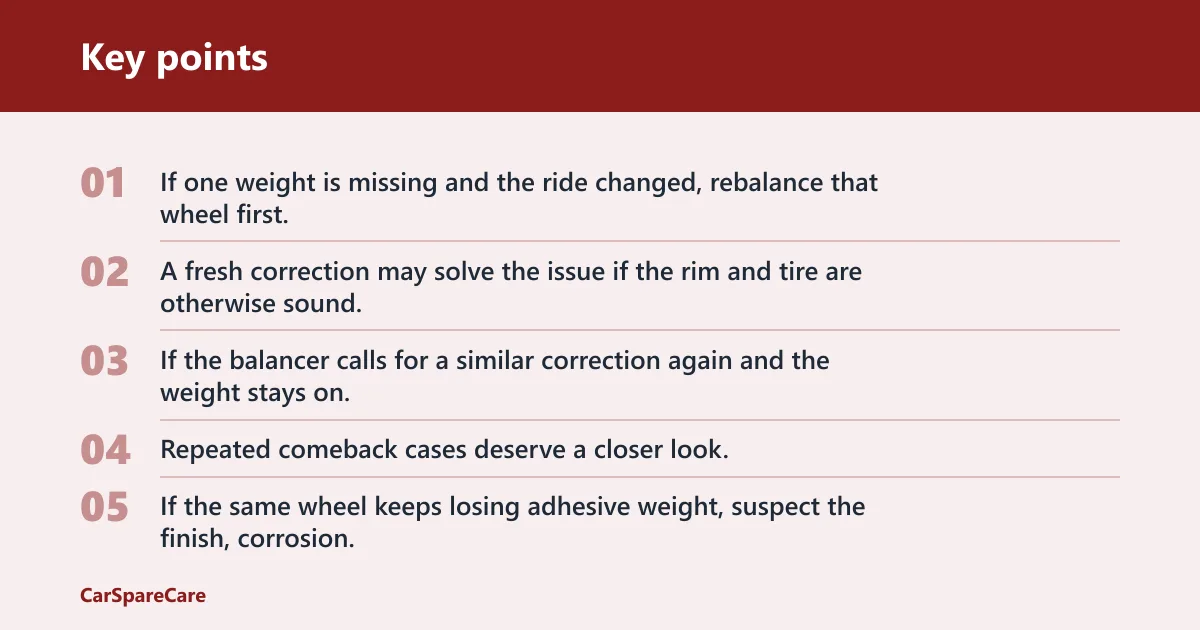
If one weight is missing and the ride changed, rebalance that wheel first. A fresh correction may solve the issue if the rim and tire are otherwise sound. If the balancer calls for a similar correction again and the weight stays on, the repair is probably complete.
After repeated loss in the same spot
Repeated comeback cases deserve a closer look. If the same wheel keeps losing adhesive weight, suspect the finish, corrosion, or an improperly prepared strip zone. That is the point to inspect the wheel surface, not just keep applying more adhesive.
When to check for bent rim or tire issues
A lost weight does not prove a bent rim. It can be one clue among several. Check for visible wheel damage, tire runout, and other signs the assembly is not spinning cleanly. If vibration stays after correct balancing, the wheel or tire may need replacement or repair.
Frequently asked questions
What do wheel weights do?
Wheel weights correct imbalance in the wheel and tire assembly so the wheel spins more evenly. The balancer shows where mass needs to be added. Without the right correction, vibration can show up through the steering wheel, seat, or floor, especially at highway speed.
What causes a wheel weight to fall off
The common causes are adhesive failure, contamination, cold-stiffened adhesive, short press time, or a poor wheel surface. Reused strip weights are also a problem. On clip-on weights, the cause is usually a fit issue at the rim lip rather than adhesive failure.
How do you make adhesive wheel weights stick better?
Clean the bond area twice, let the prep solvent flash dry, fit a new strip, and apply firm, full-contact pressure across the whole weight. Warm the wheel if it is cold. A frozen or dirty wheel gives the adhesive little chance to bond well.
How to tell if a wheel weight has fallen off
Look for a fresh bare patch or adhesive residue where the weight used to sit, then note whether the car now shakes at a certain speed. Steering-wheel shake usually points forward, while seat shake often points rearward. That pattern helps narrow the search.
How much does wheel weight affect performance?
It can matter a lot more than the weight sounds like. Even a small imbalance can create vibration at highway speed, and one example imbalance shown was 0.25 oz at the 6 o’clock position. The effect depends on wheel speed, location, and how far the balance drifted.

Hi, I’m Melvin, an automobile engineer with extensive experience in automobile equipment. I currently work for a local automobile firm, where I specialize in the car parts industry. I’ve had the opportunity to collaborate with seasoned inspectors, gaining invaluable hands-on experience that goes beyond just theory.
My passion for automotive care started at a young age, which led me to create CarSpareCare. Through CarSpareCare, I share the knowledge and skills I’ve acquired over the years to help others navigate the world of car maintenance and repairs.
My goal is to provide practical tutorials, essential safety advice, and the latest industry insights so that anyone—whether a beginner or an expert—can confidently tackle their automotive projects.