Wheel load rating is the approximate maximum weight one wheel can carry safely. A practical rule is to choose wheels rated at or above the heaviest load each wheel is likely to see, with GVWR divided by 4 as a rough minimum check. Miss that, and bent wheels, cracked spokes, bead leaks, and towing or pothole failures show up fast. This guide shows how I read the rating, work out the minimum per-wheel need, and pick the right wheel for daily driving, hauling, SUVs, EVs, pickups, and vans.
What is wheel load rating?
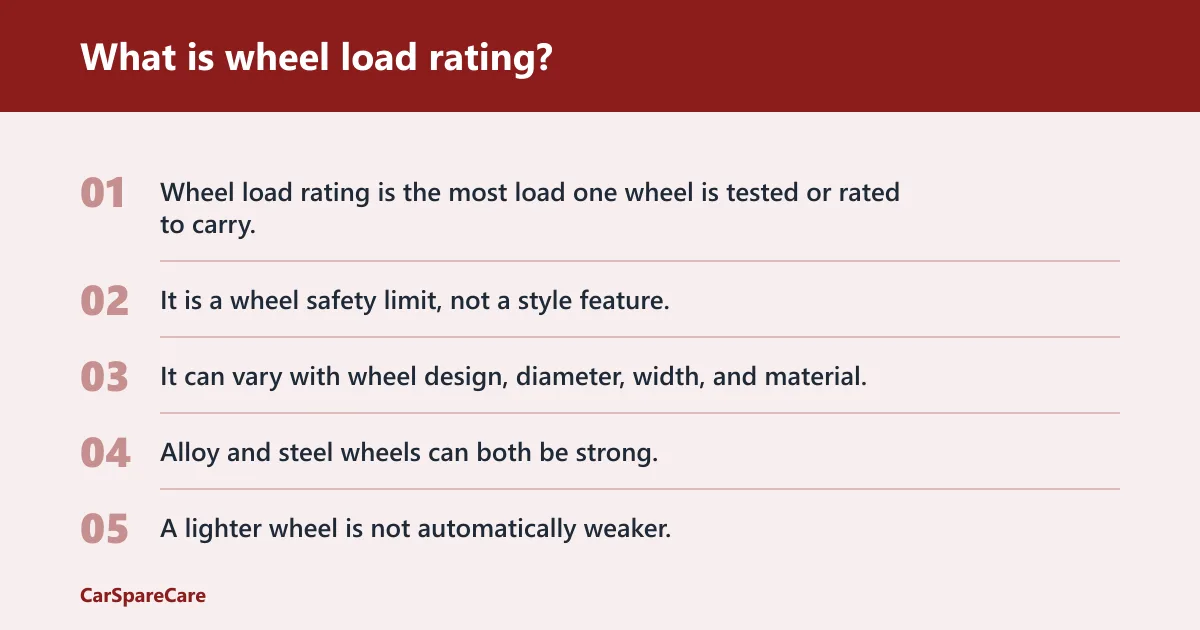
Wheel load rating is the most load one wheel is tested or rated to carry. It is a wheel safety limit, not a style feature, and I match it to the vehicle’s axle and gross vehicle weight needs before I buy.
How the rating is defined
Wheel load capacity is a per-wheel figure. It can vary with wheel design, diameter, width, and material, so two wheels of the same size may still carry different loads. Size alone never proves fitment or safety.
Wheel material matters too. Alloy and steel wheels can both be strong, but their rated capacities depend on the exact build. A lighter wheel is not automatically weaker, and a heavier wheel is not automatically safer.
Why the number matters in the real world
The rating keeps the wheel within its tested limit during normal driving, braking, cornering, and road shock. When a wheel runs near or above its limit, the margin for potholes, curb strikes, and trailer tongue weight shrinks fast.
Why does wheel load rating matter for safety and fitment?
Wheel load rating matters because a wheel rated too low may bend, crack, or leak at the bead, especially when the vehicle is loaded or takes a hard hit. It also matters for fitment, because a wheel may fit the hub and clear the brakes yet still be the wrong strength for the vehicle.
What happens when the rating is too low
Too little load rating can lead to rim deformation, spoke cracking, air loss at the bead seat, steering vibration, and a higher failure risk after pothole hits or hard braking. The danger climbs when the vehicle is carrying passengers, cargo, roof gear, or towing equipment.
Why towing, hauling, potholes, and heavy loads raise the demand
Towing shifts extra force into the rear axle and can put more load on one side of the vehicle than expected. Hauling adds static weight, but road shock adds short spikes above that static number. Potholes and broken pavement create brief impacts that can exceed the wheel’s normal working load.

How do I find the load rating on a wheel?
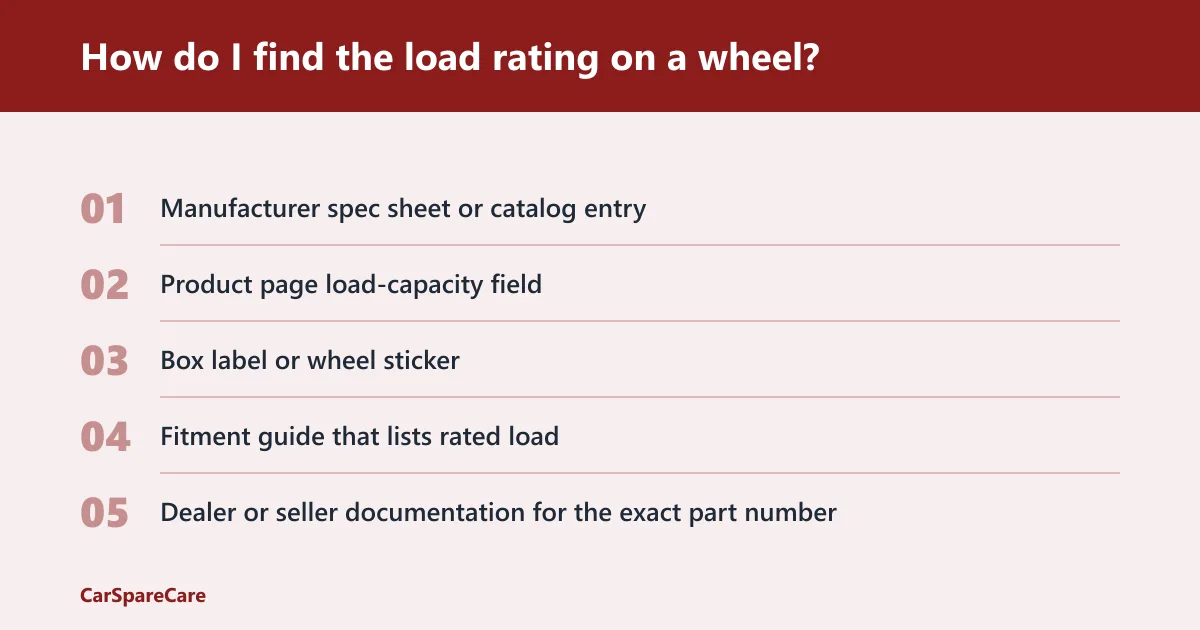
Check the product page, spec sheet, carton, or manufacturer’s label for the wheel load rating. If a seller lists only size and offset, that is not enough information to buy safely; ask for the rated load before ordering.
Where to check before buying
- Manufacturer spec sheet or catalog entry
- Product page load-capacity field
- Box label or wheel sticker
- Fitment guide that lists rated load
- Dealer or seller documentation for the exact part number
What to do when the seller only lists size and offset
Do not assume the rating matches the size. A 17-inch wheel and a 17-inch wheel can carry very different loads depending on width, offset, spoke design, and material. If the load figure is missing, treat the listing as incomplete and keep shopping.
The source material for load-related charts is framed as a guide for choosing the right rating, not only defining the term. That matters because the buyer needs a usable limit, not a label-only explanation. The same idea applies here: the number should guide the purchase.
How much wheel load rating do I need for my car?
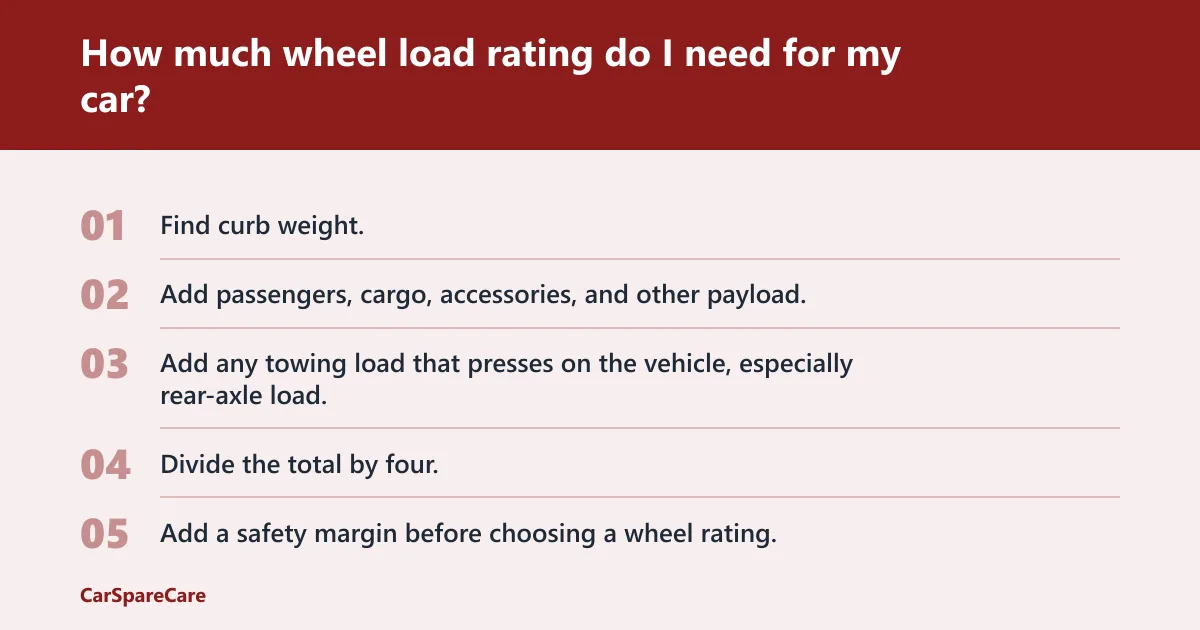
Start with curb weight, then add payload and any towing load that sits on the vehicle. Divide the total by four for a baseline per-wheel figure, then add a safety margin so the wheel rating stays above everyday load and road shock. For SUVs, EVs, pickups, vans, and towing setups, use extra margin.
A simple method that works
- Find curb weight.
- Add passengers, cargo, accessories, and other payload.
- Add any towing load that presses on the vehicle, especially rear-axle load.
- Divide the total by four.
- Add a safety margin before choosing a wheel rating.
Use this load-rating decision table before you buy
| Curb weight | Estimated cargo and passengers | Towing use | Minimum per-wheel rating with margin |
|---|---|---|---|
| 3,200 lb | 300 lb | None | At least 950 lb per wheel |
| 3,800 lb | 500 lb | None | At least 1,150 lb per wheel |
| 4,400 lb | 600 lb | Light towing | At least 1,350 lb per wheel |
| 5,200 lb | 700 lb | Frequent towing or hauling | At least 1,550 lb per wheel |
This table is a buying guide, not a substitute for the vehicle placard or manufacturer data. If the vehicle is near its GVWR, if the rear axle carries most of the load, or if the wheel will see rough roads, move to the next higher rating.
When to choose a higher rating
Choose a higher wheel load rating for SUVs, EVs, pickups, vans, and anything that tows or hauls often. These vehicles can carry more mass, and EVs can put extra demand on wheels because of battery weight. Rough-road use also calls for more margin, not less.
Decision box: choose the higher rating when this applies
SUVs with full passenger loads, EVs with heavy curb weight, pickups carrying tools or bed cargo, vans used for delivery, and tow vehicles with frequent trailer use should move above the bare minimum. If the wheel is close to the limit on paper, the real-world margin is too thin.
Wheel load rating vs tire load index: what is the difference?
Wheel load rating and tire load index are not the same thing, so they should not be treated as interchangeable. The wheel rating is the load limit of the wheel itself, while the tire load index is the tire-side rating. Both must be checked before buying a wheel-and-tire package.
Why people mix them up
The confusion is common because both numbers deal with load. The wheel rating is tied to the wheel structure and its tested capacity. The load index is tied to the tire. A strong tire does not make a weak wheel safe, and a strong wheel does not fix an under-rated tire.
Quick side-by-side check
- Wheel load rating: most load one wheel can carry
- Tire load index: most load one tire can carry
- Fitment rule: both must meet the vehicle’s needs
- Buying rule: do not treat one rating as a substitute for the other
Can I use aftermarket wheels with the same size but lower load rating?
No. Same diameter and width do not make a wheel suitable if the load rating is lower than required. Aftermarket wheels can match the size, bolt pattern, and offset yet still have less load capacity than the original wheel or the vehicle needs.
Which specs must match before you order
Check diameter, width, offset, bolt pattern, hub bore, brake clearance, and wheel load rating. Size alone only tells part of the story. The wheel also has to support the vehicle weight and the actual use case, including passengers, cargo, and towing.
Why a lower-rated wheel is a bad trade
A lower-rated wheel may look fine on paper, but that is a poor trade if the vehicle is heavier than the wheel can handle. The risk is greater on full-size SUVs, EVs, work vans, and tow rigs, where weight grows fast once people and gear are added.
Where do I check wheel load rating before buying wheels online?
Check the manufacturer’s product page, the fitment guide, the part number listing, and any posted spec sheet before placing the order. If the load rating is absent, ask the seller for the exact rated load in writing and do not rely on the size alone.
What a good listing should include
A proper listing should show wheel size, width, offset, bolt pattern, hub bore, and load rating. If the page also explains the rating with a load-related chart, that is a useful guide for choosing the right rating, especially when comparing several options with the same size.
Red flags in online listings
- No load rating shown anywhere
- Only diameter and offset listed
- Generic photos with no part number
- Claims that size alone means fitment
- No mention of vehicle load needs
Frequently asked questions
Is wheel load rating the same as tire load index?
No. The wheel load rating applies to the wheel, and the tire load index applies to the tire. They solve different parts of the same problem. Both ratings must be checked, because a tire with enough capacity does not make up for a wheel that is too lightly rated.
What happens if a wheel’s load rating is too low?
A wheel that is under-rated can bend, crack, or lose bead seal, especially after pothole strikes, heavy braking, or towing. The vehicle may still roll, but the safety margin is gone. That creates a real failure risk, not just a cosmetic problem.
Does wheel load rating matter for towing or hauling?
Yes. Towing and hauling raise the load on the wheels, often at the rear axle, and road shock adds short spikes above the static weight. If the vehicle will tow often or carry heavy cargo, choose a wheel rating that leaves extra margin above the bare minimum.

Hi, I’m Melvin, an automobile engineer with extensive experience in automobile equipment. I currently work for a local automobile firm, where I specialize in the car parts industry. I’ve had the opportunity to collaborate with seasoned inspectors, gaining invaluable hands-on experience that goes beyond just theory.
My passion for automotive care started at a young age, which led me to create CarSpareCare. Through CarSpareCare, I share the knowledge and skills I’ve acquired over the years to help others navigate the world of car maintenance and repairs.
My goal is to provide practical tutorials, essential safety advice, and the latest industry insights so that anyone—whether a beginner or an expert—can confidently tackle their automotive projects.