Add distilled water only to serviceable flooded lead-acid batteries after a full charge, and only if the electrolyte is below the tops of the plates; fill to about the lower split ring or bottom of the vent well, not above. If you top up the wrong battery, or fill past the mark, acid can spit out, chew up the tray, and hide a charging fault that will kill the battery again. This guide shows the exact fill point, the warning signs of a charging fault, and when to leave the cap alone.
Which car batteries actually need distilled water?
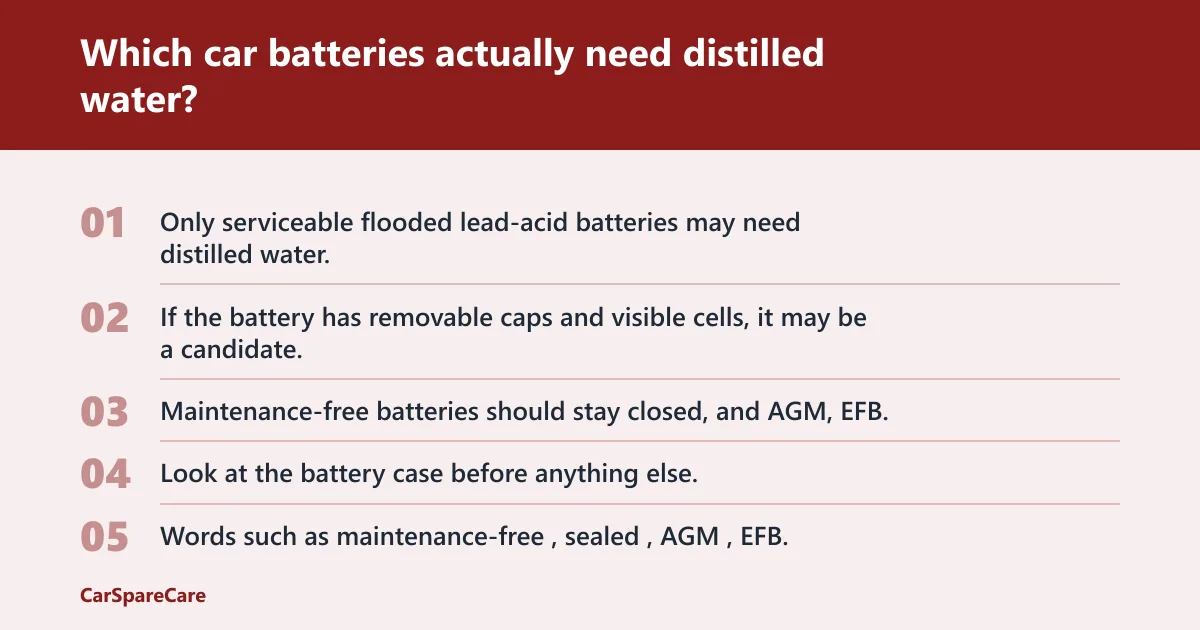
Only serviceable flooded lead-acid batteries may need distilled water. If the battery has removable caps and visible cells, it may be a candidate. Maintenance-free batteries should stay closed, and AGM, EFB, and gel batteries are not meant to be watered at all.
Start with the label and cap style
Look at the battery case before anything else. Words such as maintenance-free, sealed, AGM, EFB, or gel mean do not open the battery for topping up. A serviceable flooded battery usually has removable caps or vent plugs for each cell.
If the top is flat and fully sealed, stop there. Do not pry at a case seam. Do not guess based on age alone. The battery type decides whether water belongs inside.
Why the battery type matters
Flooded lead-acid batteries lose water over time because the electrolyte can evaporate or be driven off during charging. The liquid must stay high enough to cover the lead plates. Sealed designs manage their own internal chemistry and are not opened for water service.
| Battery type | Open for water? | Distilled water allowed? | What to do |
|---|---|---|---|
| Flooded lead-acid, serviceable | Yes, with removable caps | Yes | Check level and top up only if low |
| Maintenance-free | No | No | Leave closed |
| AGM | No | No | Do not water |
| EFB | No | No | Do not water |
| Gel | No | No | Do not water |
When should you add distilled water?

Add distilled water only when a serviceable flooded battery shows low electrolyte and the plates are no longer fully covered. If the liquid still sits above the plates, do not top up just because the battery is due for inspection. Low water can also point to overcharging or another electrical fault.
What low electrolyte looks like
Inside a serviceable cell, the liquid should cover the lead plates. If the tops of the plates are exposed, the battery needs attention. In many cases, the cell will look dry at the top or the liquid will sit clearly below the normal fill line.
Do not wait until the plates are badly exposed. Once the plates are left uncovered, damage can start. The battery may recover some function after topping up, but repeated exposure shortens its life.
When low water is a symptom, not the cause
Low electrolyte is sometimes the result of heat, long charging periods, or a failing regulator. If a battery keeps losing water after topping up, the charging system should be checked. Repeated water loss is not normal maintenance. It is a warning sign.
Do not treat distilled water as a repair for a weak battery. If the case is swollen, cracked, leaking, or the battery is obviously failing, leave it alone and replace or test it.

How high should the water level be?
The safe target is just high enough to cover the plates, but not up to the brim. In many cell designs that means stopping at the lower split ring or just below the vent well. Do not overfill. Electrolyte rises during charging and can spill acid.
The practical stop point
Battery makers use different cell shapes, so the visual stop point varies. A split ring inside the filler neck is a common guide. If there is a vent well, stop at the bottom edge of that well rather than filling it full.
The goal is coverage, not a full chamber. Once the battery is charged, the electrolyte can rise. If the cell was filled to the top before charging, it may push out acid and leave the tray dirty and corroded.
Distilled water decision checklist
- Battery label check: flooded lead-acid only; do not open maintenance-free, AGM, EFB, or gel batteries.
- Cap type check: removable caps or vent plugs present; no caps means no watering.
- Safe electrolyte target: cover the plates; stop at the lower split ring or bottom of the vent well.
- Top-up trigger: only when electrolyte is below the plates or clearly low in the cell.
- Follow-up checks: recheck after charging, and inspect caps, terminals, and the tray for acid residue.
How to add distilled water safely
Wear nitrile gloves, wraparound eye protection, and old clothes that can take acid stains. Work outdoors or in a garage with the door open, keep sparks and flames away, and use only distilled water. Open the caps gently, fill each low cell in small amounts, and stop below the fill mark.
Step-by-step topping-up order
- Switch off the vehicle and let the battery cool.
- Clean dirt from the top so debris does not fall into the cells.
- Remove the caps or vent plugs on a serviceable flooded battery only.
- Check each cell. Add distilled water only where the level is low enough to expose the plates.
- Fill slowly until the liquid reaches the split ring or bottom of the vent well.
- Wipe any spills, refit the caps, and clean the terminals if needed.
- Charge the battery if needed, then recheck the level afterward.
If a cell takes very little water
That can mean the cell was only slightly low, or it can mean the cell is damaged. If one cell behaves very differently from the others, or if the battery still struggles after charging, suspect battery wear or a charging issue rather than chasing the water level.
Does adding distilled water to a car battery help?
Yes, if the battery is a serviceable flooded lead-acid type and the electrolyte is low. It restores plate coverage and helps the battery work as intended. It does not fix sulfation, a bad cell, a cracked case, or a charging fault that keeps driving water loss.
What it fixes
Topping up can prevent the plates from being exposed and can reduce the chance of internal damage from low electrolyte. It is useful when the battery was simply low from evaporation or normal service losses.
What it does not fix
It will not repair a battery that is already weak, swollen, leaking, or unable to hold charge. If the same battery keeps dropping water, the charging system needs attention. A failing regulator can overcharge the battery and force repeated water loss.
When replacement makes more sense
If the battery needs water often, starts poorly after a full charge, or shows physical damage, replacement is usually the better path. Repeated top-ups can delay the real fix and leave the vehicle stranded later.
Why does battery water keep dropping?

Water loss can happen from heat, long charging time, or an overcharging fault. In hot regions, inspection every 2–3 months may be needed. If the battery keeps running low after you top it up, test the charging system instead of treating the water loss as routine.
Heat and normal evaporation
High ambient heat speeds up water loss in flooded batteries. That is why hot regions may need more frequent checks. A battery in steady summer use can need inspection more often than one in mild weather.
Overcharging and regulator faults
If the alternator or regulator is pushing too much charge, the electrolyte can be driven off faster than normal. Low water then becomes a symptom of the fault. Repeated top-ups will not solve that problem.
When to test the charging system
Test the charging system when a battery keeps losing water, one cell empties faster than the others, or the battery shows heat damage and acid staining around the caps. That pattern points away from simple maintenance and toward electrical diagnosis.
Can you add distilled water to a car battery?
Yes, but only to a serviceable flooded lead-acid battery with removable caps. Do not open maintenance-free, AGM, EFB, or gel batteries. Distilled water is generally the right liquid for a flooded battery; tap water is often not recommended because its minerals may affect the cells.
What to avoid
Do not use tap water, bottled drinking water, or other substitutes. Mineral content can build up inside the battery. Do not overfill. Once the battery charges, the electrolyte expands and can spill.
What to do instead of guessing
If the label is unclear, check the cap design and the battery paperwork. If the battery is sealed, leave it sealed. If the battery is serviceable and low, top up carefully and then watch whether the level drops again.
Frequently asked questions
how to add distilled water to exide car battery
Treat it by battery type, not brand name. If the Exide battery is a serviceable flooded lead-acid model with removable caps, top up with distilled water to just below the split ring or vent well. If it is maintenance-free, AGM, EFB, or gel, do not open it.

Hi, I’m Melvin, an automobile engineer with extensive experience in automobile equipment. I currently work for a local automobile firm, where I specialize in the car parts industry. I’ve had the opportunity to collaborate with seasoned inspectors, gaining invaluable hands-on experience that goes beyond just theory.
My passion for automotive care started at a young age, which led me to create CarSpareCare. Through CarSpareCare, I share the knowledge and skills I’ve acquired over the years to help others navigate the world of car maintenance and repairs.
My goal is to provide practical tutorials, essential safety advice, and the latest industry insights so that anyone—whether a beginner or an expert—can confidently tackle their automotive projects.