
Black wheels often need different care because gloss, matte, and coated finishes can react differently to pH, abrasives, and wax. If the finish is damaged, cleaning alone will not fix it. Ignore that, and you can leave brake dust stained in the clear coat, dull a matte surface, or turn a repairable finish into a refinishing job. This guide explains how to clean black wheels safely, protect each finish type, and spot damage that means more than cleaning is needed.
Why black wheels need different care
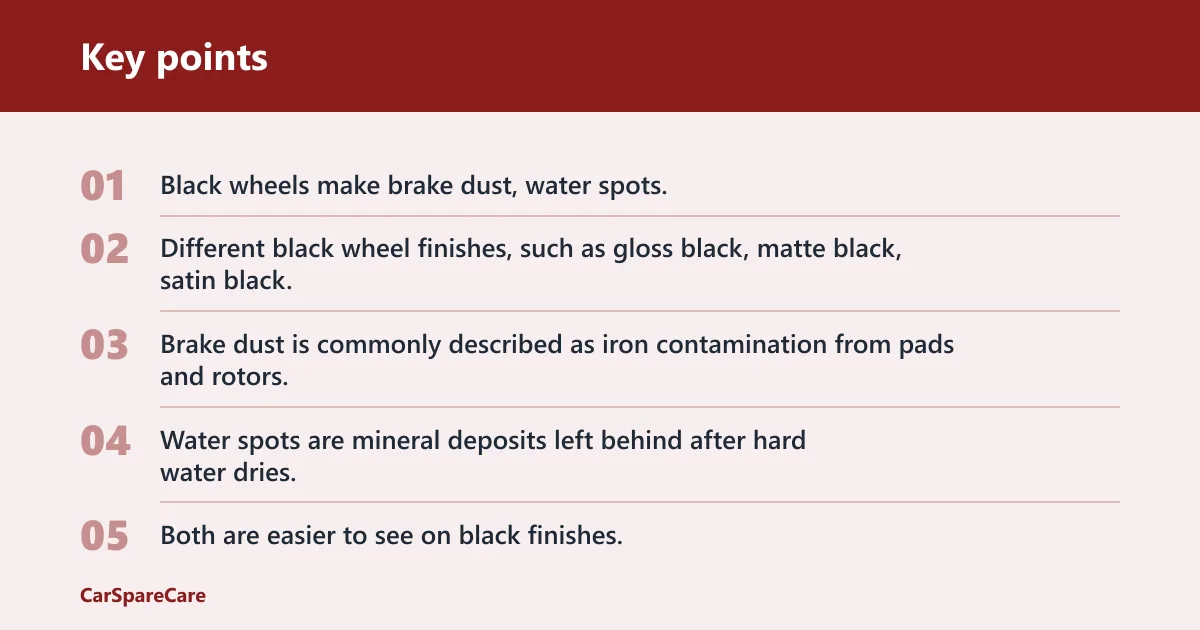
Black wheels make brake dust, water spots, and curb rash easier to notice because dark surfaces give every pale speck and shiny scratch more contrast. The finish type matters too. Different black wheel finishes, such as gloss black, matte black, satin black, powder-coated black, and black chrome, do not respond the same way to cleaner strength, drying, or protection.
Brake dust is commonly described as iron contamination from pads and rotors. It can stick fast, then bake on under heat. Water spots are mineral deposits left behind after hard water dries. Both are easier to see on black finishes, so the clean-up window is shorter than it looks on silver wheels.
Black wheel care checklist
| Wheel finish | Safe cleaners and tools | What to avoid |
|---|---|---|
| Gloss black | pH-balanced wheel cleaner, soft synthetic wheel brush, clean microfiber towels | Abrasive pads, stiff brushes, strong household cleaner, dirty towels |
| Matte black | Non-gloss-enhancing wheel cleaner, soft brush, low-lint microfiber towel for drying | Polish, waxes that add shine, aggressive scrubbing, gloss boosters |
| Satin black | pH-balanced or non-acidic cleaner, soft brush, microfiber drying towel | Polishing compounds, heavy wax buildup, rough applicators |
| Powder-coated black | Non-acidic cleaner matched to brake dust level, soft brush, microfiber towels | Acidic cleaners, harsh all-purpose cleaner unless the label allows it, abrasive pads |
| Black chrome | Mild wheel cleaner, soft brush, fresh microfiber towels, gentle drying | Strong acids, cut pads, metal brushes, harsh polishing steps |
Symptoms, likely cause, and the right fix
| Symptom | Likely cause | Right fix |
|---|---|---|
| Heavy dark dust on spoke faces | Brake dust buildup | Pre-rinse, apply pH-balanced cleaner, brush before it bakes on |
| White rings after washing | Water spots from hard water | Dry immediately with clean microfiber towels; use a spot-free rinse next time |
| Hazy or dull finish on gloss black | Swirl marks, old sealant residue, or contaminated clear coat | Use safe wash steps first; if the haze remains, inspect for damage or professional correction |
| Flat finish looks patchy or shiny in spots | Wrong cleaner, wax residue, or polishing on matte paint | Stop polishing, switch to a matte-safe cleaner, and remove residue carefully |
| Light-colored edge shows through | Curb rash or coating wear | Touch-up may help minor marks; exposed base material often needs refinishing |
How do you clean black wheels without scratching them?
Rinse first, then clean with a pH-balanced wheel cleaner and a soft synthetic brush. Use clean microfiber towels for drying and final wipe-downs. The main goal is to lift grit before it gets dragged across the finish, because that is how many visible marks start on black wheels.
Rinse before touching the wheel
Start with a strong rinse to remove loose grit, sand, and road film from the barrel, spokes, and lug area. That first rinse matters most on dirty winter wheels or after long highway drives, because hidden grit can act like sandpaper once a mitt or brush touches it.
Use a soft brush and clean microfiber towels
A soft synthetic wheel brush is the right tool for barrels, spokes, and lug recesses. It reaches tight areas without shedding metal or dragging stiff grit. Clean microfiber towels matter just as much at the end, because a dirty towel can re-deposit contamination and add fine marks during drying.
Suppose a sedan has gloss black wheels caked with fresh dust after a week of city braking. A rinse, then a non-acidic cleaner and a soft brush, will usually remove the film before it stains. Waiting until the dust has baked on under heat makes the job harder and raises the risk of scratching.
Which wheel cleaner is safe for black wheels?
A pH-balanced or non-acidic wheel cleaner is the safest routine choice for most black wheels, especially painted, powder-coated, and clear-coated finishes. Match the product to the finish and to the amount of brake dust. Stronger cleaners are not automatically better, and some can strip protection or cloud sensitive finishes.
When to choose pH-balanced or non-acidic cleaner
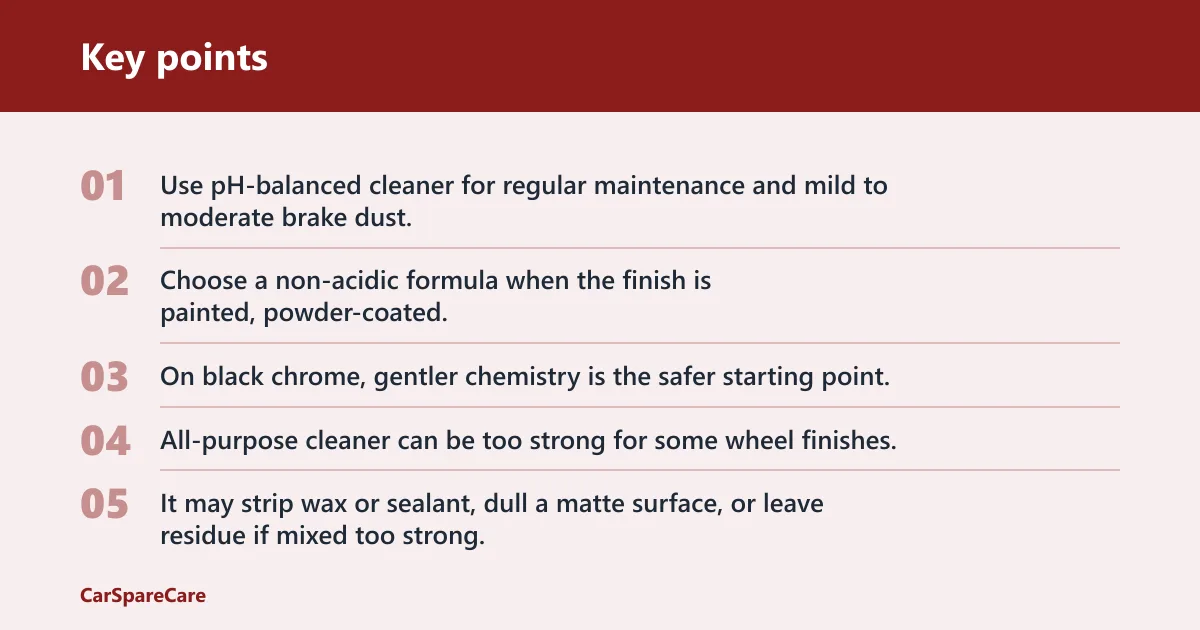
Use pH-balanced cleaner for regular maintenance and mild to moderate brake dust. Choose a non-acidic formula when the finish is painted, powder-coated, or clear-coated and the wheel needs routine care rather than heavy decontamination. On black chrome, gentler chemistry is the safer starting point.
Why all-purpose cleaner is not the first choice
All-purpose cleaner can be too strong for some wheel finishes. It may strip wax or sealant, dull a matte surface, or leave residue if mixed too strong. If a label allows dilution, follow the label exactly. For coated or matte wheels, a dedicated wheel cleaner is usually the better first step.
Match cleaner strength to the dust level
Light dust on a well-maintained wheel needs only a mild cleaner. Heavy winter buildup or repeated city braking may justify a stronger wheel-safe product, but still one that is non-acidic unless the wheel maker allows otherwise. The cleaner should fit the finish, not just the amount of grime.
Gloss black vs matte black wheels
Gloss black wheels and matte black wheels need different care because the surface behavior is different. Gloss black shows swirl marks and water spots more easily, while matte black cannot be polished like a gloss finish. Satin and powder-coated black sit between the two, but they still need finish-aware products.
Gloss black: swirl marks, spotting, and safe protection
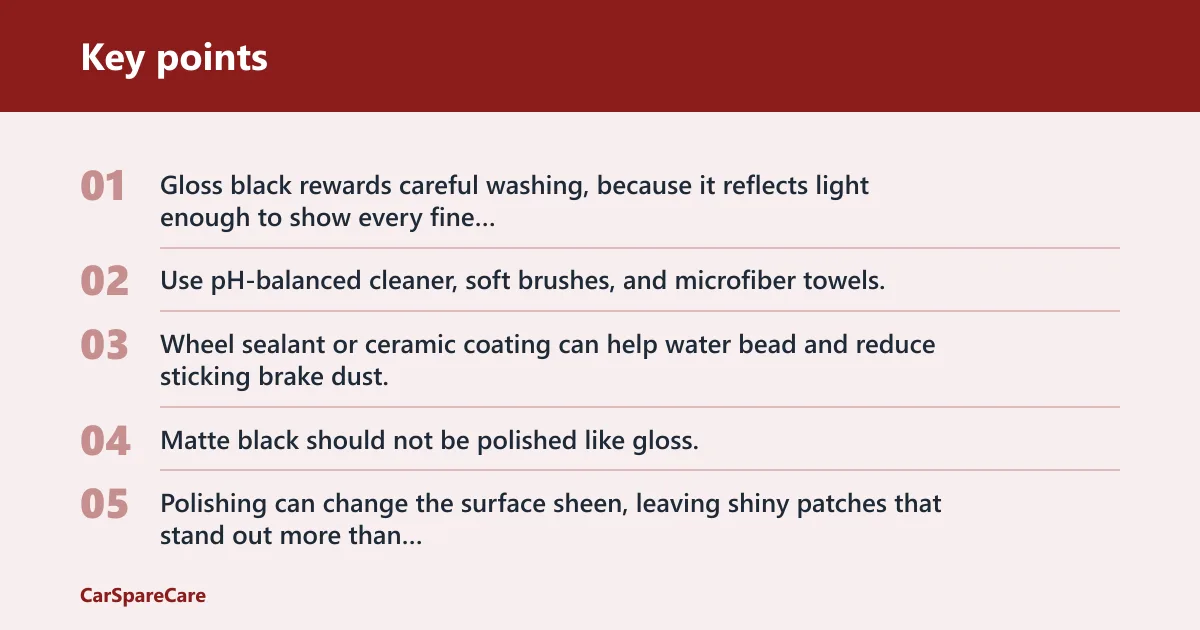
Gloss black rewards careful washing, because it reflects light enough to show every fine mark. Use pH-balanced cleaner, soft brushes, and microfiber towels. Wheel sealant or ceramic coating can help water bead and reduce sticking brake dust, but only after the wheel is fully clean and dry.
Matte black: why polishing is a mistake
Matte black should not be polished like gloss. Polishing can change the surface sheen, leaving shiny patches that stand out more than the dust did. Use a non-gloss-enhancing cleaner and gentle drying. The goal is to preserve the flat look, not add shine.
Satin and powder-coated black: middle-ground care
Satin black and powder-coated black are usually more forgiving than matte, but they are not maintenance-free. Use a mild wheel-safe cleaner and soft tools. Avoid harsh pads and heavy wax layers, because buildup can create uneven sheen or leave residue in corners and lug recesses.
A common first-timer mistake is treating matte black like gloss black. A quick polish may remove a dusty haze, but it can leave a bright, patchy spot that cannot be washed away later. At that point, the finish itself has changed, and cleaning is no longer the right fix.
How often should you wash black wheels?
Wash black wheels as often as the driving conditions demand. City traffic with frequent braking can need weekly cleaning. Winter salt, wet roads, and dusty routes need even shorter intervals. The aim is to remove brake dust before it bakes on and before minerals or salt start to mark the finish.
Daily drivers in city traffic
For daily use with stop-and-go braking, washing about once a week is a practical baseline. If the dust layer is already visible after a few days, do not wait for a full detail. Black wheels show buildup early, and fresh dust is much easier to remove than baked-on residue.
Winter salt and wet-road use
In winter, wash wheels more often if roads carry salt, slush, or brine. Salt can hold moisture against the finish and speed up staining. Dry the wheels immediately after washing, including spokes and lug recesses, because trapped water in cold weather is one of the fastest ways to leave spots.
Dusty roads and heavy braking
Dusty roads and hard braking both shorten the cleaning interval. On vehicles that regularly tow, descend hills, or spend time on rough roads, check the wheels more often than the calendar suggests. If dust is visible, it is time to clean, because that is when removal is easiest.
Black wheel protection that actually helps
Wheel sealant or ceramic coating can help reduce how much brake dust sticks and make future cleaning easier. It does not replace washing, but it can shorten scrub time and help water bead off the surface. Proper prep matters, because protection applied over dirt or residue will not last as well.
Prep steps before applying protection
- Wash the wheel with a finish-safe cleaner.
- Rinse until all cleaner residue is gone.
- Dry fully with a clean microfiber towel.
- Remove any leftover film or residue the product label allows you to remove.
- Apply the sealant or coating only to a clean, dry wheel.
What protection changes
Protected wheels usually shed water better, which helps limit spotting when you dry them promptly. They also tend to release brake dust more easily during the next wash. Protection does not stop contamination, though, so the wheel still needs regular cleaning based on use.
When cleaning is no longer enough
If the wheel has curb rash, exposed base material, staining that does not wash off, or a finish that has gone dull in patches, more cleaning will not solve it. At that point, you are likely dealing with damage, chemical etching, or worn protection. The next step may be touch-up, professional repair, or refinishing.
Curb rash and exposed base material
Curb rash is more visible on black wheels because the light-colored metal or primer underneath stands out sharply. Minor edge scuffs may take touch-up paint, but deeper gouges or exposed material usually need refinishing to look right and stay protected.
Staining, dullness, or stripped finish
If a gloss wheel has dull spots after a harsh cleaner, the protective layer may have been stripped or damaged. If a matte wheel looks shiny in one area, the finish may have been altered by the wrong product. In both cases, more scrubbing can make the problem worse.
Picture a black chrome wheel with stubborn brown marks that stay after a proper wash and safe cleaner. If the marks do not fade after the contamination is removed, the surface may be stained or etched. That is a repair question, not a cleaning one.
Frequently asked questions
Do black wheels need special care?
Black wheels need finish-specific care because gloss, matte, satin, powder-coated, and black chrome surfaces can react differently to cleaner strength, drying, and protection. Black finishes also make brake dust, water spots, and curb rash easier to spot, so slow cleanup can turn into a visible finish problem faster.
What wheel cleaner is safe for black wheels?
A pH-balanced or non-acidic wheel cleaner is the safest routine choice for painted, powder-coated, and clear-coated black wheels. Match the cleaner to the finish and the amount of brake dust. Avoid starting with harsh household products or strong all-purpose cleaner unless the label specifically allows that use.
Are matte black wheels harder to maintain than gloss black wheels?
Usually yes, because matte black cannot be polished to remove marks the way gloss black sometimes can. Matte finishes also show residue if the wrong product leaves shine behind. That said, gloss black shows swirl marks and water spots more clearly, so each finish has its own maintenance problem.
Are black wheels going out of style?
Black wheels are still common because they fit many vehicle colors and hide some road grime better than bright finishes. Style changes aside, the maintenance burden does not change. A black wheel still needs the right cleaner and the right drying method to keep its finish looking clean.

Hi, I’m Melvin, an automobile engineer with extensive experience in automobile equipment. I currently work for a local automobile firm, where I specialize in the car parts industry. I’ve had the opportunity to collaborate with seasoned inspectors, gaining invaluable hands-on experience that goes beyond just theory.
My passion for automotive care started at a young age, which led me to create CarSpareCare. Through CarSpareCare, I share the knowledge and skills I’ve acquired over the years to help others navigate the world of car maintenance and repairs.
My goal is to provide practical tutorials, essential safety advice, and the latest industry insights so that anyone—whether a beginner or an expert—can confidently tackle their automotive projects.