
Check coolant only when the engine is fully cold. A level below the MIN mark, or a reservoir that keeps dropping after normal cool-downs, usually points to real coolant loss. If you ignore it, the engine can overheat and the repair bill can grow fast. This guide helps you separate normal level movement from true loss, then narrow the cause before you add fluid or remove parts.
How to tell if coolant is low without a leak


Start with a cold check on level ground. Read the coolant reservoir only when the engine is fully cold, because warm coolant expands and can make the level look different from one drive to the next. If the level is below MIN, or it keeps falling across several cold checks, treat that as real loss, not a random fluctuation.
Check the reservoir cold
Look for the MIN and MAX marks on the coolant reservoir or expansion tank. Check only after the car has sat long enough to cool fully, and park on a flat surface so the reading is not tilted by slope. A warm engine can move coolant between the tank and the rest of the system.
If the level sits between MIN and MAX when cold, that is usually acceptable. If it is below MIN, top-up may be needed, but you still need to find out why it dropped. In a sealed cooling system, coolant should not keep disappearing.
Rule out false alarms
A recent service can leave the reservoir low until trapped air moves through the system. A prior top-off can also settle lower after a few heat cycles. Check the level again after the engine has cooled completely, then compare it with your last cold reading. One low reading by itself does not prove a leak.
Say your reservoir is at MAX the day after a coolant flush, then sits just above MIN three mornings later. That can be normal settling if the system was recently opened. If it drops again on the next cold check, the pattern points to loss, not just thermal movement.
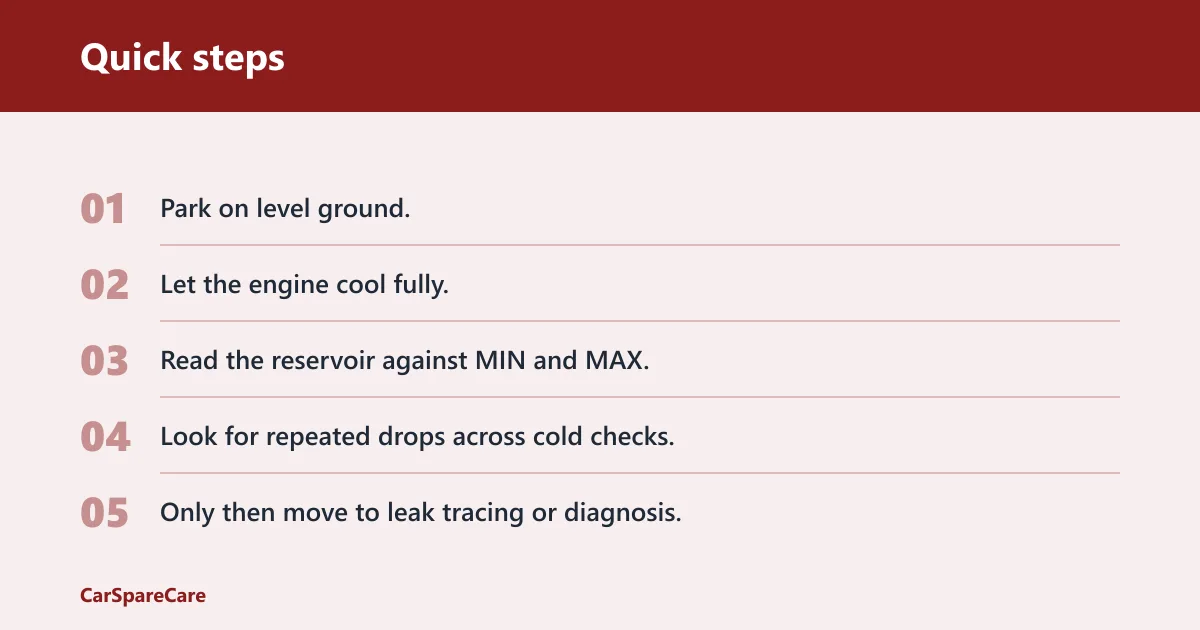
- Park on level ground.
- Let the engine cool fully.
- Read the reservoir against MIN and MAX.
- Look for repeated drops across cold checks.
- Only then move to leak tracing or diagnosis.
Coolant loss symptom-to-cause table
| Cold reservoir reading change | Odor | Cabin dampness | Exhaust behavior | Temperature-gauge behavior | Likely loss path | Next test | Urgency |
|---|---|---|---|---|---|---|---|
| Below MIN once, stable on next cold check | None | None | Normal | Normal | Recent top-off settling or small air purge | Recheck cold after one more drive cycle | Drive gently |
| Repeated drop after each cold check | Sweet coolant smell near engine bay | None | Normal or light steam after parking | May rise in traffic or idle | External leak at hose, radiator, water pump, cap, or tank | Inspect for residue; pressure test | Schedule diagnosis |
| Repeated drop | Sweet odor inside cabin | Damp passenger floor or film on windshield | Normal | May rise slowly | Heater core leak | Check carpet, vents, and fogging; pressure test | Schedule diagnosis |
| Rapid drop | Sweet smell, visible steam | None | White vapor or misfire behavior | Rising gauge | Head gasket or internal loss path | Stop now; cooling-system and engine diagnosis | Stop now |
| Low after recent service | None | None | Normal | Normal | Air trapped after service or incorrect fill | Bleed procedure per model | Drive gently |
What does leaking coolant look like?
Coolant can be green, orange, pink, blue, yellow, or purple. It often has a slightly sweet smell, but color alone does not prove the fluid. It can also leave residue that looks white, green, pink, or orange and may appear crusty or chalky around a leak point.
What to look for outside the car
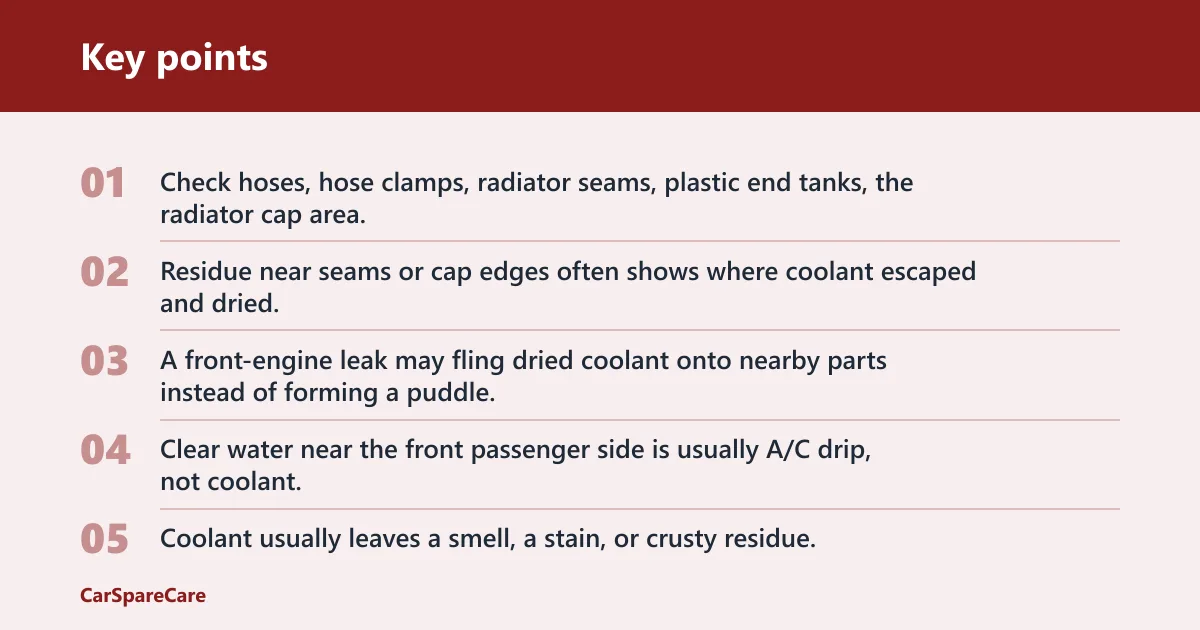
Check hoses, hose clamps, radiator seams, plastic end tanks, the radiator cap area, the water pump, and the overflow tank or expansion tank. Residue near seams or cap edges often shows where coolant escaped and dried. A front-engine leak may fling dried coolant onto nearby parts instead of forming a puddle.
Clear water near the front passenger side is usually A/C drip, not coolant. Coolant usually leaves a smell, a stain, or crusty residue. A leak can still hide on hot engine parts and burn off before it reaches the ground.
What leaking coolant can smell like
A sweet smell after shutdown, especially near the front of the car, is a common coolant clue. If you smell it with a rising temperature gauge, treat it as a warning sign. The smell may be strongest right after parking because hot parts vaporize small amounts of coolant.
A common first-timer mistake is assuming no puddle means no leak. Small leaks can evaporate on the engine, drip onto a splash shield, or only show under driving pressure.
Why is the reservoir low?
A low reservoir usually means the system has lost coolant or the level has shifted after a recent service. In a sealed system, it should not keep dropping. Common external loss points include hoses, the radiator, the water pump, the cap, and the overflow tank or expansion tank.
Inspect the common external leak points
Start at the reservoir and work outward. Look for wet seams, crusty residue, swollen hoses, or dried marks near clamps. The radiator cap is a pressure-retaining component, and a bad seal there can affect coolant recovery and make the reservoir appear low.
The water pump is another common leak point. It sits near the front of the engine, usually by the drive belt area, and a weeping seal can drip coolant without making a large puddle. If you see residue below the pump or a fresh drip pattern on nearby covers, suspect it early.
Overflow tank and expansion tank faults
Some vehicles use an overflow tank or expansion tank that may be pressurized. Those tanks can crack, leak at the seams, or seep around the cap. Look for residue around the neck, the cap threads, and the molded seam line.
If the tank level keeps dropping and the rest of the engine bay looks dry, do not dismiss the tank. A small crack can open only when the plastic gets hot and pressurized.
Could it be inside the car?
Yes. Heater core leaks can put coolant inside the cabin instead of on the ground. Signs include a sweet odor, a damp passenger floor, and a windshield film that returns soon after cleaning. Cabin heat may also fade because the heater core no longer has enough coolant flow.
Heater core clues
If the windshield fogs from the inside and leaves a greasy film, check the floor carpet and under-dash trim on the passenger side. A heater core leak often shows up there before it leaves any external puddle. You may also notice the heater output gets weak when the coolant level falls.
Internal loss on some engine designs
Some vehicles can lose coolant through internal circuits such as EGR or turbo cooler passages. In other cases, combustion leakage from a head gasket issue can push coolant into the cylinders or into the cooling system. That kind of loss may show up as white exhaust vapor, repeated low levels, or pressure in the cooling system after shutoff.
Suppose the reservoir drops, the cabin stays dry, and there is no visible drip under the car. If the exhaust leaves more white vapor than usual after warm-up, an internal loss path deserves attention before you keep topping off the tank.
What the temperature gauge is telling you
A rising engine temperature gauge is an urgency signal. It may climb only in traffic or at idle, where airflow is lower, and it can lag behind actual overheating. If the gauge climbs, pull over and shut the engine off.
Why the gauge may lag
The engine coolant temperature sensor, or ECT, reports coolant temperature to the control system and dash. The gauge is useful, but it is not instant. By the time it rises, parts of the engine may already be hotter than the display suggests.
Steam from the hood, a climbing gauge, or a sudden loss of cabin heat with overheating means stop now. Do not keep driving in the hope that the reading will settle down on its own.
Pressure test next
A cooling-system pressure test is the proper next step when the level keeps dropping and you cannot see the source. It is one of the most valuable diagnostic procedures because some cooling-system problems only show up under pressure. That matters when the leak only opens hot or while the system is loaded.
Why pressure testing works
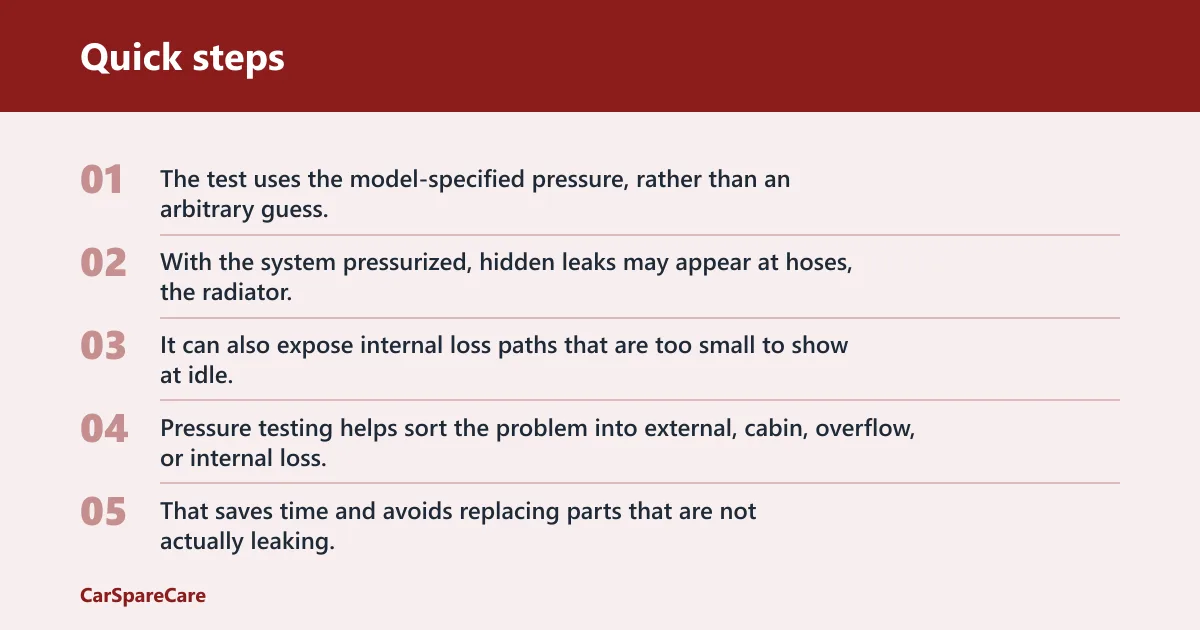
The test uses the model-specified pressure, rather than an arbitrary guess. With the system pressurized, hidden leaks may appear at hoses, the radiator, the water pump, the heater core, the cap, or the overflow tank. It can also expose internal loss paths that are too small to show at idle.
Pressure testing helps sort the problem into external, cabin, overflow, or internal loss. That saves time and avoids replacing parts that are not actually leaking.
Do not open the radiator cap hot
The radiator cap should never be opened on a hot engine. It is a pressure-retaining component, and hot coolant can erupt under pressure. Wait until the engine is fully cool before you check the cap area or open any pressurized part of the system.
Adding coolant is only a temporary fix. If the level drops again, the fault is still there. Also, ethylene glycol coolant is commonly reported as toxic to pets and children, so clean up spills promptly and keep containers sealed.
Frequently asked questions
How to tell if coolant is low without a leak: check the reservoir
Check the reservoir only when the engine is fully cold and the car is on level ground. If the level sits below MIN once but stays stable across later cold checks, it may be normal settling after service. Repeated drops after cool-downs point to real coolant loss.
What happens if engine coolant is low
Low coolant can cause overheating, weak cabin heat, and damage if you keep driving. The temperature gauge may rise only in traffic or at idle, so do not wait for a steam event. If the gauge climbs, pull over and shut the engine off.
Will low coolant cause a check engine light?
Not always. Some vehicles may set a warning, but low coolant by itself does not reliably trigger the check engine light. A rising temperature gauge, steam, or coolant smell matters more than the presence or absence of a light. Treat the symptom, not the dashboard alone.

Hi, I’m Melvin, an automobile engineer with extensive experience in automobile equipment. I currently work for a local automobile firm, where I specialize in the car parts industry. I’ve had the opportunity to collaborate with seasoned inspectors, gaining invaluable hands-on experience that goes beyond just theory.
My passion for automotive care started at a young age, which led me to create CarSpareCare. Through CarSpareCare, I share the knowledge and skills I’ve acquired over the years to help others navigate the world of car maintenance and repairs.
My goal is to provide practical tutorials, essential safety advice, and the latest industry insights so that anyone—whether a beginner or an expert—can confidently tackle their automotive projects.

