
If your car starts then dies immediately, check the immobilizer, fuel delivery, and intake air first. Any one of those can stop the engine within seconds. Leaving it alone can strand you, send you toward the wrong part, and hide a fault that gets harder to trace. This guide gives about a 10-minute symptom-based path that separates fuel, spark, air, and security-system faults.
Quick diagnosis path

Start with the first clue you see. If the engine catches, then dies in about one to three seconds, suspect the immobilizer, low fuel pressure, a major vacuum leak, or an idle-control problem before chasing deeper faults. If it runs a little longer and dies with a misfire, ignition or injector problems move higher on the list.
Separate fuel, spark, air, and security faults
The most common cause is lack of fuel delivery, but that does not mean every start-and-stall comes from a bad fuel pump. Check for a flashing key or security light, listen for normal fuel-pump prime, and note whether the engine fires and then fades or dies cleanly.
- Look at the dash before cranking. A flashing key symbol points toward the immobilizer or anti-theft system.
- Turn the key to start and listen. A normal catch followed by an immediate stall suggests fuel, air, or security control, not a dead starter.
- Watch for a misfire or roughness just before it dies. That points toward spark plugs, ignition faults, or injectors.
- If it dies only when cold or only when warm, note that pattern. It helps separate idle-control faults from fuel-pressure problems.
What to check in the first 10 minutes
Open the hood and check for loose intake hoses, disconnected vacuum lines, a cracked air duct, and any obvious fuel smell. On a cable-throttle car, look for the idle control valve. On a newer drive-by-wire car, look for the throttle body and intake tract instead. Do not keep cranking it over and over.
Say your sedan starts for two seconds, the key light flashes, and the engine stops without sputtering. That pattern points more strongly to immobilizer recognition than to a clogged filter. Now suppose the dash is normal, the engine coughs once, and a strong fuel smell appears after repeated starts. That pattern pushes fuel delivery or flooding higher on the list.
When the symptom points to towing
If the same start-and-die pattern repeats after a few careful checks, stop. Repeated restart attempts can flood the engine or overheat the catalytic converter. Tow the car if it will not stay running long enough for a basic idle test, or if the dash shows a security fault that you cannot clear with the spare key.
What causes a car to start then die
This symptom usually comes from 10 common reasons. The list is shorter in practice because the engine behavior tells you where to look first. Fuel delivery, air control, spark, and immobilizer faults account for most cases; ECU faults are less common and usually come after the simpler checks fail.
Fuel delivery faults
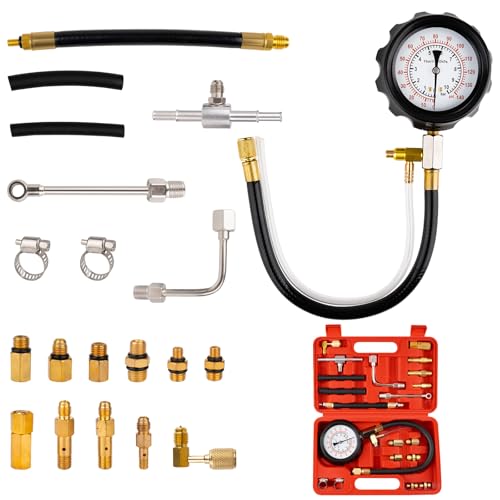
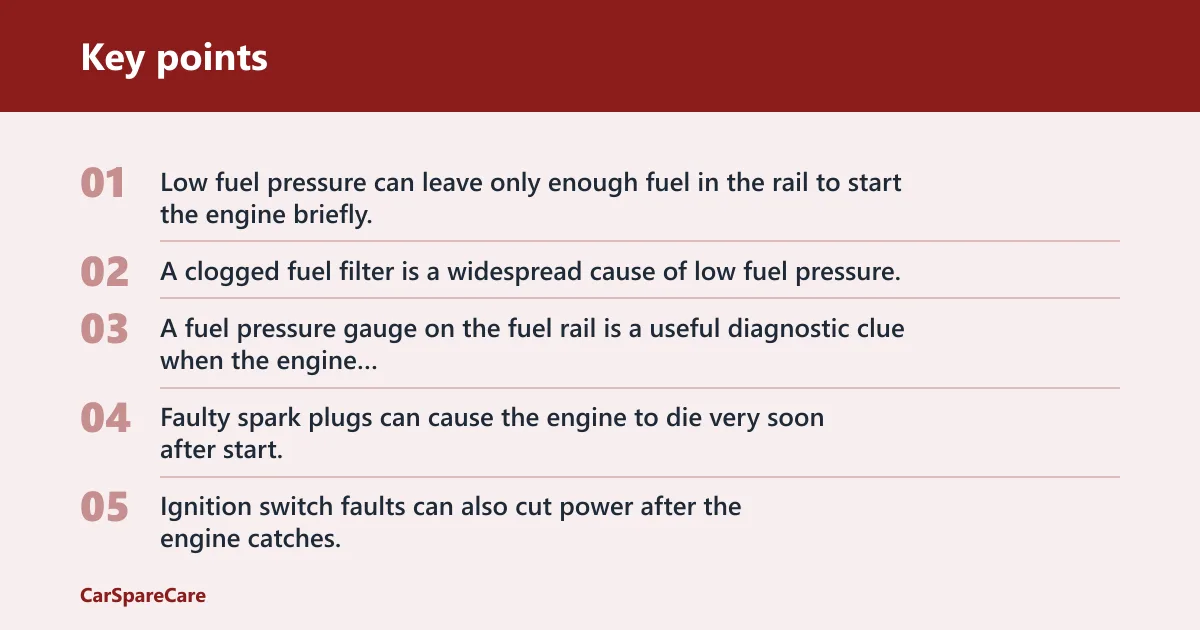
Low fuel pressure can leave only enough fuel in the rail to start the engine briefly. A clogged fuel filter is a widespread cause of low fuel pressure, and a failing pump can do the same thing. A fuel pressure gauge on the fuel rail is a useful diagnostic clue when the engine starts, then falls flat.
Ignition and spark faults
Faulty spark plugs can cause the engine to die very soon after start, especially if it misfires first. Ignition switch faults can also cut power after the engine catches. If accessories, dash power, or warning lamps behave oddly at the same moment, the ignition switch becomes a stronger suspect.
Air control and vacuum faults
A major vacuum leak can make the mixture too lean and kill the engine within seconds. A dirty idle control valve on older cars or sticky throttle-body idle control on newer cars can do the same thing at idle. Stuck-open EGR flow can also upset the mixture enough to stall the engine right after start.
Could the anti-theft system be stopping it?
Yes. A faulty immobilizer can keep the car key from being recognized, and that can stop the fuel system from staying active after the engine catches. A factory anti-theft system may show a key symbol on the dashboard. If the key symbol does not turn off, the key or immobilizer may be suspect.
Key light or security lamp clues
The dash clue matters more than the brand name. A flashing key light, security lamp, or “car with key” symbol suggests that the anti-theft system has not approved the start. The engine may fire on the first crank and then die because the system cuts fuel or disables normal running.
Factory versus aftermarket immobilizers
Factory and aftermarket systems can both cause the same stall pattern. An aftermarket alarm or remote-start unit may interrupt starter, ignition, or fuel-pump circuits in ways that look like a pump fault. If a recent alarm or remote-start install coincides with the problem, that history matters.
Why the pump may shut off
On many vehicles, the immobilizer can prevent the fuel pump from continuing to run after initial start authorization fails. That is why the engine may catch for a second and then stall. Try the spare key if you have one, but do not bypass security hardware.
Could low fuel pressure be the cause?
Yes. Low fuel pressure can cause a brief start followed by a stall because the rail has enough pressure for a moment, then cannot sustain combustion. Checking pressure at the fuel rail is one of the best early clues, because it separates pump and filter issues from ignition or air faults.
Fuel rail pressure as a clue
If the engine starts and then dies, a quick pressure check at the fuel rail tells you whether the pump is building and holding pressure. Low pressure may come from a weak pump, a restricted filter, or a wiring problem feeding the pump. That check is more useful than guessing from sound alone.
Fuel pump and fuel filter checks
A clogged fuel filter is a frequent culprit and often relatively easy to replace, but the correct part and service interval are vehicle-specific. If the car has a serviceable in-line filter, a restriction there can mimic pump failure. If the filter is in the tank module, diagnosis usually starts with pressure and volume checks.
Why the engine starts briefly anyway
The engine may start because the rail may still have residual pressure from the previous prime cycle or because the initial shot of fuel can be enough to light off. Then pressure falls, the mixture goes lean, and the engine stalls. That pattern is classic for a fuel supply problem, not a starter problem.
Could a vacuum leak make my engine die after starting?
Yes. A major vacuum leak can make the mixture too lean and kill the engine within seconds. This is more common on older intake hoses, cracked brake-booster lines, split vacuum elbows, and broken ducting between the air filter and throttle body. The stall often sounds abrupt rather than sputtering for long.
Lean mixture symptoms
Look for a fast idle surge, hissing from the intake area, or a stall that happens as soon as the engine settles from fast idle to normal idle. If the engine runs longer with the throttle slightly open, that supports an air-control or vacuum leak diagnosis rather than a dead fuel pump.
Older idle control valve issues
Older cars with a steel wire throttle body can use an idle control valve. If that valve is dirty or stuck, the engine may start on the fast-idle strategy and then stall when the idle valve cannot keep airflow steady. That fault is common enough to check before replacing sensors.
Newer throttle-body idle control problems
Newer drive-by-wire cars control idle through the throttle body. Carbon buildup or a throttle body that does not respond as commanded can cause unstable idle and stall after start. In that case, the throttle body and its adaptation data may matter more than a separate idle valve.
Ignition, injector, and ECU clues
Once fuel pressure, air leaks, and security faults are less likely, move to spark, injectors, and the ECU. Weak spark plugs, an ignition fault, or a failed injector can all let the engine catch and then die. ECU faults are less common, but they stay on the list after basic checks fail.
Spark plug and ignition faults
Faulty spark plugs can cause the engine to die very soon after start, especially if you hear a stumble or misfire first. A weak coil or another ignition fault can do the same thing. If the engine starts more cleanly with throttle but cannot hold idle, spark quality still belongs in the diagnosis.
Injector click as a quick clue
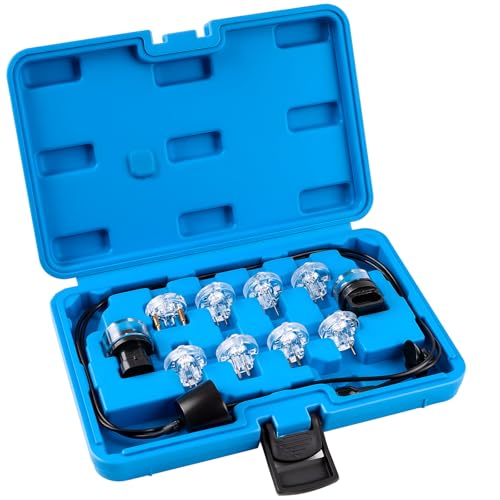
A failed fuel injector can cause the engine to run on fewer cylinders. During cranking, injector clicking is a basic clue that at least some injectors are being commanded. No click does not prove a bad injector, but it helps separate injector control issues from fuel pressure loss.
When the ECU enters the diagnosis
The ECU is a possible cause among the final diagnostic items, not the first. Consider it after the engine shows normal security behavior, fuel pressure looks reasonable, vacuum leaks are ruled out, and spark and injector command are still inconsistent. At that point, stored fault codes matter more than guesswork.
Start and stall triage table
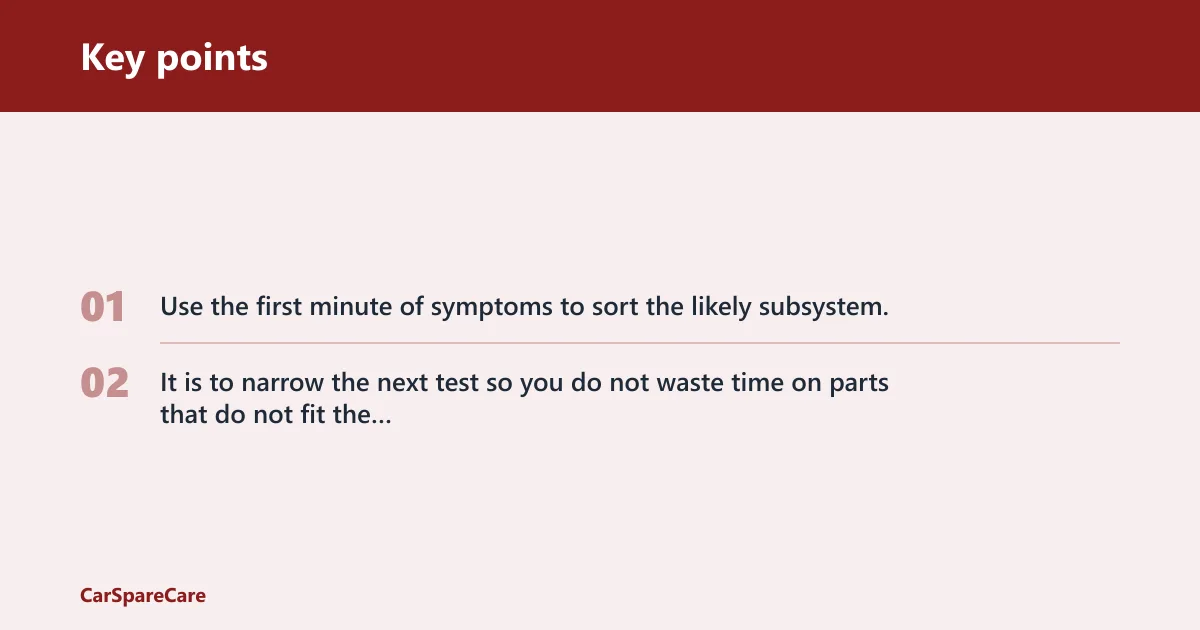
Use the first minute of symptoms to sort the likely subsystem. The goal is not to fix everything at once. It is to narrow the next test so you do not waste time on parts that do not fit the pattern.
| Symptom | Most likely subsystem | Safe first check | Likely next test |
|---|---|---|---|
| Dies after about one second, key light flashing | Immobilizer / anti-theft | Check the dash security lamp and try the spare key | Scan for immobilizer codes or inspect the key reader |
| Starts, then dies, no security lamp | Fuel delivery | Listen for pump prime and note fuel smell | Measure fuel rail pressure |
| Starts only with throttle held open | Air control / vacuum leak | Inspect intake ducting and vacuum hoses | Smoke test the intake for leaks |
| Dies only when cold | Idle control valve or throttle body | Check idle speed response as it warms | Clean or test idle control and throttle body |
| Dies only after warming up | Ignition, EGR, or ECU | Look for misfire or rough idle before stall | Read fault codes and review live data |
| Strong fuel smell with no smooth run | Flooding or injector fault | Stop repeated cranking | Check injector command and plug condition |
| Starts, misfires, then dies | Spark plugs or ignition | Check for rough running and flashing MIL | Inspect plugs, coils, and related wiring |
| Starts, then stalls with dash power acting odd | Ignition switch | Watch accessories and warning lamps during key turn | Test ignition switch output and lock cylinder |
| Starts, then dies with hiss from intake | Vacuum leak | Listen around the intake and brake-booster hose | Smoke test or use soapy air-leak checks where appropriate |
| Starts, then dies at idle but revs when held slightly open | Idle control | Inspect throttle body and idle passages | Clean throttle body or test idle control valve |
| Runs briefly, then stalls after a long crank | Low fuel pressure | Confirm pump prime and fuel filter age | Check pressure at the fuel rail |
| Starts, then dies with no injector click | Injector control | Listen for injector activity during cranking | Check injector power, ground, and ECU command |
Frequently asked questions
Why my car starts then immediately dies
The most common pattern is loss of fuel delivery, but immobilizer, vacuum leak, idle-control, and ignition faults can produce the same result. The quickest split is to watch the dash for a security light, listen for pump prime, and note whether the engine sputters, misfires, or dies cleanly.
What does it mean if your car starts and then dies?
It means the engine had enough fuel, spark, and air to catch, but one of those inputs failed almost immediately. If it dies in one to three seconds, think security system or fuel pressure first. If it runs longer and then stalls at idle, air control or vacuum leaks move up.
Could low fuel pressure make my car start and die right away?
Yes. Low fuel pressure can leave only enough fuel in the rail to start the engine briefly, then the pressure drops and the engine stalls. A pressure check at the fuel rail helps separate a weak pump or clogged fuel filter from ignition or air faults.
Can an immobilizer cause a car to start then stall?
Yes. A faulty immobilizer can keep the car key from being recognized, and a factory anti-theft system may show a key symbol on the dashboard. If that symbol does not turn off, or a spare key behaves differently, the key or immobilizer should be part of the diagnosis.
When should I stop trying to restart the car and call a mechanic?
Stop after a few attempts if the pattern repeats, especially if the key light flashes, the engine smells strongly of fuel, or it starts and dies fast every time. Repeated cranking can flood the engine or heat the catalytic converter. At that point, diagnosis is safer than more start attempts.

Hi, I’m Melvin, an automobile engineer with extensive experience in automobile equipment. I currently work for a local automobile firm, where I specialize in the car parts industry. I’ve had the opportunity to collaborate with seasoned inspectors, gaining invaluable hands-on experience that goes beyond just theory.
My passion for automotive care started at a young age, which led me to create CarSpareCare. Through CarSpareCare, I share the knowledge and skills I’ve acquired over the years to help others navigate the world of car maintenance and repairs.
My goal is to provide practical tutorials, essential safety advice, and the latest industry insights so that anyone—whether a beginner or an expert—can confidently tackle their automotive projects.

