
A car that pulls to one side usually points first to tyre pressure, then alignment; if it only pulls under braking, suspect a sticking caliper, and if it only pulls on acceleration, check for torque steer or driveline issues. Leave it alone and you can wear tyres fast, overwork brakes, and miss a steering fault that affects control. This guide shows a quick symptom-by-symptom check for constant pull, brake pull, acceleration pull, and road-crown effects.
Separate a pull from a drift and match symptoms to causes
Start by separating a true pull from a mild drift. A pull happens on a flat road and stays noticeable at steady speed. A drift may change from road to road, and an off-centre steering wheel can point to alignment trouble even when the car tracks straight enough to keep driving.
The pattern matters. Constant pull points first to tyre pressure, tyre wear, or alignment. Pull only during braking points more toward a brake fault. Pull only during hard acceleration on a front-wheel-drive car points toward torque steer.
Driving car pulling one diagnosis matrix
| Symptom pattern | Most likely cause | Quick at-home check | What a mechanic should inspect next |
|---|---|---|---|
| Constant pull at steady speed | Uneven tyre pressure, alignment, or tyre wear | Check all four tyres cold; compare left to right and read the door-jamb PSI | Alignment angles, tyre condition, suspension and steering play |
| Pull only while braking | Sticking or seized brake caliper, brake hose fault | Feel for heat at one front wheel after a short drive; look for a burning smell | Caliper slide pins, pads, hose restriction, rotor condition |
| Pull only during hard acceleration | Torque steer on a front-wheel-drive car | Notice whether the pull appears only under throttle and eases when you lift off | Tyre condition, driveline mounts, unequal front tyre size or wear, steering play |
| Pull after a pothole or tyre change | Alignment shift or damaged tyre | Check for fresh tyre damage, steering wheel off-centre, or a new vibration | Camber, caster, toe, wheels, suspension arms, steering links |
A small pressure difference can matter. A difference of just 5 to 8 PSI between left and right front tyres can produce a noticeable pull, and a difference of just 6–8 PSI between the left and right tyre is enough to feel it on the road. That is why the first check should be simple and exact.
Quick first check
- Check all four tyres when they are cold.
- Use the manufacturer-recommended PSI from the driver’s door jamb or owner’s manual.
- Compare left front to right front first, then compare the rear pair.
- Look for one tyre that is lower by even a few PSI.
- Inspect for uneven tread wear, sidewall damage, or a tyre that looks different from the others.
Check tire pressure first
Uneven tyre pressure is one of the quickest causes to rule out. A tyre that is lower on one side creates more rolling resistance, so the car can drift toward that side. Tire pressure also changes with temperature; it drops roughly one PSI for every ten degree Fahrenheit decrease in ambient temperature.
Use a cold tyre check, not a warm one after a long drive. If the left front is lower than the right front, or vice versa, correct that first before paying for alignment. If all four tyres are set correctly and the pull remains, move to the next pattern.
Picture a compact car that pulls left after an overnight drop in temperature. If the left front is 6 PSI lower than the right front, the car may feel as if the steering is off, even though the real fault is simply unequal inflation.
Could wheel alignment be the cause?
Yes, but not every pull is an alignment problem. Alignment affects camber, caster, and toe, and each angle can change how the car tracks. A car can pull, drift, or sit with an off-centre steering wheel when those angles are out of manufacturer specifications.
How alignment angles affect pull
Camber is the wheel’s inward or outward tilt. Too much side-to-side camber difference can make the car pull toward the side with more positive or less negative camber. Toe is the direction the wheels point relative to each other; toe that is out of spec can make the car wander and scrub tyres. Caster helps the steering self-centre, and unequal caster can cause a pull toward the side with less positive caster.
Alignment problems can happen after hitting a pothole, clipping a curb, or going over a speed bump too fast. A hard impact can shift angles enough to move the steering wheel off-centre and start uneven tyre wear.
When alignment will not solve it
Alignment will not cure a pull if a tyre is damaged, a brake is dragging, or a steering joint has looseness. A worn tie rod end or control arm bushing can let the wheel move enough that an alignment reading looks acceptable only on paper. In that case, repair the fault before the alignment.
Most mechanics recommend a wheel alignment check every 12,000 miles or annually. Alignment correction typically costs $75 to $150, but the right repair depends on whether the angles are the real cause or just the result of wear elsewhere.
Why does it pull only when braking?
A pull that appears only during braking points first to the brake system. A sticking or seized brake caliper can clamp one wheel harder than the other, so the car darts toward the stronger side. This is a safety issue that needs prompt inspection, not a wait-and-see approach.
What to look
A wheel that is noticeably hotter than the rest is almost always a stuck caliper. Other signs include a burning smell, one side of the car feeling slower to release after braking, or uneven pad wear from left to right. A deteriorated brake hose can also act almost like a one-way valve and keep pressure trapped in the caliper.
Suppose the car tracks straight at 40 mph, but every stoplight makes it tug hard left. That pattern points away from alignment and toward a braking fault on one side, especially if the left front wheel feels much hotter than the right front wheel after a short trip.
Brake checks a mechanic should make
- Inspect caliper slide pins and piston movement.
- Check for uneven pad thickness and rotor overheating.
- Inspect flexible brake hoses for internal restriction.
- Compare brake drag side to side after a road test.
Suspension and steering wear signs
Suspension and steering wear can create a pull or make an alignment impossible to hold. Ball joints, tie rods, control arm bushings, shock absorbers, struts, tie rod ends, and the steering rack all affect how the wheels sit under load. If those parts have play, the car may wander even after a correct alignment.
Loose steering parts can also make alignment readings unreliable until repaired. A worn part can shift under braking or cornering, which means the numbers on the alignment machine may not stay true on the road.
Signs that point past alignment
- Clunking over bumps or while turning
- Loose or vague steering response
- Uneven tyre wear that returns soon after alignment
- Steering wheel correction that changes from one road to another
- Visible play in tie rod ends or steering rack movement
When road crown or torque steer is normal
Not every mild drift means a fault. Roads are built with a slight slope from the center toward the edges for drainage, so a car may drift slightly toward the lower side of the road. That effect is usually more noticeable on some roads than others and should be small, not sudden.
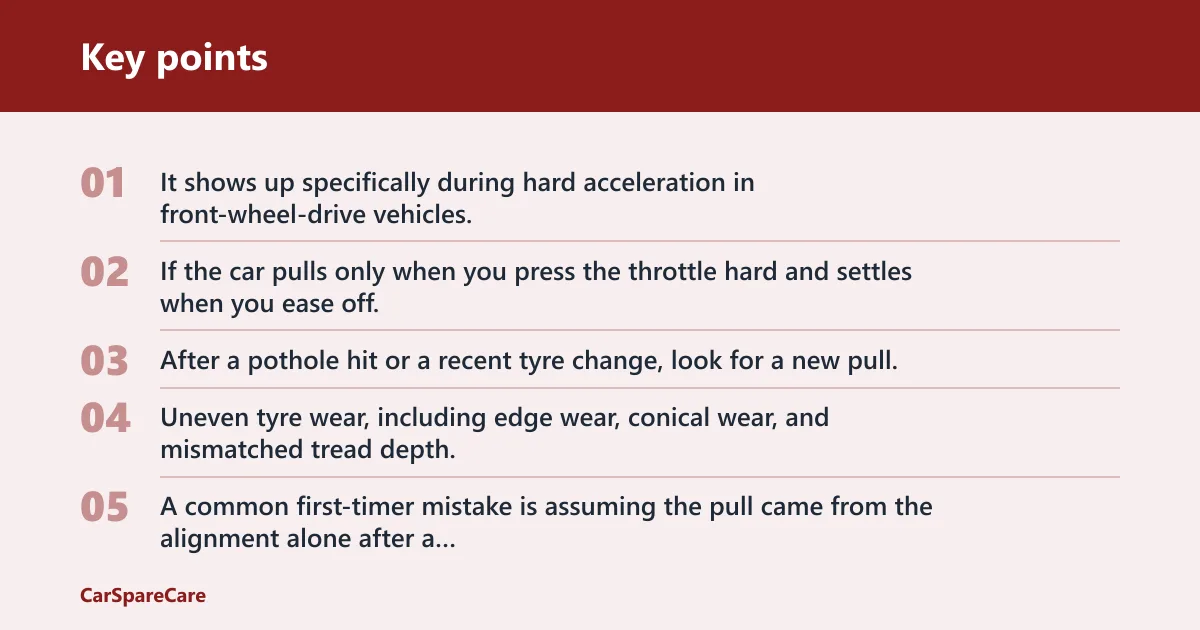
Torque steer is different. It shows up specifically during hard acceleration in front-wheel-drive vehicles. If the car pulls only when you press the throttle hard and settles when you ease off, torque steer is more likely than alignment or brake drag.
After impact or tyre work
After a pothole hit or a recent tyre change, look for a new pull, a crooked steering wheel, or fresh edge wear. Uneven tyre wear, including edge wear, conical wear, and mismatched tread depth, can worsen pulling over time and may make alignment problems feel more noticeable.
A common first-timer mistake is assuming the pull came from the alignment alone after a tyre replacement. If one tyre has deeper tread than the other on the same axle, or if one tyre has started to wear in a cone shape, the car can pull even when the alignment numbers look close.
Frequently asked questions
Why is my car pulling to one side while driving?
Start with tyre pressure, then alignment, then tyre wear and steering or suspension play. If the pull only happens while braking, look at the brake system first. If it only happens under hard acceleration in a front-wheel-drive car, torque steer becomes a stronger clue than alignment.
Why does my car pull to the left while driving?
A left pull can come from lower pressure on the left side, alignment angles out of spec, a dragging left brake, or a worn tyre. Compare the left front and right front tyres cold first. If the pull appears only while braking, inspect the left brake caliper and hose.
Why does my car pull to the right while driving?
A right pull follows the same logic in reverse. Check for low pressure on the right front tyre, tyre wear differences, or a brake fault on the right side. If the steering wheel sits off-centre after a pothole or curb strike, alignment is a likely next step.
Why does my car keep pulling to one side?
A persistent pull usually means the cause is still present, not random. Unequal tyre pressure, worn suspension parts, a brake that drags, or an alignment angle outside spec can all do it. If the pull keeps returning after tyre pressure corrections, the next check should be mechanical, not cosmetic.
Can low tire pressure make a car pull sideways?
Yes. Even a small left-right difference can change rolling resistance enough to feel on the road. Check all four tyres cold and compare the left side to the right side. Set them to the PSI on the door jamb or owner’s manual before judging anything else.
Will wheel alignment always fix the problem?
No. Alignment helps when camber, caster, or toe are out of spec, but it will not cure a sticking caliper, a damaged tyre, a brake hose fault, or loose steering parts. If the car pulls only during braking or only under hard acceleration, alignments are not the first answer.

Hi, I’m Melvin, an automobile engineer with extensive experience in automobile equipment. I currently work for a local automobile firm, where I specialize in the car parts industry. I’ve had the opportunity to collaborate with seasoned inspectors, gaining invaluable hands-on experience that goes beyond just theory.
My passion for automotive care started at a young age, which led me to create CarSpareCare. Through CarSpareCare, I share the knowledge and skills I’ve acquired over the years to help others navigate the world of car maintenance and repairs.
My goal is to provide practical tutorials, essential safety advice, and the latest industry insights so that anyone—whether a beginner or an expert—can confidently tackle their automotive projects.

