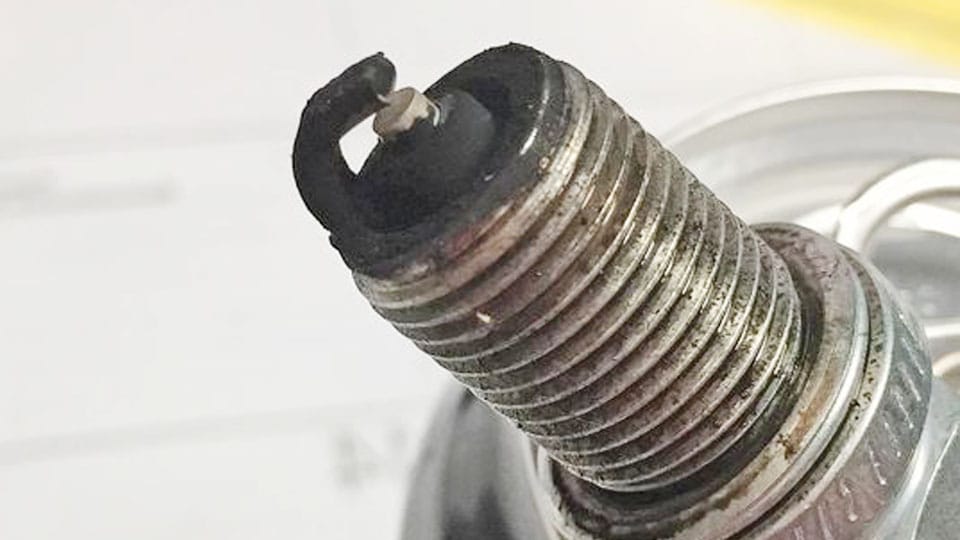
Iridium spark plugs usually last about 60,000 to 120,000 miles, and many OEM iridium plugs are rated near 100,000 miles; replace them sooner if you notice misfires, hard starts, rough idle, or fuel economy drops. Worn plugs can raise fuel use, strain coils, and trigger drivability problems. This guide explains lifespan by plug design and driving pattern, then gives a replace-or-wait checklist for normal and severe use.
Iridium spark plug lifespan
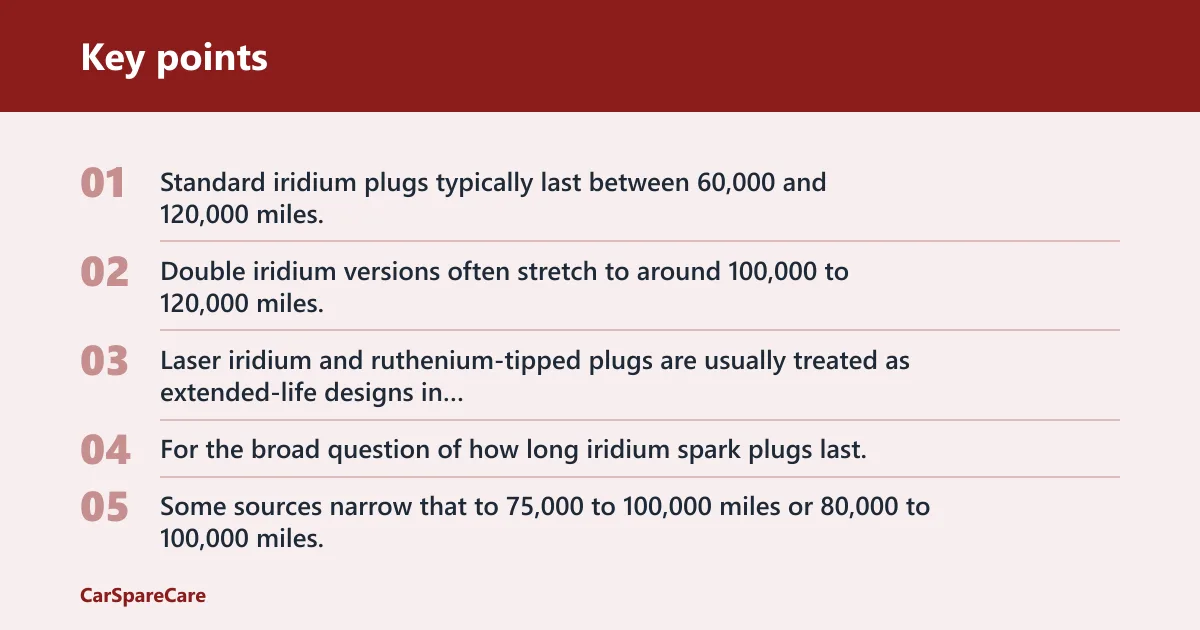
Standard iridium plugs typically last between 60,000 and 120,000 miles, but the exact interval depends on engine design, plug type, and driving pattern. Double iridium versions often stretch to around 100,000 to 120,000 miles. Laser iridium and ruthenium-tipped plugs are usually treated as extended-life designs in the same general range.
Standard iridium mileage range
For the broad question of how long iridium spark plugs last, the safest answer is the published range: 60,000 to 120,000 miles. Some sources narrow that to 75,000 to 100,000 miles or 80,000 to 100,000 miles, which is why the owner’s manual is the main reference, not a single generic figure.
How double iridium changes the interval
Double iridium plugs place iridium on both the center and ground electrodes, so they are built for longer wear resistance. They are commonly treated as 100,000 to 120,000-mile plugs. If your vehicle lists double iridium, that design usually buys more service life than a standard single-tip iridium plug.
Where laser iridium and ruthenium fit
Laser iridium plugs are a design variant readers often see on parts listings, and they are usually grouped with extended-life iridium plugs rather than treated as a separate maintenance category. Ruthenium-tipped plugs are a newer alternative that may last about 120,000 miles in some applications. In both cases, the engine’s service schedule still takes priority.
Why iridium lasts longer
Iridium lasts longer because the center electrode can be much finer than a conventional plug, so it needs less voltage to fire and resists wear better over time. NGK says iridium plugs may maintain their original spark gap longer than conventional designs. That gap retention is the key.
Fine-wire center electrode design
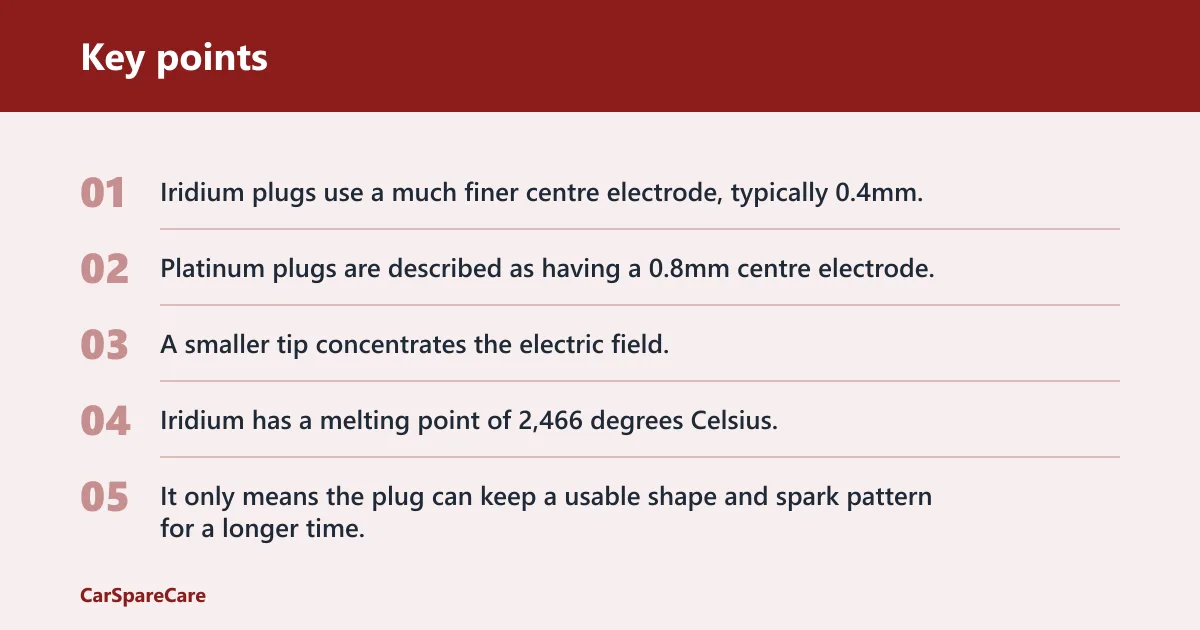
Iridium plugs use a much finer centre electrode, typically 0.4mm. Platinum plugs are described as having a 0.8mm centre electrode, and copper plugs a 2.5mm centre electrode. A smaller tip concentrates the electric field, so the spark needs less voltage and the electrode erodes more slowly.
Ultra-hard tip wear resistance
Iridium has a melting point of 2,466 degrees Celsius, which helps the tip survive heat and erosion better than softer metals. That does not make a plug immortal. It only means the plug can keep a usable shape and spark pattern for a longer time, provided the engine stays healthy.
How gap growth changes over time
As a plug wears, the spark plug gap grows wider. A wider gap raises voltage demand, which can stress the ignition system and make misfire more likely under load. That is why a plug can look acceptable by mileage alone and still need replacement if the gap has drifted too far or the insulator is fouled.
What changes the interval?
Driving pattern, engine layout, and installation quality can shorten the practical life of an iridium plug. Short trips, turbo engines, direct-injection engines, bad gaps, and current misfires all push the replacement point forward. The owner’s manual is still the reference point, but severe use can move the real-world interval well below the headline number.
Short-trip city driving
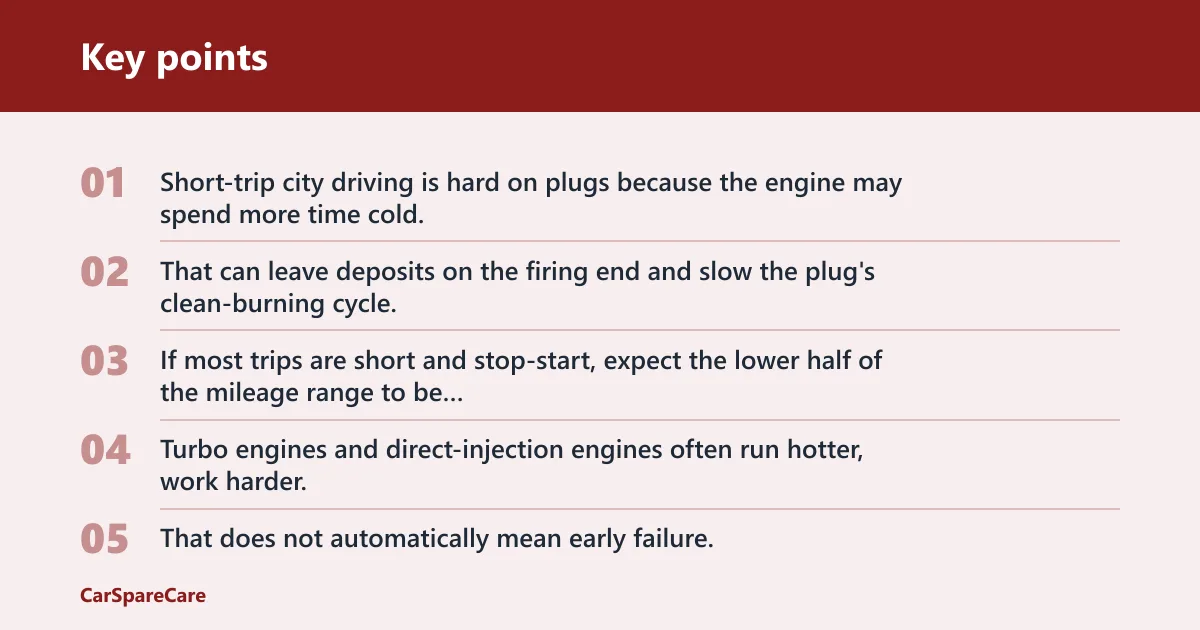
Short-trip city driving is hard on plugs because the engine may spend more time cold, idling, or rich during warm-up. That can leave deposits on the firing end and slow the plug’s clean-burning cycle. If most trips are short and stop-start, expect the lower half of the mileage range to be more realistic.
Turbo and direct-injection engines
Turbo engines and direct-injection engines often run hotter, work harder, or place different demands on ignition under boost and load. That does not automatically mean early failure, but it does mean the service interval varies by engine and plug type. If the manual calls for earlier replacement, follow that schedule instead of the broad generic range.
Fuel quality and engine condition
Poor fuel quality, oil consumption, vacuum leaks, coolant contamination, and weak coils can all shorten plug life. A healthy engine keeps the plug cleaner and the gap more stable. A tired engine can foul even an iridium plug before the mileage limit arrives, so symptoms matter as much as the odometer.
Installation and gap setting
Proper installation matters because damaged threads, the wrong gap, or overtightening can shorten plug life. Cross-threading can damage the shell, and an incorrect gap can force the ignition system to work harder from the start. Use the factory gap spec, torque to the manual, and replace any plug that looks mechanically damaged.
Should you replace them now?
Use mileage as a filter, not the final answer. Under 60,000 miles, most iridium plugs can stay in service unless you have symptoms or severe use. Between 60,000 and 100,000 miles, inspection becomes smart. At 100,000 miles and beyond, replacement is usually the safer call unless the manual clearly allows longer and the plugs still look healthy.
- Check the owner’s manual for the stated interval.
- Compare your mileage to the plug type listed on the car.
- Look for rough idle, hard starts, power loss, or fuel economy drops.
- Consider severe use: short trips, turbo use, direct injection, or frequent towing.
- If mileage is high or symptoms are present, replace instead of waiting.
Say your compact sedan has standard iridium plugs and 68,000 miles, mostly from weekday commuting with a lot of cold starts. If the idle has become uneven and the plugs show enlarged gaps, replacement makes more sense than stretching them for another season.
Picture a turbocharged crossover with 92,000 miles and a service record that shows the original plugs. If it starts hesitating under boost and the fuel economy has slipped, that is not a “wait and see” case. That is a replace-now case.
Iridium spark plug decision table
This table turns mileage into an action. Use the mileage band, then check the driving pattern and symptoms. If the symptom column matches your car, do not let the mileage band override it.
| mileage band | driving pattern | symptom checklist | recommended action |
|---|---|---|---|
| 0-60k | Normal mixed driving, no severe use | No misfire, no hard starts, idle stays steady, fuel economy normal | Usually inspect only if the manual calls for it; keep running if service history is current |
| 60k-100k | Standard use or moderate city driving | Any rough idle, harder starting, slight power loss, or visible gap growth | Inspect now; replace if symptoms are present or the manual interval is near |
| 100k+ | Any driving pattern | Plug age is high, gap wear is likely, symptoms may come and go | Replace now unless the vehicle uses a longer OEM interval and inspection proves the plugs are still healthy |
| Any mileage | Short-trip city driving | Fouling, rough idle, cold-start stumble, repeated short runs | Inspect early and shorten the replacement interval |
| Any mileage | Turbo or direct-injection engine | Load-related misfire, hesitation, boost-related power loss | Follow the manual closely; replace sooner if symptoms appear |
| Any mileage | Any current misfire condition | Rough idle, hard starts, reduced fuel efficiency, power loss | Replace or diagnose immediately; do not wait on a known misfire |
Do you need new plugs?
If your car already shows misfire symptoms, you need a diagnosis now rather than a mileage debate. Rough idle, hard starts, reduced fuel efficiency, and power loss are common replacement signs. If the plugs are within range but one cylinder is misfiring, inspection can confirm whether the plug, coil, or another part is the real cause.
Rough idle and hard starts
Rough idling often points to weak spark quality, fouling, or excess gap. Hard starts can show up first in colder weather, after short trips, or after the car has sat overnight. If both symptoms appear together, worn plugs move up the suspect list quickly.
Reduced fuel efficiency and power loss
A worn plug can still fire and still hurt combustion quality. That can show up as a small fuel economy drop, sluggish acceleration, or a flat feeling under load. Those symptoms are not proof by themselves, but they are enough to justify inspection when mileage is high.
When inspection is enough
If the car is under the interval, runs cleanly, and has no misfire history, inspection may be enough. Pulling the plugs lets you check the insulator, electrode shape, and gap growth. If the gap is still in spec and the tips are clean, you can usually keep running until the scheduled interval.
How iridium compares
Iridium usually lasts longer than copper and often longer than standard platinum, but the exact result depends on plug design and engine demands. Copper plugs are typically listed at 20,000 to 30,000 miles. Platinum plugs are approximately 60,000 miles. Iridium sits above both in the usual maintenance schedule, and double iridium stretches farther still.
Against platinum plugs
Do iridium plugs last longer than platinum plugs? In general, yes. That said, the actual service interval still depends on the vehicle.
Against copper plugs
Copper plugs are the shortest-lived of the three. With a typical range of 20,000 to 30,000 miles, they are not a fair long-life comparison for most late-model engines. If your car specifies iridium, switching to copper to save money usually creates more frequent maintenance, not less.
Against newer ruthenium-tipped plugs
Ruthenium-tipped plugs are newer and can also push toward 120,000 miles in some applications. For a driver deciding between premium plug types, the practical question is not which metal sounds best. It is which plug the engine was designed for and what the maintenance schedule calls for.
Frequently asked questions
How long do iridium spark plugs last in a car?
In a car, iridium spark plugs usually last about 60,000 to 120,000 miles. Many OEM setups sit near 100,000 miles, but that number moves with engine design, short-trip use, turbocharging, direct injection, and plug type. The owner’s manual should set the final interval.
How often to change iridium spark plugs?
Change them at the manufacturer service interval, not on a generic calendar. For many vehicles, that means somewhere in the 60,000 to 120,000-mile range, with double iridium and some OEM designs leaning higher. If symptoms appear first, replace sooner.
How long do NGK iridium spark plugs last?
NGK is the world’s largest spark plug manufacturer, and its iridium plugs are designed to keep their original spark gap longer than conventional designs. In practice, the lifespan still depends on the exact NGK plug family and the vehicle application, so the manual and box label matter.
How long do double iridium spark plugs last?
Double iridium plugs are commonly treated as 100,000 to 120,000-mile plugs. That longer interval comes from iridium on both the center and ground electrodes. Even so, a misfire, hard start, or gap issue means replacement should happen before the mileage limit.
How long do iridium spark plugs last motorcycle?
Motorcycle intervals vary widely by engine design, heat load, and how the bike is used. Some can follow car-like ranges, while others need earlier service because of higher revs or tighter packaging. For motorcycles, the service manual is the only reliable answer.
Do iridium plugs last longer than platinum plugs?
Usually, yes. Platinum plugs are often listed at approximately 60,000 miles, while iridium plugs commonly run from 60,000 to 120,000 miles and can last longer in OEM applications. The exact result depends on whether the plug is standard iridium, double iridium, or another extended-life design.

Hi, I’m Melvin, an automobile engineer with extensive experience in automobile equipment. I currently work for a local automobile firm, where I specialize in the car parts industry. I’ve had the opportunity to collaborate with seasoned inspectors, gaining invaluable hands-on experience that goes beyond just theory.
My passion for automotive care started at a young age, which led me to create CarSpareCare. Through CarSpareCare, I share the knowledge and skills I’ve acquired over the years to help others navigate the world of car maintenance and repairs.
My goal is to provide practical tutorials, essential safety advice, and the latest industry insights so that anyone—whether a beginner or an expert—can confidently tackle their automotive projects.