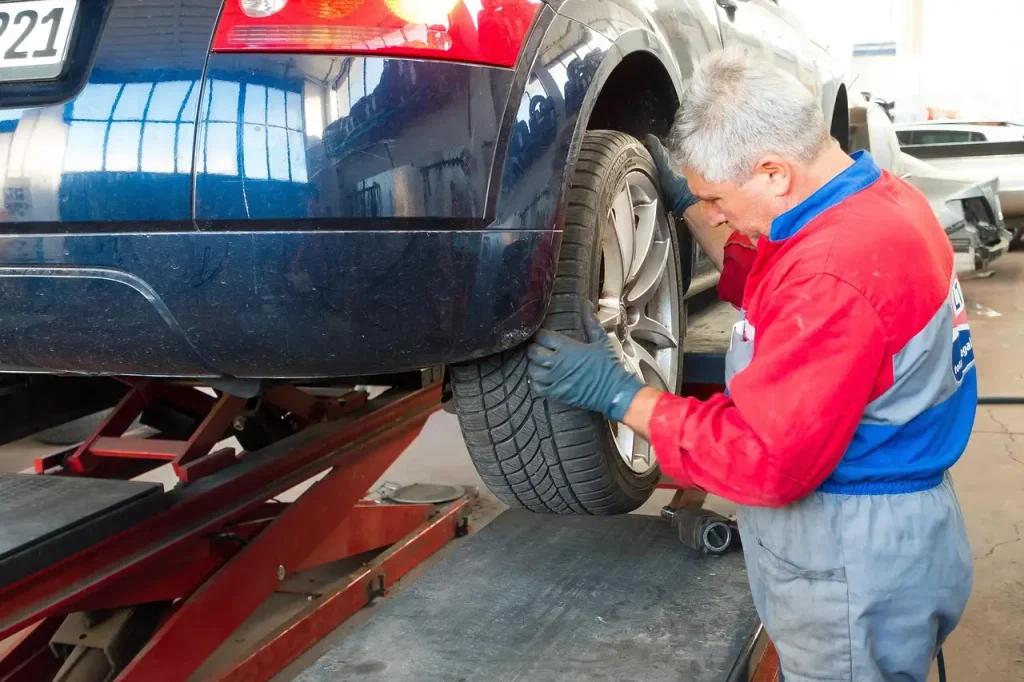
To check whether a wheel is out of round, jack up the car, spin the wheel, and measure radial and lateral runout with a dial indicator; on a passenger car, more than about 0.030 in (0.76 mm) usually calls for further inspection. Ignoring it can mean vibration, uneven tire wear, and a bent wheel or a tire problem that keeps getting misdiagnosed. This guide shows the fastest home checks to separate wheel runout from tire defects and tells you when to stop guessing and visit a shop.
What you’ll need

- Jack and jack stands rated for your vehicle
- Wheel chocks
- Flashlight
- Chalk or a paint marker
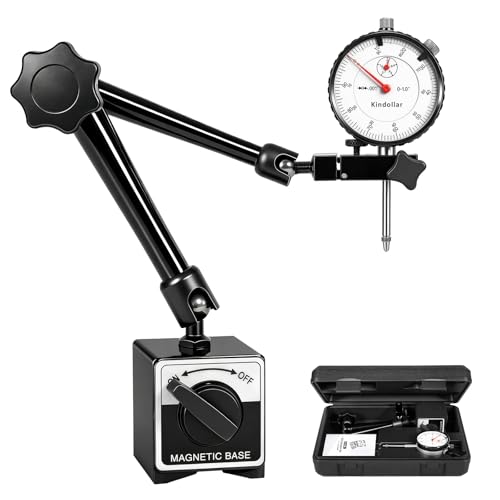
- Dial indicator, if available
- Torque wrench for rechecking lug nuts
- Gloves and eye protection
How to check a wheel at home
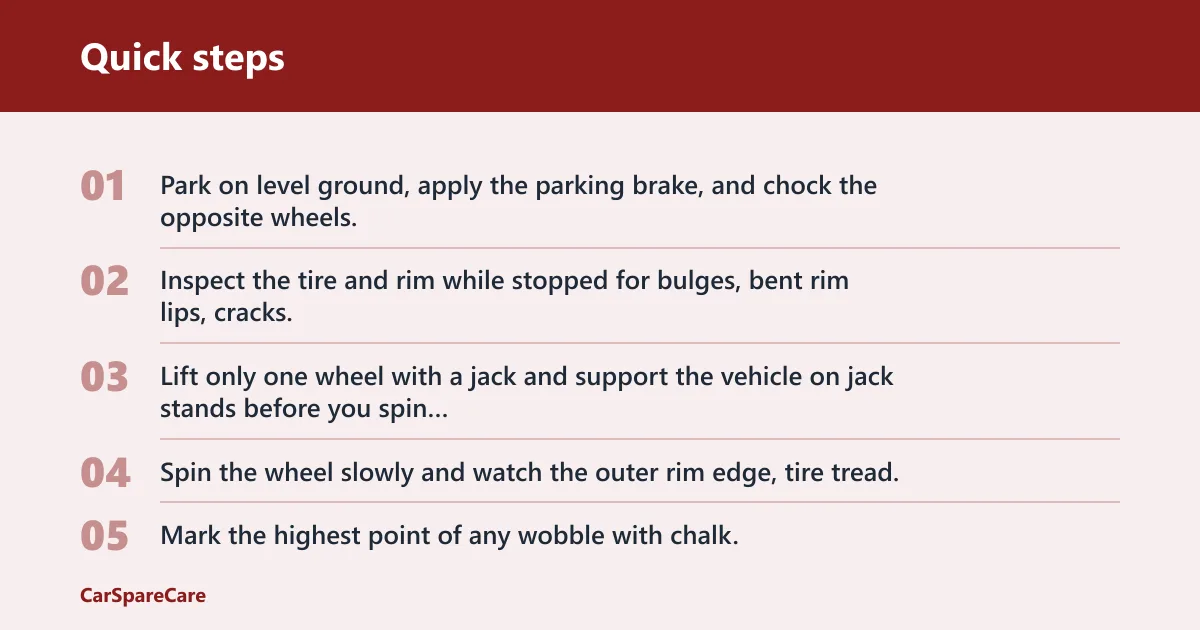
- Park on level ground, apply the parking brake, and chock the opposite wheels.
- Inspect the tire and rim while stopped for bulges, bent rim lips, cracks, curb impact marks, bead-seat corrosion, and uneven bead seating.
- Lift only one wheel with a jack and support the vehicle on jack stands before you spin anything by hand.
- Spin the wheel slowly and watch the outer rim edge, tire tread, and sidewall for side-to-side motion or hop.
- Mark the highest point of any wobble with chalk, then rotate again to see whether the same spot repeats.
- If you have a dial indicator, mount it to a fixed point near the wheel and measure the change at the rim edge for lateral runout and at the tread or rim face for radial runout.
A wheel can be out of round in two ways. Radial runout is an up-and-down deviation as the wheel turns. Lateral runout is side-to-side movement, often seen as wobble at the rim edge. Both can create vibration, but lateral wobble more often points to a bent wheel, a mounting issue, or damage at the bead seat.
A wheel balancing machine checks mass distribution, not true roundness by itself. A balanced assembly can still have runout. A tire with radial force variation can also feel like an out-of-round wheel, especially at a narrow speed range, which is why road-force balancing may be needed when a visual check is not enough.
Wheel runout checklist
| Symptom observed | Most likely cause | Next test |
|---|---|---|
| Vibration only at 50 to 70 mph | Tire radial force variation or wheel runout | Road test, then dial indicator or road-force balance |
| Visible side-to-side wobble when spinning | Bent rim, mounting issue, or heavy corrosion at the bead seat | Check runout at the rim lip and clean the hub and mounting faces |
| Flat spot after storage | Tire flat spotting | Drive a few miles, then recheck; if the shape stays, inspect for tire damage |
| Bulge or bubble in the sidewall | Belt separation or internal tire damage | Replace the tire; do not keep driving to “see if it smooths out” |
| Curb rash, bent lip, or crack | Wheel damage | Measure runout; replace or repair only if a shop confirms it is safe |
How do you tell a tire problem from a wheel problem?
Start with the visible shape. A tire issue usually shows a bulge, flat spot, uneven bead seating, or tread wear clues such as cupping, scalloping, or inside or outside edge wear. A wheel issue more often shows a bent rim lip, crack, corrosion at the bead seat, or repeatable lateral wobble.
Flat spots after storage
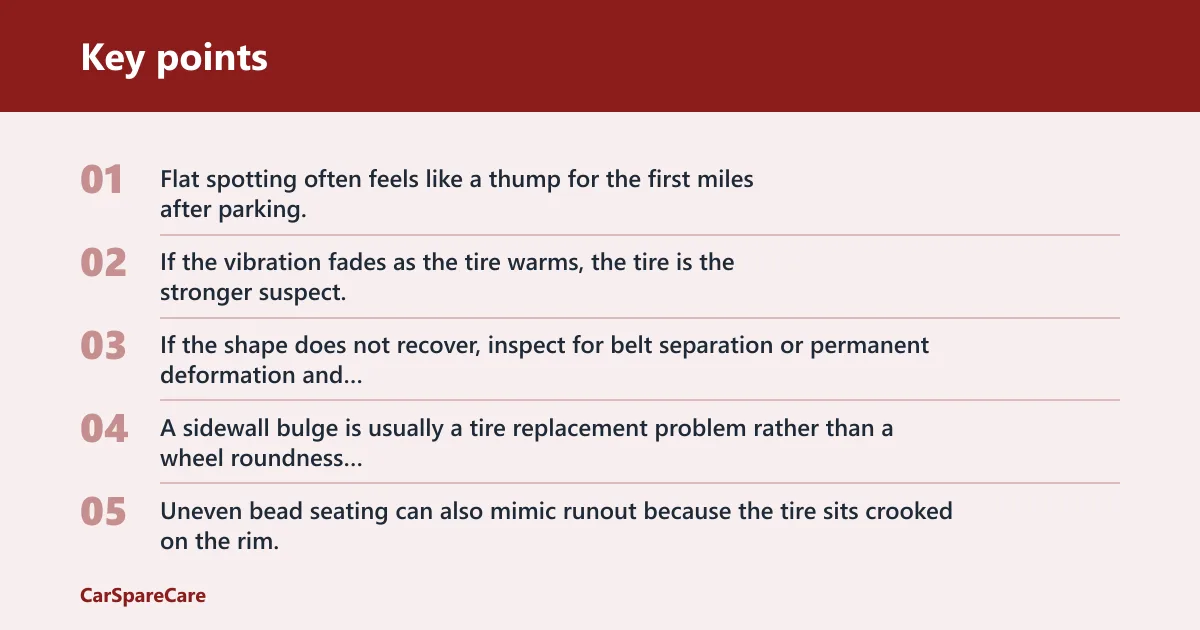
Flat spotting often feels like a thump for the first miles after parking, especially in cold weather. If the vibration fades as the tire warms, the tire is the stronger suspect. If the shape does not recover, inspect for belt separation or permanent deformation and stop relying on a visual guess.
Bulges, belt separation, and bead issues
A sidewall bulge is usually a tire replacement problem rather than a wheel roundness problem. Uneven bead seating can also mimic runout because the tire sits crooked on the rim. Check the molded line near the bead all the way around; if it is not even, break the bead and reseat it or have a shop inspect it.
Tread wear clues that point away from the wheel
Cupping and scalloping often track with suspension wear, imbalance, or a tire defect rather than a bent wheel alone. Inside or outside edge wear points toward alignment or inflation issues. Those patterns matter because a wheel can look fine and still shake if the tire or suspension is the real source.
Could it just be balance or road force variation?
Yes. A wheel can be balanced and still shake if it has runout or if the tire shows radial force variation. Balance corrects weight distribution. It does not prove the assembly is round. Road-force testing matters when the vibration shows up at a specific speed and the visual check looks normal.
A common first-timer mistake is swapping wheel weights around and expecting a bent rim problem to disappear. If the machine reports acceptable balance but the vibration remains, ask for a road-force measurement and a runout check at the same visit.
What to ask the shop to measure
Ask for rim runout in thousandths of an inch or millimeters, plus road-force values if the tire is suspect. A dial indicator gives the roundness reading. A road-force machine shows how the tire behaves under load, which can expose a tire that looks fine on the rack but still causes highway shake.
Common mistakes to avoid
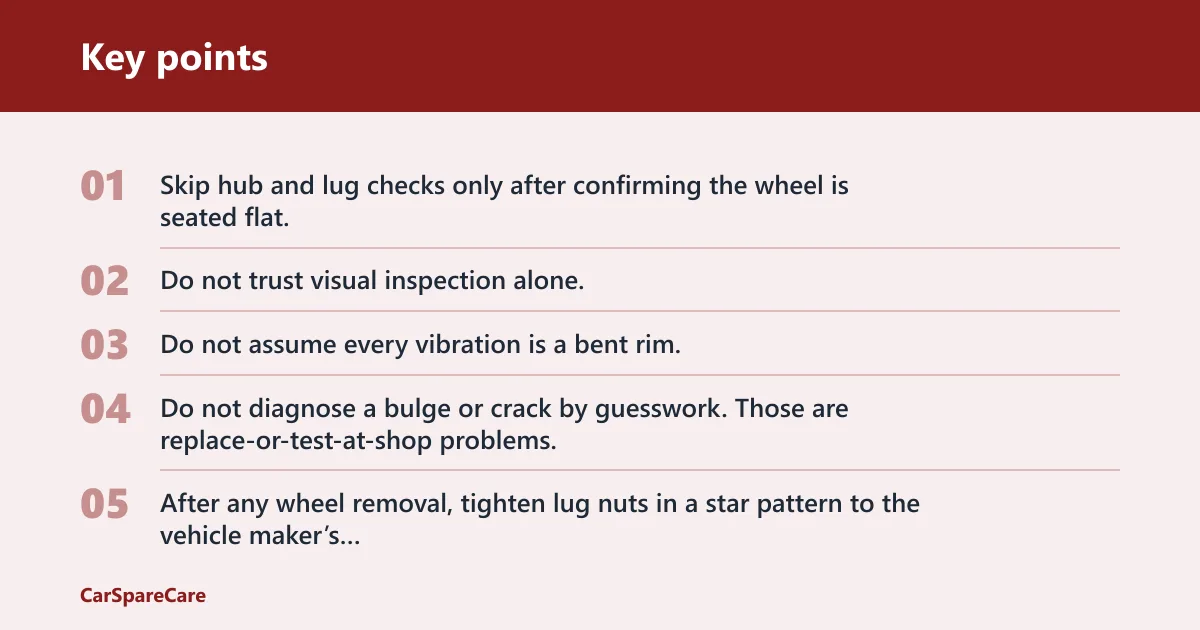
- Skip hub and lug checks only after confirming the wheel is seated flat. Dirt, rust, or uneven lug torque can create a false wobble.
- Do not trust visual inspection alone. A small radial or lateral runout may be hard to see but still measurable.
- Do not assume every vibration is a bent rim. Brake rotor issues, tire defects, and wheel imbalance can feel similar on the road.
- Do not diagnose a bulge or crack by guesswork. Those are replace-or-test-at-shop problems.
- After any wheel removal, tighten lug nuts in a star pattern to the vehicle maker’s torque spec, then recheck after about 50 to 100 miles if the manual calls for it.
Suppose a front tire shakes the steering wheel at 62 mph, but the rear tire does not create a seat vibration at the same speed. That split points you toward the front wheel, front tire, brake, or hub area, not a blanket “all tires are bad” answer. Swap front and rear only if the tire size and vehicle layout allow it safely.
When should you replace the wheel or tire?
Replace the wheel if the rim has a crack, a severe bend, a damaged lip, or runout that stays outside spec after cleaning the mounting faces and reseating the wheel. Replace the tire if it has a bulge, belt separation, permanent flat spot, or bead damage. If both parts show damage, stop trying to isolate one culprit.
When to stop guessing and book a shop test
If the wheel still shows wobble after a safe home check, or the vibration changes under braking, book a shop visit. Ask for runout measurement first, then road-force balancing if the tire remains suspect. That order keeps you from replacing the wrong part.
Picture a 17-inch alloy wheel with a visible curb scar on the outer lip and a shake that starts at 58 mph. That combination deserves measurement, not a guess. If the runout exceeds about 0.030 in (0.76 mm), replacement or professional repair is often the next step.
Frequently asked questions
How to check if a tire is out of round
Lift the wheel, spin it slowly, and watch the tread and sidewall for a hop, lump, or repeated high spot. A tire can also be checked by a shop with road-force equipment, which is better when the shake only appears at certain speeds and the wheel looks normal.
How to tell if a tire is out of round
Look for a rhythmic thump, a flat spot that does not disappear after driving, or uneven bead seating along the rim line. If the wheel itself looks straight but the tire shows a repeatable high spot, the tire is the more likely source and should be measured under load.
How to tell if a rim is out of round
Spin the bare wheel if possible, or inspect the installed wheel with a dial indicator at the rim edge. A bent rim usually shows lateral wobble, a damaged lip, or a measurable deviation that repeats once per rotation. Clean the hub face first so dirt does not fake a reading.
How do I know if my wheel is out of round or just unbalanced?
Balance problems usually show up as a shake that a balancing machine can correct with weights. Out-of-round problems still show a wobble or measured runout after balancing. If the vibration remains after a balance and the wheel has visible wobble, measure runout or request a road-force test.
Can an out-of-round wheel cause vibration at highway speed?
Yes. A wheel with runout can create vibration that appears only in a narrow speed range, often first on the steering wheel or seat. If the shake starts at one speed and disappears at another, do not rely on balance alone; measure the wheel and inspect the tire under load.
What is the difference between a bent wheel and an out-of-round wheel?
A bent wheel is damage that changes the wheel’s shape, often from a pothole or curb hit. Out-of-round is the condition you measure. A bent wheel is one common cause of runout, but a wheel can also be out of round from manufacturing variation, corrosion, or improper seating.
Can I check wheel roundness at home without special tools?
Yes, but only for a rough pass-fail check. Jack up the car, spin the wheel, and look for wobble, hop, bulges, and damaged lips. Without a dial indicator, you cannot quantify runout accurately, so treat any visible movement or vibration at speed as a reason for a proper measurement.
Will a tire with a bulge or flat spot look out of round?
Usually, yes. A bulge often appears as a local rise in the sidewall, while a flat spot can make the tread look and feel uneven as it rotates. Either condition can mimic an out-of-round wheel, but a bulge is a tire safety problem and should not be ignored.
Do I need to replace the tire or the wheel if it is out of round?
Replace the tire if the problem is a bulge, belt separation, bad bead seating, or a permanent flat spot. Replace the wheel if the rim is cracked, badly bent, or still over spec after cleaning and reseating. If both the tire and wheel show damage, both may need attention.

Hi, I’m Melvin, an automobile engineer with extensive experience in automobile equipment. I currently work for a local automobile firm, where I specialize in the car parts industry. I’ve had the opportunity to collaborate with seasoned inspectors, gaining invaluable hands-on experience that goes beyond just theory.
My passion for automotive care started at a young age, which led me to create CarSpareCare. Through CarSpareCare, I share the knowledge and skills I’ve acquired over the years to help others navigate the world of car maintenance and repairs.
My goal is to provide practical tutorials, essential safety advice, and the latest industry insights so that anyone—whether a beginner or an expert—can confidently tackle their automotive projects.