

Check paint each season, and reapply protection when water stops beading well, after harsh weather, or about every few months. Skip it and you get etching, fading, bonded grime, and repairs that cost far more than a wash. This weather-triggered car paint care checklist covers spring, summer, fall, and winter, with exact inspection points and action steps.
What should be on a seasonal paint care checklist?
The four things to track every season
Start with a few key items: wash condition, contamination type, protection state, and damage signs. A clean panel can still carry bonded film, so look beyond dust and road film.
The simple rule is this: wash when dirt is fresh, inspect after weather changes, refresh protection when water stops beading, and fix damage before it spreads into the clear coat.
How weather, parking, and mileage change the checklist
Cars parked outdoors often pick up more sap, bird droppings, dust, and sun exposure. Garage-kept cars still need checks, but their protection usually lasts longer and their contamination load is lighter.
More highway driving often means more bug splatter and tar on the nose, mirrors, and lower doors. Short-trip city use often leaves more brake dust, splash film, and water spots from repeated parking under trees or sprinklers.
What counts as a warning sign versus normal grime
Normal grime rinses away without effort. Warning signs do not: water stops beading, dirt clings after washing, paint feels rough after a wash, or a panel looks dull in sunlight.
Swirl marks, chalky oxidation, etched spots from bird droppings, and tiny chips at the leading edge of panels mean the paint system needs more than a standard wash.
Spring paint care checklist
Spring is the reset season. Wash off winter residue, remove any salt film left in seams and lower panels, and inspect for chips that opened during cold weather. If pollen and tree sap are already sticking, clean them before heat bakes them on harder.
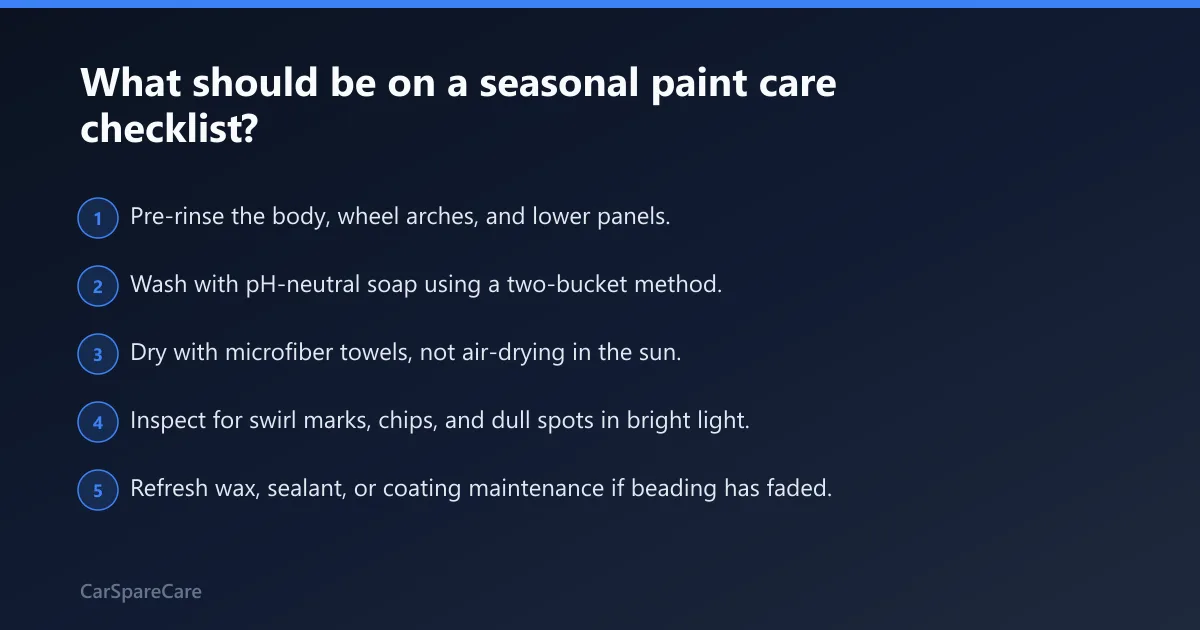
- Pre-rinse the body, wheel arches, and lower panels.
- Wash with pH-neutral soap using a two-bucket method.
- Dry with microfiber towels, not air-drying in the sun.
- Inspect for swirl marks, chips, and dull spots in bright light.
- Refresh wax, sealant, or coating maintenance if beading has faded.
Spring also suits clay bar work if bonded grit remains after washing. Use lubricant, light pressure, and short passes. If the panel feels smooth after clay but still looks hazy, a light polish may be needed before new protection goes on.
How do you protect car paint in summer heat?
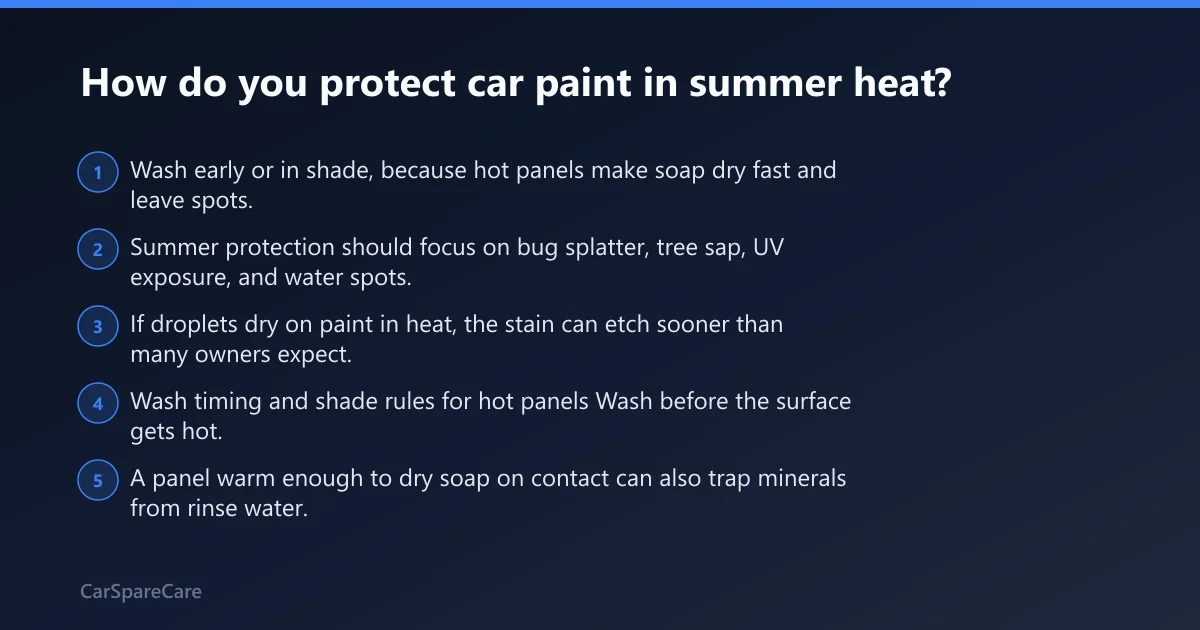
Wash early or in shade, because hot panels make soap dry fast and leave spots. Summer protection should focus on bug splatter, tree sap, UV exposure, and water spots. If droplets dry on paint in heat, the stain can etch sooner than many owners expect.
Wash timing and shade rules for hot panels
Wash before the surface gets hot. A panel warm enough to dry soap on contact can also trap minerals from rinse water. Use a pH-neutral soap, a soft microfiber mitt, and the two-bucket method to cut wash-marring.
Spot-free drying matters more in summer. A clean microfiber drying towel removes leftover minerals before they flash on dark paint or glass.
Bug splatter and tree sap removal steps
Bug splatter needs a pre-soak first. Let a paint-safe cleaner or rinse aid soften the residue, then wipe gently. Dry scrubbing can grind acidic debris into the clear coat and leave dull marks.
Tree sap is a spring and summer problem. Use a paint-safe solvent with short dwell time, then rinse or wash the spot. Do not leave sap baking on a hood, roof, or mirror cap in heat, because it can etch the finish.
UV exposure, water spots, and when to refresh protection
Summer sun breaks down weak protection faster. When water no longer forms tight beads, the surface usually needs a fresh coat of wax or sealant, or at least a maintenance wash for a ceramic-coated car.
Water spots that stay after drying are a warning. If they sit through several hot days, they can bond to the finish and need a stronger cleaner or light correction.

Seasonal paint care matrix
This matrix gives the checklist by weather at a glance. The best interval depends on parking, mileage, and how harsh the season is, but the failure cues are the same: weak beading, roughness, and visible stains that do not rinse away.
| Item | Spring | Summer | Fall | Winter |
|---|---|---|---|---|
| Wash frequency | Every 1 to 2 weeks after winter residue clears | After highway trips or when bugs and sap build up; weekly if exposed | Every 1 to 2 weeks as leaves, rain, and road film return | After each road-salt event, then a full wash when safe |
| Main contamination threats | Salt film, pollen, sap, dust | Bug splatter, tree sap, UV, water spots | Leaf tannins, mud, rain film, falling debris | Road salt, slush, grime, ice-melt residue |
| Protection refresh timing | Refresh after winter washout or when beading weakens | Check monthly; refresh before long road trips or intense sun periods | Refresh before freeze-up and before repeated wet weather | Top up before the first heavy salt cycle if protection has faded |
| Inspection cues | Swirl marks, chips, dull salt haze | Etched bug spots, sap rings, heat spotting | Water staining, roughness, falling-debris scuffs | White crust at seams, lower-panel staining, chip-edge corrosion |
| Stop-doing-this warnings | Do not wash in direct sun or scrub dry residue | Do not let bugs or sap bake on hot paint | Do not leave wet leaves or mud against paint | Do not ignore lower panels, wheel arches, or chip edges |
How do you protect car paint from road salt and winter grime?
Rinse road salt as soon as practical after exposure, then wash the lower panels and wheel arches first. Salt is a winter contamination source that can work into chips and panel edges, where corrosion starts under the clear coat and spreads outward.
Rinse timing after salt exposure
Salt should not sit for days on the car. A quick rinse after a salted road drive is better than waiting for the next warm weekend, especially on rocker panels, rear quarters, bumpers, and wheel-arch lips.
If a full wash is not possible, at least remove the brine film from the body and undercarriage areas that trap spray. Road film on the lower half does more harm than the dust on the roof.
Lower-panel and undercarriage priorities
Focus first on the parts that collect splash: front bumper edges, lower doors, rear valance, and the inside of wheel arches. Those are the places where salt residue dries in seams and where chips often start rusting at the edges.
Wax, sealant, or coating in winter conditions
For winter, a paint sealant or ceramic coating usually lasts longer than wax in repeated salt exposure. Wax still helps, but it typically needs more frequent reapplication when the car sees wet slush, freezing spray, and regular washing.
Garage storage helps any product last longer. Outdoor parking and long commutes shorten every protection interval, so winter care should lean toward stronger protection and faster rinsing, not longer gaps between washes.
What products should I use for seasonal car paint maintenance?
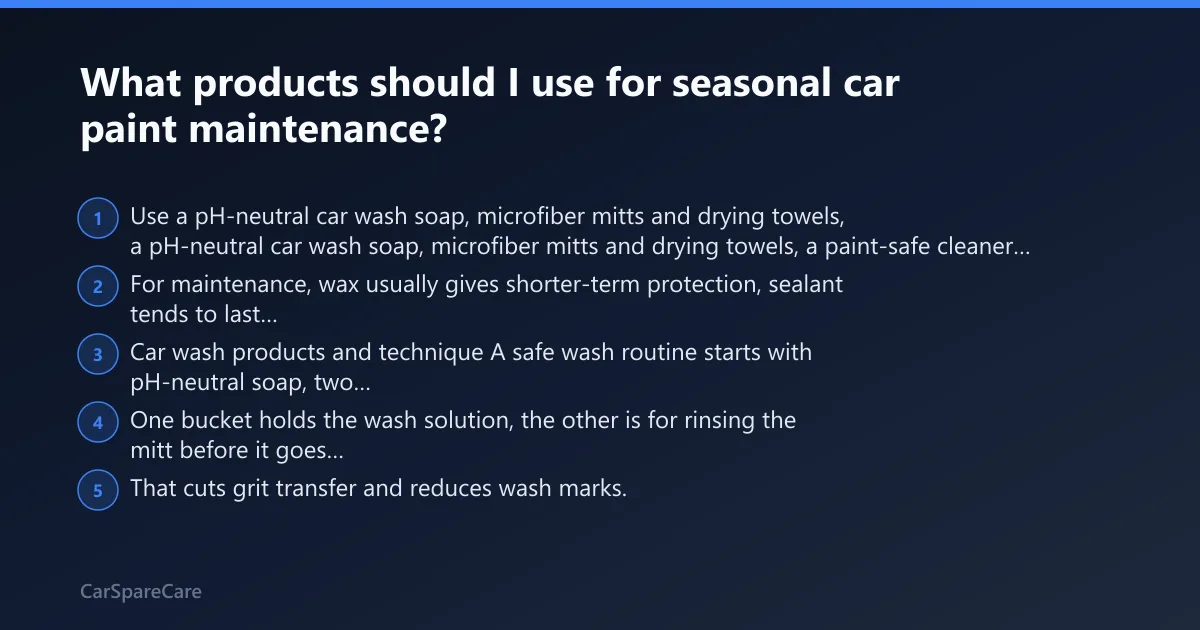
Use a pH-neutral car wash soap, microfiber mitts and drying towels, a paint-safe cleaner for bugs and sap, clay lubricant, and a protection product matched to weather and parking. For maintenance, wax usually gives shorter-term protection, sealant tends to last longer, and ceramic coating often lasts longest, though the car still needs washing.
Car wash products and technique
A safe wash routine starts with pH-neutral soap, two buckets, and separate mitt and towel care. One bucket holds the wash solution, the other is for rinsing the mitt before it goes back into the soap. That cuts grit transfer and reduces wash marks.
Avoid washing in direct sun. Clean paint, then dry with microfiber towels and a spot-free method so minerals do not dry into the finish.
Wax, paint sealant, and ceramic coating
Wax is the shortest-term choice. It suits drivers who can refresh protection more often and who want easy beading cues, because fading beading usually signals that the layer is thinning.
Paint sealant is synthetic protection with more durability than wax. It fits drivers who want longer intervals between reapplication and steady weather resistance through wet seasons.
Ceramic coating gives longer-duration protection and strong hydrophobic behavior, but it is not maintenance-free. It still needs regular maintenance washes, and bonded contamination may still require decontamination before new top-up products go on.
How to choose based on climate and storage
Choose wax for mild use, indoor parking, and owners willing to reapply more often. Choose sealant for mixed weather, commuter use, or outdoor parking where a longer interval helps. Choose ceramic coating for heavy exposure, frequent washing, and drivers who will still keep up with maintenance.
If water stops beading, the surface feels grabby after washing, or grime returns quickly, the chosen product has likely lost enough performance to justify a refresh.
How do I know when paint needs clay, polish, or touch-up?
Wash first, then inspect. If the paint feels rough after washing, clay is the next step. If swirl marks or haze remain in strong light, polish may be needed. If a chip goes through the color and exposes primer or metal, touch-up paint or body repair is usually the safer choice.
Clay after washing when bonded contaminants remain
Clay bar is for bonded contaminants that washing leaves behind. Use lubricant, keep the bar moving lightly, and stop if the panel starts to drag. Clay removes embedded grit, overspray, and road film that sit on top of the clear coat.
Polish when swirl marks or haze show up
Inspect in sunlight or under a paint light. Swirl marks often look like fine circular scratches, especially after repeated machine washes or dry wiping. Light swirl can sometimes be improved with a mild polish, but aggressive correction on thin clear coat is a bad idea.
Touch-up or repair when chips expose primer or metal
Touch up chips before winter or before a long wet season if metal is exposed. Once primer or bare metal is visible, the problem stops being cosmetic and starts becoming a corrosion path, especially where road salt and water collect.
Frequently asked questions
What should be on a car paint care checklist for each season?
Each season should include a wash, an inspection, and a protection check. Add salt removal in winter, bug and sap cleanup in summer, pollen and residue removal in spring, and leaf, rain, and grime control in fall. Look for beading loss, roughness, and fresh chips.
How often should I wash and protect my car paint in winter?
Wash after road-salt exposure whenever practical, with extra attention to lower panels, wheel arches, and chip-prone edges. Reapply wax or sealant when water no longer beads well, or before the first heavy salt cycle if the existing layer already looks tired.
What paint care should I do before summer heat and UV exposure?
Clean the paint, remove bonded grime, and refresh protection before hot weather settles in. Summer prep should include bug-splatter removal, sap cleanup, and an inspection for water spots or fading beading. Shade washing and spot-free drying matter more once panels heat up.
How do I know if my car paint needs clay, polish, or touch-up before a season change?
If the paint feels rough after washing, it likely needs clay. If sunlight shows swirls or haze, polish may be next. If chips expose primer or metal, stop at touch-up or repair. Do not polish through damage that needs filling first.

Hi, I’m Melvin, an automobile engineer with extensive experience in automobile equipment. I currently work for a local automobile firm, where I specialize in the car parts industry. I’ve had the opportunity to collaborate with seasoned inspectors, gaining invaluable hands-on experience that goes beyond just theory.
My passion for automotive care started at a young age, which led me to create CarSpareCare. Through CarSpareCare, I share the knowledge and skills I’ve acquired over the years to help others navigate the world of car maintenance and repairs.
My goal is to provide practical tutorials, essential safety advice, and the latest industry insights so that anyone—whether a beginner or an expert—can confidently tackle their automotive projects.

