
Park away from cart corrals, choose end spots or curb-side spaces, and leave at least one buffer space when you can. Parking position matters more than wax, because coatings do not stop dents. Skip that, and a rolling cart can leave dings, chipped paint, and repair bills that are far higher than the parking spot you passed up. This guide explains how to reduce cart impacts with parking position, physical barriers, and paint protection products in the right order.
Why are shopping cart dings so common?

Shopping carts can roll through parking lots with very little control. They can leave dents, scratches, paint transfer, and, in harder hits, chipped paint or more severe damage. Risk rises near store entrances and cart corrals, where cart traffic is concentrated and where people are more likely to bump parked cars while loading bags.
How carts create dents and paint damage
A cart does more than scrape a panel. The corner, frame, or handle can strike a door skin or bumper edge with enough force to leave a shallow dent, a crease, or a paint chip. If the paint cracks, the damage can expose metal and create a rust path later.
Why entrances and cart corrals matter most
Distance helps most when it moves you away from cart return routes and store exits. A far-away spot is useful because far-away spots rarely have adjacent vehicles or cart traffic. By contrast, a space beside a cart corral can see repeated cart movement, and a sloped lot can let a cart drift into a parked car.
When foot traffic matters more than distance
Distance from the entrance is not the only factor. A moderately distant space that sits in a steady walking lane can still get clipped by a cart that someone is pushing back to the store. If a lot is busy, the better move is usually to separate yourself from both the entrance path and the cart-return path.
Parking strategy that lowers cart risk
The first layer is parking geometry. Park farther from the entrance when the lot is busy, and look for fixed buffers such as walls, pillars, fences, curbs, or a neighboring barrier that blocks one side. That choice lowers cart exposure, though it can raise the chance of a door ding from the car next to you.
Park farther from the entrance when the lot is busy
If traffic is heavy, a farther spot usually cuts the odds of a cart collision more than any coating can. The key is not just distance, but distance from the store entrance and the cart return area. A quiet outer row can be safer than a half-empty row beside the cart corral.
Use end spots, corners, walls, pillars, or fences
End spots and spaces beside walls or pillars reduce exposure on one side. Denterasers recommends end spots or pillars to shield at least one side of the vehicle, and ShunAuto points to walls or large pillars as natural barriers. The tradeoff is simple: one side is better protected from carts, but the open side may face more door swings.
Balance cart risk against door-ding risk
Not every “safe” spot is safe in the same way. A spot near a wall may protect the passenger side from carts, yet narrow the opening area and make it harder to avoid another vehicle’s door. For a wide-door vehicle, that tradeoff matters more, because the swing arc needs extra space.
Shopping cart protection decision table
The right stack depends on where you park and how long the car stays there. This table separates dent prevention from paint protection, so you can see what each option can stop and what it cannot.
| Parking scenario | Best prevention stack | What it helps prevent | What it cannot prevent | Approximate cost bands |
|---|---|---|---|---|
| Busy grocery lot | Farther space + end spot if available + PPF on high-impact zones | Lower cart traffic, fewer side strikes, better paint survival from light contact | Hard cart hit, full dent, door-swing impact from another car | Low to high depending on PPF coverage |
| End spot available | End spot + wall or pillar side + door edge guards | One-sided buffer, edge chips, minor dings on door edges | Impact from the exposed side, hard roll-in from a loose cart | Low to moderate |
| Cart corral nearby | Move farther away + avoid corral-facing rows + bumper protectors | Reduced contact from carts being returned or left loose | Direct impact from a fast-moving cart or a dropped cart | Low to moderate |
| Sloped lot | Flat section if possible + curb or barrier + wheel chock only if stationary for long periods | Reduced roll-away risk and less drift from uncontrolled carts | Wind-driven movement, another driver’s door, hard cart strike | Low to moderate |
| Aluminum-door vehicle | Farther space + PPF + parking sensors or dashcam | Paint damage resistance on high-impact zones, evidence if contact occurs | Denting from a hard strike, aluminum crease repair cost | Moderate to high |
| Leased car | PPF on doors and mirrors + door edge guards + careful spot selection | Lower visible wear and less chance of turn-in damage charges | Lease-end wear, deep dents, scratched panels from hard impacts | Low to high depending on coverage |
| Low-clearance sports car | Farther space + avoid steep slopes + PPF on bumper and lower body | Lower scrape risk and better protection for low front and side surfaces | High cart impacts, underbody contact from curbs or ramps | Moderate to high |
| Daily commuter | Best available buffer spot + door edge guards + ceramic coating for easier cleaning | Fewer light marks, easier washing, less obvious surface wear | Strong cart hits, dents, repeated parking-lot contact | Low to moderate |
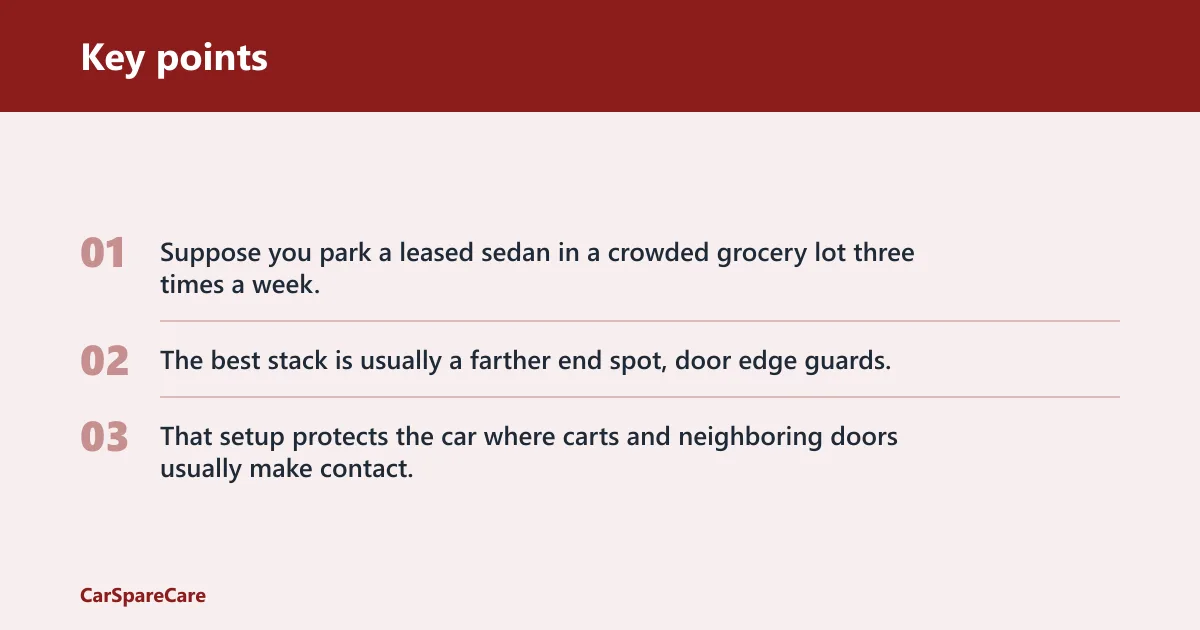
Suppose you park a leased sedan in a crowded grocery lot three times a week. The best stack is usually a farther end spot, door edge guards, and PPF on the doors and mirrors if the budget allows. That setup protects the car where carts and neighboring doors usually make contact, while keeping turn-in wear lower.
Do door edge guards help?
Yes, but only in a narrow way. Door edge guards can reduce chips and dings on the edge of the door itself, which helps when a cart brushes the edge or when the door swings toward another object. They do not reliably stop a cart from denting the door skin or bumper panel.
Rubber and U-shaped clip-on options
Common styles include rubber strips and U-shaped clip-on guards. They can be temporary or more permanent, depending on fit and adhesive. ShunAuto lists door edge guards among physical barriers, along with bumper protectors and magnetic strips, but these products should be treated as partial protection, not a shield for the whole side of the car.
Where they help and where they do not
Door edge guards are most useful when the concern is edge chips, tight parking, or minor brush contact. They are less useful against a cart that rolls into the broad face of the door. If the door panel is aluminum, the guard still cannot stop the panel from denting under enough force.
Does PPF beat ceramic coating?
For impact protection, yes. Paint protection film is the stronger option because it is a clear polyurethane film that adds a physical layer to high-impact zones. Ceramic coating helps with cleaning and surface maintenance, but it is less impact-resistant than PPF and will not stop a hard cart strike.
Where paint protection film helps most
PPF works best on high-impact areas like your front bumper, hood, side mirrors, and doors. It is described as a clear, nearly invisible barrier and is called the most effective physical barrier for these contact-prone zones. It can guard against stone chips and minor abrasions, and it is removable or replaceable if a panel gets damaged.
What ceramic coating can and cannot do
Ceramic coating helps repel grime and makes washing easier. It can preserve the finish after a light rub or minor scuff, but it will not prevent dents. If a cart hit is hard enough to flex metal or crease a panel, the coating may keep the paint looking better than untreated paint, yet the dent will still be there.
Why coatings preserve paint better than they stop dents
Think of the two products as different layers of defense. PPF can absorb some of the contact energy before the paint sees it. Ceramic coating mainly improves surface behavior after contact, so it matters more for cleaning and surface marks than for cart impact itself.
What should you do after a cart hit?
Move quickly and document everything. Take photos of the dent, the surrounding panel, any paint transfer, and the parking space if it is still available. Then check whether the damage is only cosmetic or whether the paint cracked, the panel creased, or the edge chipped, because the repair path changes with severity.
Document the damage with photos and notes
Take close and wide shots in the same light if possible. Include the cart if it is still present, nearby signage, and the lane position. Note the date, time, and lot location, because that detail can help with a claim or with a repair estimate.
Choose between PDR, touch-up paint, and body repair
Paintless dent repair, or PDR, is usually the first repair to ask about when the paint is intact and the dent is shallow. Touch-up paint is for small chips or scraped areas where paint has come off. Body repair is more likely when there is a crease, a stretched panel, or broader paint damage.
When insurance may be involved
Shopping cart hit repairs are often described in the $100 – $500+ range depending on severity, and a door ding with paint damage is listed at $150 – $350. That range is why some owners compare the repair cost to the deductible before filing a claim. For a minor mark, the claim paperwork can cost more time than the repair saves.
Which add-ons fit your car?
Fit matters as much as product choice. Aluminum doors, leased cars, low-clearance sports cars, and wide-door vehicles each change what protection makes sense. A commuting sedan parked in a public lot all week needs a different setup than a sports car that spends long periods in one place.
Aluminum-door vehicles and leased cars
Aluminum doors can dent more easily under some impacts, so parking strategy and PPF matter more than trim accessories alone. Leased cars also benefit from visible wear control because damage can matter at turn-in. For both, PPF on doors and mirrors is more useful than a coating by itself.
Low-clearance sports cars and wide-door vehicles
Low-clearance cars need extra care near curbs and sloped rows, because the front lip or lower body can be scraped before the cart ever reaches the door. Wide-door vehicles need wider gaps, which makes end spots and barrier-side parking more valuable. A bumper protector can help with minor nudges, but it is not a cure for a hard strike.
Daily commuter setups versus longer parking periods
For short grocery runs, parking geometry and a few physical add-ons are the main tools. For longer parking periods, a car cover can make sense because it helps protect against hail, debris, and environmental damage. It is not a parking-lot-only solution, and it is usually too cumbersome to be the main answer for store visits.
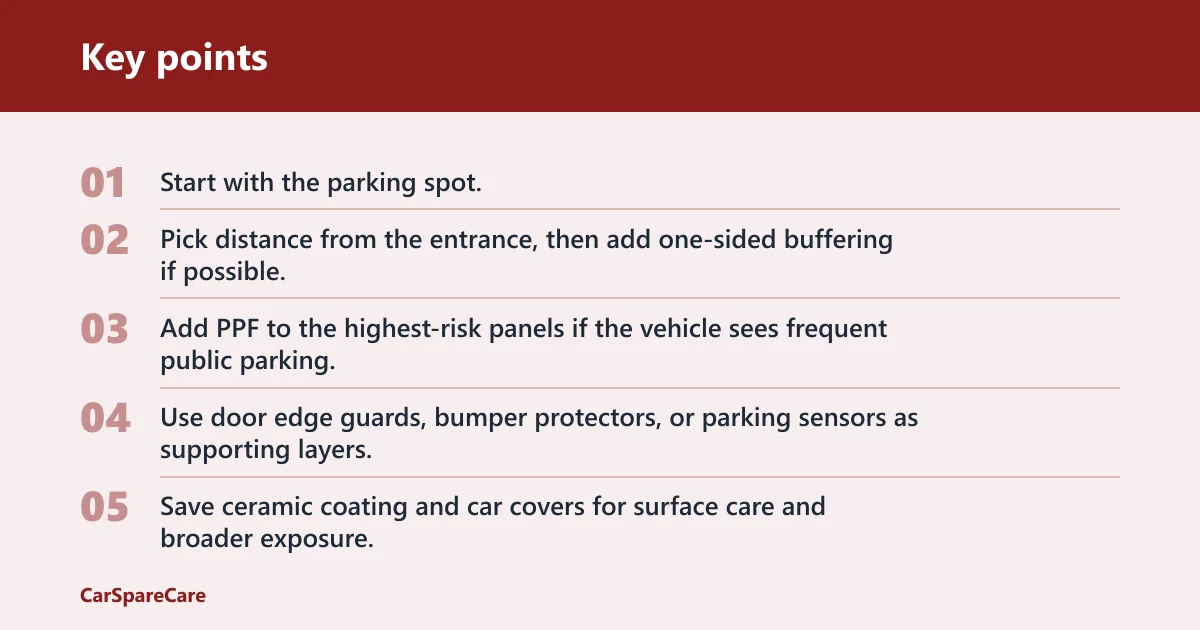
- Start with the parking spot.
- Pick distance from the entrance, then add one-sided buffering if possible.
- Add PPF to the highest-risk panels if the vehicle sees frequent public parking.
- Use door edge guards, bumper protectors, or parking sensors as supporting layers.
- Save ceramic coating and car covers for surface care and broader exposure, not cart impact.
Frequently asked questions
How do I protect my car against shopping cart damage?
Use a layered approach: distance from the entrance, a buffer side such as a wall or pillar, and physical protection on doors and bumpers. Door edge guards help with chips at the edge, while PPF protects the paint on impact-prone panels. None of these can stop every hard strike.
What is the best way to prevent shopping cart dings?
The best prevention is usually a far-away end spot or a space beside a fixed barrier, especially in a busy lot. That lowers the chance of cart traffic reaching your car. If you cannot choose the spot, PPF and parking sensors are the next useful layers.
Should I park far away to avoid cart dings?
Yes, when the lot is busy and the far space also moves you away from cart corrals and exit lanes. Farther spots matter less in quiet lots with little cart movement, but they matter more near store entrances, where carts and people are concentrated.
Do door edge guards protect against shopping cart dings?
They help with edge chips and very light contact on the door edge. They do not protect the broad door panel from a cart impact. If your main worry is a rolling cart striking the side of the car, you still need parking strategy and, for some cars, PPF.
Is paint protection film worth it for shopping cart damage?
Yes, if your car parks in public lots often and you care about keeping the paint intact after minor impacts. PPF is the stronger physical barrier on doors, bumpers, mirrors, and hoods. It will not stop a hard cart from denting a panel, but it can reduce visible paint damage.
Can ceramic coating prevent shopping cart dings?
No. Ceramic coating can make cleaning easier and help the finish resist light surface grime, but it will not prevent dents. If a cart strike bends metal or creases a panel, the coating cannot absorb that impact. It is a maintenance layer, not a dent barrier.
What should I do if a shopping cart hits my car?
Photograph the damage, note the lot location and time, and check for paint transfer, chipped paint, or a crease in the panel. Then decide whether PDR, touch-up paint, or body repair fits the damage. If the repair is expensive or the other party is known, insurance may come into play.

Hi, I’m Melvin, an automobile engineer with extensive experience in automobile equipment. I currently work for a local automobile firm, where I specialize in the car parts industry. I’ve had the opportunity to collaborate with seasoned inspectors, gaining invaluable hands-on experience that goes beyond just theory.
My passion for automotive care started at a young age, which led me to create CarSpareCare. Through CarSpareCare, I share the knowledge and skills I’ve acquired over the years to help others navigate the world of car maintenance and repairs.
My goal is to provide practical tutorials, essential safety advice, and the latest industry insights so that anyone—whether a beginner or an expert—can confidently tackle their automotive projects.

