
For winter storage longer than a couple of weeks, wash and wax the car inside and out, keep the tank at a moderate level, consider a fuel stabilizer for longer storage, maintain the battery, inflate tires to spec, and adjust the steps to the storage conditions.
Skip those steps and you risk a dead battery, flat-spotted tires, stale fuel, rodent damage, and corrosion that can turn a stored car into an expensive restart.
This guide gives a storage-by-environment checklist and notes what changes for gasoline cars, hybrids, EVs, and classics.
What you’ll need before you start

- Engine oil dipstick or owner’s manual
- Funnel and the correct engine oil if a change is due
- Fuel stabilizer for longer storage
- Tire pressure gauge and air source
- Battery charger or maintainer, if the vehicle will stay connected
- Microfiber cloths, car wash soap, and wax
- Breathable car cover, if the car will be covered
- Rodent deterrents and sealing material for openings
- Storage notes: address, access rules, and insurance paperwork
How to prepare a car for winter storage?
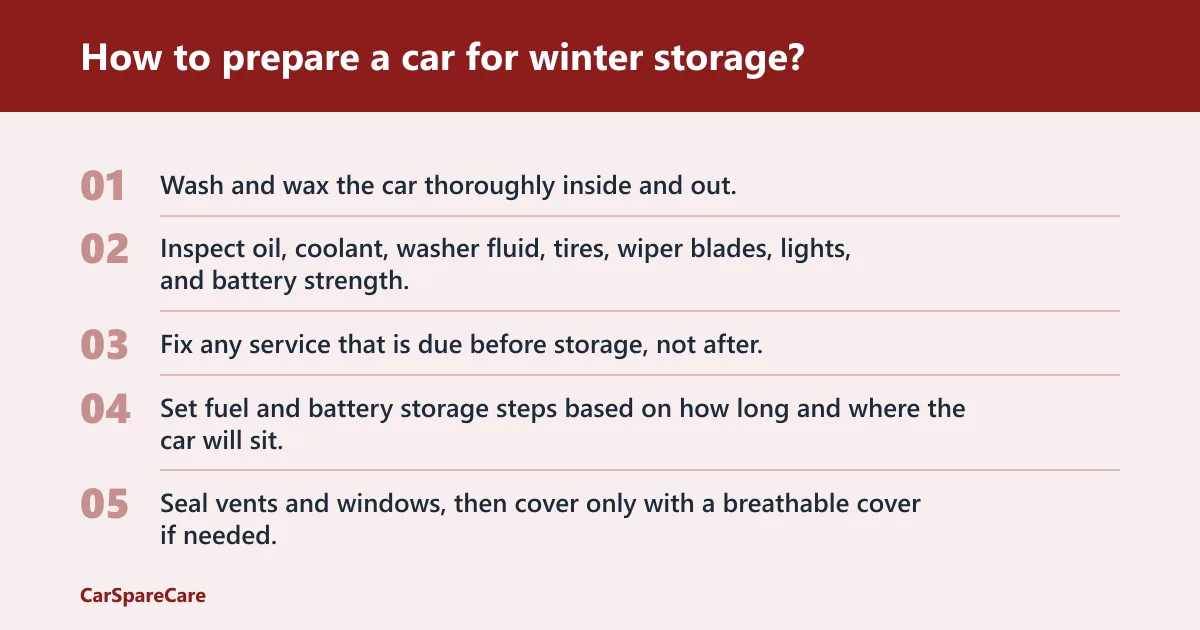
Start with cleaning, inspection, fluids, battery planning, and pest control in that order. For true multi-month storage, the goal is to cut corrosion, stop battery drain, keep fuel usable, and block moisture and rodents before the car sits still.
Use this sequence
- Wash and wax the car thoroughly inside and out.
- Inspect oil, coolant, washer fluid, tires, wiper blades, lights, and battery strength.
- Fix any service that is due before storage, not after.
- Set fuel and battery storage steps based on how long and where the car will sit.
- Seal vents and windows, then cover only with a breathable cover if needed.
How storage location changes the prep list
| Storage type | Priority | Do | Skip or reduce |
|---|---|---|---|
| Heated garage | Battery, fuel age, dust control | Disconnect or maintain battery, leave fuel about a quarter to half tank, cover if dusty | Heavy corrosion prevention is less urgent than in damp storage |
| Unheated garage | Moisture, battery, tires, rodents | Check coolant protection, use fuel stabilizer for longer storage, seal openings | Do not skip cover or rodent protection |
| Outdoor lot | Weather, moisture, pests, paint protection | Clean thoroughly, use breathable cover if allowed, inflate tires, disconnect battery if possible | Do not rely on a basic tarp that traps moisture |
| Indoor self-storage | Rules, ventilation, pests, battery | Confirm storage rules, seal vents, prepare battery storage, document the address if insurance requires it | Do not assume jack stands are allowed |

Should I change the oil before putting a car into storage?
Change the oil if it is due, and check the level on a flat, level surface with the engine cold. Fresh oil matters most when the existing oil is already near its service interval, because dirty oil can carry acids and moisture into a long pause.
What to do with engine oil
Check the dipstick before storage and avoid overfilling the engine oil sump. Overfilling can cause foaming or seal issues. If an oil change is due soon anyway, doing it before storage can help avoid leaving the car parked with old oil in the crankcase.
What to skip
Do not overfill “for extra protection.” More oil is not better. It can create its own problems, especially on modern engines with tight tolerances.
What should you do with fuel, coolant, and washer fluid?
Leave the fuel tank about a quarter to half full, decide whether stabilizer is justified by the storage length, check coolant between the minimum and maximum lines, and top up washer fluid with freeze-resistant screenwash. Those steps limit condensation, freezing, and poor restart behavior.
Fuel
A quarter to half tank leaves less empty space for condensation than a near-empty tank. Add fuel stabilizer when storing the vehicle for winter, especially if the car will sit long enough for fuel age to matter. Short storage may not need it.
Coolant
Check coolant on a cold engine and confirm the level sits between the min and max marks. Top up using the correct ratio of water to coolant/antifreeze so freeze protection and heat transfer stay in balance.
Washer fluid
Top up before winter and use screenwash additive rated for freezing temperatures. Plain water can freeze in the tank, pump, or lines.
Should I disconnect the battery for winter storage?
For longer storage, disconnecting or removing the battery can be a sensible option. It reduces parasitic draw, slows sulfation, and lowers the chance of a no-start after weeks or months. Store the battery in a warm place and avoid concrete floor storage without protection.
What to do with modern cars
Modern keyless vehicles often have higher standby loads than older cars. If the car will sit for more than a few weeks, a maintainer may be the better choice than a simple disconnect, especially if memory settings or security systems matter.
What to do with classics
Classic cars may tolerate a full disconnect better than newer cars, but carbureted systems and older electrics can still benefit from clean battery storage and a maintained charge. If the battery stays in the car, a quality maintainer can help prevent deep discharge.
What to skip
Do not leave a weak battery to “sort itself out” in spring. That usually becomes sulfation, slow cranking, or a dead cell.
How do tyres, wipers, and covers change the storage plan?
Check tires, wiper blades, lights, and the cover before the car sits. Tires can flat-spot or lose pressure, worn wipers crack faster, and a dirty cover can grind grit into paint. These are small tasks that prevent avoidable damage.
Tyres
Inspect tread, pressure, cuts, bulges, and uneven wear, and include the spare tyre in the inspection. Inflate to the vehicle placard specification unless the storage plan or conditions call for something different. For long storage, tire pressure matters because low pressure increases sidewall stress.
Wipers and lights
Run fingers along wiper blades to check for splits or cracks, and replace worn blades. Check all exterior lights and replace failed bulbs before storage so you do not discover extra faults at restart.
Cover
Clean the car before covering it. If the car will be covered, use a cover that allows airflow and avoid trapping grit or moisture underneath.
Winter storage checklist by storage type and vehicle type

The right plan depends on both where the car sits and what kind of car it is. Heated storage needs less freeze protection than an outdoor lot. A classic carbureted car needs different fuel care than a modern keyless car, and a hybrid adds battery-system considerations.
Heated garage
- Daily driver: clean, check fluids, fill to a quarter to half tank, maintain the battery, and cover only if dust is an issue.
- Classic car: add fuel stabilizer, manage battery storage carefully, and seal vents and openings.
- Modern keyless car: prioritize battery maintainer decisions and parasitic draw reduction.
- Hybrid: follow the owner’s manual for high-voltage storage state and 12V battery maintenance.
Unheated garage
- Prioritize coolant protection, fuel stabilizer, and rodent sealing.
- Disconnect or remove the battery for longer storage.
- Inspect for moisture sources and avoid parking with a wet car.
- Consider jack stands if the storage facility allows them.
Outdoor lot
- Use the most complete cleaning and covering routine.
- Keep moisture off the interior and keep pests out of vents and openings.
- Expect faster brake and rotor corrosion if the car sits for months.
- Check whether the lot permits jack stands or battery removal.
Indoor self-storage
- Confirm facility rules before you arrive.
- Store the battery in a warm place if it is removed.
- Seal vents and windows to keep dust and pests out.
- Put a plastic bag over the air intake and exhaust pipes if appropriate for the storage setup.
How do I keep mice out of a stored car?
Seal vents and openings, protect the intake and exhaust, and remove food smells and nesting material before storage. Rodents enter through small gaps, then chew insulation, wiring, and cabin materials. Deterrents can help, but blocking access matters more than scent alone.
What to seal
Focus on cabin vents, cowl openings, and any path to the engine bay. Put a plastic bag over the air intake and exhaust pipes where the storage setup and facility rules allow it. Check under-seat areas and the trunk for anything edible.
Common first-timer mistake
Suppose a hatchback is parked for several months with food wrappers under the seat. The first warm spell draws mice in, and the car comes back with chewed wiring and a blocked vent. Clean-out and sealing would have been cheaper than repairs.
How do I prepare a classic car for winter storage?
Classic cars need the same basics as newer vehicles, but they are less forgiving of stale fuel, moisture, and battery neglect. Carbureted fuel systems, older seals, and long storage gaps make fuel stabilizer, dry storage, and careful battery handling more important.
Classic-car priorities
Use stabilizer, disconnect or remove the battery, seal vents and openings, and keep the car as dry as possible. If the storage facility allows it, put the car on jack stands to reduce tire loading during a long sit. Check transmission parking or handbrake settings so the car is secured without locking components in place for months.
What to skip
Do not assume a classic can be left with old fuel and a weak battery because it “usually starts.” Long storage punishes marginal parts.
Common mistakes to avoid
Most storage damage comes from skipped basics, not dramatic failures. Dirt, moisture, rodents, and battery drain are the repeat offenders. Treat winter storage as a controlled pause, not as an easy parking job.
- Leaving the car dirty under a cover.
- Skipping rodent protection around vents, intake, and exhaust.
- Parking with low tires or a weak battery.
- Ignoring brake and rotor corrosion during month-long storage.
- Treating short-term winter parking like multi-month storage.
- Forgetting that insurance may require notification of the storage address.
If that didn’t work, try this next
If the car is already stored and a warning light, flat battery, or bad smell appears, move from preventive care to diagnosis in this order: battery charge check, tire pressure check, visual rodent inspection, then brake and fluid inspection before any long drive.
- Verify battery voltage or charge state before cranking again.
- Inspect tire sidewalls and tread for cracking, bulges, or flat spots.
- Look under the hood for chewed wiring, nests, or blocked ducts.
- Check fluid levels and look for leaks before driving.
Frequently asked questions
How much gas should I leave in the tank for winter storage?
Leave about a quarter to half a tank. That reduces condensation while avoiding the weight and evaporation concerns of a full tank. If the storage period is long, add fuel stabilizer before the car goes away.
Do I need a fuel stabilizer for winter storage?
Use it when the car will sit long enough for fuel age to matter, especially for multi-month storage. Short parking usually does not justify it, but classic cars and carbureted systems benefit sooner than newer daily drivers.
What tire pressure should I use for long-term car storage?
Inflate to the vehicle placard specification unless the storage facility or owner’s manual says otherwise. Then recheck before spring. Also inspect tread, cuts, bulges, and uneven wear, including the spare tyre.
Can I leave a car parked outside for winter storage?
Yes, but only with stronger moisture, pest, and cover control than indoor storage. Clean the car, use a breathable cover if allowed, protect the battery, and accept higher brake and paint exposure than in a garage.
What should I do with coolant before storing a car?
Check that it sits between the minimum and maximum lines, then confirm the correct water-to-coolant ratio. That protects against freezing and overheating. Do the check on a cold engine, on a flat surface, before the car is stored.

Hi, I’m Melvin, an automobile engineer with extensive experience in automobile equipment. I currently work for a local automobile firm, where I specialize in the car parts industry. I’ve had the opportunity to collaborate with seasoned inspectors, gaining invaluable hands-on experience that goes beyond just theory.
My passion for automotive care started at a young age, which led me to create CarSpareCare. Through CarSpareCare, I share the knowledge and skills I’ve acquired over the years to help others navigate the world of car maintenance and repairs.
My goal is to provide practical tutorials, essential safety advice, and the latest industry insights so that anyone—whether a beginner or an expert—can confidently tackle their automotive projects.

