
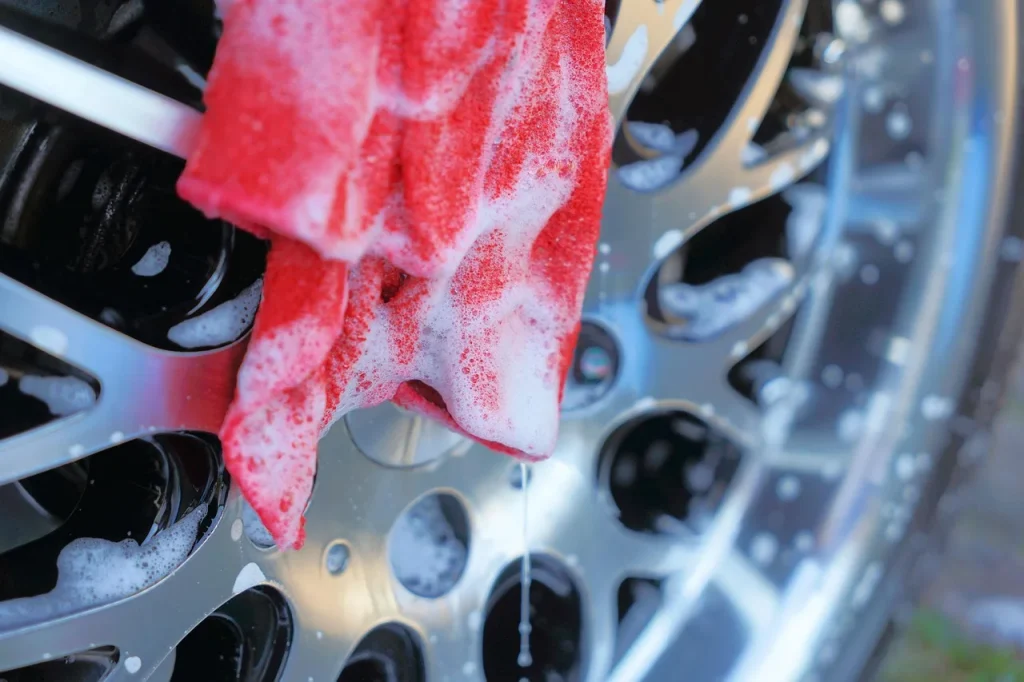
Choose a plush microfiber or lambswool mitt with a deep pile, sewn-in cuff, and no seams on the face; use microfiber for daily washing and lambswool when you want maximum lubrication on softer or darker paint. The wrong mitt can drag grit across the clear coat, leaving swirls, trim snags, and visible micro-marring that often needs polishing to fix. This guide shows how to match mitt material, pile, fit, and wash conditions to lower paint-safety risk.
What a car wash mitt does
A car wash mitt is a single-hand pocket tool for hand washing that lifts dirt away from clear coat better than a sponge. A good mitt traps grit inside its fibers instead of pushing it across paint, which lowers the chance of micro-marring when you rinse often and keep the surface lubricated.
That does not make the mitt magic. Technique matters as much as the mitt, and in some cases it matters more. Plenty of paint damage starts with poor rinsing, a dirty bucket, or a mitt that is already loaded with grit.
Wash gloves sit close to mitts in purpose, but the finger slots give better control around mirrors, badges, grilles, and tight trim. A mitt covers more paint per stroke than a glove, so it usually wins on large panels. A glove is the better detail tool.
Why mitts are safer than sponges
A sponge tends to hold dirt against its flat face, so debris can stay in contact with the panel as you wipe. A mitt lifts and holds that debris farther from the paint surface. That difference matters on modern clear coat, especially when dust or road film is present.
For paint safety, a mitt is the better default. A sponge can still have a place for dirty jobs, but not on body panels where swirl marks matter.
Which material suits your paint?
Microfiber, chenille, lambswool, and foam each behave differently on paint. For most beginners, microfiber and chenille are the best choices. Microfiber is the safer all-around pick, while chenille offers more water carry and dirt hold, with a higher risk of snagging on trim and emblems.
Microfiber
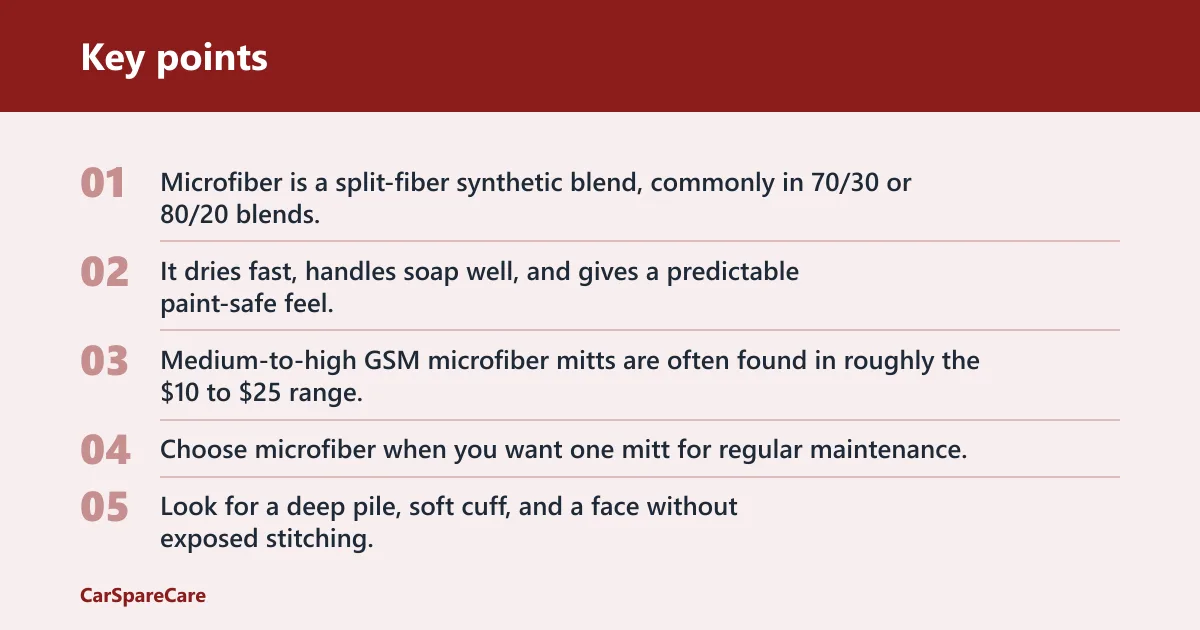
Microfiber is a split-fiber synthetic blend, commonly in 70/30 or 80/20 blends, and it is often the best all-around choice for most beginners. It dries fast, handles soap well, and gives a predictable paint-safe feel. Medium-to-high GSM microfiber mitts are often found in roughly the $10 to $25 range, which is a practical sweet spot for many buyers.
Choose microfiber when you want one mitt for regular maintenance, especially on daily drivers and coated cars. Look for a deep pile, soft cuff, and a face without exposed stitching.
Chenille
Chenille mitts have long fluffy loops and extra-long strands that create deeper pockets of dirt trapping. They hold a lot of soap and water, which helps lubrication on larger panels. The tradeoff is shape and snag risk. Loose loops can catch on trim, badges, roof rails, and sharp emblems.
Chenille suits owners who want strong water retention and a plush feel, but it needs careful rinsing between panels. If a vehicle has lots of trim edges, inspect the mitt closely before buying.
Lambswool
Lambswool is soft, absorbent, and usually expensive. It can offer excellent lubrication and a very gentle glide on softer or darker paint, but it needs careful rinsing and drying to stay clean and usable. It is less forgiving if you let grit stay embedded.
Choose lambswool when maximum paint gentleness matters more than price or convenience. It is a careful-owner choice, not a carefree one.
Foam
Foam mitts are cheap and common, but they are usually better suited for wheels than paint. Foam does not trap grit well, so it is a poor choice for body panels. If your goal is paint safety, skip foam for the main wash.
Foam can still fit into a wash kit for dirty lower parts or wheel work. Do not mix that role with body-panel washing.
What GSM and pile height should you buy?
GSM means grams per square meter. Higher GSM means a thicker, plusher mitt. On product pages, that usually signals more material density, more cushioning, and often better dirt-trapping volume. It does not guarantee safety by itself, but it helps.
For microfiber and chenille, a medium-to-high GSM mitt is the sensible target. Plushness helps trap dirt away from the paint and usually improves soap and water retention, which supports lubrication during the wash pass.
When thicker is not automatically safer
Very thick mitts can hold more water, but they can also stay wetter longer and dry more slowly. A mitt that stays damp for days can develop odor, matting, or mildew. That makes maintenance harder and can shorten its useful life.
Pick thickness with the car and climate in mind. In humid weather, a slightly less bulky mitt that dries faster may be the safer ownership choice.
How paint condition changes the choice
Paint condition changes the risk profile more than the brand name on the package. Dark daily drivers show micro-marring sooner. Ceramic-coated cars still need gentle wash media. Older swirled paint already has visible damage, so the goal is to avoid adding more.
Picture a black sedan that lives outside and picks up dust every day. A plush microfiber mitt, careful rinsing, and the two-bucket method matter more here than on a light-colored garage-kept car, because any fresh wash mark will stand out in sunlight.
Say your SUV has plastic cladding, roof rails, and many emblems. Chenille may still work, but the extra loops increase snag risk. In that case, a softer microfiber mitt with a neat edge is often the safer buy.
Ceramic-coated cars
Ceramic-coated cars need a mitt with low-marring wash media, usually microfiber or chenille, and careful rinsing with strong lubrication. The coating can help contamination release, but it does not remove the need for safe wash tools or good technique. A coating is not a free pass.
For coated paint, choose a mitt that glides easily and rinses clean without holding visible grit in the face. A high-pile microfiber is often the first choice.
Dark daily drivers and older swirled paint
On dark paint, even light micro-marring can show as haze under sun or strong shop lighting. A microfiber or soft lambswool mitt is the conservative choice. On older swirled paint, the safest target is not perfection; it is avoiding more defects during routine washing.
If the surface already has swirls, do not add a harsh mitt or a low-lubricity wash routine. That only makes the finish harder to correct later.
Which wash mitt should you buy?
The safest buy depends on contamination level, climate, body shape, and paint condition. Use the table below as a practical decision matrix. It ties the material to the job, then shows what to avoid and why.
| Paint condition | Contamination level | Climate | Body style | Best material | What to avoid | Why |
|---|---|---|---|---|---|---|
| Dark daily driver | Light dust, road film | Mixed, normal rain and sun | Sedan | Microfiber | Foam or low-pile sponge-style pads | Microfiber balances glide, dirt capture, and easy handling on visible paint. |
| Ceramic-coated car | Light to moderate | Any | Coupe or sedan | Microfiber or soft chenille | Foam | Low-marring wash media and good lubrication matter most on coated finishes. |
| Dusty climate commuter | Fine dust | Hot, dry, windy | Hatchback | Microfiber with deep pile | Flat or thin mitts | Fine dust loads the mitt fast, so a deeper pile helps trap particles away from paint. |
| Winter road salt vehicle | Heavy grime, salt film | Cold, wet, salted roads | SUV | Microfiber | Lambswool if rinsing is poor | Salt and heavy contamination demand easy rinsing and regular refresh during the wash. |
| Heavily trimmed SUV | Moderate to heavy | Any | SUV with trim, badges, rails | Microfiber with neat seams | Long-loop chenille | Trim and emblems increase snag risk, so a smoother face is safer. |
| Soft paint, dark color | Light | Cool, dry garage storage | Convertible or coupe | Lambswool | Hard-edged, stitched mitts | High lubrication and soft contact help reduce visible micro-marring. |
| Older swirled finish | Light to moderate | Any | Any body style | Microfiber | Foam and coarse-looking mitts | Existing defects make new wash marks easier to notice, so safer media is better. |
| Lower panels after salted roads | Very heavy | Cold winter | Truck or SUV | Microfiber, then separate wheel mitt | Using one mitt for the whole car | Heavy grit should not be transferred from lower bodywork to upper paint or from wheels to paint. |
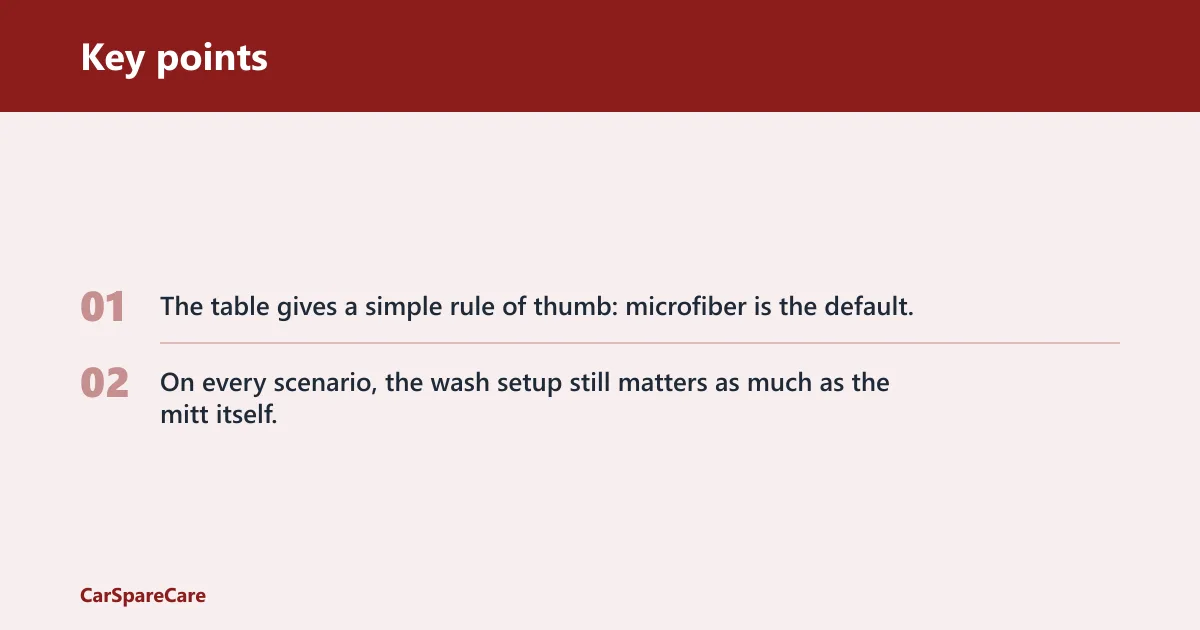
The table gives a simple rule of thumb: microfiber is the default, chenille is the plush dirt-holder, lambswool is the gentler premium option, and foam is generally better kept off body panels. On every scenario, the wash setup still matters as much as the mitt itself.
Should you choose a mitt or a wash glove?
Choose a mitt when you want quicker coverage on larger panels. Choose a wash glove when you need dexterity around badges, grilles, mirrors, and tight trim. A glove is slower because it covers about 30-40% less surface area per stroke, but its finger slots help control the contact patch.
For many owners, the best setup is both. Keep a mitt for doors, roof, hood, and quarter panels, then use a glove for detailed areas where a bulky pocket tool cannot reach cleanly.
When gloves make sense
Gloves are useful on complex front ends, deep grille openings, and cars with lots of small trim pieces. They reduce awkward wrist angles and help you steer around badges without dragging the entire hand across a hard edge.
How do you keep a mitt paint-safe?
Use the two-bucket method with grit guards, because that matters as much as the mitt itself. A grit guard is a mesh disk that sits in the bottom of the bucket and helps keep dirt away from the mitt. One bucket holds wash solution, the other holds rinse water.
Rinse the mitt often, reload it with clean soap, and keep it away from the bottom of the bucket. If the mitt hits the floor, gets loaded with heavy grit, or starts to feel stiff, stop and clean it before touching paint again.
Car wash mitt checklist
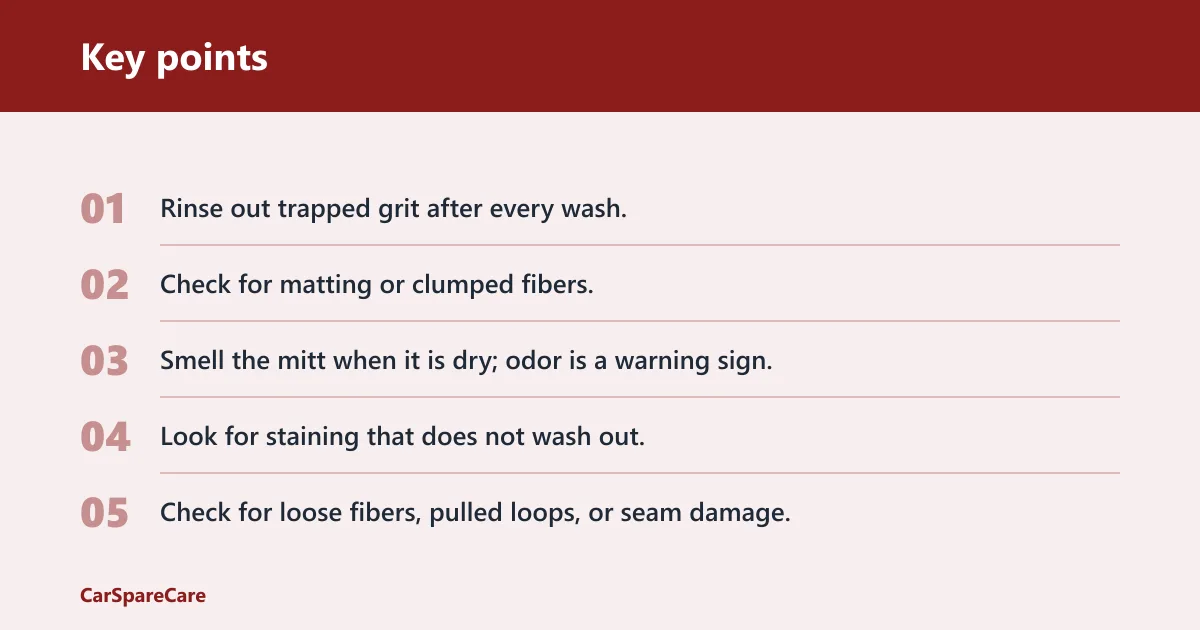
- Rinse out trapped grit after every wash.
- Check for matting or clumped fibers.
- Smell the mitt when it is dry; odor is a warning sign.
- Look for staining that does not wash out.
- Check for loose fibers, pulled loops, or seam damage.
- Watch drying time; a mitt that stays wet for too long is harder to store safely.
- Replace the mitt if it keeps shedding grit, feels rough, or no longer rinses clean.
With proper care, a quality mitt lasts 6 to 12 months. That range depends on how often you wash, how dirty the car gets, and how well you dry and store the mitt. A mitt can wear out earlier if it is used on wheels, dropped on the ground, or left packed wet.
Machine-washability matters here. A mitt that is easy to clean and quick to dry is more likely to stay paint-safe over time. Slow drying does not always mean failure, but it does raise the odds of odor and matting.
What to inspect before buying
In store or online, look for a deep pile, soft face, and clear material description. If the product page does not say microfiber blend, chenille construction, or lambswool origin, the listing may be vague. Also check for cuff shape, seam placement, and whether the face has exposed stitching that could touch paint.
If a mitt looks compacted in the package, that is not always a deal-breaker. But if the pile already looks flat, loose, or uneven, pass on it. You want a tool that can hold lubrication and move dirt away from the panel.
Frequently asked questions
What is the best car wash mitt for paint safety?
For most owners, a plush microfiber mitt is the safest all-around pick. It offers a good balance of dirt trapping, water carry, drying speed, and price. If the paint is softer or darker and you want maximum lubrication, lambswool is a strong premium option, provided you rinse and dry it carefully.
Should I choose microfiber, chenille, wool, or foam?
Choose microfiber for the best all-around mix of safety and convenience. Choose chenille if you want more water retention and a deeper pile, but watch for trim snagging. Choose lambswool for soft, demanding paint. Skip foam for body panels; it is better suited for wheels than paint.
Is a wash mitt better than a sponge for car paint?
Yes. A mitt is better than a sponge for paint because it traps dirt inside its fibers instead of pushing it across the clear coat. That lowers the chance of swirl marks and micro-marring, especially when you use soap, rinse often, and keep contamination out of the mitt.
What GSM should a car wash mitt have?
GSM means grams per square meter. For microfiber or chenille, a medium-to-high GSM mitt is a sensible target because higher GSM usually means a thicker, plusher mitt. That said, a very thick mitt still needs good rinsing, quick drying, and careful handling to stay paint-safe.
Can I use the same wash mitt on wheels and paint?
No. Wheels carry much heavier grit, brake dust, and metal contamination than body panels. A mitt used on wheels should stay on wheels only. If you move that contamination to paint, you raise the risk of scratches and visible marring.
How often should I replace a car wash mitt?
With proper care, a quality mitt lasts 6 to 12 months. Replace it sooner if it smells bad after drying, stays matted, sheds loose fibers, keeps holding grit, or takes much longer to dry than it used to. Those are signs that paint safety is dropping.
Are wash gloves better than mitts for tight areas?
Yes, for tight areas. Wash gloves have individual finger slots for better dexterity around badges, mirrors, and grilles. A mitt still covers more paint per stroke, so it is usually faster on large panels. Many owners keep both and use each where it fits best.
What should I look for in a wash mitt for ceramic coated cars?
Look for low-marring wash media, usually microfiber or soft chenille, plus strong lubricity and easy rinsing. A ceramic coating does not remove the need for gentle contact. Avoid foam for the body, and make sure the mitt has a plush face that will not grind grit into the coating.

Hi, I’m Melvin, an automobile engineer with extensive experience in automobile equipment. I currently work for a local automobile firm, where I specialize in the car parts industry. I’ve had the opportunity to collaborate with seasoned inspectors, gaining invaluable hands-on experience that goes beyond just theory.
My passion for automotive care started at a young age, which led me to create CarSpareCare. Through CarSpareCare, I share the knowledge and skills I’ve acquired over the years to help others navigate the world of car maintenance and repairs.
My goal is to provide practical tutorials, essential safety advice, and the latest industry insights so that anyone—whether a beginner or an expert—can confidently tackle their automotive projects.

