A car battery can struggle in cold weather because low temperatures slow the chemical reaction inside it, so its usable output may drop to about 50% at 0°F while the engine needs more cranking power. That can leave you stranded, force jump-starts, and hide a weak battery until the first hard freeze. This guide explains the cold-soak effect, winter electrical demand, and the warning signs that a battery is near failure.
Which car batteries struggle most in the cold?
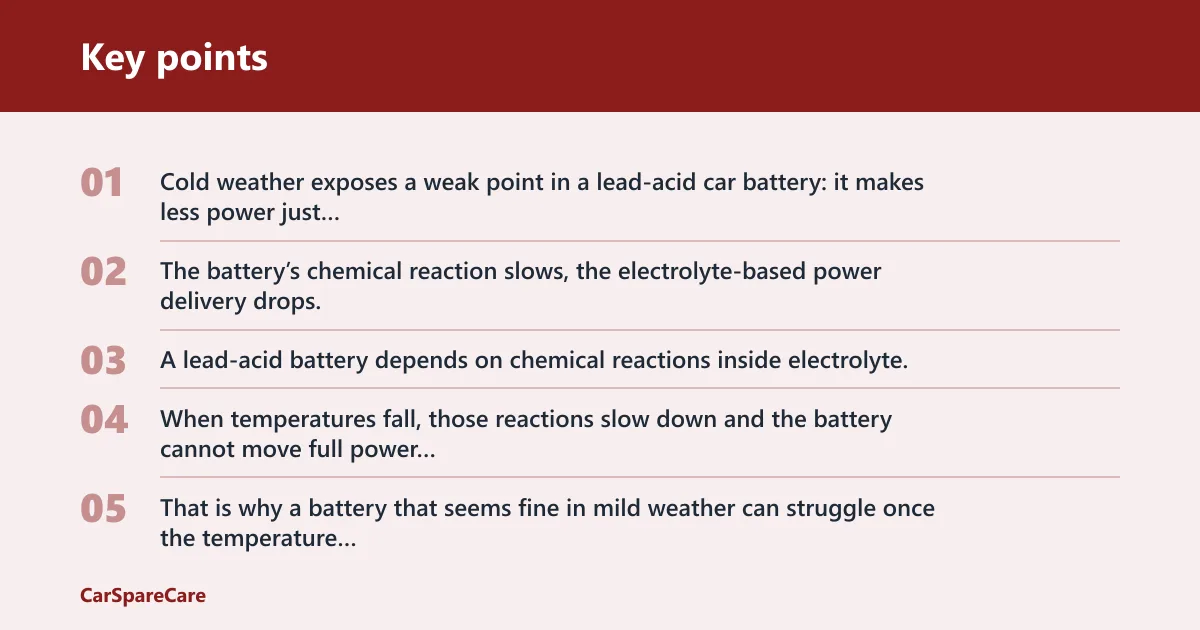
Cold weather exposes a weak point in a lead-acid car battery: it makes less power just as the car needs more. The battery’s chemical reaction slows, the electrolyte-based power delivery drops, and the starter motor has to fight thicker oil and harder engine turnover. Weak or aged batteries fail first.
What cold does to a lead-acid battery
A lead-acid battery depends on chemical reactions inside electrolyte. When temperatures fall, those reactions slow down and the battery cannot move full power as easily. That is why a battery that seems fine in mild weather can struggle once the temperature drops sharply.
Cold conditions reduce the electrolyte solution’s ability to transfer full power. The battery still exists, and it may still test in range when warm, but its cold performance is lower. Older batteries, sulfated batteries, and batteries that rarely reach a full charge are hit first.
Why winter starting needs more current
The starter motor needs more power in winter because engine oil thickens and the engine is harder to turn over. That means the battery is asked to do more work at the exact moment its output is weaker. The result is slow cranking, clicking, or a no-start.
Winter also adds load from headlights, wipers, heaters, seat warmers, and defrosters. Those loads usually do not cause failure by themselves, but they cut the reserve. A battery with little headroom can be pushed over the edge by a frosty morning and a short drive history.
Why weak batteries fail first
A battery that is already weak or aged has less reserve capacity to begin with. Cold weather does not create the problem; it exposes it. If the state of charge is already low, a cold soak can make the difference between starting and needing a jump-start.
Higher CCA means better winter performance. CCA, or Cold Cranking Amps, is the winter starting rating used to compare batteries for cold reliability. A larger CCA number gives more starting headroom, but it cannot rescue a battery that is worn out, undercharged, or damaged.
Why does my car battery die overnight in cold weather?
Overnight failure usually means a battery lost usable charge while parked, then could not deliver enough current after a cold soak. Short trips, outdoor parking, and parasitic drain can leave the battery partly discharged before the temperature drop. In the morning, the starter needs more power and the battery has less to give.
Cold-soak and parked discharge
A battery can seem acceptable after driving, then fail after sitting outside all night. The cold soak lowers available output, and the parked vehicle may lose more charge than expected. That combination is why a battery can test fine in the afternoon and still fail at dawn.
The battery may lose charge over time when a vehicle is not used for a long time. Infrequent use matters more in winter because the battery is already under more strain. If the car sits outside and only sees short trips, the next cold morning can be the first time the weakness shows.
Short trips and low state of charge
Short trips do not give the alternator enough time to restore the battery fully. If the car is used only for quick errands, the state of charge can drift downward over several days. A battery at a low state of charge is much more likely to fail overnight in freezing weather.
Fully charged is about 12.6 to 12.8 volts. Below about 12.4 volts can suggest discharge or aging. That reading does not prove the battery is bad, but it does mean the battery starts the day with less reserve than it should.
How parasitic drain makes mornings worse
Parasitic drain is battery loss while parked. It can come from modules that stay awake, a glove box light, an aftermarket accessory, or another fault that keeps drawing current. In cold weather, that drain combines with lower battery output and makes an overnight no-start more likely.
Say your hatchback starts normally after work, sits outside at around 28°F, and then only clicks the next morning. If the battery is only partly charged and a hidden draw is present, the cold soak can be enough to tip it into failure. That pattern points to more than simple winter weather.
Battery failure checklist
Use this checklist to separate a cold-weather battery problem from a charging, starter, or drain problem. The goal is not to guess. It is to match the symptom to the next check and avoid replacing a good battery for the wrong reason.
| Symptom | Likely cause | Next check |
|---|---|---|
| No-start after an overnight freeze | Cold-soak plus a weak or undercharged battery | Check resting voltage, then load test the battery |
| Slow cranking after the car sat outside | Battery output is low, or oil is thick and demand is higher | Compare voltage before cranking and inspect battery age |
| Repeated jump-starts are needed | Battery cannot hold charge, alternator may not be recharging, or there is parasitic drain | Test charging voltage and look for parked current draw |
| Battery died after short winter trips | State of charge has fallen below a healthy level | Measure resting voltage after the car sits, then inspect usage pattern |
| Recent battery still keeps going flat | Alternator fault or parasitic drain | Check charging system output and confirm no hidden load |
| Clicking sound but lights still work | Starter circuit or battery cannot supply enough current under load | Run a load test and inspect terminals for corrosion or looseness |
Is the battery the real problem?
Not always. A weak battery is common, but the right next step is to check state of charge and then test the battery under load. If the battery is low, old, or fails a load test, it is a strong suspect. If it passes, look at charging, starter load, or parasitic drain.
State of charge and resting voltage
A fully charged battery is about 12.6 to 12.8 volts at rest. Below 12.4 volts suggests discharge or aging. If the battery is already low before the first start of the day, cold weather can turn a marginal situation into a no-start.
Resting voltage is only part of the picture. A battery can show acceptable voltage warm and still fail after a cold soak. That is why a single quick reading should not be treated as a final verdict.
When a load test matters
A load test simulates starting conditions and checks voltage drop under load. That matters because a battery can look fine when it is not being asked to supply high current. Under winter start demand, weak cells often show their limits immediately.
If a battery passes a resting-voltage check but the car still struggles after a frosty night, a load test is the better filter. It is one of the clearest ways to judge cold-start readiness.
When to suspect age or weak cells
If the battery is older, has a history of flat starts, or needs frequent charging, suspect worn capacity even before winter. A battery with weak cells may still power the lights and radio, yet fail when the starter needs a large burst of current. That is a common winter pattern.
A common first-timer mistake is replacing the battery after one bad morning without checking the charging system first. A better path is to confirm state of charge, test under load, and then decide whether the battery itself is the fault.
Could it be the alternator, starter, or drain?
Yes. A bad battery is only one part of the picture. An alternator fault can leave a new battery undercharged, a starter problem can make cold cranking look like battery failure, and parasitic drain can empty the battery while the car sits. Winter makes each of these faults easier to notice.
Alternator faults that mimic battery failure
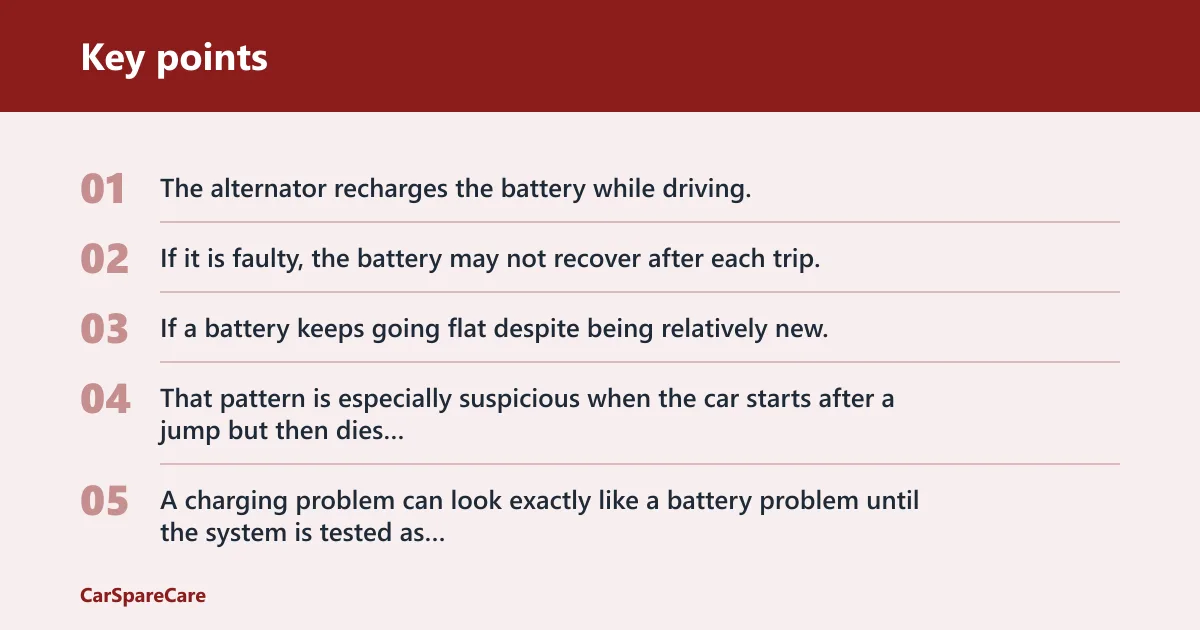
The alternator recharges the battery while driving. If it is faulty, the battery may not recover after each trip, and the car can keep going flat even after a replacement battery. If a battery keeps going flat despite being relatively new, the alternator may be to blame.
That pattern is especially suspicious when the car starts after a jump but then dies again later, or when the battery seems fine after a drive but weak after standing. A charging problem can look exactly like a battery problem until the system is tested as a whole.
Starter motor load in cold weather
The starter motor has a harder job in winter because the engine is harder to turn over. Thick oil adds resistance, so the starter needs more current and more battery reserve. If the battery is already borderline, the starter may sound slow even though the real issue is reduced electrical margin.
One useful clue is that the lights stay on bright but the engine cranks slowly or not at all. That can point to a starter circuit issue, though a weak battery can create a similar symptom. The load test helps separate the two.
Parasitic drain and accessories
Parasitic drain often shows up as a battery that is fine on Friday and flat on Monday. In winter, the problem is worse because the battery starts with less output and the car uses more electricity for heaters, wipers, washers, lights, seat warmers, and defrosters.
Diesel vehicles, short-trip commuters, and cars parked outdoors are more exposed. Diesels often need more cranking effort, short-trip use does not restore charge well, and outdoor parking gives the battery no protection from cold soak. Those factors can combine into repeated winter failures.
Can a new car battery die in winter?
Yes. A recent battery can still fail in winter if it is undercharged, sized poorly for the vehicle, or stuck in a car with a charging or drain issue. New parts do not fix short trips, outdoor parking, heavy accessory use, or a faulty alternator.
Why a recent battery can still fail
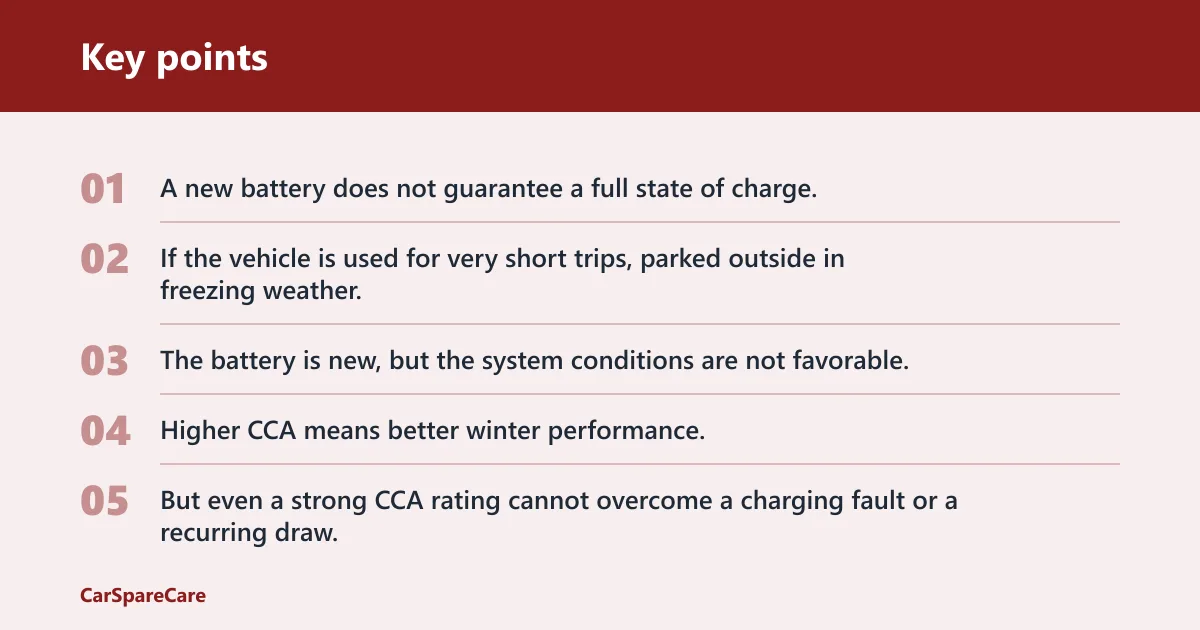
A new battery does not guarantee a full state of charge. If the vehicle is used for very short trips, parked outside in freezing weather, or fitted with an accessory that draws power when parked, the battery may still go flat. The battery is new, but the system conditions are not favorable.
CCA matters here. Higher CCA means better winter performance, so the label helps compare batteries for colder starts. But even a strong CCA rating cannot overcome a charging fault or a recurring draw.
Why short trips and outdoor parking matter
Short trips in winter are a poor charging pattern. The alternator may not have enough time to restore what the starter and accessories used. Outdoor parking adds a cold soak that lowers usable output before the next start.
Suppose a petrol car is parked outside for three nights and only driven two miles each morning. It may start on day one, then crank slowly on day three. The battery has not suddenly failed; it has been drained faster than it has been replenished.
Why diesels and heavy accessory use raise risk
Diesel engines usually demand more from the starter at cold start, so winter failures are more likely when the battery is only marginal. Heavy use of heaters, wipers, lights, and defrosters also trims the reserve. That is why a battery that seems acceptable in spring may struggle in January.
If symptoms persist after a jump-start, professional battery testing is the right next step. A proper test can separate low charge, weak cells, charging faults, and drain problems instead of guessing at the battery alone.
Frequently asked questions
Why does a car battery die in cold weather?
Cold weather slows the battery’s chemical reaction, so it cannot deliver as much current. At the same time, the engine needs more power because oil thickens and cranking gets harder. That combination makes a weak battery fail sooner in winter than it would in mild weather.
Why does my car battery keep dying in cold weather?
Repeated winter failures usually point to an underlying problem, not just the temperature. The most common causes are an undercharged battery, a charging fault, parasitic drain, or a battery that is too weak for the vehicle’s winter demand. A load test and charging check are the best next steps.
Will a car battery die in cold weather?
It can, especially if the battery is old, weak, or not fully charged. Cold weather reduces effective output, while the car asks for more power to start. A healthy, fully charged battery is less likely to fail, but no battery is immune to a severe cold soak.
How does cold weather affect car battery performance?
Cold weather lowers available cranking power and slows the chemical reaction inside the battery. It also raises starting demand because the engine is harder to turn and winter accessories draw more electricity. That is why a battery can seem fine in warm weather but struggle once temperatures drop.

Hi, I’m Melvin, an automobile engineer with extensive experience in automobile equipment. I currently work for a local automobile firm, where I specialize in the car parts industry. I’ve had the opportunity to collaborate with seasoned inspectors, gaining invaluable hands-on experience that goes beyond just theory.
My passion for automotive care started at a young age, which led me to create CarSpareCare. Through CarSpareCare, I share the knowledge and skills I’ve acquired over the years to help others navigate the world of car maintenance and repairs.
My goal is to provide practical tutorials, essential safety advice, and the latest industry insights so that anyone—whether a beginner or an expert—can confidently tackle their automotive projects.