

Power steering fluid can disappear because it is leaking from a hose, rack, pump, reservoir, or a failed seal. If the level drops again after one top-up, treat it as a likely active leak or an air-ingestion problem. Leaving it alone can make steering stiff, damage the pump, and turn a small repair into a larger bill fast. This guide shows how to read the leak pattern, find the failure point, and choose the first parts to inspect.
This guide is part of our Power steering and brake problems series.
Why does my power steering fluid keep disappearing?
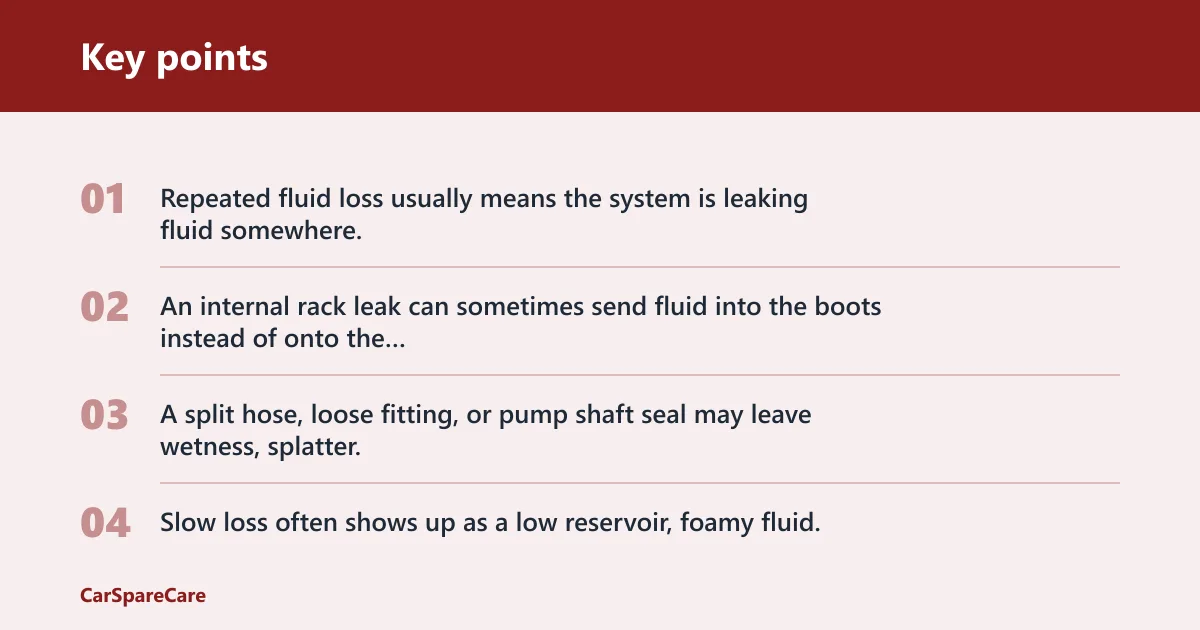


Repeated fluid loss usually means the system is leaking fluid somewhere, or drawing air in and pushing fluid out through the cap, vent, or seals. A slow seep can leave little on the ground. An internal rack leak can sometimes send fluid into the boots instead of onto the driveway.
Fast loss is usually easier to spot. A split hose, loose fitting, or pump shaft seal may leave wetness, splatter, or a fresh puddle after a short drive. Slow loss often shows up as a low reservoir, foamy fluid, or steering feel that changes over days rather than minutes.
Power steering leak pattern guide
| Symptom location | Fluid trail | Steering feel or noise | Most likely failure point | Urgency | Next check |
|---|---|---|---|---|---|
| Front of engine, around belt end of pump | Wet pump housing, drips under pulley, mist on nearby parts | Whine, groan, or assist that fades at low speed | Pump shaft seal or pump housing leak | High | Check reservoir level and pump pulley area |
| Under front subframe, near rack boots | Wet inner tie rods, fluid inside boots, damp rack body | Intermittent assist, wandering feel, noise after turning | Rack or steering gear seal leak | High | Inspect both rack boots for fluid |
| Along the hose route from pump to rack | Spray pattern or wet crimp, worse after turning lock to lock | Whine under load, assist may fade during parking maneuvers | Pressure hose or fitting leak | High | Trace hose crimps and threaded fittings |
| Low on chassis near reservoir or return line | Seepage at clamp, damp hose, slow drip near tank | Usually quiet at first, then pump noise when level drops | Return hose or loose clamp | Medium | Check hose ends and clamp tension |
| Reservoir body or cap | Wet cap, stained seam, wet reservoir mount | Foam, aeration, or level that drops without clear puddle | Cracked reservoir, bad cap, or O-ring issue | Medium | Inspect tank seams and cap seal |
| Pump area with belt noise | Little or no visible fluid loss | Squeal on startup or at full lock, reduced output | Belt slip, worn pulley, or tensioner problem | Medium | Check belt condition and pulley alignment |
Where is the fluid going?
When the loss is not obvious on the ground, the fluid is often collecting somewhere hidden. Rack boots can trap leaked fluid. A reservoir crack may seep only when the fluid sloshes. A pump leak may spread across the housing and drip from the lowest edge, far from the true source.
Pump shaft seal and housing leaks
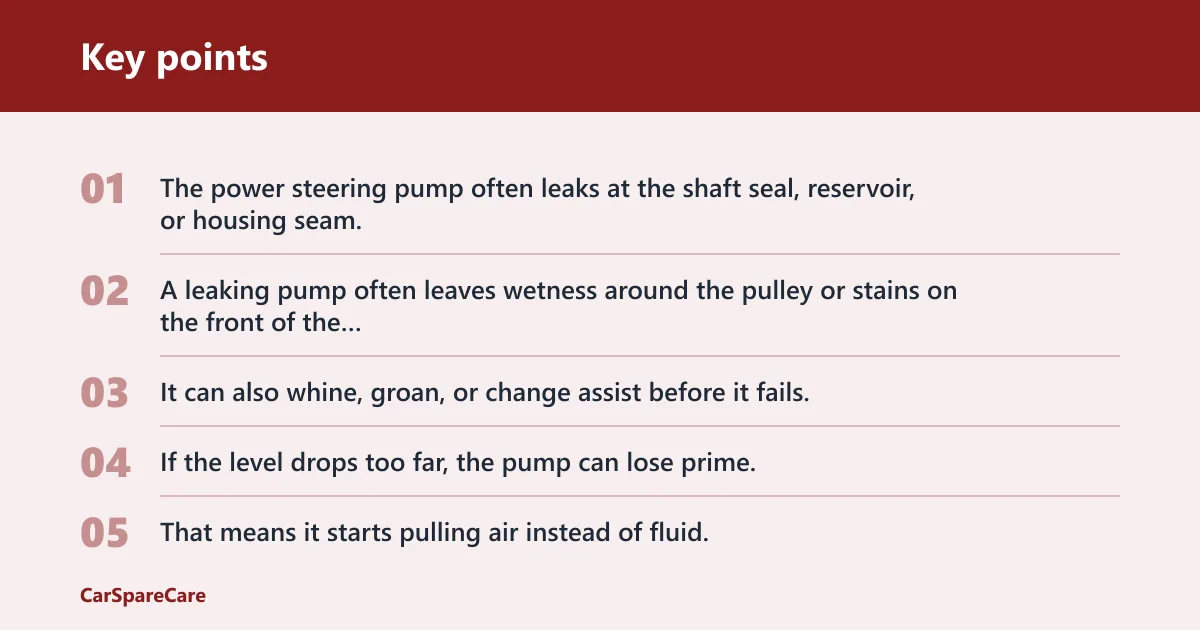
The power steering pump often leaks at the shaft seal, reservoir, or housing seam. A leaking pump often leaves wetness around the pulley or stains on the front of the engine. It can also whine, groan, or change assist before it fails.
If the level drops too far, the pump can lose prime. That means it starts pulling air instead of fluid, which makes steering noise worse and can speed up wear.
Rack seals and fluid inside boots
The rack or steering gear can leak at the rack end seals or pinion seal. When that happens, fluid may collect inside the rack boots instead of dripping right away. A wet boot on either side is a strong clue that the leak may be in the rack rather than the pump.
Internal rack leakage can also change steering feel without a big puddle. Leaks often appear under the front subframe, where residue is harder to see unless the vehicle is raised safely.
Pressure hose, return hose, and fitting leaks
The pressure hose carries high pressure from the pump to the rack. A cracked crimp or loose fitting can spray fluid under load, especially when the wheel is turned to lock. That is why a leak may appear worse during parking than at idle.
The return hose runs back to the reservoir at low pressure. It can seep, split, or loosen at clamps and may go unnoticed for a long time. A slow return-side leak can drain the system until steering noise becomes obvious.
Reservoir cracks, caps, and O-rings
A cracked reservoir or loose cap can mimic a system leak. Some vehicles also use a filter or integrated strainer inside the reservoir, and a clog there can affect flow. Foaming at the tank can point to low fluid or air entry rather than a simple external drip.
Seals and O-rings matter here too. Heat, age, and the wrong fluid can make them hard and brittle. O-rings at fittings and cooler joints are common failure points, and poor replacement quality can make a leak return quickly.
Picture a car that comes in low every week, but the driveway stays clean. The rack boots are damp, the pump is dry, and the reservoir level keeps falling. That pattern fits an internal rack seal leak far better than a pump failure.
Could it be air or belt slip?
Yes. Air in the system and belt or pulley problems can look like a fluid leak because they create noise, weak assist, and an unstable fluid level. Foamy fluid often means air is entering through a loose clamp, bad O-ring, low fluid level, or a hose connection that is not sealing.
Foamy fluid and aeration
Foam in the reservoir is a sign of aeration. Air bubbles make the fluid compressible, so assist can feel weak or uneven. If the fluid looks frothy right after a top-up, the system may still have a leak, a loose suction-side clamp, or an air pocket that needs proper bleeding.
Bleeding matters after repairs. If air remains trapped, the pump can sound noisy even when the visible leak is small.
Whine, groan, and intermittent assist
A whine or groan does not always mean the pump itself is damaged. Low fluid, aeration, or belt slip can all cause the same noise. Intermittent assist is a warning sign that the pump may be losing prime or that flow is being interrupted by air.
Belt, pulley, and tensioner problems
The serpentine belt and pulley drive can be mistaken for steering failure. A worn pulley or weak tensioner can reduce pump output, and belt slip often squeals on startup or at full lock. If the belt is glazed, cracked, or loose, inspect the drive before replacing the pump.
Power steering fluid leak checks
Start with the reservoir level and visible wetness. Then inspect the system under the car on jack stands with wheel chocks in place. Never rely on a jack alone for under-car inspection. You need the vehicle supported before checking hoses, the rack, and the boots.
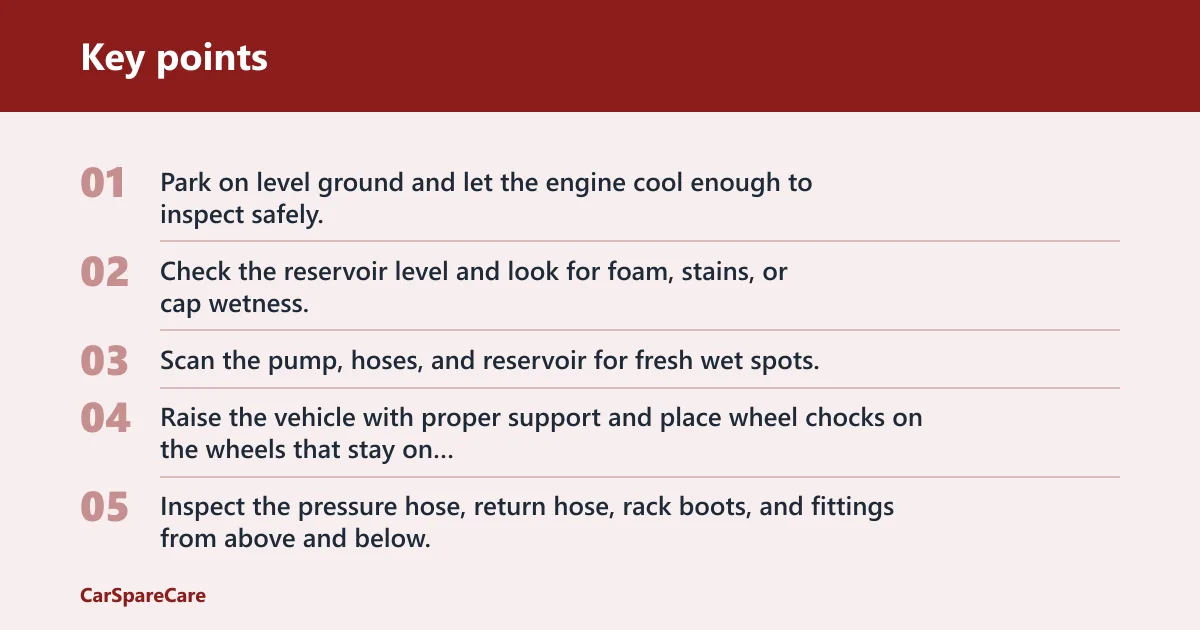
- Park on level ground and let the engine cool enough to inspect safely.
- Check the reservoir level and look for foam, stains, or cap wetness.
- Scan the pump, hoses, and reservoir for fresh wet spots.
- Raise the vehicle with proper support and place wheel chocks on the wheels that stay on the ground.
- Inspect the pressure hose, return hose, rack boots, and fittings from above and below.
- Wipe clean areas, then recheck after a short drive or a few steering turns.
How to trace wetness and residue
Follow the fluid upward from the lowest wet point. Gravity moves the fluid, so the drip you see is often not the source. Check hose crimps, clamp areas, reservoir seams, and the back side of the pump housing. Fresh fluid looks cleaner than old residue and is easier to trace.
A common first-timer mistake is replacing the visible drip point before checking the wet area above it. A hose that looks dry at the bottom can be soaked at the fitting hidden behind another bracket.
How UV dye helps find slow leaks
UV dye leak detection is useful when the leak is slow or when multiple wet areas are present. Use a dye that is compatible with the fluid in the system, then inspect with a UV lamp after the vehicle has been driven. The dye can reveal paths that are hard to see in normal light.
It is especially helpful for rack leaks, small fitting seepage, and reservoir cracks that do not leave a big puddle. If the leak pattern is confusing, dye can separate the true source from splash and runoff.
Why does it leak again after a top-up or repair?
A repeat leak usually means the root cause was not fixed, or a service step was missed. Wrong fluid, reused O-rings, loose clamps, and damaged fittings are common reasons the level drops again after a refill. Heat-aged seals can also fail soon after a repair.
Wrong fluid or contaminated fluid
Some systems are sensitive to the specified fluid type. Using the wrong fluid can swell or harden seals and O-rings over time, then the leak returns. Contaminated fluid can also shorten seal life and leave deposits in the reservoir or valve body.
Reused O-rings and loose clamps
O-rings at fittings and cooler joints should not be treated as reusable wear items. If a clamp is not seated correctly, the return side can seep and slowly empty the reservoir. A repair that seems dry at first can fail again once the system heats up.
Heat-aged seals and repeat failure points
Age and heat harden rubber parts. That is why an older pump, rack, or hose set may start leaking at more than one point close together. If one seal fails, nearby seals often are not far behind, especially on higher-mileage vehicles.
Can you keep driving with low fluid?
You can top up briefly to move the vehicle a short distance, but that does not fix the problem. If the level keeps dropping, the system is still leaking or pulling air. Long-term driving with low fluid can damage the pump and leave you with heavy steering at the worst possible moment.
What short-term topping up can and cannot do
Topping up can restore assist long enough to reach a safe parking place or repair shop. It cannot stop a cracked hose, leaking rack, or worn pump seal. If the reservoir empties again soon after refilling, treat it as an active fault.
When to stop driving
Stop driving if steering becomes heavy, the pump starts screaming, the fluid foams badly, or the level drops fast after a top-up. Those signs point to a leak or air entry that can worsen quickly. If the belt starts slipping badly, steering output can fall without warning.
Signs the pump is losing prime
A pump losing prime often makes a rising whine, gives intermittent assist, and may recover for a moment after a top-up before failing again. That pattern means the pump is drawing air. Check for leaks at the suction side, reservoir, and hose connections before assuming the pump itself is the only problem.
Frequently asked questions
Why does my power steering fluid keep going low?
Repeated low fluid often points to a slow seep that only shows up after driving or turning the wheel. Common sources are return hoses, fittings, reservoir seams, and rack boots. A quiet system can still be losing fluid internally, so check for wet boots and hidden residue under the car.
Why is my power steering fluid leaking fast?
Fast loss usually means a cracked pressure hose, a loose fitting, a failed pump seal, or a larger reservoir crack. If steering gets noisy or heavy at the same time, stop and inspect it soon. A fast leak can empty the system before a small drip ever appears on the ground.
How do I find a power steering fluid leak?
Start with the reservoir level, then inspect the pump, hoses, reservoir, and rack for wetness. Use jack stands and wheel chocks before going underneath. If the source is unclear, UV dye can help separate the true leak from splash, old residue, or fluid trapped in the rack boots.
Is it safe to top up power steering fluid until I can fix it?
Yes, for a short trip or to move the vehicle to a repair bay, but only if steering still feels normal and the leak is not severe. Topping up is a temporary step. If the fluid keeps dropping, or the pump starts whining and foaming, stop driving and inspect the cause.
Can I keep driving if my power steering fluid is low?
Not for long. Low fluid can damage the pump, increase steering effort, and lead to sudden assist loss. If you must move the car, top it up with the correct fluid and drive only far enough to reach a safe place or repair shop. Recheck the level immediately afterward.

Hi, I’m Melvin, an automobile engineer with extensive experience in automobile equipment. I currently work for a local automobile firm, where I specialize in the car parts industry. I’ve had the opportunity to collaborate with seasoned inspectors, gaining invaluable hands-on experience that goes beyond just theory.
My passion for automotive care started at a young age, which led me to create CarSpareCare. Through CarSpareCare, I share the knowledge and skills I’ve acquired over the years to help others navigate the world of car maintenance and repairs.
My goal is to provide practical tutorials, essential safety advice, and the latest industry insights so that anyone—whether a beginner or an expert—can confidently tackle their automotive projects.

