
Raise the front wheels if the procedure calls for it, keep fluid at the cold mark, and turn lock to lock 10 to 15 times with the engine off, then once with it idling. Stop if foam returns or the whine comes back. Bleeding done badly can leave air in the rack, overfill the reservoir, or hide a leak that brings the noise and stiffness back. This guide shows how to tell air, low fluid, contamination, and a leak apart before and after bleeding.
This guide is part of our Power steering and brake problems series.
What you’ll need
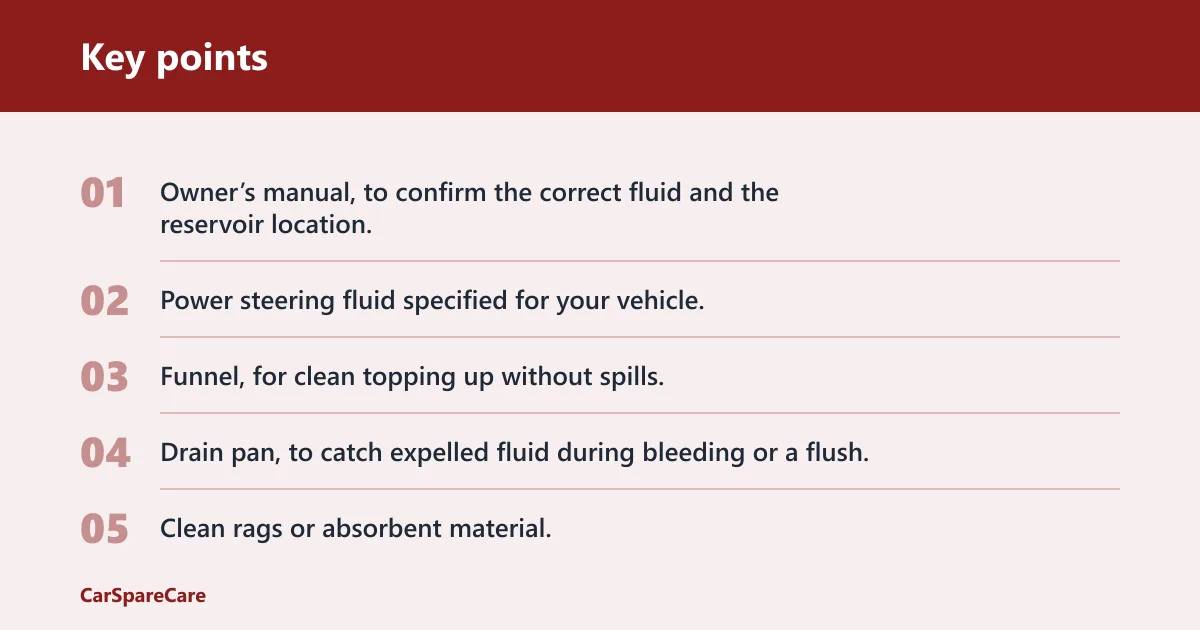


- Owner’s manual, to confirm the correct fluid and the reservoir location.
- Power steering fluid specified for your vehicle, or the approved ATF-equivalent if the manual calls for it.
- Funnel, for clean topping up without spills.
- Drain pan, to catch expelled fluid during bleeding or a flush.
- Clean rags or absorbent material.
- Jack stands, only if the service procedure requires the front wheels off the ground.
Check the reservoir first
Find the reservoir before you touch the wheel. It is usually next to the coolant reservoir on the passenger side, though some systems use a remote reservoir mounted away from the pump. Read the cap, the small dipstick, or the MIN/MAX marks before adding anything.
Most reservoirs have cold and hot marks. Check on level ground, with the engine off unless the manual says otherwise, and look for low fluid, foam, dark color, or damp hoses before you start bleeding.
- Open the hood and locate the power steering reservoir near the pump or on the remote mount.
- Read the cap labeling and fluid type note.
- Check the dipstick or the cold mark first.
- Inspect hoses, clamps, and the rack boots for wet spots.
- If the level is low, add fluid up to the cold fill line, then pause and recheck.
How do you bleed power steering?
Bleed the system by pushing trapped air out through slow steering cycles while keeping the reservoir from running dry. Use the lock-to-lock motion only after the correct fluid is in the reservoir and the vehicle is set up safely. Many procedures call for the engine to be running for the final cycles at idle.
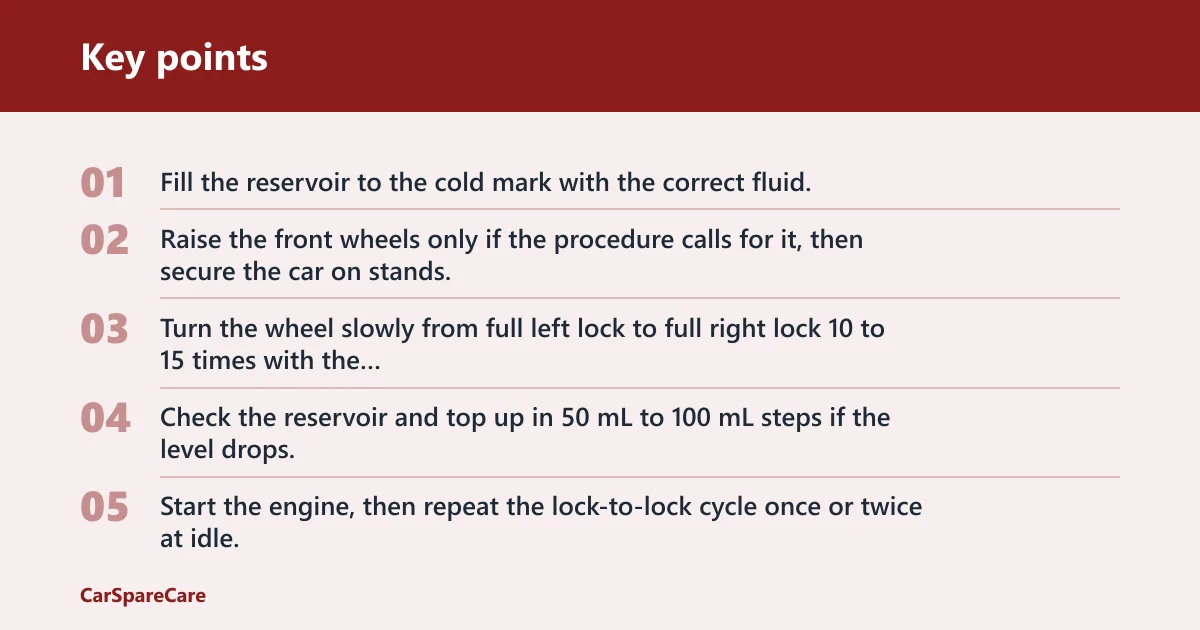
- Fill the reservoir to the cold mark with the correct fluid.
- Raise the front wheels only if the procedure calls for it, then secure the car on stands.
- Turn the wheel slowly from full left lock to full right lock 10 to 15 times with the engine off.
- Check the reservoir and top up in 50 mL to 100 mL steps if the level drops.
- Start the engine, then repeat the lock-to-lock cycle once or twice at idle.
- Stop if the fluid foams heavily, then let it settle and recheck for a leak.
Say your sedan whines after a belt or hose replacement and the reservoir looks foamy. That points to air in the lines more than worn steering parts. Bleed again with slow, full sweeps, then recheck the level and the hose clamps before assuming the pump has failed.
Bleed vs. leak vs. pump failure
| Symptom | Likely cause | What to check next | Will bleeding fix it? |
|---|---|---|---|
| Whining at lock | Air in the lines or low fluid level | Check level, hose clamps, and return line seepage | Maybe, if the cause is trapped air |
| Foamy fluid | Air entry or contamination | Inspect the suction side, reservoir seal, and hose joints | Only if the air source is fixed |
| Stiff steering | Low fluid, air, wrong fluid, or pump wear | Verify the fluid type and check for leaks first | Sometimes, but not if parts are worn |
| Fluid level dropping overnight | External leak | Look at the rack boots, pump shaft, hoses, and fittings | No, the leak must be repaired |
| Persistent noise after bleed | Pump wear, rack issue, or ongoing leak | Reinspect for seepage and listen at idle and full lock | Usually not |
What to do if the noise or foam stays
If the noise stays after several slow cycles, stop treating the bleed as the whole answer. Air can keep coming back through a loose clamp, cracked hose, failing reservoir seal, or rack seal leak, and a weak pump can sound the same at idle and full lock.
- Shut the engine off and let the fluid settle for 5 to 10 minutes.
- Check the level again at the cold mark or dipstick.
- Inspect the pump inlet, return hose, pressure hose, and rack boots for wetness.
- Wipe the reservoir cap and check for a damaged seal or blocked vent.
- If the fluid remains foamy or the whine persists, move to leak repair or component diagnosis.
A common first-timer mistake is to keep topping up without fixing the source of air. That can make the reservoir look correct while the system still gulps air through the suction side.
Common mistakes
- Using the wrong fluid: check the owner’s manual first. Some manufacturers call for ATF, while others require a vehicle-specific power steering fluid.
- Overfilling: stop at the cold mark, then recheck after the bleed. Overfill can push fluid out of the cap or aerate it.
- Bleeding before checking for leaks: a leak will refill the problem with air.
- Turning the wheel too fast: quick swings churn fluid and create foam.
- Letting the reservoir run low: that can pull air back into the pump and lines.
- Ignoring dark or milky fluid: that points to contamination or aged fluid, not just trapped air.
When bleeding will not fix it
Bleeding helps only hydraulic systems that contain fluid, a pump, hoses, and a rack-and-pinion unit. It does not apply to most electric power steering systems, and it is not the main answer for electrohydraulic systems if the pump motor or controller is at fault.
If the fluid turns dark brown or black, smells burnt, or looks milky, the system needs more than a purge. Dark fluid can indicate the fluid needs changing, and milky fluid can suggest contamination with water or air. A repair may need a flush, hose replacement, or pump or rack work.
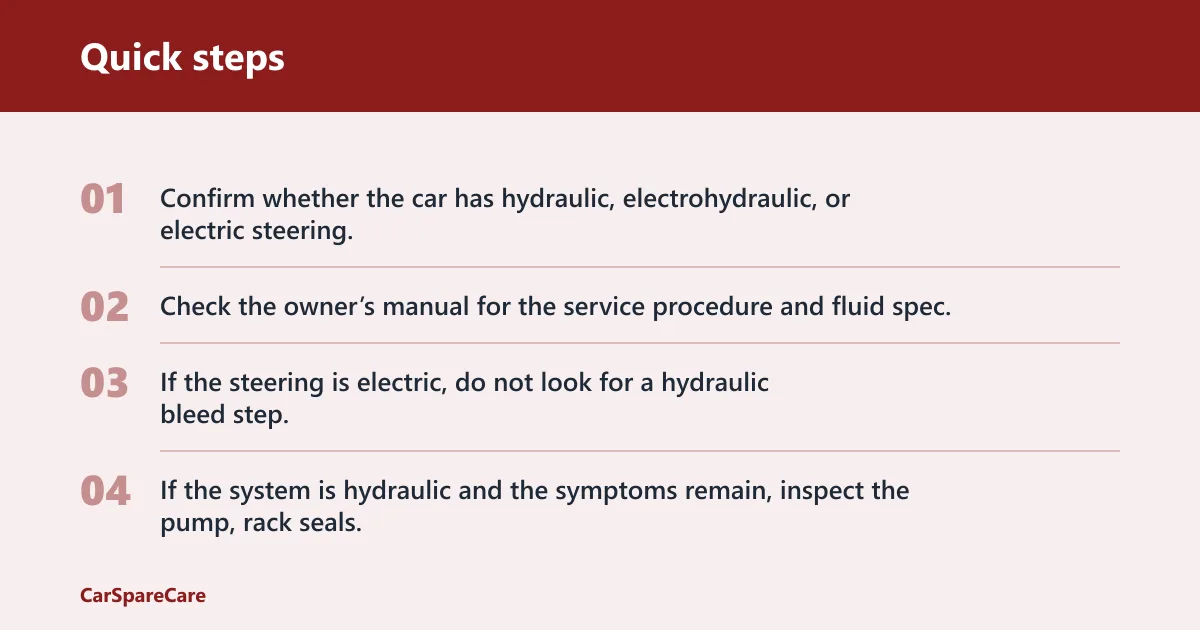
- Confirm whether the car has hydraulic, electrohydraulic, or electric steering.
- Check the owner’s manual for the service procedure and fluid spec.
- If the steering is electric, do not look for a hydraulic bleed step.
- If the system is hydraulic and the symptoms remain, inspect the pump, rack seals, and pressure hose.
Suppose a compact car still groans after three bleed cycles and the fluid drops again by the next morning. That pattern points to a leak first, then possible pump wear if the level stays correct after repairs.
What power steering fluid should I use for my car?
Use the fluid listed in the owner’s manual, even if the bottle says it works in many systems. Power steering fluid is the hydraulic medium in the system, and it can be clear, amber, or pinkish, with some vehicles using a specific formulation and others calling for ATF-equivalent fluid. (Thedrive)
Do not assume all red fluid is the same. A vehicle-specific fluid can protect seals and internal parts differently from generic ATF, so the label must match the manual or cap specification.
How do you know when power steering fluid is low?
Low fluid is often reported as harder steering, a groan or growl when turning, or a level below the cold mark on the reservoir. Check the reservoir first, then look for leaks, because low fluid can mimic pump failure and can be caused by a slow seep you can see only under the car or around the rack boots.
What happens if air gets into power steering lines?
Air in the lines can make the steering wheel harder to turn and can create a growling or whining noise. The fluid may look foamy, and the pump can cavitate because it is trying to move air instead of a steady hydraulic column.
How do you tell if power steering fluid is contaminated?
Look for color and texture changes. Healthy fluid is typically clear, amber, or pink, while dark brown, black, milky, or foamy fluid points to aging, contamination, or air in the system. A burnt smell is another warning sign that the fluid should be changed and the source checked.
How do you bleed the power steering pump?
The pump is bled by pushing air out through the reservoir and lines, not by opening the pump itself. Fill to the cold mark, cycle the wheel slowly lock to lock, then recheck the level and the sound at idle. If the pump still whines after the fluid clears, inspect the inlet side and the pump seal.
How do you vacuum bleed a power steering system?
A vacuum fill or vacuum bleed tool can pull air out before the engine runs, but it is not required on every vehicle. Many systems are serviced with the lock-to-lock method alone, while some procedures use vacuum equipment to speed the purge and reduce foaming after component replacement.
Frequently asked questions
How do you bleed the power steering system?
Fill the reservoir to the cold mark, then turn the wheel slowly from lock to lock a few times, checking the level after each set. Keep the fluid from dropping below the pickup, and stop when the noise and foam drop to a normal level at idle.
Can I use ATF instead of power steering fluid?
Only if the owner’s manual or reservoir cap explicitly allows ATF. Some manufacturers call for automatic transmission fluid instead of dedicated power steering fluid, but the wrong fluid can damage seals or alter steering feel, so the label on the reservoir is not enough by itself.
How do I know when to stop bleeding?
Stop when the fluid stays clear of foam, the steering feels even at idle, and the noise does not rise at full lock. Recheck the reservoir after the engine has run, then inspect for fresh leaks around the pump, hoses, and rack seals.
How do you bleed boat power steering?
Use the same basic idea only if the marine steering system is hydraulic and the manufacturer’s procedure calls for it. Confirm the correct fluid, purge air at the helm and cylinder, and inspect for leaks at fittings before returning the system to service.

Hi, I’m Melvin, an automobile engineer with extensive experience in automobile equipment. I currently work for a local automobile firm, where I specialize in the car parts industry. I’ve had the opportunity to collaborate with seasoned inspectors, gaining invaluable hands-on experience that goes beyond just theory.
My passion for automotive care started at a young age, which led me to create CarSpareCare. Through CarSpareCare, I share the knowledge and skills I’ve acquired over the years to help others navigate the world of car maintenance and repairs.
My goal is to provide practical tutorials, essential safety advice, and the latest industry insights so that anyone—whether a beginner or an expert—can confidently tackle their automotive projects.

