
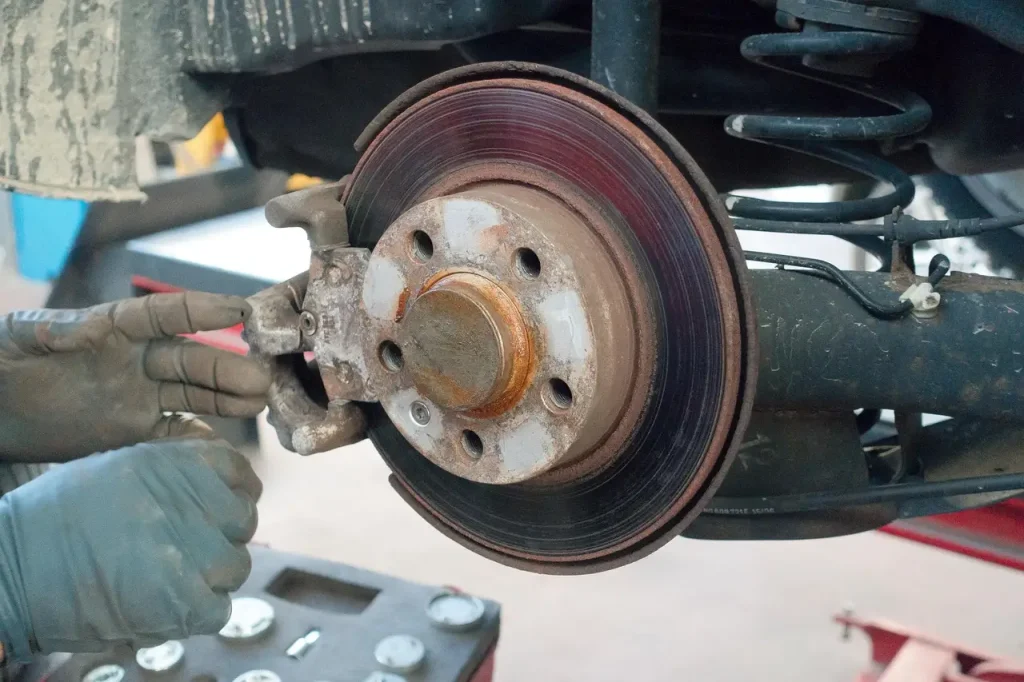
Inspect tie rods, ball joints, bushings, struts, and alignment if steering play, pull, clunks, or uneven wear appear; if you can move a wheel by hand more than a few millimeters or hear a knock, suspect worn parts before alignment. Ignoring those signs can wear tires fast, make the car drift, and turn a small fix into a larger repair bill. This guide matches symptoms to the most likely suspension or steering parts, then shows how to check each one safely.
What you’ll need
- Flashlight
- Gloves
- Tire pressure gauge
- Floor jack
- Jack stands
- Wheel chocks
- Pry bar
- Notebook or phone for notes
Some checks need a helper to turn the wheel or rock the car. Procedures vary by model, so follow the vehicle manual. Never work under a vehicle held only by a jack; use rated jack stands on approved lift points, chock the wheels, and keep the car in park or in gear with the parking brake set. (Wikipedia)
What suspension parts cause steering problems?
Steering symptoms often start in suspension parts that hold wheel position, not in the steering wheel itself. Tie rods, ball joints, bushings, springs, bearings, struts, and alignment angles all affect whether the wheels point straight, return cleanly, and stay stable over bumps.
Tie rods and ball joints
Inner and outer tie rods link the steering rack to the wheels, so wear here can create slack, poor alignment, and steering wander. A bad tie rod end can make steering response sluggish. Ball joints let the steering knuckle pivot; looseness here can cause wandering, instability, and a knock or creak while turning.
Control arms, bushings, and sway bar links
Control arms connect the suspension to the frame. Torn rubber, looseness, or a bent arm can cause clunking and uneven tire wear. Sway bar end links and bushings control body roll, and wear here often shows up as knocking or rattling over bumps or during weight transfer in a turn.
Shocks, struts, springs, and ride height
Shocks and struts control ride quality and bounce. Firestone says they typically last around 50,000 miles, depending on driving conditions, and worn shocks can increase stopping distance. Springs and ride height matter too: a low corner can change alignment geometry and steering feel, especially if one end sags. (Firestonecompleteautocare)
Wheel bearings, hubs, and alignment angles
Wheel bearings and hubs should rotate smoothly. Humming, grinding, or wheel movement can mimic steering vibration or looseness. Alignment angles matter as well. Camber, toe, and thrust angle can all make a car pull or wander, especially if a rear suspension issue shifts the vehicle’s track.
Steering symptom diagnosis matrix
| Symptom | Most likely suspension parts | Quick driveway check | Stop-driving warning |
|---|---|---|---|
| Pull | Tire pressure, alignment, bent arm, rear thrust angle | Check all four pressures, compare tread wear, then look for a low corner or obvious impact damage | Stop if the pull is sudden, worsens after a bump, or comes with vibration |
| Wander | Tie rods, ball joints, bushings, alignment | With the car safely lifted, confirm no free movement at the wheel before the steering wheel starts to move | Stop if the car changes lane position with small wheel inputs |
| Clunk over bumps | End links, bushings, control arms, struts | Push on each joint and look for torn rubber, shiny contact marks, or a loose link that taps metal | Stop if the clunk is loud and repeats on every bump |
| Steering play | Inner or outer tie rods, ball joints, wheel bearings | Rock the wheel lightly and watch which joint moves first; note any knock before the tire reacts | Stop if the steering wheel moves before the wheels do |
| Off-center wheel | Alignment, tie rod length, rear thrust angle | Drive straight on a level road and note whether the wheel sits off-center while the car tracks straight | Usually monitor, but inspect soon if the wheel was centered before a recent pothole or repair |
| Uneven tire wear | Alignment, bushings, ball joints, shocks or struts | Inspect all four tires for inner edge wear, outer edge wear, cupping, feathering, or patchy wear | Stop if cord is visible or one tire is worn far faster than the others |
| Nose dive | Shocks, struts, springs | Watch the front end during a normal brake application; excessive dive points to weak damping or sag | Stop if braking feel changes sharply or the car bottoms out |
| Bounce after bumps | Shocks, struts | Use the bounce test: press and release one corner, then see whether it settles quickly rather than continuing to rise and fall | Stop if the car keeps oscillating or feels unstable at speed |
| Vibration | Wheel bearing, hub, tire, bent wheel, alignment | Check for humming, grinding, or wheel movement when the tire is rocked at the 12-and-6 position | Stop if the vibration grows with speed or the wheel feels loose |
| One-corner sag | Spring, strut, control arm, bushing | Measure ride height at each corner on level ground and compare side to side | Stop if the car sits visibly low or rubs the tire on bumps |
How do you inspect suspension parts safely?
Start on level ground with the engine off. Check tire pressure, ride height, and all four tires for wear patterns before lifting anything. Then look for fluid leaks, damaged rubber, bent arms, and missing hardware. If the car feels unsafe or sits very low, do not keep driving it.
- Set the parking brake, chock the wheels, and confirm the transmission is in park or in gear.
- Inspect all four tires for edge wear, cupping, feathering, and patchy wear.
- Look for oily strut housings, torn boots, cracked bushings, and sagging springs.
- Lift one axle at a time at approved lift points, then place the car on appropriately rated jack stands.
- Verify the wheel is free, then shake it gently by hand to find play before prying.
- Use a pry bar only at the joint or bushing you are checking, and note whether movement is in the linkage, hub, or arm.
A common first-timer mistake is inspecting the tires but skipping the tie rods, ball joints, and control-arm bushings that can cause steering trouble. A rear bushing or rear toe problem can still make the car pull or wander, since rear alignment can affect how the vehicle tracks down the road.
When is alignment the right next step?
Alignment is usually one of the last steps after worn tie rods, ball joints, bushings, springs, or bearings are repaired. A fresh alignment may not hold if loose parts remain. If the front end looks fine but the car still pulls, check the rear suspension and thrust angle before booking alignment again.
Suppose the left front tire shows inner-edge wear and the wheel sits off-center after a pothole hit. Replace the damaged part first, then get alignment. Suppose the tires wear evenly but the car still wanders; that points you back to loose joints or rear geometry, not alignment alone.
Common mistakes
Do not replace alignment parts before checking for free play in tie rods, ball joints, hubs, and control arm bushings. Do not use bounce test rebound alone to condemn shocks or struts. Do not ignore rear suspension, tire pressure, or tire wear patterns. And do not assume every steering symptom starts at the front axle.
What goes wrong most often is sequence. The symptom shows up, alignment gets blamed, and the real fault remains loose. That can leave the steering off-center after repair and can shorten tire life again within a short time.
Frequently asked questions
How do I inspect suspension parts for steering problems?
Begin with tire pressure and tread wear, then check for leaks, torn rubber, and obvious damage on level ground. Lift one axle safely, secure it on jack stands, and check for play at the wheel, tie rods, ball joints, and bearings before you decide on alignment or parts replacement.
What suspension parts can cause steering to pull or wander?
Most pull or wander complaints point to tire pressure, tie rods, ball joints, bushings, rear thrust angle, or a bent component. If the steering wheel stays off-center or the car drifts after a pothole hit, inspect both front and rear suspension before you schedule alignment.
How do I tell if a control arm bushing is causing steering issues?
Look for torn rubber, a cracked sleeve, or an arm that shifts when you pry near the bushing. If the wheel moves after a dull knock and the tire wears unevenly, the bushing may be letting the arm change position under load.
Can worn ball joints affect steering feel?
Yes. Worn ball joints can make steering feel loose, unstable, or noisy, and a bad lower ball joint may create an audible creak while turning the wheel. Check for looseness at the knuckle and compare both sides; any play that changes wheel position is abnormal.
How do I check tie rods for play at home?
With the car safely lifted, grasp the tire at the 3 and 9 o’clock positions and rock it gently. If the wheel moves before the steering linkage responds, inspect the inner and outer tie rods for slack, damaged boots, or a delayed response at the joint.
Can bad shocks or struts cause steering problems?
Yes. Bad shocks or struts can let the body pitch, bounce, and nose dive, which can make steering feel vague and can increase stopping distance. Inspect for oily housings, uneven ride height, and excessive bounce; the bounce test is a quick clue, not a final verdict.
Should I get an alignment before or after replacing suspension parts?
After, not before. Replace worn tie rods, ball joints, bushings, springs, or bearings first, then align the car. If you align it while parts are loose, the settings may not hold, and rear thrust-angle problems can still leave the car pulling.

Hi, I’m Melvin, an automobile engineer with extensive experience in automobile equipment. I currently work for a local automobile firm, where I specialize in the car parts industry. I’ve had the opportunity to collaborate with seasoned inspectors, gaining invaluable hands-on experience that goes beyond just theory.
My passion for automotive care started at a young age, which led me to create CarSpareCare. Through CarSpareCare, I share the knowledge and skills I’ve acquired over the years to help others navigate the world of car maintenance and repairs.
My goal is to provide practical tutorials, essential safety advice, and the latest industry insights so that anyone—whether a beginner or an expert—can confidently tackle their automotive projects.

