
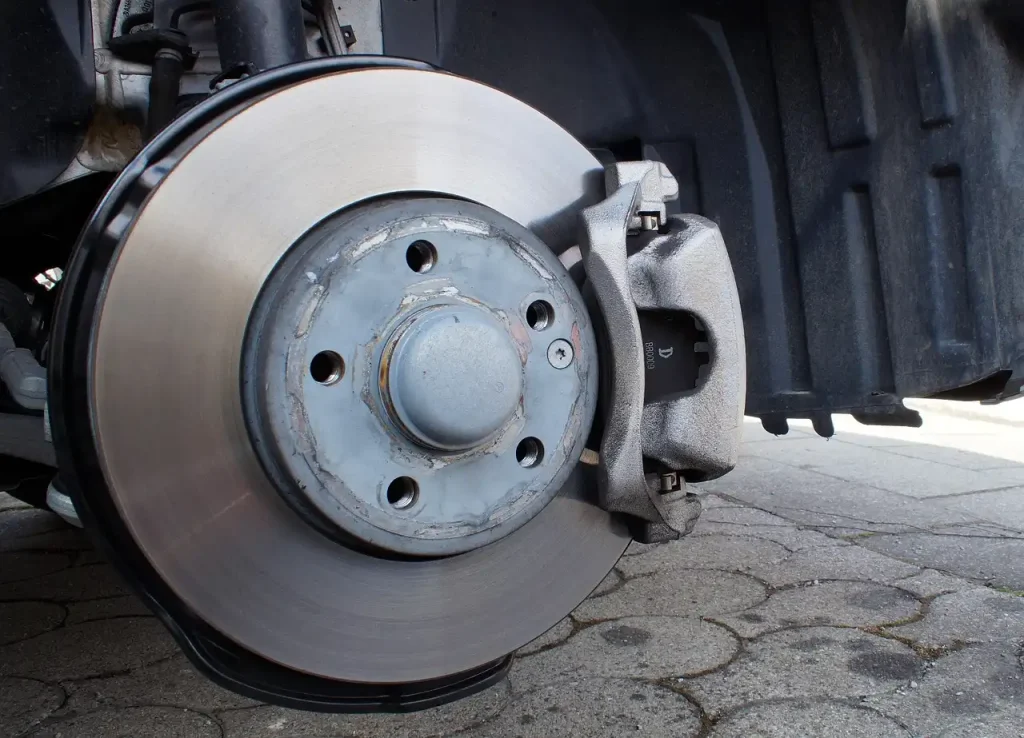
Replace a brake caliper when it leaks, has a seized piston or slide, causes one-wheel drag or pull after new pads and rotors, or shows bore corrosion; clean or rebuild only if the body is sound and the piston still moves freely. Skip those signs and you can overheat pads and rotors, lengthen stopping distances, and turn a cheap repair into a bigger brake job. This guide shows how to judge cleaning, rebuilding, or replacement, and which related parts to replace at the same time.
Factory service information from major OEMs and brake manufacturers generally treats caliper inspection as part of every brake job, not a separate mileage-based replacement item. In practice, most calipers are checked whenever pads are replaced, when a wheel runs hot, or when pad wear is uneven across an axle.
What does a brake caliper do?
A brake caliper is the hydraulic clamp in a disc brake system. Brake fluid pushes the piston, the piston squeezes the pads against the rotor, and that friction slows the wheel. Front and rear calipers are not always interchangeable, so fitment matters before you buy a new or remanufactured unit.
Calipers usually outlast pads. OEM service manuals and major brake manufacturers do not publish a universal replacement interval, but real-world service guidance commonly puts caliper life well beyond a single pad set, with inspection emphasized around brake service intervals rather than a fixed mileage changeout. That is a check point, not a replacement schedule.
Front and rear calipers, and why fitment matters
Front and rear calipers can differ in mounting points, piston size, parking-brake design, and hose routing. Some rear calipers are integrated with the parking brake. That means the correct part is not just “a caliper,” but the right caliper for that axle and side.
Advance Auto Parts lists separate front and rear brake caliper categories, and its catalog guidance says you should confirm caliper type and front or rear fitment before ordering. A wrong match can leave you with a part that bolts up poorly or does not work with the hose and bracket layout.
New versus remanufactured calipers
New and remanufactured calipers are both common options. New parts are usually the simplest choice when corrosion or bore damage is severe. Remanufactured calipers can be a good budget choice if the core is rebuildable and the supplier has replaced wear items correctly.
Remanufactured does not mean universal. The same fitment checks still apply, including side, axle position, and front or rear use. If the old caliper failed from heavy rust, inspect the bracket, hose, pads, and rotor before assuming a rebuilt unit alone will solve the problem.
When should you replace brake calipers?
There is no fixed mileage interval for every brake caliper. Calipers often last longer than pads, and many survive multiple pad jobs. Replace them based on condition: leak, seizure, repeated sticking, or corrosion that affects the bore, piston, or slide movement.
Serviceable, rebuildable, or replace-now
A serviceable caliper is one with a sound body, free-moving slide pins, and a piston that retracts normally. A rebuild candidate usually has a rebuildable body and a piston area that can be cleaned, resealed, and returned to smooth motion. Replace now if the piston is seized, the caliper leaks, or corrosion has eaten into the working surfaces.
Factory service procedures typically call for caliper inspection whenever pads are replaced. If the slide pins are clean but the wheel still drags, the piston may be sticking internally. If the wheel frees up only after loosening the hose, suspect a collapsed brake hose rather than a seized caliper.
Should you replace, rebuild, or inspect a brake caliper?
| Symptom | Likely cause | Urgency | Next action |
|---|---|---|---|
| Pulling on braking | Sticking caliper, uneven hydraulic pressure, or seized slide pins | High | Inspect caliper movement, pads, hose, and rotor; replace if drag remains |
| Uneven pad wear | Pad-to-rotor contact is not even because the caliper is hanging up | High | Check slide pins and piston action; replace worn pads and faulty caliper parts together |
| Fluid leak | Seal failure, damaged hose joint, or caliper bore issue | Immediate | Do not drive far; inspect the leak source and replace the failed caliper if the body or seal area is compromised |
| Spongy pedal | Hydraulic pressure loss, air in the system, or internal caliper seal failure | Immediate | Check fluid level and bleed the brake system after repairs; replace the caliper if it is leaking internally or externally |
| One wheel overheating | Seized piston, stuck slide pins, or dragging pads | Immediate | Stop and inspect the wheel, rotor, pads, and caliper; replace if it will not release cleanly |
| Seized slide pins | Corrosion or dried lubricant in the guide hardware | Moderate to high | Clean and lubricate if pins are still straight and usable; replace hardware or caliper if pitting or binding remains |
| Torn piston boot | Boot damage lets moisture and debris reach the piston | Moderate | Inspect the piston for corrosion; rebuild only if the bore and piston still move freely |
| Corrosion on the caliper body | Moisture, road salt, and heat cycles | High if heavy | Replace if rust is severe, flaky, or affecting the piston or guide bores; inspect the opposite side too |
Use this labeled checklist before you decide
- Confirm the symptom: pull, drag, leak, noise, or uneven wear.
- Check the slide pins for free movement and proper lubrication.
- Inspect the piston boot, piston face, and caliper body for corrosion.
- Measure pad wear and rotor condition on both sides of the axle.
- Replace the caliper if seizure, leakage, or heavy corrosion remains.
- Bleed the brake system after any caliper replacement.
What signs show a brake caliper needs attention?
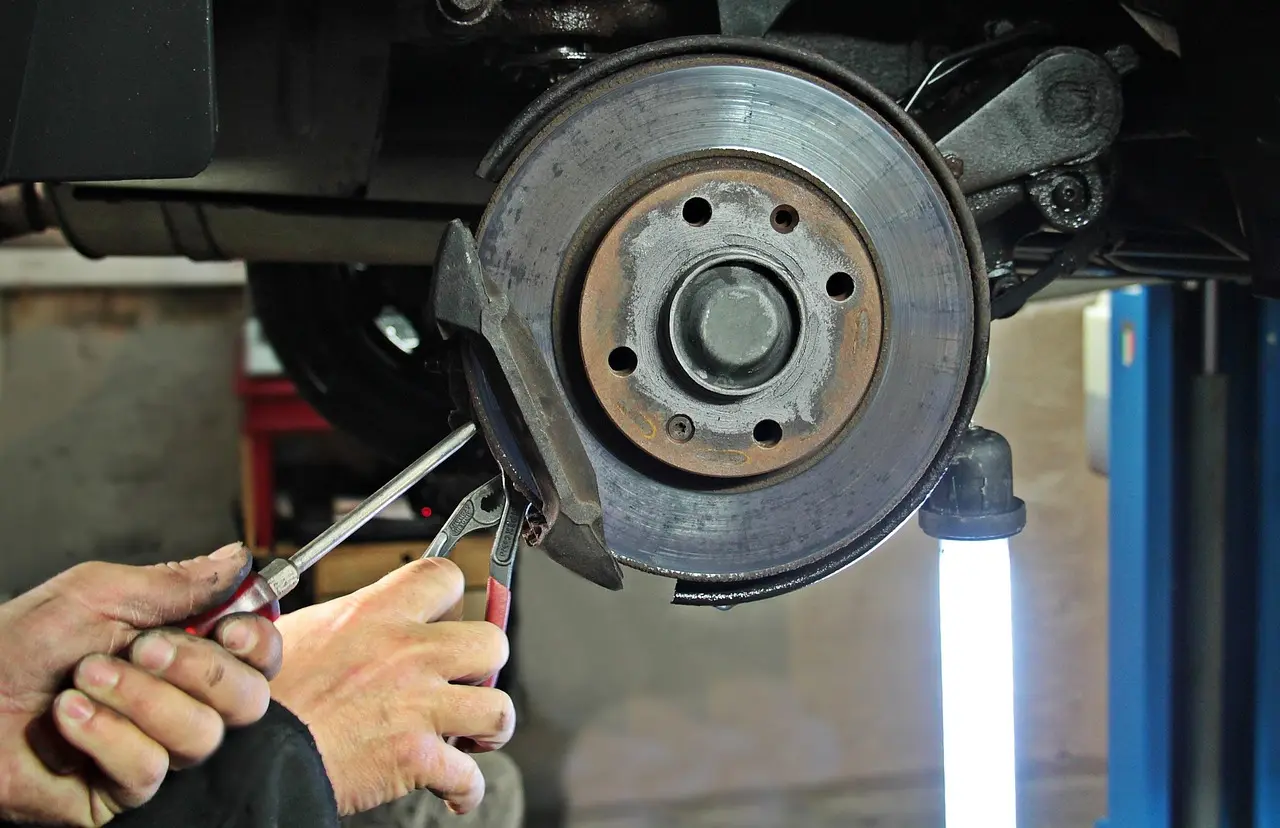
The main warning signs are uneven pad wear, pulling while braking, one wheel running hotter than the others, fluid around the wheel, a soft or spongy pedal, and odd noise during braking. These signs point to a caliper that is sticking, leaking, or not clamping evenly.
How sticking changes pad wear and braking feel
Uneven brake pad wear is a common sign of caliper trouble. If one pad is thinner than the other on the same wheel, the caliper may not be sliding or releasing correctly. A sticking caliper can also create a pull to one side during braking, especially when the problem is worse on one front wheel.
Say your left front wheel pulls the car under light braking and the inner pad is nearly gone while the outer pad still has material left. That pattern points to a sticking caliper or slide pin issue, not a normal pad replacement interval. If the inner pad wears faster than the outer pad, that is a classic clue for a seized piston or restricted hose; if the outer pad wears harder than the inner, the caliper may be hanging up on the slides. A collapsed hose can mimic a seized caliper because it may let pressure in but not release it cleanly.
Noise, vibration, grooves, and rotor condition
Strange noises while braking can be linked to caliper issues, but noise can also come from rotor problems. Grooved rotors, rotor thickness loss, and rough pad contact can all create vibration or scraping. If the caliper is sticking, the rotor may show heat spots or uneven wear as a result. Heat discoloration, blueing, or dark patches on the rotor face are practical shop clues that the brake has been dragging.
Rotors can last multiple pad cycles, but a dragging caliper can cut that life short. If the rotor shows excessive thickness variation, heavy grooves, or other damage, fix the caliper fault first and then decide whether the rotor still meets service limits.
What a seized piston or corroded body means
A seized piston means the caliper is not clamping and releasing as it should. Corrosion around the piston bore, dust boot area, or body can stop smooth motion and damage the seal. A torn piston boot matters because it opens the door to moisture and grit, which speeds corrosion.
One-wheel overheating is a red flag. If the wheel is hotter after a normal drive, the caliper may be dragging even when the pedal is released. That is replace-now territory if the piston will not retract or the caliper body is badly corroded.
Can you rebuild a brake caliper?
Yes, but only when the caliper body is sound and the piston and bores are still serviceable. A rebuild can make sense for a unit with a torn boot, tired seals, or sticky motion from contamination. It is not a cure for heavy corrosion, deep pitting, or a seized piston that will not clean up.
When a rebuild makes sense
A rebuild works best when the caliper has no major damage, the piston is free enough to clean, and the slide hardware can be restored with cleaning and lubrication. It is also a reasonable choice when the original part is hard to source and the housing is in good shape.
When replacement is the safer call
Replace the caliper when the piston is seized, the body is badly rusted, or fluid is leaking from the caliper itself. Salt-belt corrosion failures often fit this pattern. Heat-related failures from towing or repeated hard braking can also warp seals and cook the grease out of the slide pins, which may make replacement simpler than a partial repair.
What a rebuild does not fix
A rebuild does not fix a damaged rotor, worn pads, a collapsed hose, or contaminated brake fluid. If the hose is internally restricted, the caliper may still drag after a rebuild. Check the hose, pad wear, rotor condition, and fluid level before calling the job finished. For related maintenance, see our brake pad replacement, rotor resurfacing/replacement, brake fluid flush, brake bleeding, and stuck caliper diagnostics guides.
Should you replace calipers with pads and rotors?
Not always. Replace the caliper with pads and rotors when the caliper caused uneven wear, heat damage, or a leak that contaminated the pads. If the caliper is sound and the pads simply wore out, there is no reason to replace it just because the brakes are already apart.
When pads should be replaced with the caliper
If a caliper leaked onto the pads, the friction material can be soaked and should go. If one side wore much faster than the other, replace the pads on that axle so both sides have matched friction material and thickness. A caliper repair without new pads can leave the system unbalanced.
When rotor damage points to a paired service
If the rotor has grooves, blue heat spots, or vibration from a sticking caliper, replace or resurface it only if it still meets thickness requirements. If the rotor is thin or damaged, a new caliper alone will not restore clean pad-to-rotor contact.
How brake fluid and hose checks fit
Brake fluid leaks around the wheels are a warning sign of caliper failure. A low fluid warning can follow, especially if the leak is active or pad wear is severe. Inspect the hose, banjo bolt area, and bleeder screw when you replace the caliper, because a bad hose or leaking fitting can mimic a caliper fault.
How much does caliper replacement cost and how long does it take?
A single caliper job is usually the cheapest path, but the total rises fast if you add pads, a rotor, brake fluid, or a seized hose. An axle-pair replacement costs more up front, yet it can prevent a mismatched feel if both sides are similarly worn or corroded.
Single caliper versus axle pair
Replacing only one caliper can make sense when the other side is healthy and the failure is isolated. Replacing both sides on the axle is worth considering when corrosion is present on both, the vehicle has seen harsh winter use, or you want matched wear and clamping feel across the axle.
Budget-wise, the single-side repair is the lowest parts cost, but labor often rises if the other side also needs slide-pin service, pads, or a rotor. If both calipers are old and rusty, an axle pair can be the cleaner long-term decision. Typical parts pricing varies widely by vehicle: a single new caliper is often higher than a remanufactured unit, while an axle pair usually lands near double the one-side parts cost before pads, fluid, and hardware. Labor time is commonly about 1 to 2 hours for an accessible single caliper, and longer when rust, bleeding, or seized hardware adds delays.
Why bleeding adds time
Bleeding the brake system is required after caliper replacement because the hydraulic circuit has been opened and air can enter the lines. Without bleeding, the pedal can feel soft and the hydraulic pressure may not return properly. That step adds labor time and sometimes the need for fresh brake fluid. OEM service procedures commonly require bleeding after opening the hydraulic circuit, and many recommend checking for leaks and pedal feel before returning the vehicle to service.
How long to replace brake caliper depends on rust, access, and whether the bleeder screw cooperates. A straightforward one-side job can be fairly quick, while a corroded bolt, stubborn hose fitting, or extra bleeding steps can add a lot more time.
Frequently asked questions
How often should you replace brake calipers?
There is no fixed interval. Brake calipers should be replaced when they leak, seize, stick after cleaning, or show corrosion that affects the piston or bore. Replace them based on condition. Inspection during brake service is a practical check point, not a replacement rule.
How long should brake calipers last?
Under normal use, calipers often last much longer than pads. Heat, moisture, road salt, debris, and skipped slide-pin service shorten that life. Heavy towing, mountain driving, and winter corrosion can reduce it further. OEM and aftermarket service literature generally focuses on inspection during brake service, because lifespan varies so much by climate and use.
What are the signs a brake caliper needs replacing?
Look for pulling during braking, uneven pad wear, fluid around the wheel, a soft pedal, one wheel running hot, and odd braking noise. Those symptoms point to sticking, seizure, or leakage. If cleaning and lubricating the slides do not restore normal movement, replacement is the safer move. A hot rotor, blue discoloration, or a wheel that frees up after loosening the hose are especially strong clues that the caliper or hose is failing.
Should I replace calipers when doing brakes?
Only if the caliper caused the problem. If the pads wore evenly and the caliper moves freely, it usually does not need replacement just because the brakes are apart. Replace it when you find a leak, seized piston, stuck slide pins, or rotor damage from dragging.
Should brake calipers be replaced in pairs?
Not always, but it can be smart on the same axle when both sides show age, corrosion, or similar wear. Replacing both sides can keep brake feel balanced. If only one caliper failed and the other side is clean and free-moving, a single replacement is reasonable.
Can brake calipers be rebuilt instead of replaced?
Yes, if the body is sound and the piston and bore are still usable. Rebuilding makes sense for torn boots, worn seals, or minor contamination. It is not a good answer for a seized piston, severe corrosion, or a caliper that leaks from the body itself.
Is brake caliper replacement DIY-friendly?
It can be, but only for someone comfortable with brake hydraulics, safe vehicle support, and final bleeding. The basic swap is straightforward on some vehicles, yet rusted fasteners, stuck bleeders, ABS bleeding procedures, and integrated parking-brake rear calipers can make the job much harder. If the caliper replacement also requires brake bleeding or parking-brake adjustment, the job moves from simple mechanical work to a more advanced repair.
What do new and remanufactured calipers typically cost?
Remanufactured calipers are usually the lower-cost option, while new calipers generally cost more but may be the better choice when corrosion or bore damage is severe. Final price depends on the vehicle, axle position, and whether hardware is included. In most cases, the price difference between new and remanufactured parts is enough to matter, but the labor to install them is usually similar.
How much labor time does caliper replacement take?
A simple single-caliper swap can be completed in about 1 to 2 hours on many vehicles, but rusted hardware, brake bleeding, and related pad or rotor work can extend that time. Rear calipers with parking-brake mechanisms often take longer than front calipers. If the bleeder is seized or the hose fitting breaks, the repair time can increase quickly.

Hi, I’m Melvin, an automobile engineer with extensive experience in automobile equipment. I currently work for a local automobile firm, where I specialize in the car parts industry. I’ve had the opportunity to collaborate with seasoned inspectors, gaining invaluable hands-on experience that goes beyond just theory.
My passion for automotive care started at a young age, which led me to create CarSpareCare. Through CarSpareCare, I share the knowledge and skills I’ve acquired over the years to help others navigate the world of car maintenance and repairs.
My goal is to provide practical tutorials, essential safety advice, and the latest industry insights so that anyone—whether a beginner or an expert—can confidently tackle their automotive projects.

