

Start with every accessory added or powered in the last 30 days, then measure key-off current after the car sleeps. A healthy modern vehicle often settles below about 50 mA, and a draw above about 100 mA may point to a fault. Ignore it and you can keep killing batteries, chasing random no-starts, and replacing parts that were never bad. This guide shows how to trace the drain backward from recent add-ons, confirm sleep-wake behavior, and isolate the accessory without guessing.
What you’ll need
- Digital multimeter with a current range in milliamps or amps
- Test light for a quick draw check
- Fuse puller or needle-nose pliers
- Basic hand tools for unplugging accessories
- Access to the battery and the fuse boxes
Accessory drain triage table
| Accessory type | Typical symptom pattern | First isolation step | Can it keep a module awake? |
|---|---|---|---|
| Dash cam with parking mode | Battery low after one overnight park | Unplug the camera and its hardwire kit | Yes |
| OBD2 tracker or dongle | Draw starts after key-off and stays steady | Remove the device from the OBD port | Yes |
| Aftermarket alarm or remote start | Intermittent no-start after sitting for a day | Pull the accessory fuse or unplug the control module | Yes |
| Stereo amplifier or subwoofer controller | Battery drains faster after audio work | Check the amp remote wire and main power feed | Sometimes |
| Phone charger or USB adapter | Small overnight drain, often after a new install | Remove the adapter from the outlet | Sometimes |
| Factory module kept awake by added wiring | Draw only appears after an accessory update or splice | Undo the last added tap or harness | Yes |
How do I diagnose a car battery drain?
Work backward from recent changes first, then verify resting current after the car has entered sleep mode. A parasitic drain occurs when a component keeps drawing power after the car is turned off. That draw may come from modules, lights, relays, or aftermarket accessories.
Before chasing deeper faults, check battery terminals and grounds for corrosion or looseness. A weak connection can mimic a drain by hurting cranking and charging performance. If the battery is flat only after an overnight park and the only recent change was a hardwired dash cam, point the diagnosis at the add-on before blaming the battery itself.
1. Check the obvious first
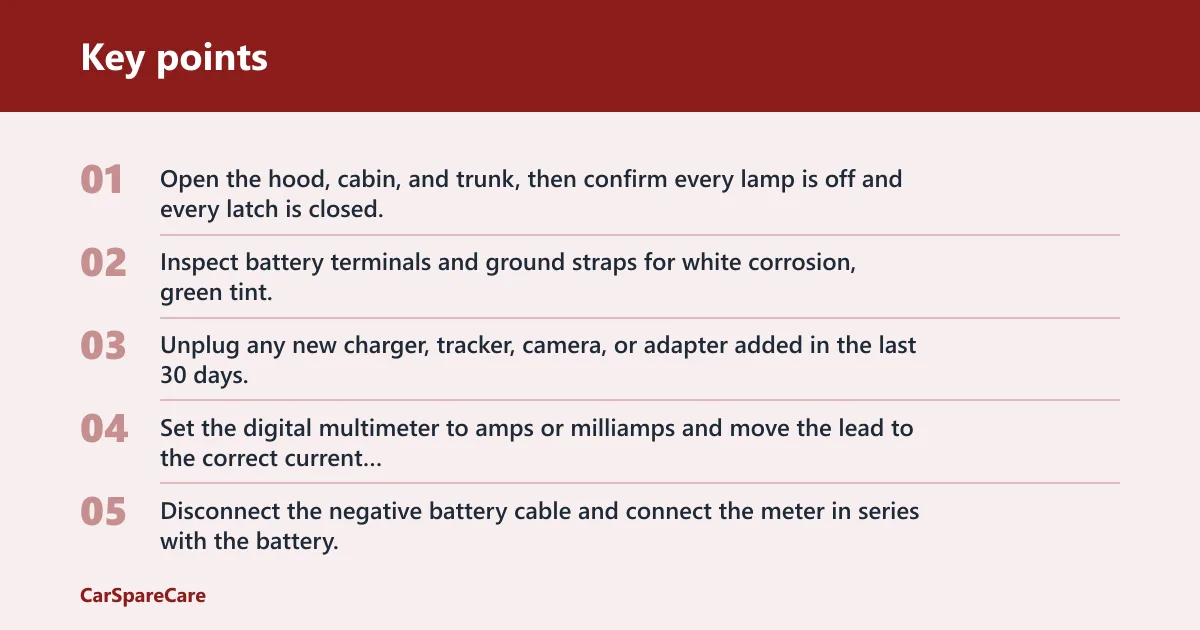
- Open the hood, cabin, and trunk, then confirm every lamp is off and every latch is closed.
- Inspect battery terminals and ground straps for white corrosion, green tint, or loose clamps.
- Unplug any new charger, tracker, camera, or adapter added in the last 30 days.
2. Measure resting current correctly
- Set the digital multimeter to amps or milliamps and move the lead to the correct current port.
- Disconnect the negative battery cable and connect the meter in series with the battery.
- Wait until sleep mode is reached before trusting the reading; Mercedes sleep mode may take 10 to 45 minutes, and Audi diagnosis recommends at least 15 minutes.
- Note the value. Modern vehicles commonly sit around 20 mA to 50 mA, while 100 mA to 250 mA is a moderate parasitic leak and 500 mA to 1,000 mA can kill a battery in one to two days.
A common first-timer mistake is reading the meter too soon after opening a door. The interior network wakes up, the number jumps, and the drain looks worse than it is. Keep doors, the hood, and the trunk latched before you judge the reading.
How do I test for a battery drain with a multimeter?
Use the meter in series with the battery, not across it, so you measure current instead of voltage. That setup is the cleanest way to confirm parasitic battery drain with ignition off. The Mercedes guide uses a negative-cable disconnect and series connection, which is the right pattern for most DIY checks.
Use the correct current range and port before you touch the circuit. If you leave the lead in the voltage jack and try to measure current, you can blow the meter fuse. If the reading is above the normal standby range after sleep mode, the vehicle has an elevated parasitic draw.
3. Keep the test safe
- Use the multimeter’s fused current input and start on the highest available current range.
- Do not crank the engine or switch high-load accessories on while the meter is in series.
- If the reading is unstable, recheck that the cable clamps are tight and the meter leads are fully seated.
Accessory drain triage order
Start with the add-ons most likely to stay alive after parking. Aftermarket accessories can stay powered when parked, and some can keep modules awake through CAN activity or ignition-status wiring. The fastest path is to work from the newest install backward, not to pull random fuses across the whole car.
4. Isolate the most likely add-ons first
- Unplug dash cams and parking-mode kits.
- Remove OBD2 devices and trackers from the diagnostic port.
- Disconnect aftermarket alarms, remote start modules, and audio amplifiers.
- Pull phone chargers, USB adapters, and 12V splitters from every outlet.
- Undo the last hardwire tap if the draw began after a wiring change.
Suppose a truck has a tracker on the OBD port and a dash cam hardwired for parking mode. If the battery goes flat after one night, remove the OBD device first, then retest. If the draw drops from triple-digit milliamps to the normal range, the added device is the likely path.
How do I isolate the circuit?
Pull fuses from one box, one fuse at a time, and watch for the current to drop. Fuse boxes may be in the engine bay, the cabin, or the trunk, and the circuit that opens when the draw falls is the one to inspect next. This step turns a vague drain into a specific branch.
5. Pull fuses one at a time
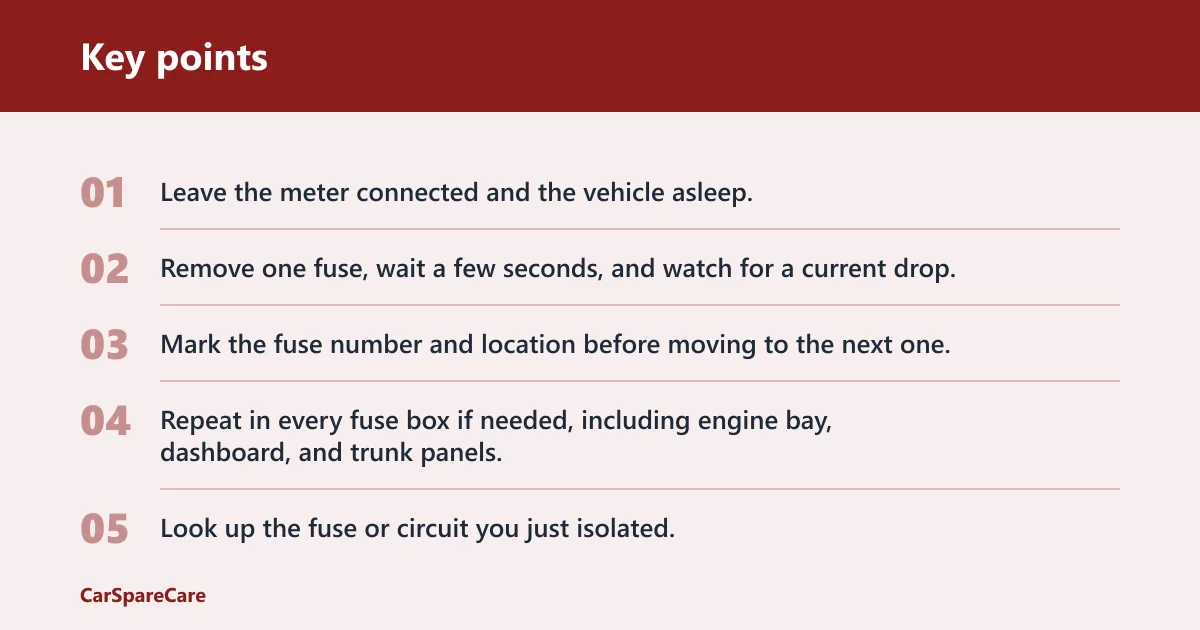
- Leave the meter connected and the vehicle asleep.
- Remove one fuse, wait a few seconds, and watch for a current drop.
- Mark the fuse number and location before moving to the next one.
- Repeat in every fuse box if needed, including engine bay, dashboard, and trunk panels.
6. Unplug the identified accessory
- Look up the fuse or circuit you just isolated.
- Unplug the accessory on that branch before chasing deeper components.
- Retest after every removal to confirm the current falls back toward the standby range.
If that did not work, move to the next most invasive check: inspect the accessory harness itself. A splice tied into an ignition or wake wire can keep a factory module alive even when the add-on looks innocent. After a software update, the same symptom can appear if a module now refuses to sleep.
How do I tell if an accessory keeps modules awake?
Compare the parked-with-key-off current to the overnight result. If the car looks normal at first but is dead the next morning, a module may be waking after it tries to sleep. The Audi guide says an OBD-II scanner with VW-specific capability can reveal modules refusing to sleep, which is useful when the draw appears only after a delay.
7. Check for wake-up behavior
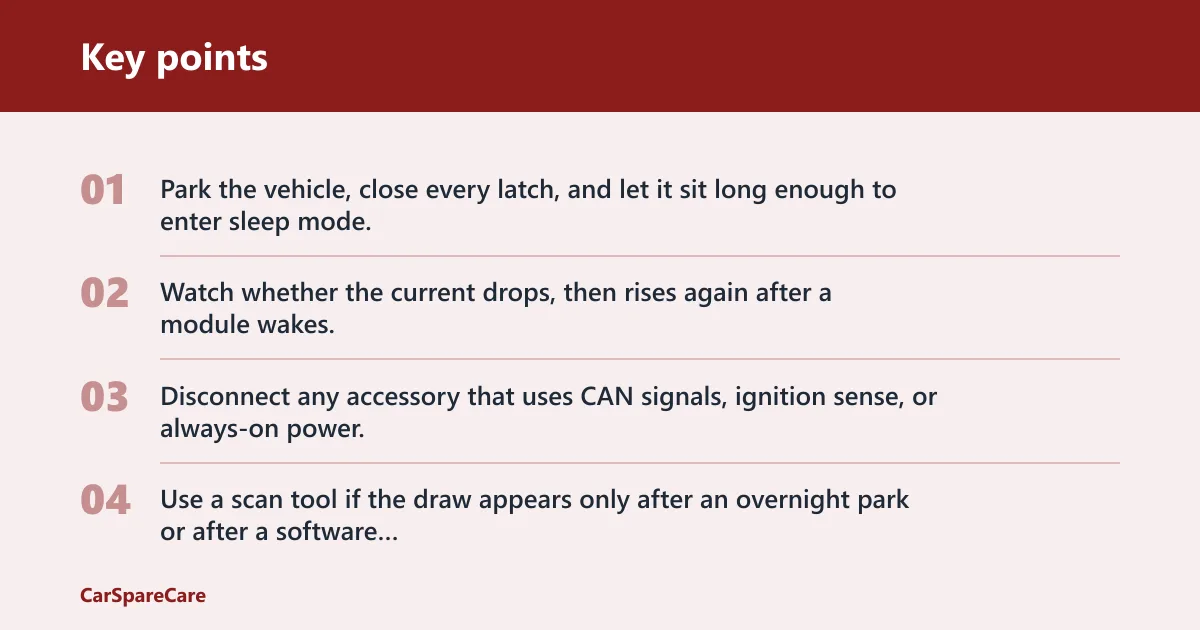
- Park the vehicle, close every latch, and let it sit long enough to enter sleep mode.
- Watch whether the current drops, then rises again after a module wakes.
- Disconnect any accessory that uses CAN signals, ignition sense, or always-on power.
- Use a scan tool if the draw appears only after an overnight park or after a software update.
Use a test light only as a quick draw-checking tool. It is less precise than a multimeter, but it can help find an obvious current path when a lamp or add-on is staying live. It is not the right tool for exact milliamps.
Common mistakes
- Testing before the vehicle sleeps. Wait until the modules shut down, or the reading will be too high.
- Leaving a door, hood, or trunk latch open. That can keep modules awake and turn on courtesy lights.
- Using the wrong multimeter port or range. Current testing needs the correct fused jack and range.
- Pulling fuses too fast. Give the system a few seconds after each pull so the current can settle.
- Blaming the battery first. Check terminals, grounds, and recent add-ons before replacing the battery.
A quick recharge may hide the symptom for a day, but it does not solve the drain. If the current is still high after the vehicle sleeps, keep tracing the branch instead of assuming the battery is weak. Older batteries and short trips can contribute to the problem, but they do not explain a clear post-parking draw by themselves.
Frequently asked questions
How do I check for a battery drain?
Disconnect the negative cable, place a multimeter in series, and wait for the vehicle to sleep before reading current. If the draw stays above the normal standby range after doors, hood, and trunk are latched, start removing recent accessories and then pull fuses to find the circuit.
How do I find out what’s draining my car battery?
Start with anything added last: dash cam, tracker, alarm, remote start, stereo work, or a charger left in the outlet. If removing those does not lower the current, move to fuse-by-fuse isolation. The circuit that makes the draw fall is the one to inspect next.
How do I check a car battery drain safely?
Keep the meter on the correct current jack, start on the highest current range, and avoid switching on loads while the meter is inline. Close every door, latch the hood and trunk, and do not bypass the meter fuse. That prevents false readings and meter damage.
What current draw is normal when my car is off?
Many modern vehicles settle around 20 mA to 50 mA after sleep. Mercedes is usually around 50 milliamps after sleep mode, while Audi says draw should not exceed 50 milliamps and anything over 100 milliamps is excessive. Vehicle design changes the exact limit.
How do I troubleshoot a battery drain after installing accessories?
Unplug the newest accessory first, then retest the resting current. If the draw drops, inspect that add-on’s fuse, relay, ground, and wake wire. If the draw remains high, move to the next accessory on your install list and then check the related fuse box.

Hi, I’m Melvin, an automobile engineer with extensive experience in automobile equipment. I currently work for a local automobile firm, where I specialize in the car parts industry. I’ve had the opportunity to collaborate with seasoned inspectors, gaining invaluable hands-on experience that goes beyond just theory.
My passion for automotive care started at a young age, which led me to create CarSpareCare. Through CarSpareCare, I share the knowledge and skills I’ve acquired over the years to help others navigate the world of car maintenance and repairs.
My goal is to provide practical tutorials, essential safety advice, and the latest industry insights so that anyone—whether a beginner or an expert—can confidently tackle their automotive projects.

