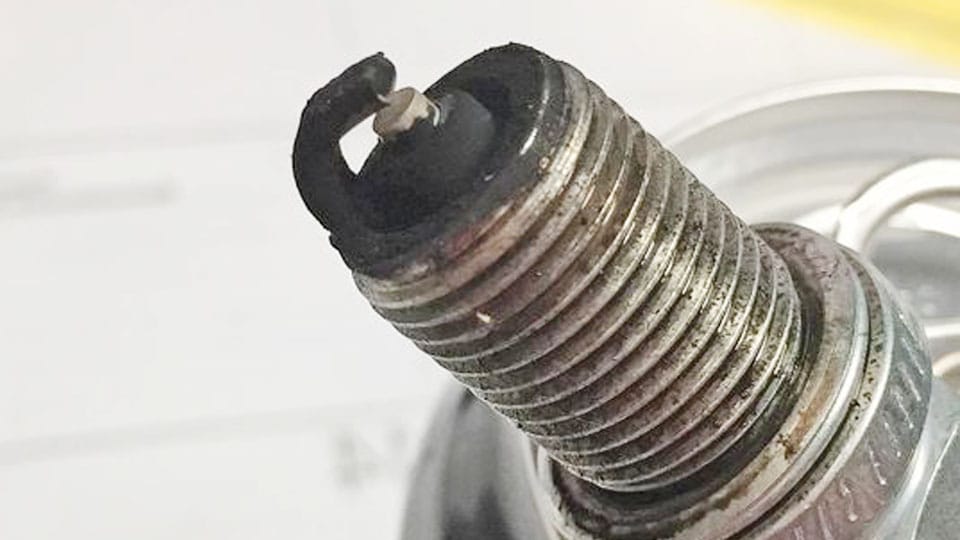
Buy the spark plug type your engine specifies. If both are approved, iridium spark plugs usually pay off when access is poor and replacement labor matters more than the part price. Choose the wrong plug and you can pay twice, once for the incorrect part and again for extra labor, misfires, or a shorter interval. This comparison focuses on fitment, cost, lifespan, and OEM spec.
OEM maintenance guidance commonly places spark-plug replacement around 30,000 miles for some applications and much longer intervals for precious-metal plugs, but the exact interval depends on the engine and the plug specified in the owner’s manual or service information.
| Decision factor | Copper | iridium spark plugs | Winner |
|---|---|---|---|
| Upfront cost | About $5 to $10 each | About $10 to $30 each | Copper |
| Service interval | Typically 20,000 to 30,000 miles, depending on OEM spec | Often 60,000 to 120,000 miles or more, depending on OEM spec | iridium spark plugs |
| Labor sensitivity | Lower value on engines that are easy to reach | Often better value on hard-to-reach engines | iridium spark plugs |
| OEM-spec fit | Can be correct on some older or performance engines | Common OEM choice on many modern engines | Tie |
| Long-term ownership | More repeat labor over time | Fewer replacements over the same period | iridium spark plugs |
Copper vs iridium spark plugs: the quick answer
The factory specification decides the starting point, not the metal. Copper plugs usually cost less up front, but iridium spark plugs often win on total ownership cost when the plugs sit under intake parts, coil packs, or tight firewall clearances. That is where repeat labor hurts more than a higher parts price.
Copper uses a copper core with a nickel-alloy tip. Iridium uses an ultra-fine iridium center electrode, and that design usually lasts much longer. Longevity matters only if the engine is actually specified for that plug style, heat range, and gap.
Why labor time can matter more than plug price
A set of copper plugs may look cheaper at checkout, but the job may need to be repeated two or three times before one iridium set would have been due. On a transverse V6 or a four-cylinder with buried rear plugs, the labor bill can wipe out the parts savings quickly.
That is why the better value is not always the cheaper plug. The real comparison is parts plus access time plus how long you plan to keep the car.
Spark plug materials and OEM spec
Copper core with nickel-alloy tip
Copper spark plugs use a copper core and a nickel-alloy tip. They are generally the budget-friendly choice and they are commonly replaced sooner, though some OEM schedules differ by engine.
That shorter interval can fit older engines, some performance builds, and cars where plug access is easy. It also fits owners who service the car often and want to keep parts cost low.
Ultra-fine iridium center electrode
Iridium spark plugs typically use a very fine iridium center electrode and are generally designed for long service life. Their higher upfront cost is often offset by fewer replacements.
Many modern engines specify iridium from the factory. That matters more than forum advice or material hype.
Why some engines specify platinum or iridium instead
Some ignition systems are built around a particular plug style, including single or double platinum in some applications. The owner’s manual or service information should govern the final choice, because plug material is only one part of fitment.
Heat range, reach, seat style, and electrode design all matter. A plug that looks close enough can still be wrong.
Comparison matrix: five buy scenarios
| Buy scenario | Upfront cost | Expected service interval | Labor sensitivity | Recommendation |
|---|---|---|---|---|
| OEM-spec match on a modern daily driver | Iridium costs more upfront | Longer interval helps reduce repeat service | High if plugs are under the intake or rear bank | Buy the OEM-specified iridium or platinum design |
| Older easy-access engine with copper allowed by spec | Copper is cheaper upfront | Shorter interval is less painful when access is simple | Low, because replacement is straightforward | Choose copper if the manual allows it and you will service it on schedule |
| Hard-access V6/V8 with rear plugs under the cowl or intake | Iridium costs more upfront | Long interval reduces tear-down frequency | Very high; labor dominates total cost | Choose iridium if it matches the OE spec |
| Short-term ownership, easy plug access | Copper saves the most upfront | Shorter interval may never be fully used before sale | Low | Choose copper only if it is an approved application |
| Long-term ownership, hard-to-reach plugs | Iridium costs more upfront | Fewer replacements over years of driving | High | Choose iridium if the engine calls for it |
Simple total-ownership example
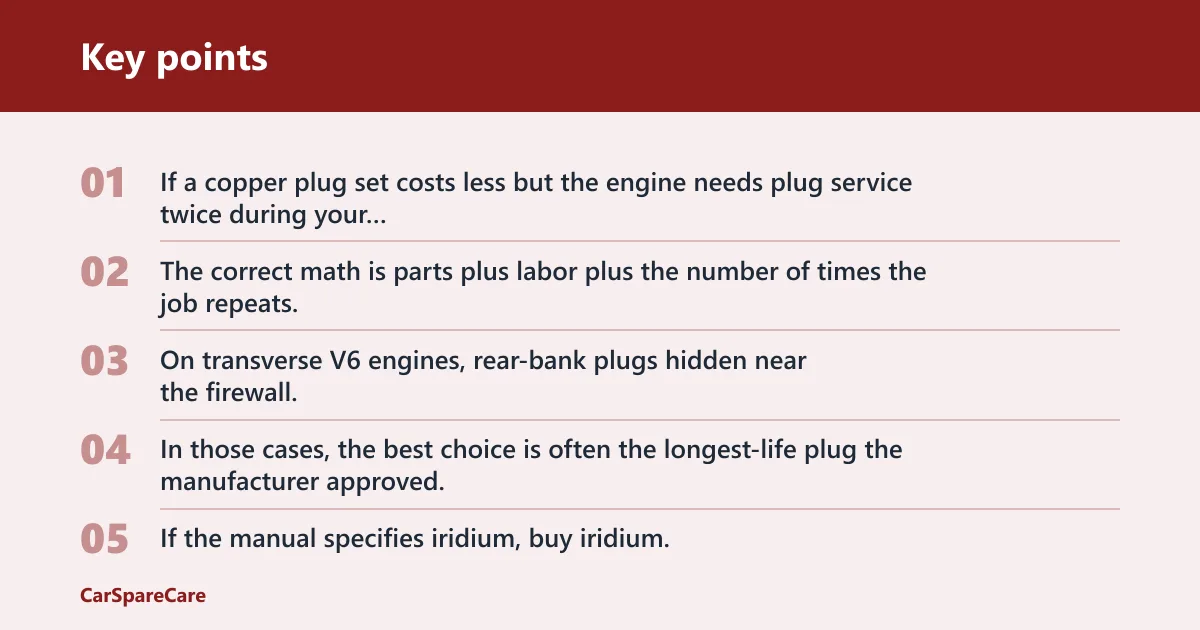
If a copper plug set costs less but the engine needs plug service twice during your ownership, the total bill can exceed one iridium service after labor is included. The correct math is parts plus labor plus the number of times the job repeats.
Real-world hard-access examples that change the recommendation
On transverse V6 engines, rear-bank plugs hidden near the firewall, and some engines that require intake manifold removal or significant coil-pack disassembly, labor changes the recommendation quickly. In those cases, the best choice is often the longest-life plug the manufacturer approved, because a repeat service is expensive even if the plug set itself is cheap.
OEM-spec match
If the manual specifies iridium, buy iridium. If it specifies copper or a specific platinum design, follow that instead. The right answer is the plug the engine was designed around.
This is where many rankings go wrong. They compare materials as if every engine accepts both equally, but the correct plug type, heat range, and gap are part of the vehicle’s calibration.
Older easy-access engine
On an older distributor-based engine with easy access, copper often makes the most sense. The job is simpler, the parts are cheaper, and the shorter service interval is less of a penalty when the plugs are easy to reach.
Picture a straightforward four-cylinder with plug wires on top of the valve cover. A lower-cost copper set can be the sensible buy if the engine is designed for it and the plugs are changed on schedule.
Modern hard-to-reach engine
On a modern coil-on-plug engine with buried rear cylinders, iridium often wins. Longer service life reduces how often you have to tear into the intake area or remove other components just to reach the plugs.
This is where the part price gap matters less than labor. A plug set that lasts longer can cost less over the vehicle’s life even if each plug costs more.
Budget short-term ownership
If you plan to sell the car soon and the plug job is easy, copper can be the better buy. You avoid paying for longevity you may never use.
That only holds if copper is allowed by the OEM specification. A cheap wrong plug is not a bargain.
Long-term ownership
If you plan to keep the car for years, iridium usually makes more sense, especially when the engine is difficult to service. Fewer plug changes can reduce the odds of repeated labor, broken boots, or time lost to the same repair.
That benefit is largest when plug access is poor. It is smaller on engines where replacement takes only a few minutes.
Heat range, gap, reach, torque, and seat type: what must match first
Before switching spark plug materials, five items must match the engine specification: heat range, gap, reach, seat type, and torque requirement. A plug can have the right thread diameter and still be wrong if any of those details do not match the OEM application.
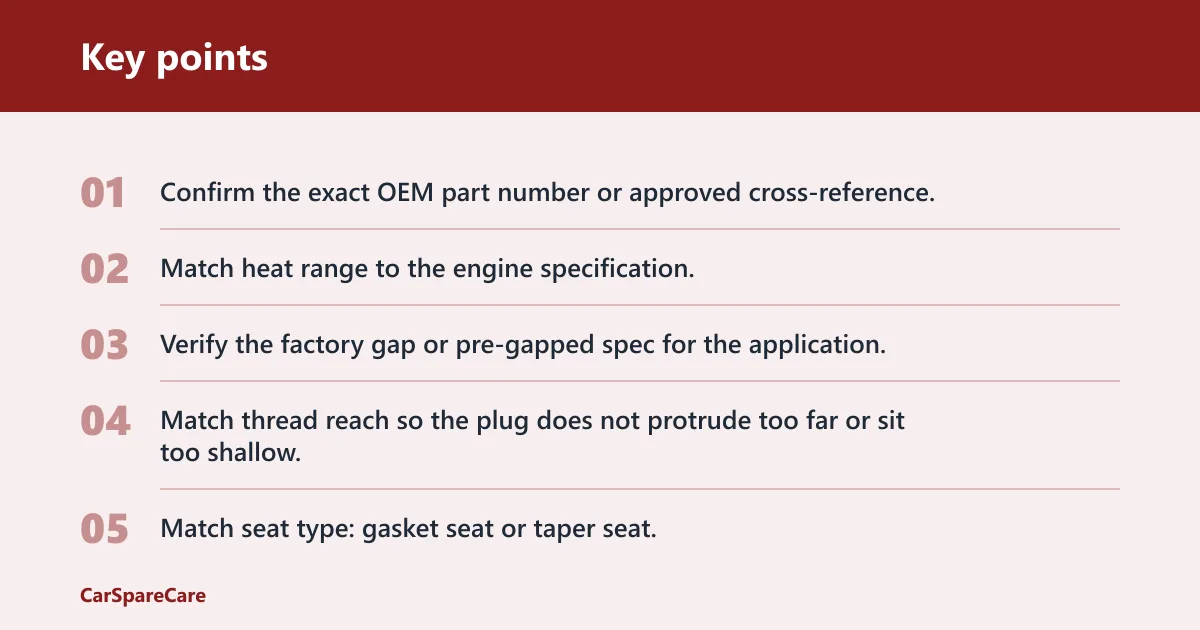
Fitment checklist before changing plug material
- Confirm the exact OEM part number or approved cross-reference.
- Match heat range to the engine specification.
- Verify the factory gap or pre-gapped spec for the application.
- Match thread reach so the plug does not protrude too far or sit too shallow.
- Match seat type: gasket seat or taper seat.
- Use the correct torque procedure from the service manual.
- Confirm whether the ignition system requires single platinum, double platinum, or a specific iridium electrode design.
Heat range
Heat range controls how quickly the plug sheds heat. A plug that runs too hot can overheat and damage the engine or itself; a plug that runs too cold can foul. OEM manuals and plug manufacturers treat heat range as a critical match, not a tuning preference.
Gap
Gap affects spark demand and ignition performance. The correct gap is engine-specific, and many modern plugs are installed as supplied unless the manufacturer instructs otherwise. If the specified gap is wrong, misfires and drivability problems can follow even when the plug material is correct.
Reach
Reach is the threaded length that enters the combustion chamber. Too much reach can interfere with the piston or hot spots; too little reach can disrupt combustion chamber exposure. This is one of the most important reasons to use the exact application listing instead of a generic “fits most” plug.
Torque
Torque matters because an under-tightened plug can leak compression and an over-tightened plug can damage threads or the shell. Use the OEM torque spec or the manufacturer’s installation method for the specific plug and cylinder head material.
Seat type
Seat type must match the cylinder head: gasket seat and taper seat are not interchangeable. The wrong seat can cause sealing problems, damage, or incorrect heat transfer.
How long do copper spark plugs last compared with iridium?
Copper plugs typically last less time than iridium plugs. Iridium plugs often last much longer. The gap is large enough that service interval, not just purchase price, should drive the decision.
That difference is why iridium often wins on labor-sensitive jobs. The parts may cost more, but you may only have to pay the labor once instead of two or three times over the same ownership period.
What shortens service life
Heat, deposits, coil output, and driving pattern all affect life. A plug used in a high-heat or deposit-prone engine may wear faster than the mileage range suggests, especially if the heat range is wrong.
Gap wear also increases as plugs age. A plug can still run, but the gap may drift away from spec and make the ignition system work harder.
Why replacement access changes the real cost
Labor matters most when the plugs are hard to reach. If a shop or driveway repair takes serious time to access the plugs, a longer service interval can save more than the price difference between copper and iridium.
Suppose a plug job requires intake removal on a V-engine. In that case, the higher upfront cost of iridium can be easier to justify because you are buying fewer repeat tear-downs.
Do iridium spark plugs improve fuel economy or just last longer?
Iridium plugs mainly last longer. They do not normally create a meaningful fuel-economy gain by themselves if the ignition system, fuel system, and engine condition are already in spec. Their value is mostly service life and reduced repeat labor.
Any mpg change is usually small and easy to confuse with other factors. If a vehicle runs poorly, the cause is more likely to be worn coils, injectors, vacuum leaks, carbon buildup, or compression loss than the plug metal alone.
When the payback comes from service interval
The economic case for iridium comes from fewer replacements, not from dramatic power or mileage gains. That is why it becomes more attractive as labor time rises or the ownership horizon gets longer.
On an easy plug job, the payback can be modest. On a difficult one, the savings can be real.
Can you switch from copper to iridium in your car?
Sometimes yes, but only if the engine manufacturer allows that plug style and the heat range, reach, seat type, and gap all remain correct. A material swap does not make an incompatible plug suitable.
Some engines can move from copper to iridium if an equivalent part exists. Others cannot, especially when the ignition system was calibrated around a specific platinum or iridium design.
When the swap is acceptable
If the manufacturer lists both plug types as acceptable equivalents, or if the replacement catalog clearly cross-references the exact OE part, the swap can be fine. The key is exact fitment, not just the same thread size.
That includes the correct gap and heat range. Changing plug material does not replace those requirements.
When the swap is wrong
If the engine calls for a specific heat range or electrode design, an iridium plug that does not match should not be treated as an upgrade. Wrong heat range can cause fouling, overheating, or shorter plug life.
Do not ignore single versus double platinum requirements either. Some systems need a very specific firing-surface design to match the ignition system and service interval.
Why older and modern ignition systems differ
Older distributor-based systems and some performance engines may suit copper, especially when they were designed for frequent service and simple access. Modern coil-on-plug systems often specify iridium because the engine is expected to run longer between plug changes.
The design difference is practical. A plug choice that fits an older engine’s maintenance rhythm may be wrong for a modern engine that expects long intervals and tight calibration.
Choose Copper if… / Choose iridium spark plugs if…
Choose Copper if the manual allows it, the engine is older and easy to service, you want the lowest upfront parts cost, or you are working on a build that calls for frequent plug checks and changes.
Choose iridium spark plugs if the manual specifies them, the plugs are hard to reach, you plan to keep the car for a long time, or the vehicle was designed around longer maintenance intervals. In those cases, the labor savings usually matter more than the part price.
- Check the owner’s manual or OE service data first.
- Confirm heat range, gap, seat style, and reach.
- Check whether the engine requires single or double platinum, or a specific iridium design.
- Estimate the labor time for plug access, not just the parts bill.
- Pick the plug that matches the engine and your ownership horizon.
Frequently asked questions
Are iridium spark plugs worth the extra money?
They are worth it when the engine is designed for them, access is difficult, or you plan to keep the car long enough to benefit from the longer service interval. If the plug job is cheap and easy, copper can still be the better value.
How much more do iridium spark plugs cost?
spark plugs can cost more in iridium form than in copper form. That price gap matters less when the job is labor-heavy, because a longer interval can reduce the total cost over the vehicle’s life.
Do I need to match gap and heat range when changing plug type?
Yes. The plug material does not replace the manufacturer’s gap or heat-range requirement. Gap wear increases as plugs age, and the wrong heat range can lead to fouling or overheating, so the replacement should match the engine spec exactly.
What happens if I use the wrong spark plug type?
You can get misfires, poor drivability, and shortened plug life. In more serious cases, the wrong reach or heat range can cause damage. The plug may also fail to match the ignition system’s needs.
Which spark plug is better for an older engine?
Copper is often the better fit for an older engine if the manual allows it and the plugs are easy to reach. Older distributor-based systems may be designed around more frequent service, so the lower upfront price can make sense when labor is low.
Do iridium plugs improve fuel economy or just last longer?
They mainly last longer. Any fuel-economy gain is usually small and should not be the main reason to buy them. The practical advantage is fewer replacements, which matters most on engines where the labor to reach the plugs is high.
Sources
Consult the exact vehicle’s owner’s manual and OE service data before purchasing replacement plugs.

Hi, I’m Melvin, an automobile engineer with extensive experience in automobile equipment. I currently work for a local automobile firm, where I specialize in the car parts industry. I’ve had the opportunity to collaborate with seasoned inspectors, gaining invaluable hands-on experience that goes beyond just theory.
My passion for automotive care started at a young age, which led me to create CarSpareCare. Through CarSpareCare, I share the knowledge and skills I’ve acquired over the years to help others navigate the world of car maintenance and repairs.
My goal is to provide practical tutorials, essential safety advice, and the latest industry insights so that anyone—whether a beginner or an expert—can confidently tackle their automotive projects.