Compare the spark plug’s stamped part number, box label, and physical details with the manufacturer catalog. If any code, font, seal, or electrode feature does not match, treat it as suspect. A counterfeit or wrong-spec plug can misfire, overheat, damage coils, and waste your time and money. This guide shows how to verify packaging, markings, dimensions, and electrode construction before installation.
What you’ll need
- Wire-style gap gauge
- Spark plug socket with deep well and rubber or magnet insert
- Factory part number lookup, service manual, or VIN-based catalog entry
- Flashlight or inspection light
- Clean cloth for handling packaging and parts
How do you spot fake spark plugs?
Start with the seller, then match the part number to the exact vehicle application. A genuine plug should line up with the stated heat range, thread size, reach, and seat type. Misspelled branding, blurred print, odd electrode shape, or an unverified seller origin all raise the risk of a counterfeit.
Check the seller and listing details
Use the seller’s full business name, return policy, and address. If the listing gives no traceable source, or the seller cannot show where the stock came from, treat the plug as unverified. OEM parts usually come through a dealer channel or a known distributor with clear lot traceability.
Match the part number and application
Compare the plug’s stamped number with the manufacturer catalog for your vehicle. Confirm heat range, thread size, reach, and seat type. A plug can be real and still be wrong for the engine if the application does not match.
Check branding and print quality
Look for clean, even lettering, correct logo shape, and consistent font spacing. Counterfeit plugs often show smeared ink, shallow stamping, or spelling mistakes. If a brand uses laser etching, the mark should be crisp and even across the ceramic or metal body.
Confirm the plug type
Iridium plugs often use a fine-wire center electrode and may arrive pre-gapped, but you still verify the gap. Platinum plugs may be single or double platinum, and both should show consistent wear-resistant construction. Do not assume a different look means fake; compare it with the claimed design.
What should OEM spark plug packaging look like?
OEM packaging should be clean, consistent, and traceable. Packaging details such as box construction, label layout, barcode or QR code, lot or batch code, country of origin, and supplier branding should generally match the catalog or dealer reference. Loose print, poor cardboard, or mismatched codes are warning signs.
Check box construction and label consistency
The box should close cleanly and hold its shape. Labels should sit straight, use consistent type, and show the same part number on every face that carries identification. If the outer box and the inner sleeve show different codes, it is safest to stop there and verify the part.
Match codes and traceability marks
Scan or compare the barcode or QR code if the packaging includes one. The lot or batch code should be legible and repeated consistently on the packaging. A missing code does not prove a fake, but it does remove an important traceability check.
Look for country and supplier marks
Country of origin and supplier branding should be printed clearly and placed where that brand normally puts them. A counterfeit often gets these details wrong, uses a generic box, or prints information in a layout that does not match known OEM packaging.
How can you verify a spark plug before installing it?
Verify the plug’s dimensions and build against the service manual before it goes near the engine. Check thread size, reach, and seat type, then inspect electrode geometry, insulator finish, and thread finish. Measure the gap with a wire-style gauge against factory spec, even on pre-gapped iridium plugs.
Confirm thread size, reach, and seat type
Wrong threads can strip, leak, or hit the piston. Compare the plug with the vehicle’s specified gasket seat or tapered seat, along with the listed thread size and reach. If any of those do not match the catalog entry, do not install it.
Inspect the electrode and insulator
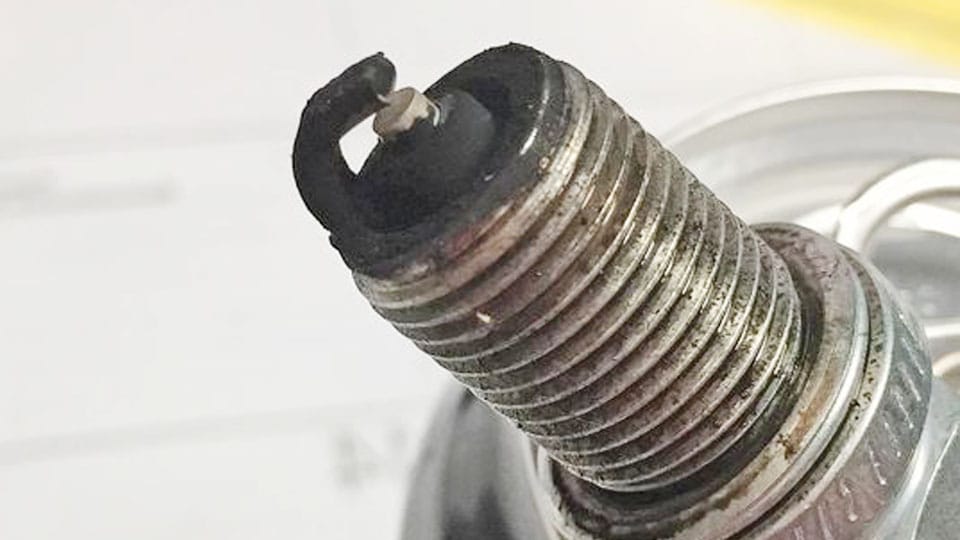
The center and ground electrodes should be straight, even, and consistent from plug to plug. The insulator ceramic should have a uniform finish without cracks, chips, or rough glazing. A common first-timer mistake is to trust a shiny shell while ignoring a bent or uneven ground strap.
Measure the gap with the right gauge
Use a wire-style gap gauge to check the gap between the center and ground electrodes. The correct gap helps the spark form and grow the flame. Recheck against the factory spec, not a guess.
Inspect laser etching and thread finish
Laser etching should be sharp, with clean edges and no blurred zones. The threads should have an even cut and a consistent finish, not burrs or rough spots. If the plug shows uneven machining or inconsistent electrode geometry, compare it with a known OEM reference before proceeding.
Spark plug verification checklist
Use this table as a pass/fail review before installation. Mark anything uncertain as unclear, then verify it against the catalog or service manual before the plug goes into the engine.
| Check | Pass | Fail | Unclear |
|---|---|---|---|
| Part number matches the vehicle application | Matches catalog exactly | Different code or suffix | Catalog not checked |
| Heat range matches OEM listing | Exact match | Different heat range | Not listed clearly |
| Thread size matches spec | Correct size | Wrong thread size | Not confirmed |
| Reach matches spec | Correct reach | Too short or too long | Unknown |
| Seat type matches gasket or tapered design | Matches vehicle spec | Wrong seat type | Not verified |
| Box label matches plug marking | Same number and brand | Mismatch | Box missing or damaged |
| Barcode or QR code is consistent | Scans or matches label | Broken, fake, or inconsistent | Unavailable |
| Lot or batch code is present | Readable and consistent | Missing or altered | Too faded to read |
| Country of origin is clearly marked | Legible and plausible | Missing or conflicting | Not shown |
| Brand markings and laser etching are clean | Sharp and even | Blurred or misspelled | Hard to judge |
| Electrode geometry matches OEM reference | Even and consistent | Odd angle or shape | No reference on hand |
| Gap matches factory specification | Within spec | Outside spec | Not checked |
Common mistakes
Do not trust a single cue. A clean box does not prove the plug is real, and a sharp logo does not fix a wrong application. Compare the part number, packaging, and physical details together.
Do not assume aftermarket spark plugs are counterfeit. Aftermarket means not OEM; it does not automatically mean fake. The real test is whether the plug matches the maker’s stated application and construction.
Do not treat pre-gapped iridium plugs as ready without checking. A wire-style gauge still matters, because shipping damage or factory error can change the gap.
Say your plug box shows the correct brand but the plug itself has a different suffix in the stamped number. That mismatch is enough to pause installation and verify the exact catalog entry before the plug goes into the head.
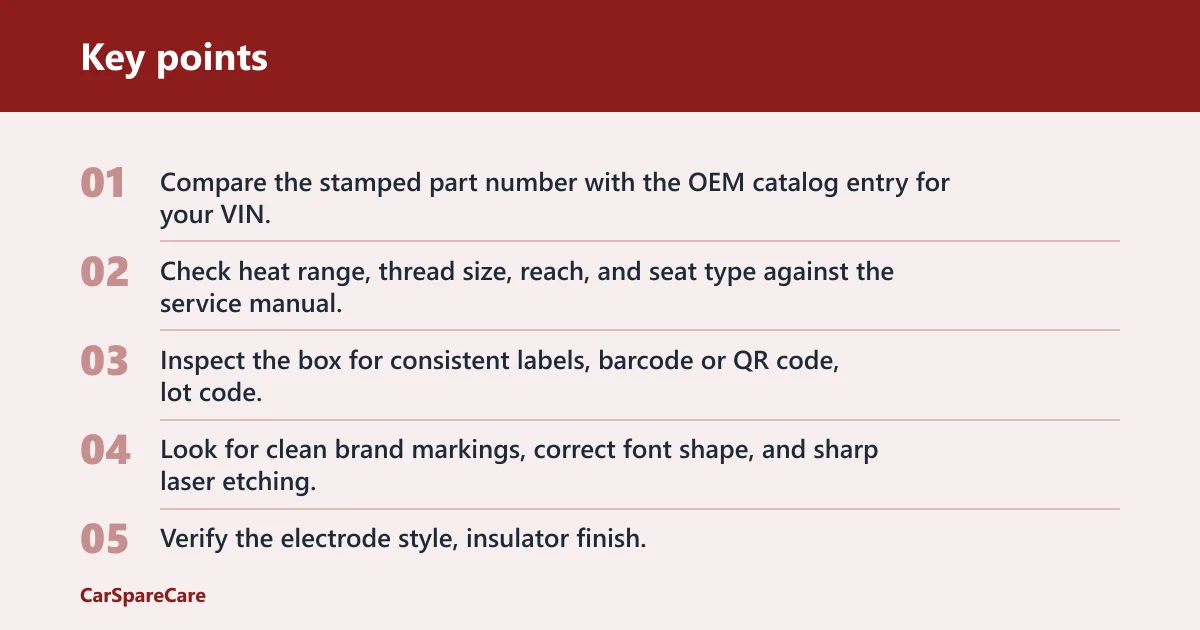
- Compare the stamped part number with the OEM catalog entry for your VIN.
- Check heat range, thread size, reach, and seat type against the service manual.
- Inspect the box for consistent labels, barcode or QR code, lot code, and country of origin.
- Look for clean brand markings, correct font shape, and sharp laser etching.
- Verify the electrode style, insulator finish, and thread finish against a trusted reference.
- Measure the gap with a wire-style gauge and compare it to factory spec.
- If any item is unclear, stop and compare it with a known genuine part or dealer reference before installation.
Frequently asked questions
How can I tell if spark plugs are OEM or counterfeit?
Match the stamped part number, box label, and physical build with the manufacturer catalog. Then verify seller traceability, lot code, and packaging quality. If the plug’s heat range, reach, seat type, or electrode shape does not line up, treat it as suspect before installation.
Are aftermarket spark plugs the same as OEM?
No. Aftermarket plugs are made outside the original vehicle brand’s parts channel, but they can still be correct for the engine if the application matches. Check the exact part number, heat range, reach, thread size, and seat type instead of assuming OEM and aftermarket are interchangeable.
What part numbers should I compare on spark plugs?
Compare the number stamped on the plug, the number on the box, and the number listed in the OEM catalog for your vehicle. If the plug has a suffix or revision code, that should match too. Any mismatch is a reason to stop and verify fitment.

Hi, I’m Melvin, an automobile engineer with extensive experience in automobile equipment. I currently work for a local automobile firm, where I specialize in the car parts industry. I’ve had the opportunity to collaborate with seasoned inspectors, gaining invaluable hands-on experience that goes beyond just theory.
My passion for automotive care started at a young age, which led me to create CarSpareCare. Through CarSpareCare, I share the knowledge and skills I’ve acquired over the years to help others navigate the world of car maintenance and repairs.
My goal is to provide practical tutorials, essential safety advice, and the latest industry insights so that anyone—whether a beginner or an expert—can confidently tackle their automotive projects.