
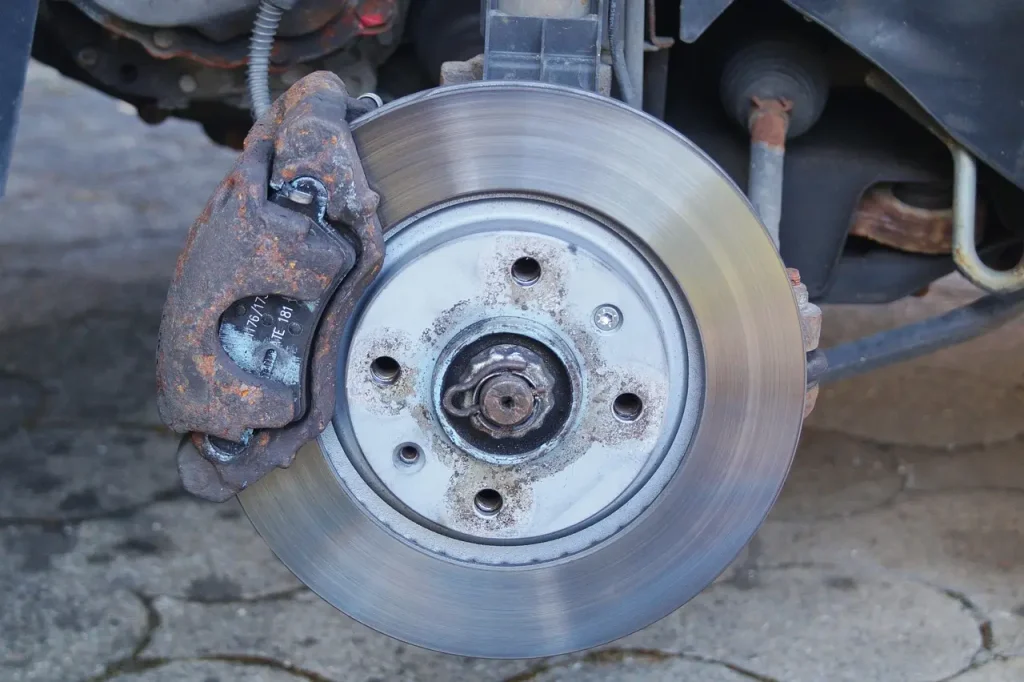
If front-end shimmy shows up only under light to moderate braking at road speed, start with rotor runout and pad deposits. If it also shakes while coasting or over bumps, look first at tires, hubs, or suspension. Ignoring it can waste parts, hide a failing wheel bearing, and stretch stopping distance. This guide shows a symptom-first path to separate brake, tire, hub, steering, and suspension faults before you replace anything.
Brake shimmy decision table
Use the symptom location first. That keeps you from chasing rotors when the real fault is a loose tie rod, or replacing suspension parts when the problem is brake pedal pulsation from the front axle pair.
| Symptom location | Likely cause | Quick check | Next test | Home or shop |
|---|---|---|---|---|
| Brake pedal pulse, little or no steering shake | Rotor runout, thickness variation, pad deposits, or caliper drag | Controlled stop from moderate speed; note whether the pulse rises and falls through the pedal | Measure rotor runout and thickness variation; inspect pads, caliper slides, and hose restriction | Home for visual checks; shop for dial indicator and micrometer work |
| Steering wheel shake, pedal feels normal | Front tire defect, wheel balance issue, hub play, tie rod end wear, or ball joint wear | Compare shake at braking and coasting; inspect tire pressure and tread on both front wheels, plus visible damage | Lift the vehicle with wheel chocks and jack stands, then check wheel play and inspect steering and suspension joints on the same side | Home if you have chocks and stands; shop for precise hub and alignment checks |
| Whole-car shimmy during braking | Combined brake and chassis issue, often with tire defect or worn suspension parts | See whether the shudder changes with road speed, braking force, or bumps | Inspect rotors, tires, wheel bearings, control arm bushings, and alignment angles | Home for first-pass inspection; shop if the source stays unclear |
| Pull to one side during braking | Sticking caliper, hose restriction, tire mismatch, loose steering parts, or alignment drift | Note whether the pull changes sides after tire rotation or stays tied to one corner | Check caliper drag, pad wear, tire condition, and front-end play | Home for visual checks; shop for brake hydraulic diagnosis |
What the symptom tells you first
Separate the symptom before naming parts. A brake pedal pulse points more toward rotor or caliper trouble, a steering wheel shake points more toward front-end looseness or tire issues, and a body-wide shudder often means both systems deserve attention.
Pedal pulse usually points to brake hardware
When the pedal rises and falls under braking, the front rotor pair is often the first place to check. Runout, thickness variation, scoring, heat spots, or uneven pad transfer can all create a vibration you feel through the pedal, especially during a controlled stop from moderate speed.
Rotor symptoms are not limited to hard braking. Some judder shows up most clearly at a moderate speed and pedal-pressure range, then fades if you brake harder or softer. That pattern matters, because it helps separate rotor issues from loose suspension parts that react to load more broadly.
Shake in the wheel often points to front-end looseness
If the steering wheel shivers more than the pedal, look at the parts that hold toe and camber steady under braking. Tie rod ends, ball joints, control arm bushings, and wheel bearings can let the wheel move enough to magnify a brake vibration.
Front-end problems can also make a vehicle pull to one side and wear tires unevenly. Alignment alone will not fix worn components. It only holds geometry after the loose or damaged part is repaired.
Chassis shudder can involve both
A whole-car shimmy is a mixed signal. Tires, hubs, brakes, and suspension can all contribute, so the test order matters. Start with the symptom that is strongest, then expand outward only if the first subsystem does not explain it.
- Confirm whether the pulse is in the pedal, wheel, or body.
- Check tire pressure, tread, and visible damage on both front wheels.
- Inspect brake pads and rotors for scoring, heat marks, and uneven wear.
- Lift the vehicle safely with wheel chocks and jack stands before checking play.
- Compare the same side to the other side before replacing any parts.
Follow the vehicle manual, avoid working under a vehicle held only by a jack, do not exceed the vehicle’s rated roof, hitch, or tow limit, keep items out of airbag zones and the driver’s view, and check local laws.
Why does my steering wheel shake when I brake?
Steering wheel shake under braking usually means the front corner can move, or the brake surface is not running true. Rotor runout and thickness variation can start the vibration, then tie rod end play, ball joint wear, hub looseness, or tire defects make it easier to feel through the wheel.
Rotor runout and thickness variation
Runout means the rotor face does not spin perfectly true. Thickness variation means the rotor is not evenly thick around the disc. Either one can push the pads back and forth, which shows up as pedal pulsation and sometimes steering wheel shake through the front axle pair.
To check it properly, the wheel usually needs to be off, the rotor clean, and a dial indicator and micrometer are commonly used. A quick eyeball check is useful, but it does not replace a measurement. Scoring, hot spots, or bluish patches suggest heat history, not just a cosmetic mark.
Caliper drag and uneven pad wear
A sticking piston or slide pin can keep one pad in contact longer than the other. That creates uneven pad wear, extra heat, and a pull or shimmy that can look like rotor trouble. If one front wheel runs much hotter than the other after a drive, caliper drag moves up the list.
Look for torn boots, frozen slides, or pads that wear unevenly from inner to outer edge. A restricted hose can also hold pressure in the caliper and mimic a binding slide. That check is more than visual; it usually needs brake service procedures from the manual.
Lug torque and hub face contamination
Loose lug nuts or rust and debris between the rotor and hub can mimic a warped rotor. If the rotor was installed on a dirty hub face, it may sit crooked and show runout right away. Lug torque matters because uneven clamping can distort the rotor enough to create brake shake.
Suppose the steering wheel shakes only after a recent brake job. In that case, check the hub face for corrosion and confirm the wheel nuts were tightened in the correct pattern and to the vehicle spec before chasing a more expensive fault.
How do I inspect rotors and calipers?
Start with pad thickness, rotor surface condition, and caliper movement. Then measure runout and thickness variation if the basic inspection does not explain the symptom. That order keeps you from replacing rotors when the real issue is a sticking caliper or a contaminated hub.
Pad thickness, scoring, and heat spots
Inspect both pads on the same axle. Uneven wear across one corner points toward caliper drag or guide pin trouble. Heavy scoring, grooves, or blue heat spots on the rotor point to heat and friction issues that need more than a simple pad swap.
Runout and thickness variation checks
Measuring rotor runout requires the rotor to be mounted the way it runs on the car. A dial indicator tells you whether the disc wobbles as it turns. A micrometer helps compare rotor thickness at several points around the rotor to find thickness variation.
Do not start with runout unless you can measure it. If you cannot set up the tool correctly, the number is not useful. A shop with the right measuring tools is the better choice when the diagnosis hinges on that reading.
Slide pins, piston return, and hose restriction
Check that the caliper slides move freely and the boots are intact. Then verify the piston returns normally when the brake pedal is released. If the wheel still drags, the flexible hose may be collapsing internally and holding pressure in the caliper.
Front-end repair addresses uneven tire wear, but brake drag can create its own wear pattern too. A caliper that sticks on one side can mimic a suspension pull and make the car feel unstable under braking.
Could tires or wheel balance be the cause?
Yes. Tires can mimic brake shake very convincingly. Belt separation, flat spots, pressure mismatch, and radial force variation can all make the car vibrate when braking, even when the brakes themselves are within spec.
Separated belts and flat spots
Look for bulges, scalloped tread, or a tire that looks distorted when it spins. A separated belt can move under load and create a shake that feels like rotor trouble. Flat spots from storage or a hard lockup can also create a speed-dependent vibration.
A common first-timer mistake is to blame the rotors when the tire has an obvious defect on the same corner. A separated belt can shake most at road speed, then seem worse when you brake because the suspension loads the tire harder.
Pressure mismatch and uneven wear
Check both front tires cold and compare them to the placard or owner’s manual. A pressure mismatch can change how the tire contacts the road and exaggerate a vibration. Uneven wear can point to alignment drift, worn steering parts, or a tire issue that came first.
When balance or radial force variation matters
Wheel balance is worth checking if the shake appears at certain speeds whether you brake or not. Radial force variation can also mimic brake shimmy because the tire flexes unevenly as it rolls. If the vibration stays present while coasting, balance and tire structure rise on the list.
Could steering or suspension wear be causing it?

Yes. If the wheel moves when you brake, the suspension and steering parts that locate the wheel may be worn. Tie rod ends, ball joints, control arm bushings, and wheel bearings all deserve inspection when the symptom changes with load or road irregularities.
Tie rod end play, inner and outer
Tie rod ends control toe. Wear in either the inner or outer joint can let the wheel steer slightly as the brakes load the front end. The joint should not show looseness when the wheel is lifted and moved by hand according to the manual’s test method.
Do not confuse normal steering-system movement with actual play. A small amount of system movement can be normal, but a clunk, visible lag, or side-to-side free play at the joint is not. The inner joint often needs more careful checking because it sits closer to the rack.
Ball joint movement and boot damage
Ball joints can wear gradually and develop vertical or horizontal play. Damaged boots let grease escape and dirt enter, which speeds wear. A worn joint can let the wheel tilt during braking or turning, and that tilt can feel like shimmy or wander.
How do you know if a ball joint is bad? Look for torn boots, uneven tire wear, clunks over load changes, and movement during the correct pry or lift test. The exact test varies by design, so use the manual rather than guessing at the direction of force.
Control arm bushings and alignment drift
Control arm bushings allow some motion, but cracks, separation, or oil saturation let the wheel move too far under braking. That movement changes alignment dynamically, so the car may track straight at one moment and drift the next as load shifts.
How can you tell if your control arm bushings are worn? Look for split rubber, metal-to-metal contact, leaking fluid if the bushing is hydraulic, and excessive movement when the arm is loaded. If the bushing changes shape dramatically under brake load, it is no longer doing its job.
Wheel bearing looseness under load
A wheel bearing can add noise, looseness, and vibration that gets worse under braking. Check for play with the wheel off the ground and compare both sides. A bearing that is noisy or loose can amplify a brake shimmy and make the front end feel vague.
When you lift the vehicle, compare the left and right front corners. Same-side comparison matters because a tiny amount of movement on one side can be normal for that design, while more movement than the other side usually points to a fault.
When should you stop DIY diagnosis?
Stop when the diagnosis needs a lift, dial indicator, torque wrench, or alignment rack and you do not have the right tools. That is especially true if the symptom changes sides, the car pulls hard, or the wheel play is not obvious but the vibration remains.
Signs that need a lift or measuring tools
If you cannot safely lift the vehicle with wheel chocks and jack stands, do not continue. If the rotor diagnosis depends on runout or thickness measurements, you need the correct equipment. If a wheel bearing feels loose or a caliper drags but the cause is still unclear, a shop inspection is the better next step.
The shop should inspect front-end problems with the vehicle lifted and the joints checked for movement. That is the type of work that catches worn tie rod ends, ball joints, control arm bushings, and wheel bearings before more parts are replaced.
When alignment comes after part replacement
Alignment is the final step after worn steering or suspension parts are repaired. It cannot fix a loose joint or torn bushing. Once the parts are in spec, alignment brings toe, camber, and caster back to a controlled range so the car stops drifting and tracks straight.
When the source is still unclear
If the shake does not match a clear brake, tire, or suspension pattern, book a professional inspection. A Bossier City, Louisiana facility listed at 5355 Swan Lake Rd can be reached at (318) 616-1976. Their hours are Monday through Friday, 7:30 am to 5:00 pm, and they are closed on Saturday and Sunday.
Frequently asked questions
How do I diagnose front end shimmy under braking?
Start by identifying where the symptom is strongest: pedal, wheel, or whole body. Then inspect tires, brakes, and front-end parts in that order. Use a safe lift with chocks and stands, compare both sides, and move to dial-indicator or alignment-rack testing if the first-pass checks do not explain it.
Is a steering wheel shimmy under braking caused by rotors or suspension?
It can be either, and the symptom location helps separate them. Pedal pulsation leans toward rotors or calipers. Steering wheel shake leans toward tires, hubs, or suspension. A whole-car shimmy usually means more than one issue is contributing, so do not replace parts based on guesswork.
How can I tell if my control arm bushings are worn?
Look for cracks, separation, oil saturation, or metal contact where rubber should isolate the arm. Under load, worn bushings let the wheel move enough to change alignment and brake feel. If the car drifts, wanders, or shifts under braking, the bushings deserve close inspection.
How do I know if a tie rod end is bad?
A bad tie rod end shows looseness when the wheel is lifted and checked by hand, but the test must follow the manual for that suspension design. You are looking for actual joint play, not normal steering movement. Clunks, delayed wheel response, and uneven toe control are common signs.
Do warped rotors cause a shake in the wheel or the brake pedal?
They usually show up as brake pedal pulsation first, though the steering wheel can shake too if the front axle pair is involved. The vibration may be most noticeable at moderate speed and moderate pedal pressure. Runout and thickness variation are better terms than “warped” for many cases.

Hi, I’m Melvin, an automobile engineer with extensive experience in automobile equipment. I currently work for a local automobile firm, where I specialize in the car parts industry. I’ve had the opportunity to collaborate with seasoned inspectors, gaining invaluable hands-on experience that goes beyond just theory.
My passion for automotive care started at a young age, which led me to create CarSpareCare. Through CarSpareCare, I share the knowledge and skills I’ve acquired over the years to help others navigate the world of car maintenance and repairs.
My goal is to provide practical tutorials, essential safety advice, and the latest industry insights so that anyone—whether a beginner or an expert—can confidently tackle their automotive projects.

