
15 volts is generally too high if it stays at the battery with the engine running; many 12V systems settle around 13.5 to 14.8 volts, with brief spikes being less concerning (Battery University; Battery Council International). If it keeps climbing, overcharging can cook the battery, damage electronics, and shorten alternator life. This guide shows how to tell a normal charging fluctuation from a fault and how to check it safely.
What does 15 volts mean?
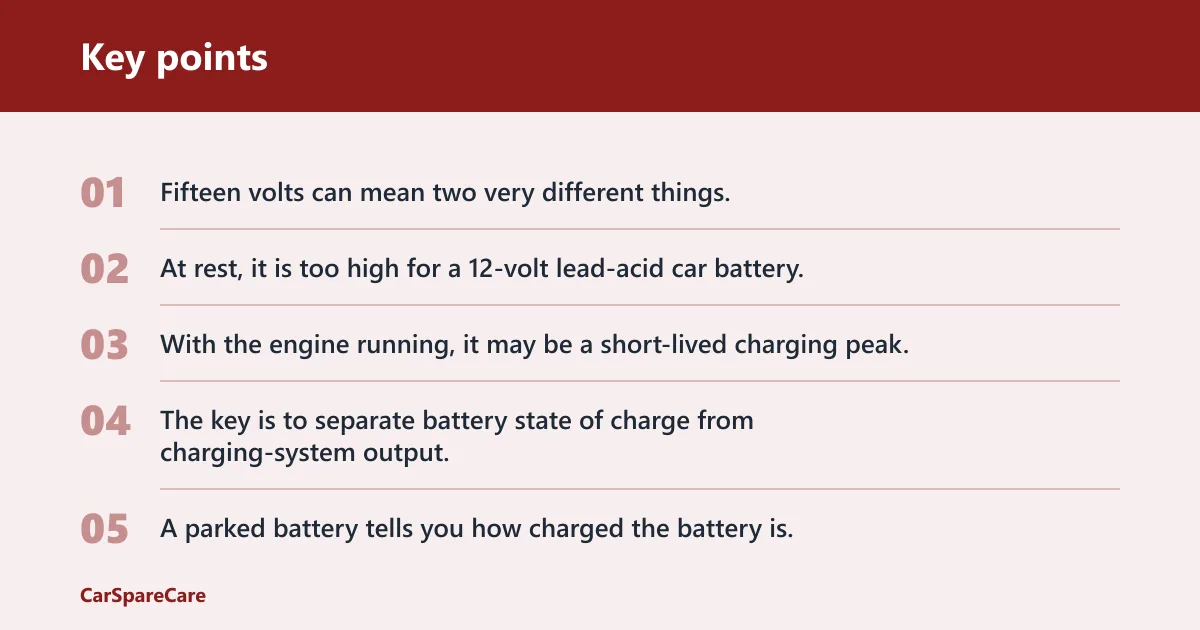


Fifteen volts can mean two very different things. At rest, it is too high for a 12-volt lead-acid car battery. With the engine running, it may be a short-lived charging peak, a cold-weather charging strategy, or a sign that the alternator or voltage regulator is pushing too hard.
The key is to separate battery state of charge from charging-system output. A parked battery tells you how charged the battery is. A running engine tells you what the alternator is doing, and that reading can be higher by design.
Resting voltage vs charging voltage
A healthy 12-volt battery in a passenger vehicle is normally checked with the engine off after the surface charge has faded. In that state, 15 volts is not a healthy reading. It is far above a fully charged resting range and points to a bad test, a surface-charge effect, or the wrong measurement point (Battery University).
Charging voltage is different. The alternator is the charging-system component, and it can raise system voltage above battery-resting levels while the engine runs. That is why “15 volts” only makes sense when you know whether the engine is off or on.
When 15 volts can be temporary
Some vehicles, especially those with smart charging, can briefly command higher voltage after startup, in cold weather, or when the battery is low. Short periods near 15 volts are less concerning if the reading drops as the battery recovers and the load changes.
A brief spike is not the same as sustained overvoltage. If the meter stays near 15 volts after the engine has been running for several minutes, the reading deserves a closer look.
When 15 volts points to a fault
Persistent 15 volts on many vehicles can mean overcharging. Common causes include a failing voltage regulator, an alternator fault, a bad ground, or wiring that is making the system read and control voltage incorrectly (NAPA Know How). If the reading stays high across repeat checks, do not assume the battery itself is the only problem.
Is 15 volts too high for a car battery?
At rest, yes. A 12-volt lead-acid car battery should generally not read 15 volts when the engine is off. With the engine running, 15 volts may be acceptable only in a brief or managed charging condition. If it stays there, the charging system may be overcharging (Battery University; Bosch Automotive Aftermarket).
That difference matters because the same number can mean “bad battery reading” or “charging system fault.” The answer changes with engine state, temperature, and whether the reading settles or remains high.
What sustained overvoltage can do
Sustained overcharging can heat the battery, drive off electrolyte, and cause gassing. You may notice a sulfur or rotten-egg smell, warmth at the case, swelling, or a dashboard charging warning light (ODYSSEY Battery). Electronics can also be stressed if the system voltage remains too high for long periods.
If you see heat, smell, swelling, or warning lights with a high-voltage reading, stop treating the battery as the only suspect. Inspect the alternator, regulator, ground paths, and belt drive.
What should a 12-volt battery read?
A healthy 12-volt lead-acid battery in a passenger vehicle commonly reads about 12.4 to 12.7 volts at rest when fully charged (Battery University). Lower numbers can still be usable, but they suggest reduced state of charge. A reading near 12.0 volts is low, not full.
Healthy resting voltage bands
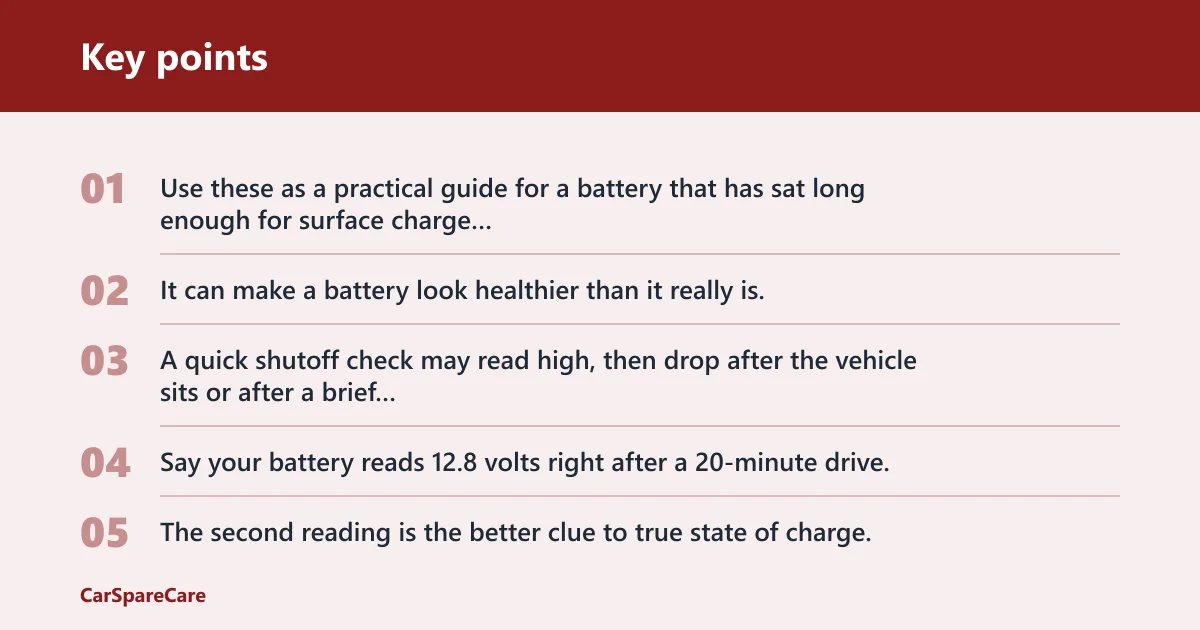
Use these as a practical guide for a battery that has sat long enough for surface charge to fade:
| Resting voltage | Likely state of charge | What it usually means |
|---|---|---|
| 12.6 to 12.7 volts | Full or near full | Healthy resting range for many lead-acid batteries |
| 12.4 to 12.5 volts | Mostly charged | Often acceptable, but not fully topped off |
| 12.2 to 12.3 volts | Partly discharged | Needs charging soon, especially before testing starts |
| 12.0 to 12.1 volts | Low | Battery is discharged or has sat with a load |
| Below 12.0 volts | Very low | Charge the battery and retest before judging the alternator |
Why surface charge can mislead you
Surface charge is a temporary voltage rise on the battery plates after charging or driving. It can make a battery look healthier than it really is. A quick shutoff check may read high, then drop after the vehicle sits or after a brief electrical load removes the surface charge.
Say your battery reads 12.8 volts right after a 20-minute drive, then falls to 12.5 volts after the headlights are on for a minute and the car sits for 10 minutes. The second reading is the better clue to true state of charge.
How to check voltage with a multimeter

A multimeter is the proper tool for this job. Set it to DC volts, place the probes on the battery posts, and compare engine-off and engine-running readings. A bad probe location or the wrong meter setting can create a false diagnosis.
- Set the meter to DC volts, not AC volts.
- Touch the red probe to the positive battery terminal.
- Touch the black probe to the negative battery terminal or a clean engine ground point.
- Read the voltage with the engine off.
- Start the engine and read the voltage again.
- Turn on headlights, blower, and rear defogger, then watch whether voltage settles or stays high.
- If the reading seems high, let the car sit or apply a brief load, then retest.
Probe placement and meter setup
Probe placement matters. Measuring across the battery posts gives a clearer answer than touching random fasteners or painted metal. If you use the engine block as the ground reference, make sure it is clean and solid. Corroded clamps can also throw off the reading.
If the meter is on the wrong setting, it can misread the system completely. That is especially important when people see a number near 15 and assume the battery itself is bad.
Test engine off, then engine running
Start with the engine off. That tells you battery state of charge. Then start the engine and repeat the test. That second reading tells you what the alternator and voltage regulator are doing under real conditions.
A common first-timer mistake is reading only one value and treating it as both battery health and charging output. Those are different checks.
15 volts too high decision table
This table ties the reading to engine state, symptoms, and the most likely next step. Use it as a diagnosis path, not as a replacement for a full charging-system inspection.
| Measured voltage | Engine state | Ambient / condition clue | Symptom pattern | Most likely cause | Next action |
|---|---|---|---|---|---|
| 12.4 to 12.7 volts | Engine off | Battery has sat long enough for surface charge to fade | No warning light, normal cranking | Normal resting battery voltage | No action needed unless other symptoms exist |
| About 12.7 to 12.9 volts | Engine off, right after charging or driving | Warm battery, recent run time | Reading falls after sitting or after a brief load | Surface charge | Retest after 10 to 30 minutes or after a short headlight load |
| 13.5 to 14.8 volts | Engine running | Normal load, moderate temperature | No smell, no swelling, no warning light | Normal charging | Monitor only if behavior changes |
| Near 15 volts, brief spike only | Engine running | Cold start or smart charging event | Voltage drops after startup or load changes | Managed charging or cold-weather behavior | Retest after several minutes with accessories on |
| 15 volts or higher, sustained | Engine running | Any temperature | Battery heat, odor, swelling, or charging light | Regulator fault or alternator issue | Inspect charging system and avoid long driving until checked |
| High or unstable reading | Any state | Corroded terminals, loose ground, or odd meter behavior | Reading changes when cables are moved | Bad ground, wiring fault, or test error | Clean connections and repeat the test at the battery posts |
Why is my car charging at 15 volts?
Fifteen volts while charging can come from a regulator fault, a bad ground, wiring resistance, or a charging strategy that is temporarily raising voltage. If the reading is steady and the battery is heating or gassing, treat it as overcharging until proven otherwise.
The alternator and its voltage regulator are the main parts to inspect first. On many modern vehicles, the regulator is built into the alternator, so a fault there can raise output voltage above normal. Belt slip and poor drive conditions can also confuse the diagnosis, though they usually cause low charging, not high.
Alternator regulator fault
A failed voltage regulator can let alternator output climb above the normal range. That is a common reason for a battery-side reading near 15 volts while the engine runs. If the voltage stays high across different engine speeds and electrical loads, the regulator moves high on the suspect list.
Bad ground or wiring issue
Bad grounds, corroded terminals, or damaged wiring can distort what the meter shows and can also interfere with how the charging system controls output. A weak ground path can create strange readings that change when the engine revs, accessories switch on, or the cable is moved.
Inspect battery terminals, chassis grounds, and engine ground straps. Then repeat the test directly across the battery posts to reduce error from the vehicle body or cable connections.
Smart charging or cold-weather behavior
Some vehicles vary charging voltage with battery condition, temperature, and electrical load. Cold batteries can receive a higher charging voltage for a short time, and smart charging systems may change output after startup. That behavior can be normal if it settles down instead of staying high.
Picture a car that shows 15.0 volts for the first minute after a winter start, then falls to 14.2 volts once the cabin fan and headlights are on. That pattern is very different from a flat 15.0 volts that never drops.
Meter or test error
A false high reading is possible if the meter is on the wrong setting, the probes are not on the battery posts, or the connection is unstable. Cheap or damaged meters can also mislead you. If the number seems odd, repeat the test with a known-good meter or at a parts store if available.
Signs of overcharging
Overcharging often leaves clues beyond the voltage number. Heat at the battery, a strong chemical smell, swelling, wetness around the case, or a dashboard charging warning light all deserve attention. Electrical oddities, such as bulbs that seem brighter than normal or accessories acting strangely, can also fit the picture (ODYSSEY Battery; Interstate Batteries).
When to stop driving and inspect
Stop driving and inspect the charging system if the battery is hot, swollen, venting odor, or if the voltage stays near 15 volts or higher after repeat checks. Continued driving can damage the battery and other electronics. A charging-system inspection is the next step, not a battery guess.
Frequently asked questions
What voltage is too high for a car battery?
For a resting 12-volt lead-acid battery, 15 volts is too high. For a running vehicle, sustained voltage above the normal charging range, often above about 14.8 volts on many systems, is suspicious. Context matters, so always note whether the engine is off or on (Bosch Automotive Aftermarket).
Is 14.5 volts good for a car battery?
Yes, 14.5 volts is often a normal charging voltage with the engine running. It is not a resting battery voltage. If the reading is steady, the battery is not overheating, and no warning lights are on, 14.5 volts is usually within a healthy charging range.
Is 12.5 volts ok for a car battery?
Yes, 12.5 volts is generally an acceptable resting reading for a 12-volt battery. It suggests the battery is partly to mostly charged, though not at the very top of the usual full-charge range. Use it as a resting reading only, not as a running-voltage target.
What should a car battery read when the engine is running?
Most 12-volt systems should read roughly 13.5 to 14.8 volts with the engine running. Some vehicles briefly go higher, especially in cold conditions or with smart charging, but a steady reading near 15 volts is more likely to signal overcharging or a control fault.
Can 15 volts damage a car battery?
Yes, if 15 volts is sustained. Long periods of overvoltage can heat the battery, push out electrolyte, and shorten battery life. It can also stress bulbs, modules, and other electronics. A short spike is less worrying than a steady high reading that does not fall (ODYSSEY Battery).

Hi, I’m Melvin, an automobile engineer with extensive experience in automobile equipment. I currently work for a local automobile firm, where I specialize in the car parts industry. I’ve had the opportunity to collaborate with seasoned inspectors, gaining invaluable hands-on experience that goes beyond just theory.
My passion for automotive care started at a young age, which led me to create CarSpareCare. Through CarSpareCare, I share the knowledge and skills I’ve acquired over the years to help others navigate the world of car maintenance and repairs.
My goal is to provide practical tutorials, essential safety advice, and the latest industry insights so that anyone—whether a beginner or an expert—can confidently tackle their automotive projects.