Cold Weather Car Battery Care Tips start with one rule: keep the battery fully charged, clean the terminals, and test it before temperatures drop below freezing. A weak battery can fail in extreme cold because starting performance drops as temperatures fall, oil thickens, and electrical load rises. This guide covers prevention, short-trip habits, storage, and a clear when-to-charge, test, or replace decision tree.
Why cold weather hurts battery starts
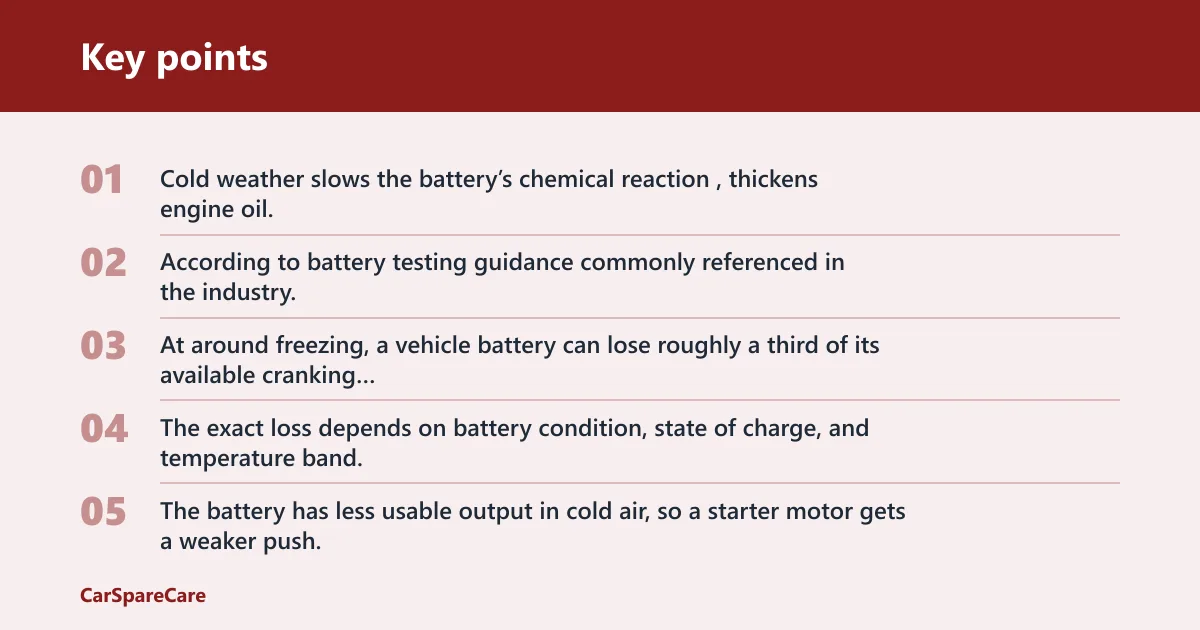


Cold weather slows the battery’s chemical reaction, thickens engine oil, and raises the load from heaters, headlights, wipers, and heated seats. According to battery testing guidance commonly referenced in the industry, output falls as temperature drops, so all three changes work the same way: less starting power, more resistance, and a harder first crank.
At around freezing, a vehicle battery can lose roughly a third of its available cranking capability, and in much colder weather the drop can become much steeper. The exact loss depends on battery condition, state of charge, and temperature band, but the practical result is the same: a weak battery can turn into a no-start battery.
Cold slows the battery
The battery has less usable output in cold air, so a starter motor gets a weaker push. The problem gets worse if the battery is already old, partially discharged, or coated in corrosion at the terminals. SAE CCA testing is done at -18°C (0°F), which is why that benchmark matters when winter starting becomes difficult.
Winter oil raises cranking resistance
Winter engine oil thickens in cold weather. That raises starting resistance and makes the battery work harder to spin the engine. The battery may not be the only weak point, but it often gets blamed first because the symptom shows up at the key turn.
Accessory load cuts available reserve
Heaters, headlights, wipers, and heated seats increase winter electrical load and reduce the reserve left for starting. If you switch everything on during a cold start, the battery has less margin to recover from the first crank. Battery reserve capacity is the standardized backup measure for how long a battery can supply power if the charging system is struggling or offline.
What the battery specs mean in winter
Cold cranking amps, or CCA, is measured at -18°C and tells you how much starting power the battery can deliver in cold weather. Reserve capacity is measured in minutes and shows how long the battery can supply power if the charging system has trouble. In winter, both numbers matter, along with the battery’s type and age.
Cold cranking amps and freezing starts
Higher CCA helps in freezing temperatures because the battery can deliver more starting current when chemical activity slows down. Battery Council International describes CCA as the number of amps a battery can deliver at 0°F for 30 seconds while maintaining a usable voltage, so more CCA is usually a better fit for severe winters, diesel engines, and vehicles with heavier starting loads.
Reserve capacity and backup power
Reserve capacity matters when the alternator or charging system is not keeping up. A battery with more reserve capacity can support electrical loads longer if the charging system malfunctions, or if you are driving with defrosters, lights, and wipers on for an extended period. Industry definitions generally use reserve capacity to describe the minutes a fully charged battery can sustain a standard load at 80°F before voltage drops too far.
Instead of chasing brand names, choose by fit and spec: match the factory battery group size and terminal layout, meet or exceed the vehicle maker’s OEM CCA recommendation, and verify whether the car requires AGM or EFB for start-stop or hybrid support systems. In colder climates, prioritize stronger CCA and a battery design suited to deeper cycling.
How to size for climate severity
Use CCA as the first filter, then check reserve capacity. In milder winter areas, a battery near the vehicle maker’s recommended spec is often enough. In colder regions, or for diesel and start-stop vehicles, choose above the minimum instead of the cheapest fit.
For gasoline cars, the factory spec usually gives enough headroom if the battery is healthy. For diesel vehicles, which often need more cranking power, a higher CCA rating is worth paying for. Hybrids and start-stop systems rely on batteries that tolerate frequent cycling, so the correct battery type matters as much as the amp rating.
Winter battery decision table
Use this table as a simple winter rule: match the temperature band and symptom to the likely issue, then choose charge, test, or replace. If the battery is already older or symptoms repeat after charging, move toward testing or replacement instead of cycling through more jump-starts.
| Outside temperature band | Drive pattern | Battery age | Symptom | Likely issue | Recommended action | Urgency |
|---|---|---|---|---|---|---|
| Above 32°F / 0°C | Daily driver | Under 3 years | Normal start, but lights dim at idle | Charging system may be weak | Test battery and alternator | Soon |
| 32°F to 14°F / 0°C to -10°C | Short trips | 3 to 5 years | Slow cranking after several short drives | Battery undercharged | Charge fully, then retest | Within 24 to 48 hours |
| 14°F to 0°F / -10°C to -18°C | Short trips with heater and wipers on | 5 years or older | Repeated clicking | Battery may be near end of life | Test under load; replace if weak | Immediate |
| 14°F to 0°F / -10°C to -18°C | Parked for weeks | Any age | Starts after a jump, then dies again | Battery cannot hold charge or charging system fault | Test battery and charging system before driving far | Immediate |
| Below 0°F / -18°C | Any pattern | 4 years or older | Cranks very slowly or no-starts | Cold capacity drop plus weak battery | Charge, test, and plan replacement if readings are poor | Immediate |
| Below 0°F / -18°C | High-mileage winter commuter | Under 3 years | Starts slow only after many accessory-heavy trips | High electrical demand and repeated discharge | Reduce accessory load, recharge fully, test if it repeats | Soon |
Say your hatchback lives outside, the forecast drops to 10°F, and it only makes three five-minute trips in a week. A weak battery in that pattern may crank slowly even though it seemed fine in autumn. The fix is not another short hop; it is a full charge and a proper test, especially if the problem repeats after a normal drive.
How should you prep a car for winter?
Start with the battery itself, then match the rest of the prep to how the vehicle is used. A daily driver needs clean terminals and a healthy charge. A parked car needs maintenance charging. A short-trip car needs longer recovery time. A high-mileage winter commuter needs the strongest battery health and the highest margin against accessory load.
| Vehicle use case | Best winter action | Main risk | Tool or supply to consider |
|---|---|---|---|
| Daily driver | Keep the battery charged and terminals clean | Slow crank after a cold soak | Battery terminal cleaner, basic battery tester |
| Short-trip commuter | Plan a longer drive or full recharge after several short trips | Chronic undercharging | Battery maintainer, portable charger |
| Parked-for-weeks car | Use a maintainer in maintenance mode and confirm storage guidance | Parasitic drain and deep discharge | Battery maintainer for winter storage, optional tire pressure gauge |
| High-mileage winter commuter | Choose the correct battery spec and test it before the season | Accessory-heavy loads and repeated discharge | Load tester, replacement battery matched to OEM spec |
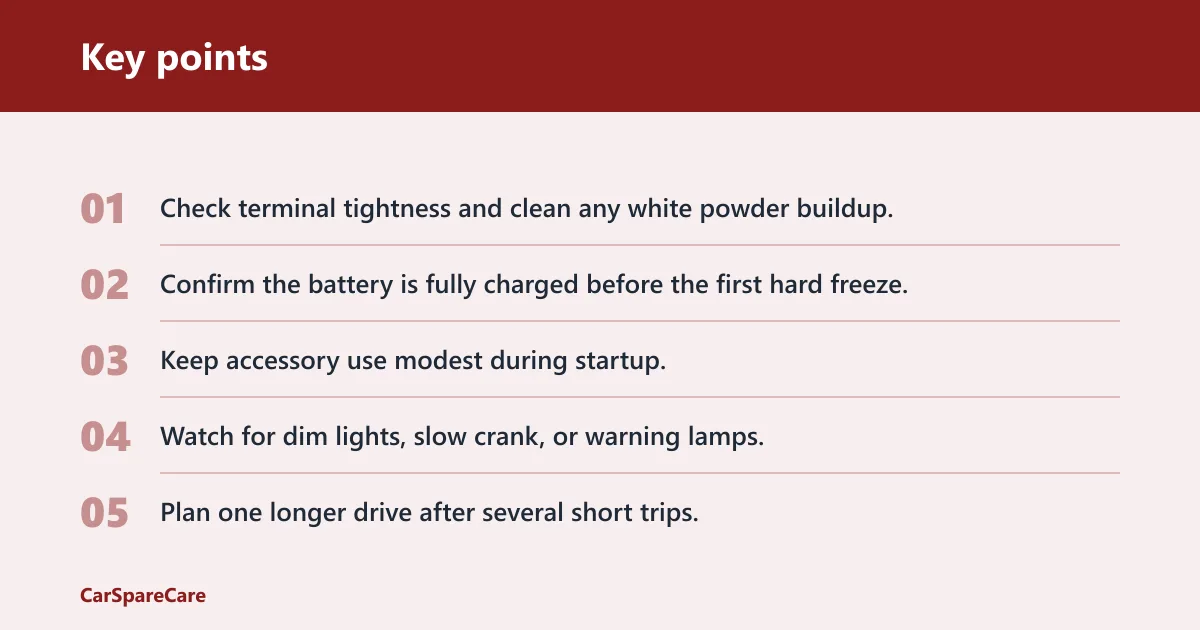
Cold weather car battery checklist
- Check terminal tightness and clean any white powder buildup.
- Confirm the battery is fully charged before the first hard freeze.
- Keep accessory use modest during startup.
- Watch for dim lights, slow crank, or warning lamps.
Cold weather car battery checklist
- Plan one longer drive after several short trips.
- Limit heater, rear defrost, heated seats, and wipers during crank.
- Consider a charger if trips are too short for recovery.
- Test the battery before winter if the car is older than three years.
Cold weather car battery checklist
- Use a battery maintainer in maintenance mode.
- Store the car where temperature swings are smaller if possible.
- Disconnect only if the vehicle maker allows it.
- Check state of charge before and after storage.
Cold weather car battery checklist
- Choose a battery with strong CCA for your climate.
- Inspect terminals and cable ends often.
- Reduce needless electrical load at startup.
- Test reserve capacity if the battery is aging.
Cold-weather battery care by vehicle type
Different drivetrains place different demands on the battery. Gasoline cars usually need the least from the battery beyond starting. Diesel engines often need more cold-start power. Hybrids and start-stop systems may cycle the battery more often, so battery type and health matter as much as age.
Gasoline cars
For most gasoline cars, winter care is about keeping the battery fully charged and reducing needless load. Short trips are the common problem because the alternator may not fully recharge the battery, especially when the heater, lights, and wipers are all on. A longer drive can help recharge it, but it is best treated as recovery time rather than a guaranteed fix.
Diesel vehicles
Diesels typically ask more from the battery on cold mornings because starting resistance is higher. If you live where temperatures stay below freezing, a higher CCA battery is often the better fit. Weak glow-plug performance or repeated slow cranking should trigger a battery and charging-system check.
Hybrids and start-stop systems
Hybrids and start-stop vehicles can be unforgiving if the wrong battery type is fitted. These systems rely on batteries built for frequent cycling, not just starting. If the vehicle uses an AGM or specific factory battery spec, match that spec rather than choosing only by price.
How do you keep a car battery from dying in winter?
Keep the battery charged, keep the connections clean, and stop repeated undercharging. If the car sits, use a battery maintainer in maintenance mode. If it is driven only in short hops, give it a longer run so the alternator has time to recover the charge. Manage heater and accessory use at startup.
Clean terminals and cable ends
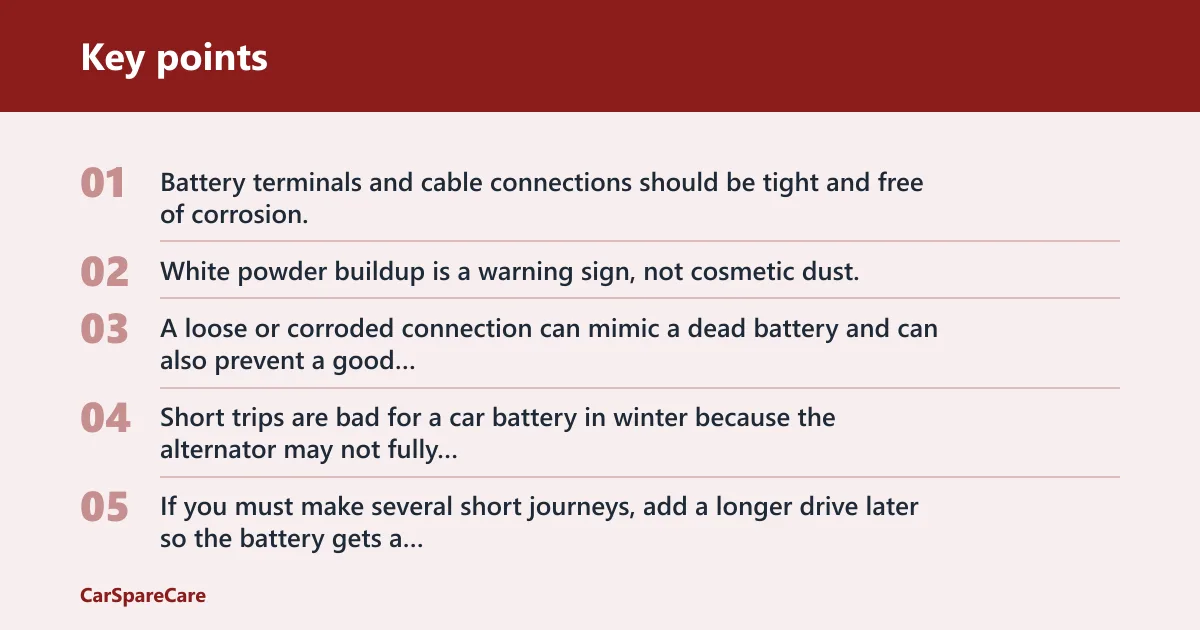
Battery terminals and cable connections should be tight and free of corrosion. White powder buildup is a warning sign, not cosmetic dust. Clean it off, then recheck fit. A loose or corroded connection can mimic a dead battery and can also prevent a good battery from delivering full starting current.
Limit short trips and heavy electrical loads
Short trips are bad for a car battery in winter because the alternator may not fully recharge the battery, and winter accessory load makes the issue worse. If you must make several short journeys, add a longer drive later so the battery gets a better chance to recover.
Suppose a sedan does school drop-offs, grocery runs, and a five-minute commute, all with the heater and defrost running. That pattern can leave the battery behind even if the car starts most days. A half-hour drive may help recovery, but if the battery is already weak, charging and testing are more reliable than assuming one longer trip will solve it.
Use a battery blanket or maintainer
A battery blanket is used to keep the battery warm. It gives gentle, consistent heat and can be helpful in severe cold, but only when the product and vehicle guidance allow it. A battery maintainer or charger in maintenance mode is for vehicles that sit unused; it keeps the battery at an optimal level without overcharging it.
Use a blanket as a cold-weather aid, not as a rescue for a failing battery. Use a maintainer for storage, not for a battery that cannot hold charge. If a battery keeps dying after charging, the issue is likely battery age, bad connections, or a charging-system fault.
When should you replace the battery before winter?
Replace the battery before winter if it is old, tests weak, or needs repeated jumps. If it is already showing slow crank, clicking, or a start-and-die pattern after a jump, replacement often makes more sense than another round of charging. Waiting until the first hard freeze usually costs more time and hassle.
Age and symptom thresholds
A battery that is roughly four to five years old deserves a test before winter, even if it still starts today. Replace it sooner if it shows slow cranking, repeated clicking, corrosion that returns quickly, or poor test results after a full charge. Those are all signs that the margin has narrowed.
When a jump-start is not enough
If the car starts after a jump but dies again, the battery may not hold charge or the charging system may be failing. Do not assume the jump solved the problem. Test the battery and alternator before trusting it for another cold start.
Budgeting for replacement versus repeat charging
Replacement cost can be easier to justify than repeated breakdowns. Prices vary by vehicle and battery type, and the cheapest option is not always the right one if the vehicle needs AGM, EFB, or a specific group size. A charger or maintainer is cheaper than replacement, but it does not fix a battery that is worn out. If the battery is old and the symptoms repeat, replacement is the better tradeoff.
- Test the battery before the first cold snap.
- Charge it fully if state of charge is low.
- Clean terminals and tighten cable ends.
- Check whether short trips are leaving it undercharged.
- Replace it if it still cranks slowly, clicks, or fails under load.
Frequently asked questions
Is cold weather bad for car batteries?
Yes. Cold weather reduces battery efficiency, and freezing temperatures can significantly cut a vehicle battery’s output. In colder conditions, capacity loss can be substantial, especially when the battery is already older or partially discharged. That is why a battery that seems fine in mild weather may struggle on the first hard frost.
How cold can a car battery get
A car battery can sit in outdoor temperatures well below freezing, but its performance drops as the temperature falls. The practical issue is not whether the case survives the cold; it is whether the battery can still deliver enough current. Below 0°F, even a decent battery can struggle, and performance falls further if the battery is weak or undercharged.
Why does cold weather affect car batteries?
Cold slows the chemical reaction inside the battery, thickens engine oil, and adds electrical load from heaters, lights, wipers, and heated seats. Those factors leave less reserve for starting. The result is slower cranking, weaker output, and a higher chance of no-starts when the battery is already weak.
How do I keep my car battery from dying in winter?
Keep the battery fully charged, clean the terminals, and reduce short-trip driving where possible. If the car sits unused, use a battery maintainer. If winter starts are already weak, test the battery and charging system instead of waiting for a dead battery to force the decision.
Should I use a battery blanket in cold weather?
A battery blanket can help in severe cold by keeping the battery warm with gentle, consistent heat. It is most useful for parked cars in very low temperatures and should be used according to the product and vehicle instructions. It helps a good battery stay warm; it will not rescue a failing one.
When should I replace my battery before winter?
Replace it before winter if it is four to five years old, cranks slowly, clicks repeatedly, or dies again after a jump-start. If a full charge and terminal cleaning do not restore normal starting, the battery is probably past its best winter performance and should not be trusted for freezing mornings.

Hi, I’m Melvin, an automobile engineer with extensive experience in automobile equipment. I currently work for a local automobile firm, where I specialize in the car parts industry. I’ve had the opportunity to collaborate with seasoned inspectors, gaining invaluable hands-on experience that goes beyond just theory.
My passion for automotive care started at a young age, which led me to create CarSpareCare. Through CarSpareCare, I share the knowledge and skills I’ve acquired over the years to help others navigate the world of car maintenance and repairs.
My goal is to provide practical tutorials, essential safety advice, and the latest industry insights so that anyone—whether a beginner or an expert—can confidently tackle their automotive projects.