Keep a car battery near 12.6 volts at rest, limit short cold starts, and recharge promptly after trips shorter than 20 minutes. If it sits below 12.4 volts, treat it as undercharged. Ignore that, and a weak battery can leave you stranded, strain the starter, and hide a charging-system fault. This guide shows how to prevent winter battery failure and separate battery, alternator, and parasitic-draw problems.
This guide is part of our Car battery maintenance guide series.
What you’ll need


- 12V battery charger or smart maintainer with float or maintenance mode
- Battery terminal brush or wire brush
- Basic hand tools for terminal clamps
- Voltmeter or multimeter
- Gloves and eye protection
Why winter weakens a battery
Cold slows the chemical reaction inside a 12V lead-acid car battery, so it can deliver less starting power just when the engine needs more. Higher CCA helps because Cold Cranking Amps is the battery’s starting-power rating in cold weather, and it is often printed on the label.
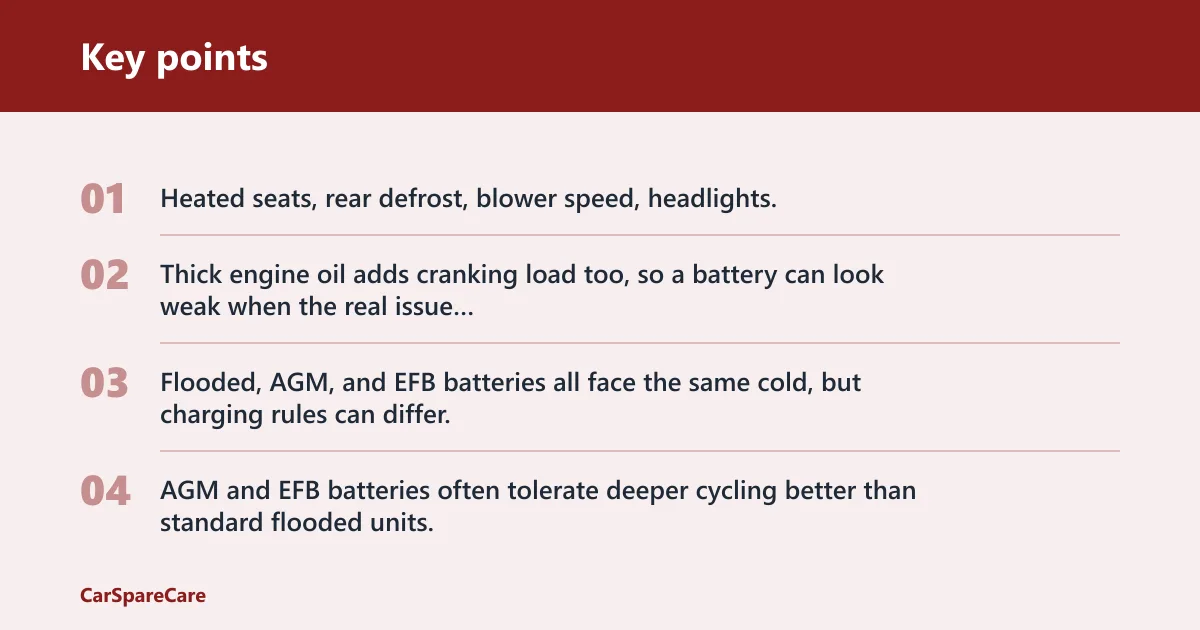
Winter also raises demand. Heated seats, rear defrost, blower speed, headlights, and short-trip driving can pull the battery down faster than the alternator can recover it. Thick engine oil adds cranking load too, so a battery can look weak when the real issue is heavy starting resistance.
Flooded, AGM, and EFB batteries all face the same cold, but charging rules can differ. AGM and EFB batteries often tolerate deeper cycling better than standard flooded units, yet they still need the correct charging profile and a 12V-compatible charger.
Check battery condition
- Read the battery label for age, type, and CCA.
- Measure resting voltage after the car has sat long enough to settle; around 12.6V is typical for a fully charged 12V lead-acid battery.
- Watch for slow cranking, dim lights, or repeated jump starts, because those are warning signs that charging alone may no longer be enough.
Say your 5-year-old flooded battery shows 12.3V at rest on a freezing morning and the starter turns slowly. That is more than a weather complaint; it is a charge-state problem that needs charging, testing, or replacement before the next cold snap.
If that didn’t work, test the charging system
- Start the engine and check charging voltage at the battery with the multimeter.
- Look for a normal charging range near 13.8V to 14.7V with the engine running; exact targets vary by vehicle and battery type.
- If voltage is low or unstable, have the alternator charging system inspected before replacing the battery.
Clean the terminals
Corrosion on the positive and negative posts raises resistance and can make a healthy battery seem weak. Clean both posts and cable clamps, then tighten them so they do not move by hand.
- Switch the ignition off and remove the key.
- Disconnect the negative cable first, then the positive cable.
- Clean the posts and clamps until the metal is bright.
- Reconnect the positive cable first, then the negative cable.
- Check for movement at each clamp and tighten again if needed.
How do you keep a battery charged?
Drive long enough to replace the energy used at startup. Frequent short-trip driving is a winter risk because the battery may never recover from the extra load of cold starts, heated accessories, and high blower use. A 15-minute trip can leave a recharge deficit, especially in stop-and-go traffic.
Use a 12V smart charger for low state of charge, and choose maintenance or float mode for vehicles that sit. A battery tender is an automatic low-current maintainer, which is the best fit for cars parked for days or weeks. Trickle charging is older and less controlled; maintenance charging is the safer storage approach.
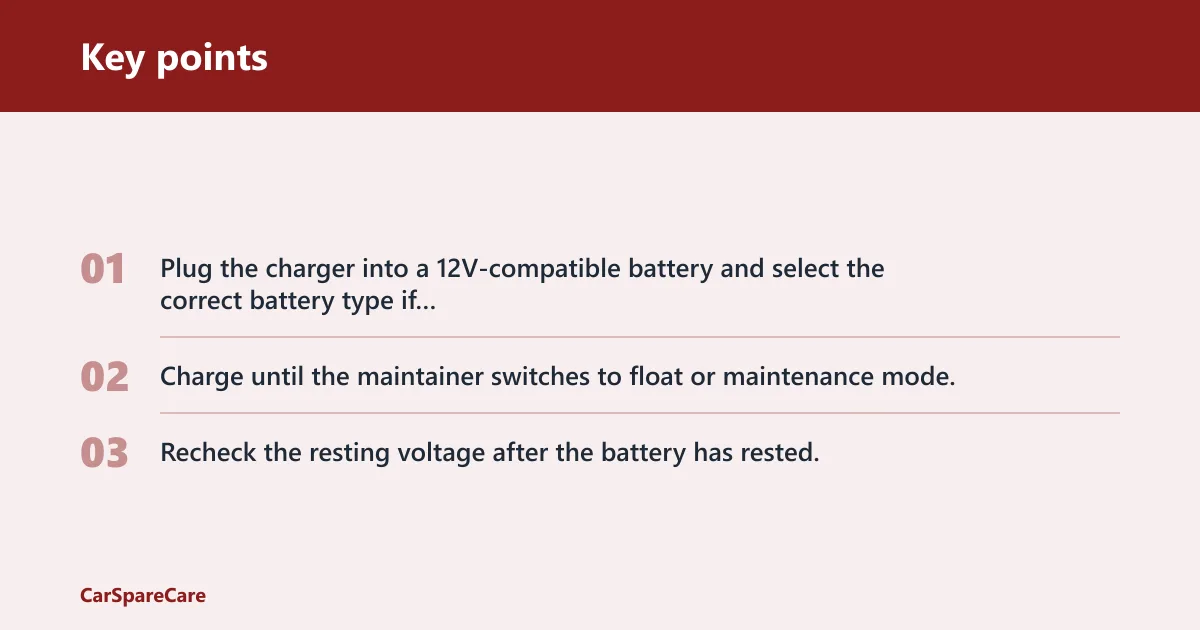
- Plug the charger into a 12V-compatible battery and select the correct battery type if the charger asks.
- Charge until the maintainer switches to float or maintenance mode.
- Recheck the resting voltage after the battery has rested, and repeat charging if it falls below about 12.4V.
Short-trip recharge deficit
A common first-timer mistake is assuming every drive “recharges the battery.” If the vehicle goes 8 miles to work, idles in traffic, and runs heated seats plus the rear defrost, the alternator may spend most of the trip covering current loads rather than restoring capacity. That is how winter starting problems build up.
Reduce starting load
Turn off accessories before cranking. Shut off the blower, heated seats, rear defrost, and audio system before you turn the key or press start. Lower load gives the battery and starter a better chance in cold weather.
Check whether the maker approves winter-grade oil for your engine. Thicker oil increases cranking resistance in low temperatures, so the battery has to work harder. Oil choice does not replace charging, but it can change how hard the starter has to work.
- Switch off accessories before starting.
- Use the oil viscosity listed for winter conditions in the owner’s manual, if approved for your engine.
- If cranking still feels slow, have the alternator and starter circuit checked rather than assuming the battery alone is to blame.
How do you keep a parked battery alive?
Use a battery tender for cars parked for days or weeks. It prevents parasitic draw from draining the battery during storage, which matters more in winter because capacity drops in the cold. Common parasitic-draw sources include alarms, trackers, and dash cams.
Keep the car in a sheltered place when possible, but do not rely on indoor parking to fix a weak battery. A thermal wrap or battery insulation can slow heat loss in extreme cold, but it is only an aid and should fit securely with proper ventilation. It is not a substitute for charging.
- Connect the maintainer to a 12V battery before storage.
- Unplug accessories that continue to draw power when the car is parked.
- For long storage, check voltage every few weeks and recharge if it falls below 12.4V.
Storage checklist for parked cars
- Fully charge the battery before parking.
- Disconnect nonessential loads if the vehicle allows it safely.
- Use a smart maintainer with float mode, not a basic charger left on indefinitely.
- Park in a garage, carport, or other sheltered spot if available.
- Inspect the battery for swelling, leaks, or damaged terminals before storage.
Battery care decision table
| Scenario | Best action | Use a smart maintainer? | Drive or charge frequency | Replace if you see |
|---|---|---|---|---|
| Daily driver | Inspect terminals, keep the battery charged, and avoid short cold starts back to back | Usually no, unless the car sits for several days | Drive long enough to restore charge; longer than 20 minutes is a useful minimum rule | Repeated jump starts, slow cranking after charging, or resting voltage below 12.4V after a full charge |
| Short-trip driver | Charge more often and reduce accessory load before starting | Yes, if trips are too short to recover charge | Charge after several short drives; plan a longer drive or an overnight charge when voltage falls | Voltage keeps sagging, the starter turns slowly, or the battery cannot hold 12.6V after charging |
| Weekend car | Store on float mode between drives and check the terminals before each outing | Yes | Drive or top up at least every 2 to 4 weeks in cold weather, sooner if voltage drops | It needs a boost every weekend or fails to start after sitting only a short time |
| Parked-for-weeks car | Use a maintainer, limit parasitic draw, and keep the battery at full charge | Yes, strongly recommended | Keep it on maintenance charge during storage; recheck voltage before returning it to service | It will not hold charge, shows corroded terminals that keep returning, or the battery is old and still fails after proper charging |
Common mistakes
Do not rely on a thermal wrap to save a weak battery. It can slow heat loss, but it cannot replace lost charge.
Do not ignore repeated low-voltage starts. A battery that keeps falling below 12.4V needs charging, testing, or replacement, not another jump start and wishful thinking.
Do not assume every cold-start problem is a battery problem. A weak alternator or a parasitic draw can create the same symptom.
Do not leave a vehicle parked for weeks without a maintainer. Winter self-discharge and key-off loads are enough to flatten a marginal battery.
Frequently asked questions
How to keep a car battery charged in the winter
Use a 12V smart charger or maintainer when trips are short or infrequent. For a parked vehicle, float mode is the right setting. For a driven car, a longer trip after several short runs helps restore charge that heated accessories consume.
How to keep a car battery from dying in cold weather
Check the resting voltage, clean the terminals, and cut startup load by switching off accessories first. If the battery still struggles after charging, have the alternator and parasitic draw checked before replacing parts at random.
How to keep car battery alive in winter overnight
If the car will sit overnight in extreme cold, make sure the battery is fully charged first and remove unnecessary loads. A battery tender is the practical choice for cars that sit often, because it offsets parasitic drain while the vehicle is parked.

Hi, I’m Melvin, an automobile engineer with extensive experience in automobile equipment. I currently work for a local automobile firm, where I specialize in the car parts industry. I’ve had the opportunity to collaborate with seasoned inspectors, gaining invaluable hands-on experience that goes beyond just theory.
My passion for automotive care started at a young age, which led me to create CarSpareCare. Through CarSpareCare, I share the knowledge and skills I’ve acquired over the years to help others navigate the world of car maintenance and repairs.
My goal is to provide practical tutorials, essential safety advice, and the latest industry insights so that anyone—whether a beginner or an expert—can confidently tackle their automotive projects.