To protect your car battery in hot weather, keep it fully charged, mounted securely, and clean at the terminals; for serviceable flooded batteries, check electrolyte level monthly and use distilled water only when the case markings or owner’s manual allow it. Heat speeds internal wear, so a weak battery can become a no-start quickly. OEM and battery-maker guidance from groups such as AAA, DOE Energy Saver, Clarios/Interstate, and Optima all point to the same basics: minimize heat exposure, avoid chronic undercharge, and check the charging system when symptoms appear.
This guide is part of our Car battery maintenance guide series.
What you’ll need


- Battery-safe gloves and eye protection
- Battery terminal brush or cleaner
- Digital multimeter
- Distilled water for serviceable flooded batteries, if the case markings or owner’s manual allow topping off
- Trickle charger or maintainer for long sit periods
Can hot weather drain your car battery?
Yes. Heat speeds chemical aging, water loss, and corrosion inside a 12-volt lead-acid battery. AAA and DOE Energy Saver note that high temperatures can shorten battery life, and the battery may seem fine until a later heat soak or a cooler morning exposes the weakness. Heat often does the damage first; the no-start shows up later.
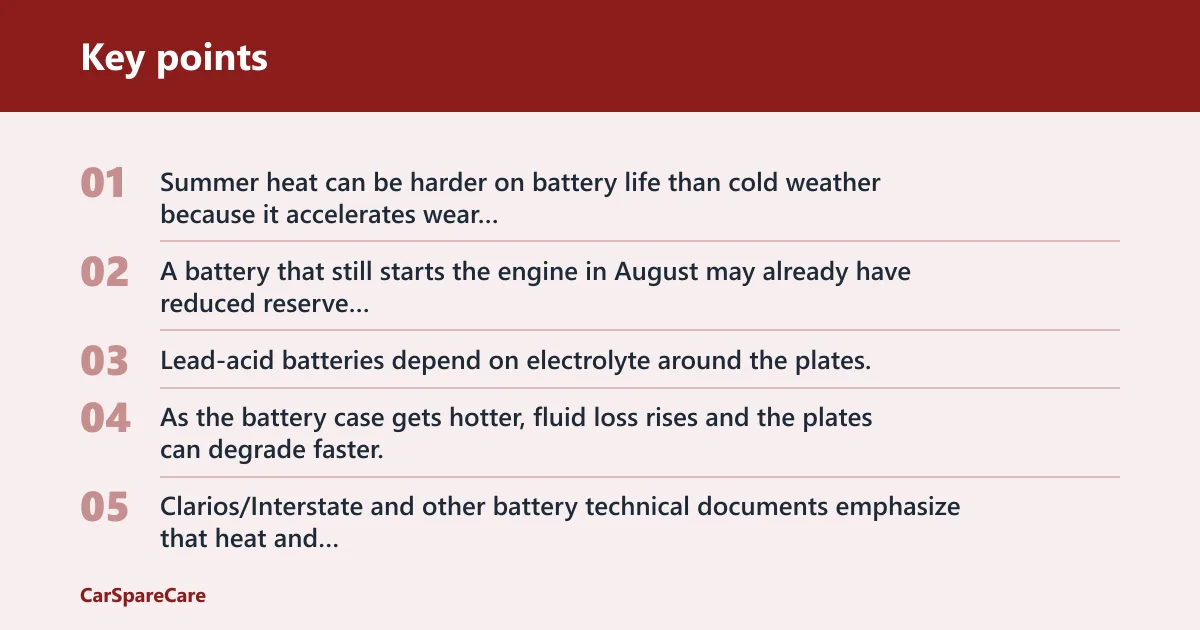
Summer heat can be harder on battery life than cold weather because it accelerates wear that may not be obvious right away. A battery that still starts the engine in August may already have reduced reserve capacity, which is why heat-related failures often show up after repeated short trips, long parking periods, or another load on the system.
Heat-driven evaporation and plate wear
Lead-acid batteries depend on electrolyte around the plates. As the battery case gets hotter, fluid loss rises and the plates can degrade faster, especially if the battery is kept partially charged. Clarios/Interstate and other battery technical documents emphasize that heat and undercharging both shorten service life, and that flooded batteries are the most vulnerable to electrolyte loss.
AGM batteries handle vibration well and are sealed, but they are not heat-proof. They still age faster when exposed to high underhood temperatures or improper charging voltage. Because the electrolyte is absorbed in a glass mat, AGM batteries do not get water top-offs; they need the correct charging profile and secure mounting instead.
Why summer failure can follow winter stress
Heat can reduce a battery’s overall life long before winter arrives. A battery that has already lost reserve during the summer has less margin for cold starts later. That is why a battery can seem acceptable in warm weather and then fail suddenly when temperatures drop and cranking demands rise.
How do you protect your car battery in hot weather?
Start with the basics: reduce heat exposure, keep the battery charged, remove corrosion, and verify charging voltage. For flooded batteries, inspect electrolyte monthly and top off only if the battery is serviceable and the fill level is below the recommended mark. For AGM batteries, focus on charging system health and secure mounting. If the battery already shows swelling, slow cranking, or repeated low fluid, replacement may be safer than continued maintenance.
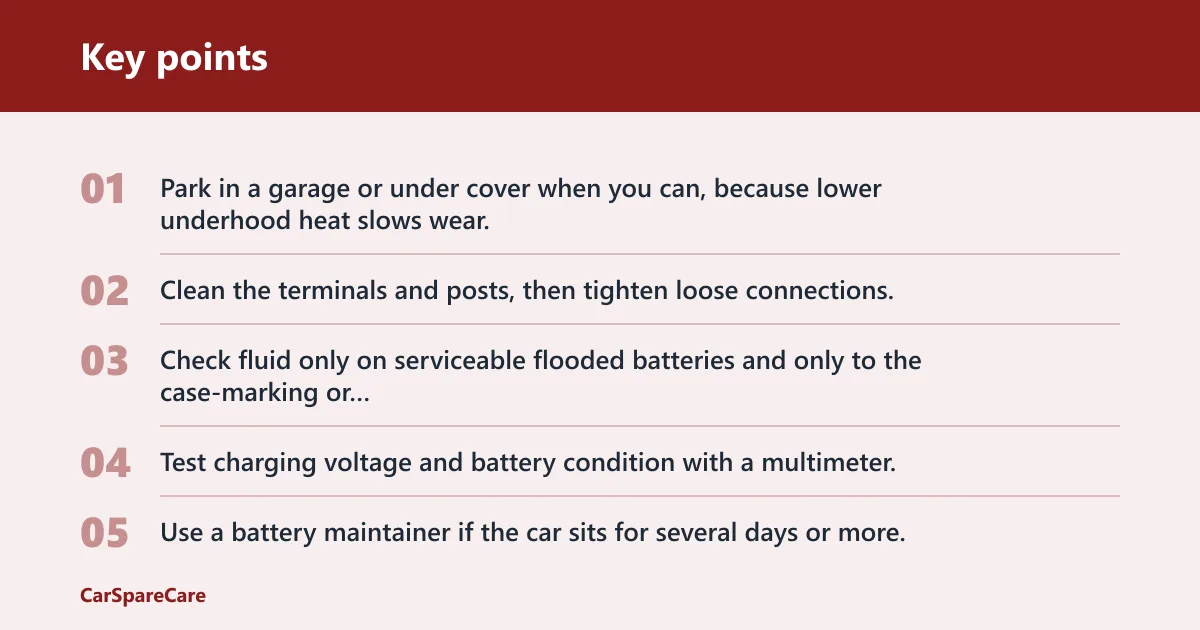
Summer battery protection checklist
- Park in a garage or under cover when you can, because lower underhood heat slows wear.
- Clean the terminals and posts, then tighten loose connections.
- Check fluid only on serviceable flooded batteries and only to the case-marking or owner’s manual limit.
- Test charging voltage and battery condition with a multimeter.
- Use a battery maintainer if the car sits for several days or more.
- Replace any battery that shows heat damage, swelling, or repeated weak starts.
Say your sedan sits outside in 95-degree afternoons and starts slowly after two short trips. That points to a battery that may be heat-stressed and undercharged at the same time. Clean the terminals first, then check charging voltage so you can separate a connection problem from a battery that is already near the end.
Flooded battery: warning signs and immediate action
Flooded lead-acid batteries are serviceable, so fluid level matters. Warning signs include low electrolyte, corrosion on the posts, slow cranking, and visible swelling. Clean the terminals first. Then, if the battery is designed for service, add distilled water only to the case-marking or owner’s manual limit before charging.
AGM battery: warning signs and immediate action
AGM batteries are sealed and non-spillable, so do not add water. Warning signs are swelling, corrosion at the terminals, weak cranking, and poor charging voltage. Clean the posts, verify tight fit, and test the charging system. Battery-maker guidance generally warns that excessive charging voltage can damage AGM batteries quickly, so a bad alternator can ruin one fast.
Maintenance-free battery: warning signs and immediate action
Many maintenance-free batteries still need external checks even though you do not top up fluid. Look for swelling, corrosion, and slow cranking. If the battery case is distorted or the vehicle needs jump starts more than once, test the charging system and replace the battery if the fault keeps returning.
What battery type is best for hot weather?
AGM batteries are often the better hot-weather choice because they are sealed, spill-resistant, and generally more tolerant of vibration than conventional flooded designs. For hot climates, reserve capacity can matter as much as starting power because it shows how long the battery can support loads when the engine is idling or accessory demand is high.
Flooded vs AGM in heat
Flooded batteries are common and serviceable, but they are more exposed to electrolyte loss in heat. AGM batteries keep the electrolyte in a glass mat and do not need water checks. They still need correct charging voltage, and overcharging can damage them quickly.
How to use reserve capacity and CCA when replacing a battery
Cold-cranking amps still matter for starting power, but reserve capacity is an important buying spec for hot climates because it better reflects how long the battery can support loads and accessories at idle. Choose a battery that meets the vehicle maker’s minimum CCA, then compare reserve capacity among suitable sizes and types.
When to stop maintaining and replace it
| Battery type | Warning signs | Exact action now |
|---|---|---|
| Flooded | Swelling, corrosion, low fluid, slow crank | Clean terminals, test charging voltage, top off only if serviceable and below the fill mark, then replace if symptoms return |
| AGM | Swelling, corrosion, slow crank | Clean terminals, inspect charging voltage, verify secure mounting, replace if the battery still tests weak |
| Maintenance-free | Swelling, corrosion, slow crank | Clean terminals, test battery and alternator, replace if repeated weak starts continue |
| When to stop maintaining | What it usually means | Action now |
|---|---|---|
| Swelling case | Heat stress or charging damage | Replace |
| Repeated low fluid in a flooded battery | Evaporation or overcharging | Test charging voltage, then replace if it returns |
| Slow crank after a full charge | Weak internal plates | Replace |
| Poor alternator output | Battery cannot stay healthy | Repair charging system, then replace battery if needed |
If that did not work, check the alternator next. A charging system that sits too high or too low will shorten battery life. Hot weather does not excuse bad charging behavior; it often makes the damage happen faster.
Does parking in shade help a car battery?
Yes. Parking in a garage or shade can reduce daytime heat exposure and lower the thermal load under the hood. It will not stop heat damage completely, but it can slow the evaporation, swelling, and corrosion that build up faster in direct sun.
How lower heat load helps
Shade matters most after the car has already been driven or idled. The battery sits in a hot engine bay, and every hour of less sun exposure helps reduce peak temperature. Lower peak temperature means less electrolyte loss and less stress on the internal plates.
Why parking choice matters most after driving and idling
Short trips, traffic, and idling with accessories on all raise battery stress. If the vehicle then sits in full sun, the battery gets hit twice: low charging time and high heat. A shaded parking spot cuts one part of that load immediately.
Should you use a battery maintainer in hot weather?
Use a battery maintainer when the vehicle sits for several days or longer and the battery does not get regular driving time. It helps maintain charge during infrequent use. It is not a cure for a damaged battery, and it should not be used to hide a charging-system fault.
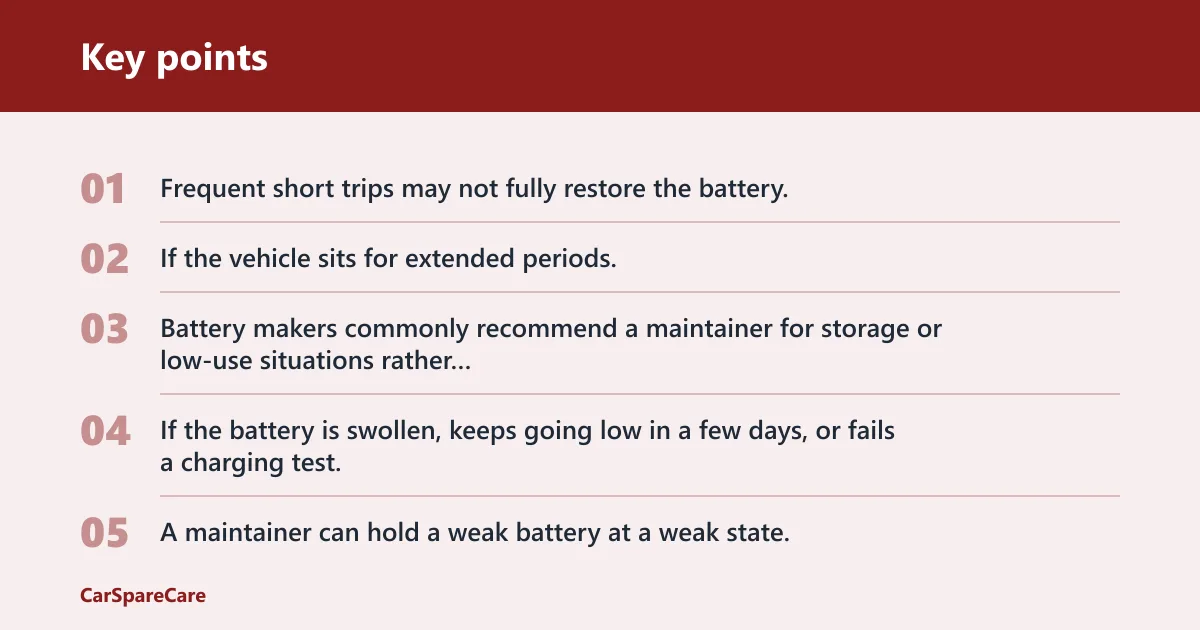
Best use case for vehicles that sit for days
Frequent short trips may not fully restore the battery, especially with modern accessories and heat-related losses. If the vehicle sits for extended periods, a maintainer is a better fit than repeated jump starts. Battery makers commonly recommend a maintainer for storage or low-use situations rather than relying on brief driving to recover a weak battery.
When a maintainer is not the answer
If the battery is swollen, keeps going low in a few days, or fails a charging test, stop treating it as a storage problem. The battery may already be heat damaged. A maintainer can hold a weak battery at a weak state; it cannot restore worn plates or correct a charging fault.
Suppose an SUV sits at an airport lot for eight days in summer and the battery is already three years old. A maintainer can help during the sit, but a battery that still cranks slowly afterward should be tested and likely replaced rather than asked to do one more season.
Common mistakes
- Checking fluid on an AGM battery. It is sealed, so that step does not apply.
- Adding water to a battery with a cracked or swollen case. Replace it instead.
- Ignoring corrosion on the terminals and posts. Clean and tighten them before chasing bigger faults.
- Assuming a battery is fine because it starts today. Heat damage can show up later.
- Using a maintainer on a battery with bad charging voltage. Fix the alternator first.
Check serviceable flooded batteries about once a month in hot weather, and sooner if the vehicle sees long idling, repeated short trips, or obvious heat stress. Use only distilled water, and recheck the level against the case markings or owner’s manual limit after any top-off. If the battery keeps losing fluid, the issue is usually overcharging or end-of-life wear.
Frequently asked questions
How do you keep your car battery healthy in extreme heat?
Keep it charged, clean, and properly mounted. Park in shade when possible, drive long enough to restore charge, and test charging voltage if the battery seems weak. For flooded batteries, check fluid monthly and follow the case markings or owner’s manual. For AGM batteries, watch for swelling and charging problems instead.
How often should you check battery fluid in summer?
Check serviceable flooded batteries about once a month during hot weather. If the vehicle is driven mostly on short trips or sits outside in direct sun, check more often. AGM and most maintenance-free batteries are sealed, so the fluid check applies only to batteries built for service.
Can overcharging damage a car battery in summer?
Yes. Overcharging can speed damage, raise heat inside the battery, and increase water loss in flooded batteries. On AGM batteries, excessive charging voltage can damage them quickly. If you see repeated low fluid or swelling, test the alternator before replacing the battery alone.
Sources
- AAA guidance on hot-weather battery strain and battery care
- U.S. Department of Energy, Energy Saver guidance on batteries and temperature effects
- Clarios / Interstate technical information on heat, charging, and battery life
- Optima technical guidance on AGM charging and battery maintenance
- Vehicle owner’s manual battery service and charging specifications

Hi, I’m Melvin, an automobile engineer with extensive experience in automobile equipment. I currently work for a local automobile firm, where I specialize in the car parts industry. I’ve had the opportunity to collaborate with seasoned inspectors, gaining invaluable hands-on experience that goes beyond just theory.
My passion for automotive care started at a young age, which led me to create CarSpareCare. Through CarSpareCare, I share the knowledge and skills I’ve acquired over the years to help others navigate the world of car maintenance and repairs.
My goal is to provide practical tutorials, essential safety advice, and the latest industry insights so that anyone—whether a beginner or an expert—can confidently tackle their automotive projects.